Rādhā-Śyāmasundara Mandira (Vṛndāvana)
राधा-श्यामसुन्दर मन्दिर (वृन्दावन) Hindi name proposed
Also called Śrī Śyāmasundara temple, Rādhā Śyāmasundara Temple
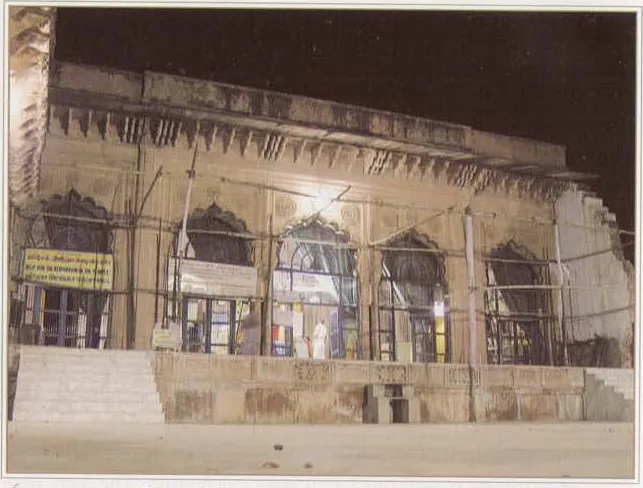
- What it is
- The Rādhā-Śyāmasundara Mandira stands near the Rādhā-Dāmodara temple in Vṛndāvana.
- Visiting
- The temple stands near the Rādhā-Dāmodara temple, by Loī-bāzār next to Sevā-kuñja on the town plan of Vṛndāvana-Dhāma Ki Jaya!
In short
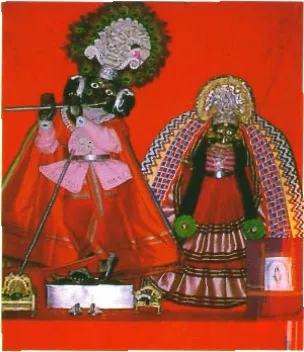
The Rādhā-Śyāmasundara Mandira stands near the Rādhā-Dāmodara temple in Vṛndāvana.[1 +3] Śrīla Prabhupāda counts it among the seven original Gauḍīya Vaiṣṇava temples of Vṛndāvana, and he writes that Śrīla Śyāmānanda Gosvāmī built it.[5 +9] Three guidebooks also connect its Deities with Śrīla Baladeva Vidyābhūṣaṇa, and the sources differ on whose Deities stand on the altar.[1 +3] Śrīla Śyāmānanda Paṇḍita's samādhi is across the road from the entrance.[1 +5] No scripture or Gosvāmī text names the temple, and its date is not certain: a Bengali book of 1920 already found no account of its founding.[18]
Key facts
| Kind | temple |
|---|---|
| Region · area | Vṛndāvana |
| Ācāryas | Śyāmānanda Paṇḍita (Śyāmānanda Gosvāmī, earlier Duḥkhī Kṛṣṇadāsa), Śrīla Baladeva Vidyābhūṣaṇa, Śrīla A.C. Bhaktivedanta Swami Prabhupāda |
The Gosvāmīs and ācāryas
Śrīla Śyāmānanda Paṇḍita
Śrīla Śyāmānanda Paṇḍita was first called Duḥkhī Kṛṣṇadāsa. The Bhakti-ratnākara tells how he got his new name in three places (summarised here, not translated). In its First Wave, he came to Vṛndāvana at his guru's order and gave great joy to Śyāmasundara by his practice, and the name Śyāmānanda came about there. In its Sixth Wave, Śrīla Jīva Gosvāmī gave him the name, knowing that he had given happiness to Rādhā-Śyāmasundara. A song in the same book praises him as the one who found Rāī's (Rādhā's) anklet "in a new nikuñja" (grove) in Vṛndāvana, where the name became known. None of these passages names this temple or its Deity.[21 +2]
The Prema-vilāsa tells that he found the anklet that had slipped from Śrī Rādhā's left foot during a dance at a rāsa-sthalī (a place of the rāsa dance) that it does not name. Śrīla Jīva Gosvāmī recognised it, made him a tilaka in the shape of Kṛṣṇa's foot and said: from today your name is Śyāmānanda (summarised here, not translated).[24 +1] The modern guidebooks tell a longer story, in which Śrī Rādhā or Lalitā meets him at Sevā-kuñja or Jhāḍū-maṇḍala; according to the local tradition recorded in Vṛndāvana, the Playground of God and The Color Guide, Śrīmatī Rādhārāṇī gave him the small Deity of Śyāmasundara then, which is not certain.[13 +3] The tellings differ on who gave the name and how the anklet was returned (see below). Read more: How Śrīla Śyāmānanda Paṇḍita found Śrī Rādhā's anklet →
Śrīla Prabhupāda writes that Śrīla Jīva Gosvāmī later inspired Śrīla Śrīnivāsa Ācārya, Śrīla Narottama dāsa Ṭhākura and Duḥkhī Kṛṣṇadāsa to preach Kṛṣṇa consciousness in Bengal; other sources send Śrīla Śyāmānanda Paṇḍita to Orissa (see below).[26]
Śrīla Baladeva Vidyābhūṣaṇa
Three guidebooks connect Śrīla Baladeva Vidyābhūṣaṇa with the temple. Śrī Vraja-maṇḍala Parikramā (2007) calls Rādhā-Śyāmasundara the Deities that he established and worshipped. Vṛndāvana, the Playground of God says that he led the temple for some years and installed the large Deities, and The Color Guide that he looked after it while he studied under Śrīla Viśvanātha Cakravartī Ṭhākura. None gives a date.[1 +3]
Śrīla Prabhupāda dedicated his Bhagavad-gītā As It Is to him:[20 +1]
General teaching (does not name the place)“To Śrīla Baladeva Vidyābhūṣaṇa, who presented so nicely the Govinda-bhāṣya commentary on Vedānta philosophy”
Śrīla Prabhupāda, Bhagavad-gītā As It Is, Dedication · vedabase.io
Śrīla Prabhupāda
In his books, letters and talks Śrīla Prabhupāda names Rādhā-Śyāmasundara among the seven original temples of Vṛndāvana, with …
In his books, letters and talks Śrīla Prabhupāda names Rādhā-Śyāmasundara among the seven original temples of Vṛndāvana, with those of Madana-mohana, Govinda, Gopīnātha, Rādhā-Ramaṇa, Rādhā-Dāmodara and Gokulānanda.[5 +5]
Names this place“Originally there were seven important Gauḍīya Vaiṣṇava temples established in Vṛndāvana, namely the Madana-mohana temple, Govinda temple, Gopīnātha temple, Śrī Rādhāramaṇa temple, Rādhā-Śyāmasundara temple, Rādhā-Dāmodara temple and Gokulānanda temple.”
Śrīla Prabhupāda, Śrī Caitanya-caritāmṛta, Ādi-līlā 10.90, purport · vedabase.io
In a letter of 1968 he planned seven temples named after these seven, the last being Rādhā-Śyāmasundara, and wrote that the whole town of Vṛndāvana began with them.[8] In 1974 he listed them again for a French professor and called them "old seven temples".[7]
His biographer records that in the early 1960s, while Śrīla Prabhupāda lived at the Rādhā-Dāmodara temple, he sometimes walked to this temple:[5 +2]
From his biography“Bhaktivedanta Swami would sit and chant even after the early-morning rush of visitors, or sometimes he would walk to the nearby temples of Rādhā-Śyāmasundara or Rādhā-Madana-mohana, always returning by eleven to cook his meal.”
Satsvarūpa dāsa Gosvāmī, Śrīla Prabhupāda-līlāmṛta, vol. 1, ch. 10 · vedabase.io
Songs
The kīrtana Jaya Rādhā-Mādhava, which the song book does not credit to an author, hails Rādhā-Śyāmasundara as the treasure of …
The kīrtana Jaya Rādhā-Mādhava, which the song book does not credit to an author, hails Rādhā-Śyāmasundara as the treasure of Śyāmānanda's life.[29]
Visiting today
The temple stands near the Rādhā-Dāmodara temple, by Loī-bāzār next to Sevā-kuñja on the town plan of Vṛndāvana-Dhāma Ki Jaya! (c. 1986), with the Savāmana Śālagrāma temple almost opposite its entrance.[1 +3] Across the road from the entrance is Śrīla Śyāmānanda Paṇḍita's samādhi; Vṛndāvana, the Playground of God places his puṣpa-samādhi (memorial) beside the place where he received his tilaka, inside a small āśrama.[1 +5]
Location
| Where it is | near the Rādhā-Dāmodara temple; map key 21[32] Śālagrama Temple almost opposite its entrance[33] |
|---|
Nearby places
Rādhā-Dāmodara Mandira (Vṛndāvana) · Savāmana Śālagrāma Mandira · Śyāmānanda Paṇḍita's puṣpa-samādhi · Śyāmānanda Tilaka-sthāna
Pictures
4 pictures
History
Śrīla Prabhupāda writes in the Caitanya-caritāmṛta that, after Śrīla Rūpa Gosvāmī and Śrīla Sanātana Gosvāmī, others built temples in Vṛndāvana:[6 +5]
Names this place“Similarly, their nephew Jīva Gosvāmī constructed the Rādhā-Dāmodara temple, Śrī Gopāla Bhaṭṭa Gosvāmī constructed the Rādhā-ramaṇa temple, Śrī Lokanātha Gosvāmī constructed the Gokulānanda temple, and Śyāmānanda Gosvāmī constructed the Śyāmasundara temple.”
Śrīla Prabhupāda, Śrī Caitanya-caritāmṛta, Ādi-līlā 7.164, purport · vedabase.io
He said the same in a London lecture of 1976, and the guidebooks agree; The Color Guide to Vṛndāvana (2000) adds that Śrīla Śyāmānanda Paṇḍita established it during his second visit to Vṛndāvana. No inscription or dated document has been found.[6 +6]
The Bengali Vṛndāvana-kathā (1920) says that its author found no account in any book of when or how Śyāmasundara was installed. He supposes that Śrīla Śyāmānanda Paṇḍita may have installed the Deity at the end of his life, and that the temple was probably founded long after the other old temples; he had seen it nearly in ruins a few years before, and it was then being repaired.[18]
Vṛndāvana, the Playground of God (2010) gives years without a source: it says that the small Deity of Śyāmasundara was given to Śrīla Śyāmānanda Paṇḍita in 1578, and that a Deity of Śrīmatī Rādhārāṇī came in 1580 as a gift of "the Mahārāja of Bharatpur". Whether a ruler of Bharatpur could have given a Deity in 1580 is doubtful, the years are not certain, and the sources differ (see below).[13 +3]
Where the sources differ
Who founded the Vṛndāvana Rādhā-Śyāmasundara temple, and whose Deities stand in it.
Accounts differ Who founded the Vṛndāvana Rādhā-Śyāmasundara temple, and whose Deities stand in it.
- Śrīla Prabhupāda (CC Ādi 7.164 and 1.19 purports; lecture, London, 25 July 1976)Śyāmānanda Gosvāmī constructed / established the Śyāmasundara temple; 'the temple of Śyāmasundara of Śyāmānanda Gosvāmī'.
- Śrī Vraja-maṇḍala Parikramā (2007)Śrī Rādhā-Śyāmasundara are 'the deities established and worshipped by' Śrīla Baladeva Vidyābhūṣaṇa; Śyāmānanda is named only for the samādhi opposite the entrance.
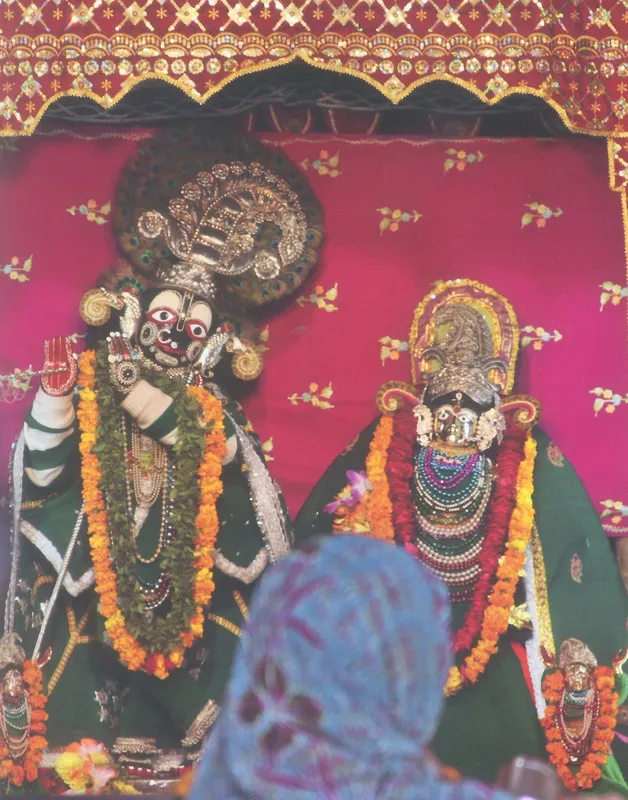
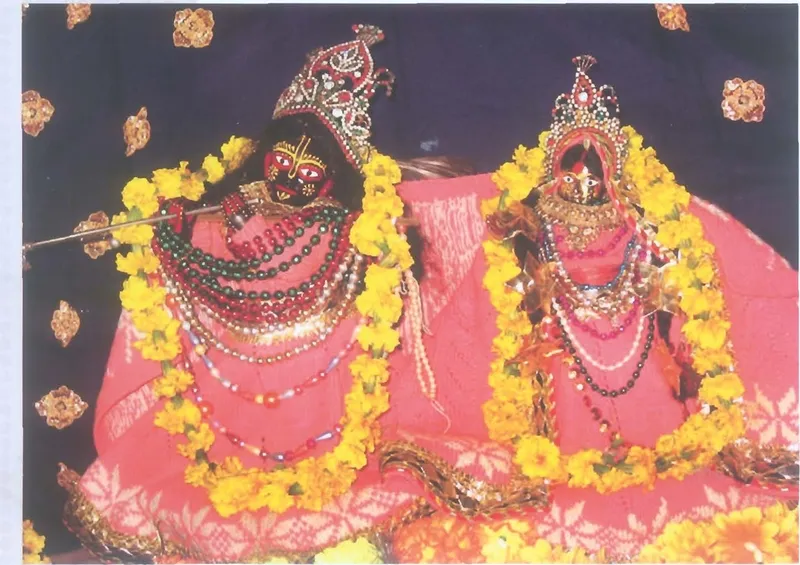
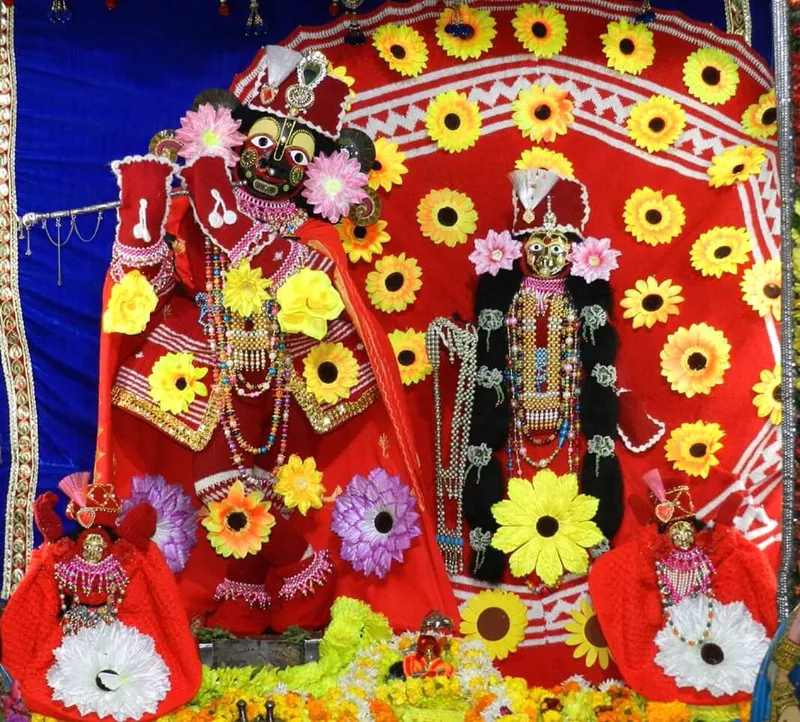
- Vṛndāvana, the Playground of God (2010)The temple was established by Śrīla Śyāmānanda Paṇḍita; his Deity is the small one to the right of the main altar ('Lāla-lāli'); the large Deities were installed and worshipped by Baladeva, the larger Deity carved under his supervision.
- The Color Guide to Vṛndāvana (2000)Established by Śyāmānanda during his second visit to Vṛndāvana; his original Deity stands to the right of the altar; the large Deity on the central altar was personally worshipped by Baladeva, who looked after the temple.
Who gave Duḥkhī Kṛṣṇadāsa the name Śyāmānanda, and on what occasion, is told differently: the Bhakti-ratnākara, the Prema-vilāsa and the Vṛndāvana-kathā (1920) name Śrīla Jīva Gosvāmī, other texts name no giver, and the guidebooks connect the name with Śrīmatī Rādhārāṇī's mercy when he returned Her anklet. The accounts are set side by side on the Śyāmānanda Tilaka-sthāna page.[14 +5]
Accounts differ How Śyāmānanda returned the anklet and met Śrīmatī Rādhārāṇī (the guidebooks' versions).
- Śrī Vraja-maṇḍala Parikramā (2007)Two vraja-bālās asked for it; he refused; they brought their friend, on whose foot he tied it; they were Rādhikā Herself with Lalitā and Viśākhā; Lalitā stamped the anklet on his forehead.
- Vṛndāvana, the Playground of God (2010)Lalitā came disguised as an old woman, 'Rādhādāsī', claiming it for her daughter-in-law; she dipped him in Lalitā-kuṇḍa, he became Kanaka Mañjarī and was brought before Rādhārāṇī, who pressed the anklet to his forehead and gave him the small Śyāmasundara.
- The Color Guide to Vṛndāvana (2000)Lalitā asked for her sister's anklet; he refused; she had him bathe in Lalitā Kuṇḍa, he became a mañjarī and was taken to 'gupta Vṛndāvana', where Rādhārāṇī on a jewelled throne received the anklet, marked his forehead and had Lalitā give him a Deity of Śyāmasundara.
- the undated parikramā notes VṛndāvanaLalitā asked for it; he refused; Rādhārāṇī Herself came there, touched the anklet to his forehead and gave him the name.
Accounts differ Whether a 'Mahārāja of Bharatpur' could have given the Rādhārāṇī Deity to Śyāmānanda in 1580.
- Vṛndāvana, the Playground of God (2010)The Deity of Śrīmatī Rādhārāṇī 'is said to be a self-manifested Deity that the Mahārāja of Bharatpur gave to Śyāmānanda prabhu in 1580'.
- Muttra district gazetteer, 1911The Jāṭs became a power only after Aurangzeb's death, 'under the leadership of the chief who founded the royal house of Bharatpur'; Thakur Badan Singh was proclaimed Rāja of the Jāṭs at Dig in 1722, and his son Suraj Mal was 'the first Raja of Bharatpur'. It names no ruler of Bharatpur in the 16th century.
Accounts differ Where Śrīla Jīva Gosvāmī sent Śyāmānanda to preach.
- the undated parikramā notes VṛndāvanaŚrīla Jīva Gosvāmī sent him to Orissa with Śrīla Śrīnivāsa Ācārya and Śrīla Narottama dāsa Ṭhākura; they became 'the first book distribution party'.
- Śrīla Prabhupāda, CC Ādi 10.85 purportŚrīla Jīva Gosvāmī inspired Śrīla Śrīnivāsa Ācārya, Śrīla Narottama dāsa Ṭhākura and Duḥkhī Kṛṣṇadāsa to preach Kṛṣṇa consciousness in Bengal.
- Bhakti-ratnākara, Fifteenth Wave song (1912 ed. p. 1060)Śyāmānanda went by way of Gauḍa and Ambikā to Utkala (Orissa) and stayed there by the order of the Gosvāmīs.
- Vṛndāvana-Dhāma Ki Jaya! (c. 1986)Śyāmānanda was instrumental in spreading Kṛṣṇa consciousness in Orissa; with Narottama and Śrīnivāsa he brought the Gosvāmīs' teachings out of Vṛndāvana.
More on this place
How Śrīla Śyāmānanda Paṇḍita found Śrī Rādhā's anklet
References
33 references
- Śrī Vraja-maṇḍala Parikramā (2007), PDF p. 333
- Śrī Vraja-maṇḍala Parikramā (2007), PDF p. 337
- Vṛndāvana, the Playground of God (2010), Bhakti Caitanya Svāmī, PDF p. 162
- Vṛndāvana-Dhāma Ki Jaya! (c. 1986), by Dhruva Mahārāja dāsa, PDF p. 100
- Śrīla Prabhupāda, Śrī Caitanya-caritāmṛta, Ādi-līlā 10.90, purport · vedabase.io
- Śrīla Prabhupāda, Śrī Caitanya-caritāmṛta, Ādi-līlā 1.19, purport · vedabase.io
- Śrīla Prabhupāda, Room Conversation with Professor Olivier Lacombe, Paris, 14 June 1974 · vedabase.io
- Śrīla Prabhupāda, Letter to Hayagriva, 68-11-18, November 18th 1968 · vedabase.io
- Vṛndāvana, the Playground of God (2010), Bhakti Caitanya Svāmī, PDF p. 12
- The Color Guide to Vṛndāvana (2000), Written and Photographed by Rājaśekhara dāsa Brahmacārī, PDF p. 25
- Śrīla Prabhupāda, Śrī Caitanya-caritāmṛta, Ādi-līlā 7.164, purport · vedabase.io
- Śrīla Prabhupāda, Sunday Feast Lecture, London, 25 July 1976 · vedabase.io
- Vṛndāvana, the Playground of God (2010), Bhakti Caitanya Svāmī, PDF p. 96
- The Color Guide to Vṛndāvana (2000), Written and Photographed by Rājaśekhara dāsa Brahmacārī, PDF p. 97
- Vṛndāvana, the Playground of God (2010), Bhakti Caitanya Svāmī, PDF p. 98
- Vṛndāvana-Dhāma Ki Jaya! (c. 1986), by Dhruva Mahārāja dāsa, PDF p. 68
- the undated parikramā notes Vṛndāvana, ¶122
- Vṛndāvana-kathā, chapter 8 (aṣṭama pariccheda: Śyāmasundarajī), printed p. 113
- The Colour Guide to Rādhā-kuṇḍa (1999), Rājaśekhara dāsa Brahmacārī, PDF p. 80
- Vṛndāvana, the Playground of God (2010), Bhakti Caitanya Svāmī, PDF p. 100
Show all 33 references
- Śrīla Narahari Cakravartī, Bhakti-ratnākara, First Wave (prathama taraṅga), 1912 ed. p. 27, 2nd ed., 1912
- Śrīla Narahari Cakravartī, Bhakti-ratnākara, Sixth Wave (ṣaṣṭha taraṅga), 1912 ed. p. 457, 2nd ed., 1912
- Śrīla Narahari Cakravartī, Bhakti-ratnākara, Fifteenth Wave (pañcadaśa taraṅga), 1912 ed. p. 1060, song in rāga Suhai ('punaḥ suhai'), 2nd ed., 1912
- Prema-vilāsa, twelfth vilāsa (dvādaśa vilāsa), printed p. 87, end of the left column and right column, Kolkata, 1913
- Prema-vilāsa, twelfth vilāsa (dvādaśa vilāsa), printed p. 87: the last couplet but one of the left column, and lines 5–9 of the right column (line 8 holds only 'প্রমাণে।', carried over from line 7), Kolkata, 1913
- Śrīla Prabhupāda, Śrī Caitanya-caritāmṛta, Ādi-līlā 10.85, purport · vedabase.io
- Śrīla Prabhupāda, Bhagavad-gītā As It Is, Dedication · vedabase.io
- Satsvarūpa dāsa Gosvāmī, Śrīla Prabhupāda-līlāmṛta, vol. 1, ch. 10 · vedabase.io
- Jaya Radha Madhava Radha Madhava Radhe (Jaya Rādhā-Kṛṣṇa Gīti) (no author credited in the song book) · song book
- the undated parikramā notes Vṛndāvana, ¶130
- Śrī Vraja-maṇḍala Parikramā (2007), PDF p. 309
- Śrī Vraja-maṇḍala Parikramā (2007), p. 640-641
- Vṛndāvana, the Playground of God (2010), Bhakti Caitanya Svāmī