Rādhā-Govinda Mandira (Vṛndāvana, old)
राधा-गोविन्द मन्दिर (वृन्दावन, पुराना) Hindi name proposed
Also called Govindajī Mandir, Rādhā-Govinda Mandira, Rādhā-Govinda Temple
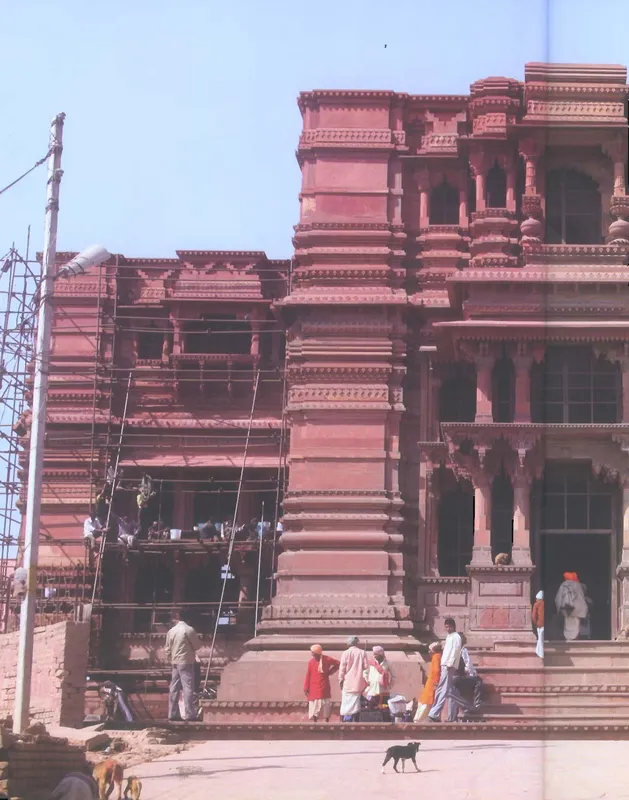
- What it is
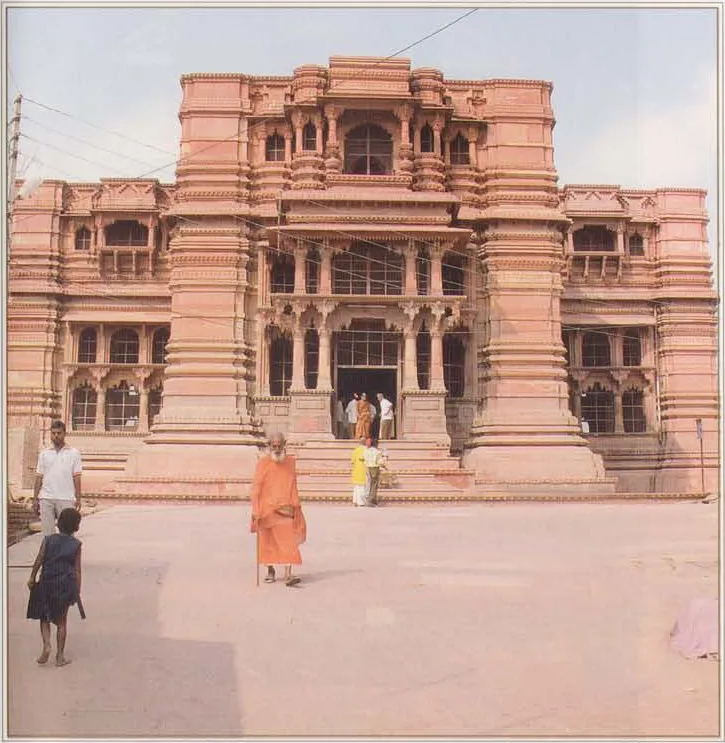
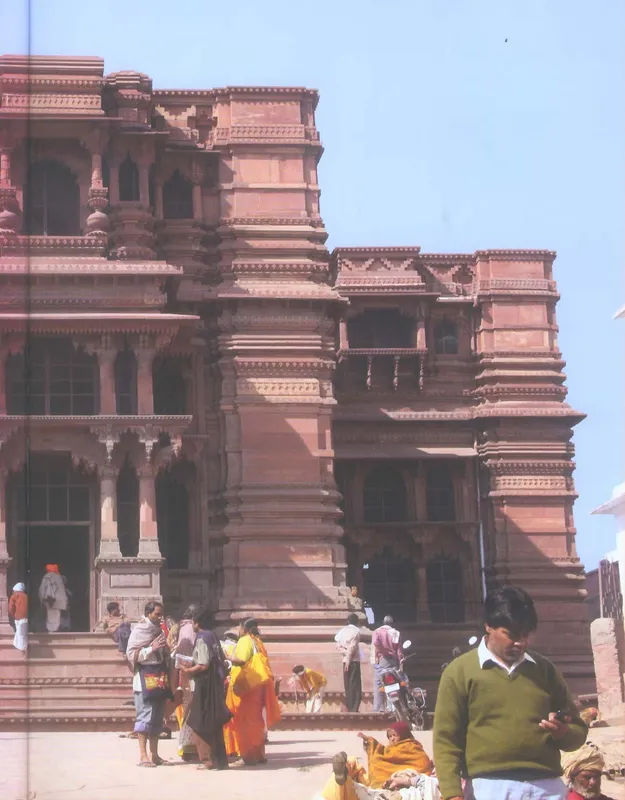
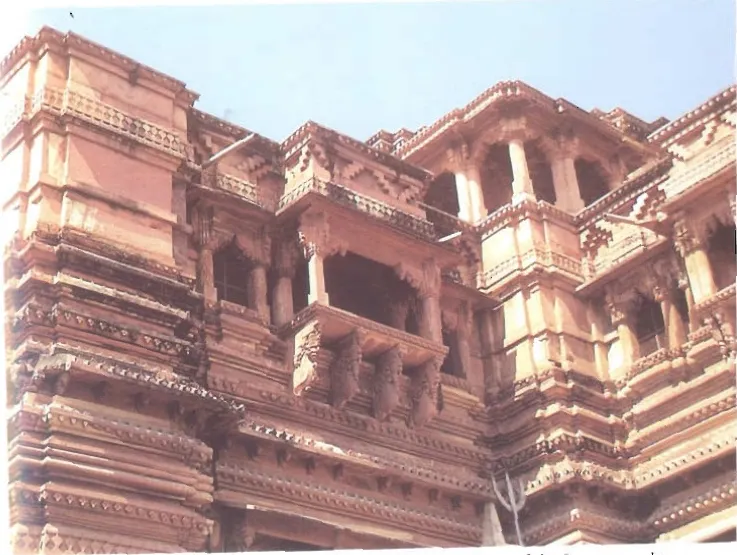
- The old Rādhā-Govinda Mandira is the great red-sandstone temple of Śrī Govindadeva in Vṛndāvana, built, as the guidebooks say, on top of Gomā-ṭīlā, a mound.
- Visiting
- The Color Guide to Vṛndāvana (2000) printed darśana from 8 am to 12:30 pm and from 4 to 9 pm; Vṛndāvana, the Playground of God (2010) says that a Vrajavāsī family looks after the Deities in the old …
- Places here
- Yogamāyā Mandira (old Govindajī temple), Govardhana-śilā (old Govinda temple), Yogapīṭha (old Govinda temple)
In short
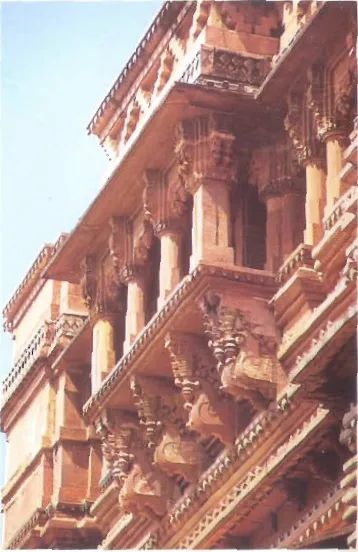
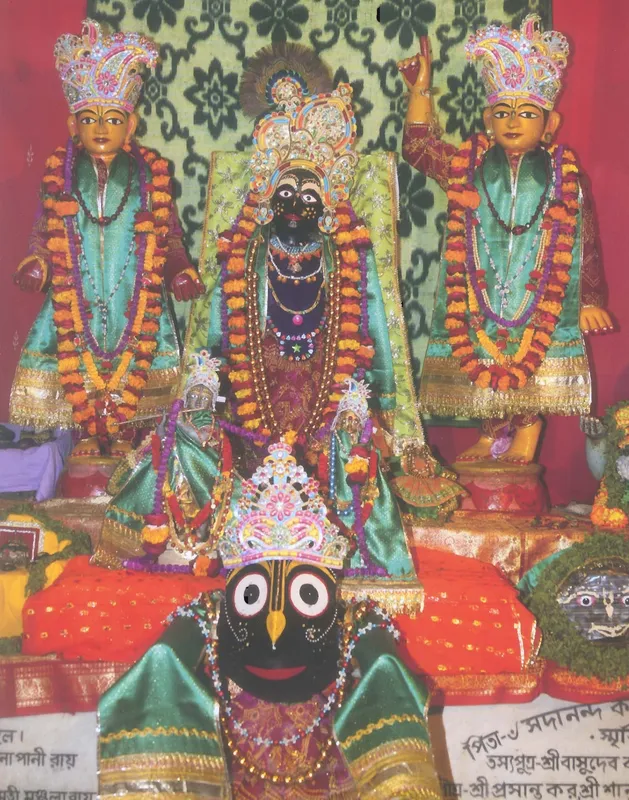
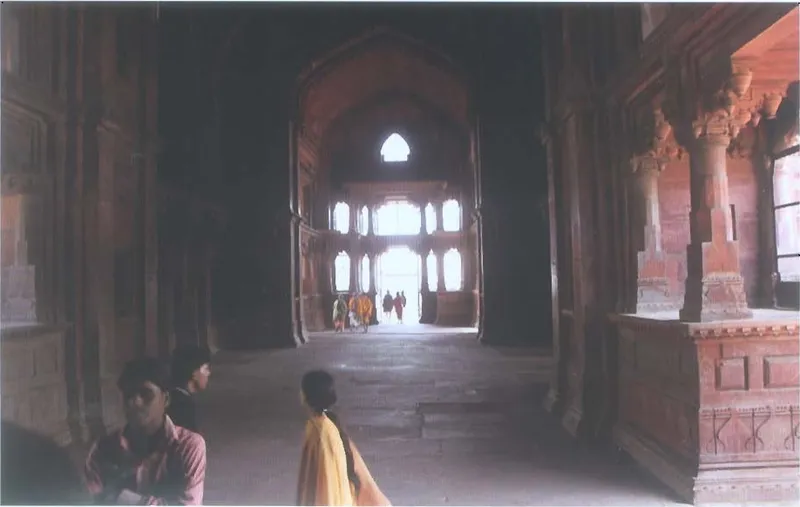
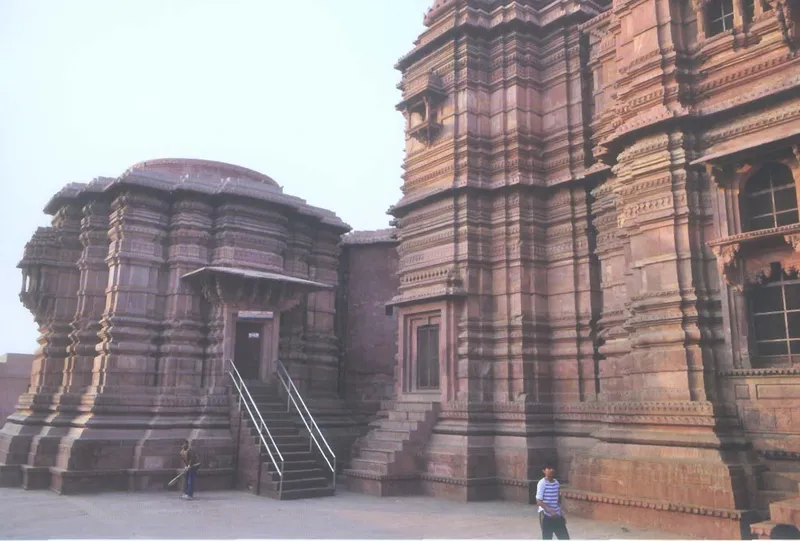
The old Rādhā-Govinda Mandira is the great red-sandstone temple of Śrī Govindadeva in Vṛndāvana, built, as the guidebooks say, on top of Gomā-ṭīlā, a mound.[1 +4] According to the Bhakti-ratnākara, Śrīla Rūpa Gosvāmī found Śrī Govinda in the earth of this hill, which the book calls the yogapīṭha of Vṛndāvana.[6 +5] The Caitanya-caritāmṛta describes the royal service of Govinda here and says that Śrīla Raghunātha Bhaṭṭa Gosvāmī had his disciples build His temple.[1 +8] Śrīla Prabhupāda often told how Mahārāja Mānsiṅgh built it at Śrīla Rūpa Gosvāmī's word.[19 +4] The original Deity was taken to Jaipur in Aurangzeb's time.[2 +5]
Key facts
| Kind | temple |
|---|---|
| Region · area | Vṛndāvana |
| Also part of | Gomā-ṭīlā |
| Ācāryas | Śrīla Rūpa Gosvāmī, Śrīla Sanātana Gosvāmī, Śrīla Raghunātha Bhaṭṭa Gosvāmī, Kāśīśvara Paṇḍita, Śrīla Kṛṣṇadāsa Kavirāja Gosvāmī |
Why it is glorified
In the Bhakti-rasāmṛta-sindhu Śrīla Rūpa Gosvāmī quotes the Varāha Purāṇa on seeing the Deity of Govinda in Vṛndāvana …
In the Bhakti-rasāmṛta-sindhu Śrīla Rūpa Gosvāmī quotes the Varāha Purāṇa on seeing the Deity of Govinda in Vṛndāvana:[27 +4]
41 - atha śrī-mūrter darśanam, yathā vārāhe-- vṛndāvane tu govindaṃ ye paśyanti vasundhare
na te yama-puraṃ yānti yānti puṇya-kṛtāṃ gatim ||
My dear Vasundharā, any person who goes to Vṛndāvana and sees the Deity of Govinda-deva is free from the courthouse of Yamarāja and is allowed to enter into the highest planetary system, in which reside the demigods.
Translation: Śrīla A.C. Bhaktivedanta Swami PrabhupādaŚrīla Prabhupāda applies the verse to the temple of Govindadeva:[27 +4]
Names this place“This means that simply by visiting the Deity of Govinda in Vṛndāvana one becomes highly elevated in pious life.”
Śrīla Prabhupāda, The Nectar of Devotion, Chapter 9, 'Seeing the Deity' · vedabase.io
Śrīla Kṛṣṇadāsa Kavirāja Gosvāmī writes that by Śrī Nityānanda Prabhu's mercy he was granted the sight of Śrī Govinda, which words cannot describe.[32] He then describes what he saw:[33 +4]
বৃন্দাবনে যোগপীঠে কল্পতরু–বনে ।
রত্নমণ্ডপ, তাহে রত্নসিংহাসনে ॥ ২১৮ ॥
শ্রীগোবিন্দ বসিয়াছেন ব্রজেন্দ্রনন্দন ।
মাধুর্য প্রকাশি’ করেন জগৎ মোহন ॥ ২১৯ ॥
vṛndāvane yoga-pīṭhe kalpa-taru-vane
ratna-maṇḍapa, tāhe ratna-siṁhāsane
śrī-govinda vasiyāchena vrajendra-nandana
mādhurya prakāśi’ karena jagat mohana
On an altar made of gems in the principal temple of Vṛndāvana, amidst a forest of desire trees, Lord Govinda, the son of the King of Vraja, sits upon a throne of gems and manifests His full glory and sweetness, thus enchanting the entire world.
Translation: Śrīla A.C. Bhaktivedanta Swami PrabhupādaIn his next verse Śrī Rādhikā and Her friends are at Govinda's left, and with them He enjoys the rāsa and other pastimes.[35 +1] In the same book the three Deities of Vṛndāvana, Madana-mohana, Govinda and Gopīnātha, are the Lords of the Gauḍīya Vaiṣṇavas; Śrīla Prabhupāda explains that Govinda is worshipped when one serves the Lord with strong attachment.[38 +3]
Govinda and the yogapīṭha
The Padma Purāṇa, the Caitanya-caritāmṛta, Śrīla Jīva Gosvāmī and the Ūrdhvāmnāya-tantra quoted in the Bhakti-ratnākara describe Govinda as eternally seated on a jewelled throne at the yogapīṭha in Vṛndāvana, with Śrī Rādhā and the sakhīs. The identification of that yogapīṭha with Gomā-ṭīlā is the Bhakti-ratnākara's.[10 +6] Śrīla Jīva Gosvāmī writes (summarised here, not translated) that Keśava and Govinda are known by these names at the great yogapīṭhas of Mathurā and Vṛndāvana: to worldly eyes they appear as Deities, to their own devotees directly.[43 +1] Śrīla Sanātana Gosvāmī calls Śrī Govindadeva the presiding Deity of Vṛndāvana, as Śrī Keśava is of Mathurā.[47]
Śrīla Kṛṣṇadāsa Kavirāja Gosvāmī's Govinda-līlāmṛta calls Śrī Govinda-sthala the crown of Vṛndāvana and the seat of union with Kṛṣṇa, and Śrīla Viśvanātha Cakravartī Ṭhākura says that the place the Purāṇas call Govinda's land and the tantras the yogapīṭha he calls Śrī Kuñja-rāja. Both describe the eternal place, not the temple.[48 +1] Śrīla Rūpa Gosvāmī, Śrīla Jīva Gosvāmī and the Bhakti-ratnākara also quote verses that they give to the Skanda Purāṇa: Govinda's abode in Vṛndāvana is His Vaikuṇṭha on earth, and those who have seen His great house there are fulfilled.[31 +4]
Divine pastimes
Śrīmad-Bhāgavatam (10.29–10.33) tells the rāsa dance: "there", on the Yamunā's bank, Govinda began the dance with the gopīs (10.33.2), and at the end of the night He sent them home. It does not name Gomā-ṭīlā, the temple or the yogapīṭha.[53 +2] The Caitanya-caritāmṛta says that Śrī Govinda of the yogapīṭha enjoys the rāsa with Śrī Rādhā and Her friends, an eternal pastime in the Gauḍīya understanding.[35 +1] Commenting on the killing of Keśī (ŚB 10.37), Śrīla Sanātana Gosvāmī places it on the Yamunā "north of Śrī Govindadeva", near Keśī-ghāṭa; he does not say where Śrī Govindadeva stood.[56 +1]
Traditional accounts
The Sādhana-dīpikā, written by a priest of this temple, says that Śrī Caitanya Mahāprabhu met Śrīla Rūpa Gosvāmī at Prayāga and …
Śrī Govinda is found
The Sādhana-dīpikā, written by a priest of this temple, says that Śrī Caitanya Mahāprabhu met Śrīla Rūpa Gosvāmī at Prayāga and told him to go to Vṛndāvana and make known the service of Śrī Govinda there.[58 +2] According to the Bhakti-ratnākara, which quotes that book (summarised here, not translated), Śrīla Rūpa Gosvāmī searched Vraja in vain until a beautiful Vrajavāsī told him that at Gomā-ṭīlā, the yogapīṭha, a cow gave her milk every forenoon and that Govinda was hidden there. The villagers dug the ground, and Govinda appeared in the middle of the yogapīṭha.[6 +9] As soon as Govinda had appeared, Śrīla Rūpa Gosvāmī sent a letter to Śrī Caitanya Mahāprabhu at Purī, so the finding took place in Mahāprabhu's lifetime; no year is given.[61] The story is told in full on the page of Gomā-ṭīlā. Read more: How Śrīla Rūpa Gosvāmī found Śrī Govinda on Gomā-ṭīlā →
According to the local tradition recorded in four guidebooks, the Deity was first installed by Kṛṣṇa's descendant Vajranābha and later lost until Śrīla Rūpa Gosvāmī found it; no scripture or Gosvāmī text has been found that says so, and it is not certain.[9 +4]
Gaura-Govinda, Rādhā and Vṛndā-devī
According to the Bhakti-ratnākara, quoting the Sādhana-dīpikā, Śrī Caitanya Mahāprabhu then gave Śrī Kāśīśvara Paṇḍita His own Deity form, named Gaura-Govinda, and Kāśīśvara brought Him to Vṛndāvana and seated Him at Govinda's right.[4 +5] The sources differ on where that Deity is now.
Accounts differ Where the Gaura-Govinda Deity that Kāśīśvara brought is now.
- Bhakti-ratnākara, Second Wave pp. 91-92 (with the Sādhana-dīpikā)Kāśīśvara seated Him on Govinda's right (দক্ষিণে); the Mahāprabhu beside Śrī Govinda (no present location).
- Śrī Vraja-maṇḍala Parikramā (2007)'That same deity is nearby, in the southern part of the Govindajī Temple.'
- Vṛndāvana, the Playground of God (2010)Placed on Govindajī's right; 'The Deity is now in Jaipur in the Rādhā-Govinda temple.'
The wording of these accounts is our summary of the sources, not a published translation.
The sources differ on when Śrī Rādhā came to stand beside Govinda. The Caitanya-caritāmṛta describes Śrī Rādhikā at His left.[35 +1] The Bhakti-ratnākara and the Sādhana-dīpikā say that She was not with Govinda when He appeared and was sent later from Purī by a son of King Pratāparudra, and in 1973 Śrīla Prabhupāda wrote that there was no Rādhārāṇī in the temple at first:[16]
Names this place“As far as the old Govindaji temple is concerned, that is now rejected. It is now newly situated. Both the old Govindaji and Madan Mohan temples were desecrated by the Mohammedans and partly destroyed, but Govindaji deity was removed. … No, there was no Radharani in the temple of Govindaji then; she was later introduced.”
Śrīla Prabhupāda, Letter to Jadurani, letter 73-06-28, 28 June 1973 · vedabase.io
Accounts differ Whether a Rādhā Deity stood beside Govinda in the Gosvāmīs' and Śrīla Kṛṣṇadāsa Kavirāja's time.
- Śrī Caitanya-caritāmṛta, Ādi 5.220In Kṛṣṇadāsa's description of the Govinda he saw, Śrī Rādhikā and Her friends are at His left side.
- Śrīla Prabhupāda, letter to Jadurani, 28 June 1973There was no Rādhārāṇī in Govindajī's temple then; She was introduced later.
- Bhakti-ratnākara, Sixth Wave pp. 458-461Rādhikā was not with Govinda when He manifested; She was later sent from Purī by Puruṣottama Jānā and seated at His left.
- Vṛndāvana-Dhāma Ki Jaya! (c. 1986)She was the first Rādhārāṇī Deity worshipped by the Gosvāmīs in Vṛndāvana.
Śrīla Nārāyaṇa Bhaṭṭa Gosvāmī's Vraja-bhakti-vilāsa sets the darśana of Govinda together with Vṛndā-devī in its Vṛndāvana circuit, with a prayer and nine obeisances.[4 +1] Where Vṛndā-devī stood before she went to Kāmyavana is told differently.
Accounts differ Where Vṛndā-devī was worshipped in Vṛndāvana before she went to Kāmyavana.
- Bhakti-ratnākara / Sādhana-dīpikā (Second Wave p. 92)Manifested by Rūpa from the bank of Brahma-kuṇḍa; praised as standing 'beside Śrī Govinda'.
- Vṛndāvana-Dhāma Ki Jaya! (c. 1986)Previously installed in the Rādhā-Govinda Mandira in Vṛndāvana.
- Vṛndāvana, the Playground of God (2010)The original Vṛndā-devī Deity formerly resided in the other wing of the old temple (the southern wing holds the yogapīṭha).
- the undated parikramā notes KāmyavanaRūpa installed her 'in a small temple next to the Radha Govinda Temple'.
Śrī Gopāla and Hanumān
The Caitanya-caritāmṛta says that at Govinda's place in Vṛndāvana there was once a great temple of Gopāla, and Śrīla Prabhupāda's translation places it at the site where the Govinda temple stands now. This is the Gopāla who walked to Orissa to bear witness for a brāhmaṇa, as Sākṣi-gopāla.[69 +3] Śrīla Prabhupāda adds that a temple of Hanumān near the Govindajī temple formerly stood in front of that Gopāla's temple.[71] The other accounts of where Gopāla's temple stood, among them the 2007 guidebook's ruins west of the Govinda temple, are set side by side on the Sākṣi-gopāla Mandira page.[70 +1]
The Gosvāmīs and ācāryas
- Śrīla Rūpa Gosvāmī found Govinda and made His service known, according to the Bhakti-ratnākara and the Sādhana-dīpikā; the Caitanya-caritāmṛta says that he and Śrīla Sanātana Gosvāmī began the service of Madana-gopāla and Govinda in Vṛndāvana.[7 +6]
- Śrīla Raghunātha Bhaṭṭa Gosvāmī had the temple built by his disciples and gave Govinda His flute and makara earrings.[5 +1]
- Śrīla Kṛṣṇadāsa Kavirāja Gosvāmī offered the finished Caitanya-caritāmṛta for the pleasure of Madana-gopāla and Govindadeva. He wrote it at the order of the Vaiṣṇavas of Vraja, chief among them Haridāsa, whom Śrīla Prabhupāda's translation calls the priest of Govindajī.[13 +4]
- Śrī Haridāsa Paṇḍita was the chief of Govinda's service in Śrīla Kṛṣṇadāsa Kavirāja Gosvāmī's time, when thousands of servants served the Deity; Govinda Gosāñi, a disciple of Śrī Kāśīśvara, was one of His priests. The author of the Sādhana-dīpikā calls Haridāsa his guru.[12 +5]
- Śrīla Śrīnivāsa Ācārya, according to the Bhakti-ratnākara, took Govinda's darśana at dusk on his first evening in Vṛndāvana and was overwhelmed; Śrīla Jīva Gosvāmī found him there, and Śrī Kṛṣṇa Paṇḍita was then Govinda's adhikārī. Later, when the Gosvāmīs prayed that Śrīnivāsa be given the power to spread their books, a garland fell from Govinda's neck for him, and the books set out for Gauḍa from this temple, with the mahāntas of Vraja gathered there.[87 +3]
- Śrīla Narottama dāsa Ṭhākura was overwhelmed at his first sight of Govinda, or of His temple; the books tell his arrival differently.[88 +2]
- Śrīla Gaṅgāmātā Gosvāminī, a disciple of Śrī Haridāsa Paṇḍita, swept the Govindajī temple every day, according to the local tradition recorded in The Colour Guide to Rādhā-kuṇḍa (1999); no older source is known, so this is not certain.[92]
Śrīla Prabhupāda
Śrīla Prabhupāda counts the Govinda temple among the seven original Gauḍīya temples of Vṛndāvana.
Śrīla Prabhupāda counts the Govinda temple among the seven original Gauḍīya temples of Vṛndāvana.[40] He told the story of its building many times, in his books and in his classes:[19 +4]
Names this place“For example, Rūpa Gosvāmī was offered a favor by Mahārāja Mānsiṅgh, the commander-in-chief of Emperor Akhbar, and Rūpa Gosvāmī instructed him to construct a large temple for Govindajī, which cost vast amounts of money.”
Śrīla Prabhupāda, The Nectar of Devotion, Chapter 7 · vedabase.io
In a class in Vṛndāvana in 1976 he said:[19 +4]
Names this place“Just like first of all, Mahārāja Mansingh, he carried out the order of Rūpa Gosvāmī. He spent so much---in those days, lakhs and crores of rupees. You have seen the Govindajī's temple, broken. It is not possible to construct such a temple at the present moment. But it was done by the order of Śrī Rūpa Gosvāmī.”
Śrīla Prabhupāda, Śrīmad-Bhāgavatam 5.5.9 lecture, Vṛndāvana, 31 October 1976 · vedabase.io
In Montreal in 1968 he spoke of what remains of the building:[82]
Names this place“In Vṛndāvana there is a temple of Govindajī that was seven-storied. Four stories was broken by Aurangzeb on political grounds. Still, three stories are still remaining. If somebody goes there, he'll see how wonderful workmanship is there in that temple.”
Śrīla Prabhupāda, Śrīmad-Bhāgavatam 7.9.11 lecture, Montreal, 17 August 1968 · vedabase.io
Songs
The praṇāma to Rādhā-Govinda that opens the Caitanya-caritāmṛta (Ādi 1.16): the Divine Couple on a throne in a temple of jewels …
The praṇāma to Rādhā-Govinda that opens the Caitanya-caritāmṛta (Ādi 1.16): the Divine Couple on a throne in a temple of jewels beneath a desire tree in Vṛndāvana.[33 +4]
dīvyad-vṛndāraṇya-kalpa-drumādhaḥ
śrīmad-ratnāgāra-siṁhāsana-sthau
śrīmad-rādhā-śrīla-govinda-devau
preṣṭhālībhiḥ sevyamānau smarāmi
A verse of the Śrī Govindadevāṣṭaka of the Stavāmṛta-laharī, Śrīla Viśvanātha Cakravartī Ṭhākura's collection, places Govinda on the lotus of the yogapīṭha.[94]
Visiting today
The temple
The Color Guide to Vṛndāvana (2000) printed darśana from 8 am to 12:30 pm and from 4 to 9 pm; Vṛndāvana, the Playground of God (2010) says that a Vrajavāsī family looks after the Deities in the old temple and that Yogamāyā's darśana is given on request. Both may have changed since.[2 +2] According to the guidebooks of 2000 and 2010, the Yogapīṭha chapel is the spot where Śrīla Rūpa Gosvāmī found Govinda; the Bhakti-ratnākara calls the whole hill the yogapīṭha.[2 +5]
The Yogamāyā shrine
The Yogamāyā shrine of the old temple is known from a photograph in Vṛndāvana, the Playground of God (2010), whose caption says that a doorway at the top of a flight of stairs leads to the temple of Yogamāyā.[25] The guidebooks place a small Deity of Yogamāyā in a chapel on the south or south-west side of the temple, some of them underground; this is not certain.[2 +3] In 1883 F. S. Growse recorded a cell under the south-west chapel called Pātāl Devī.[98 +1]
Śrīmad-Bhāgavatam (10.2–10.4) tells of Yogamāyā: Kṛṣṇa told her to appear in Yaśodā, she was born of Nanda's wife, and when Kaṁsa tried to dash the girl against a stone she rose into the sky as the eight-armed goddess, the younger sister of Viṣṇu. It names no Deity of her and no place in Vṛndāvana.[100 +5] Śrīla Viśvanātha Cakravartī Ṭhākura explains (summarised here, not translated) that Yogamāyā herself stayed unseen in Vraja, and that the Māyā who deceived Kaṁsa is a part of her.[106 +1] The guidebooks identify the shrine's Deity with the girl Kaṁsa tried to kill (see below).
The Govardhana-śilā
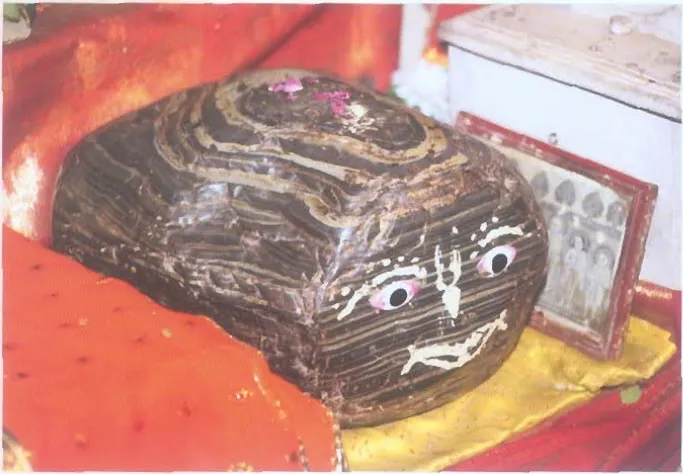
Vṛndāvana, the Playground of God (2010) prints a photograph captioned "Govardhana śilā in the old Govinda temple": a rounded dark stone decorated with painted eyes, tilaka and a mouth. Nothing is recorded about where the Govardhana-śilā came from or who worships it.[41] In the Caitanya-caritāmṛta Śrī Caitanya Mahāprabhu tells Śrīla Raghunātha dāsa Gosvāmī that a stone from Govardhana is the form of Kṛṣṇa and should be worshipped with eagerness.[108 +1] Śrīla Prabhupāda's statements on taking stones from Govardhana, each given for its own occasion, are set side by side on the Govardhana page.[110]
Location
| Where it is | map key 17[111] Gomā-ṭīlā is 'this mound', to which 'Every day, just before noon, one cow comes ... and irrigates this place with the milk from her udder'[112] |
|---|
Places at Rādhā-Govinda Mandira (Vṛndāvana, old)
3 places
Nearby places
Govindajī Mandira (Vṛndāvana, new) · Sākṣi-gopāla Mandira (Vṛndāvana) · 64 Samādhis · Raṅgajī Mandira
Pictures
8 pictures
History
Who built the temple
The Caitanya-caritāmṛta says that Śrīla Raghunātha Bhaṭṭa Gosvāmī had his disciples build a temple for Govinda, and made Govinda's flute and shark-shaped earrings; Śrīla Prabhupāda's purport says that one of his disciples built it on his order. Neither names the disciple or gives a date.[1 +3] In other purports Śrīla Prabhupāda writes that Śrīla Rūpa Gosvāmī constructed the Govindajī temple, and in The Nectar of Devotion and his lectures he tells how Mahārāja Mānsiṅgh, Akbar's commander-in-chief, offered Śrīla Rūpa Gosvāmī a service and was told to build a large temple for Govindajī.[19 +8]
The Sādhana-dīpikā, written by a priest of the temple (in the early seventeenth century, according to its editor), praises King Māna-siṁha, devoted to Govinda and to Śrī Caitanya, as the one who had the great temple built; it names no instructor and gives no date.[75] The temple's own inscription, as printed by F. S. Growse (1883), copied by Pulinbihārī Datta in his Vṛndāvana-kathā (1920) and reported by A. W. Entwistle (1987), says that Mahārājādhirāja Mānasiṁhadeva, son of Bhagavantadāsa, made the temple for Śrī Govindadeva at the place of the Śrī Vṛndāvana yogapīṭha. It is dated "saṁvat 34", which Growse and Datta read as Akbar's thirty-fourth year (1590); Entwistle notes that it would normally mean Saṁvat 1634 (1577).[76 +4] The guidebooks give 1590 for its completion.[1 +4] Read more: The great temple of Śrī Govinda →
Accounts differ Under whose instruction the great temple was built, and whose disciple Mānsiṅgh was.
- Śrī Caitanya-caritāmṛta, Antya 13.131Śrīla Raghunātha Bhaṭṭa had his own disciples build Govinda's temple (no name).
- Śrīla Prabhupāda, CC Ādi 10.158 purportOn Śrīla Raghunātha Bhaṭṭa's order one of his disciples built the Govinda temple.
- Śrīla Prabhupāda, CC Ādi 7.164 and Madhya 23.104 purportsŚrīla Rūpa Gosvāmī constructed/established the Govindajī temple.
- Śrīla Prabhupāda, Nectar of Devotion ch. 7 and lectures 1972-1976Mānsiṅgh, Akbar's commander-in-chief, offered Śrīla Rūpa Gosvāmī a service and Rūpa told him to build the temple; Mānsiṅgh 'carried out the order of Rūpa Gosvāmī'.
According to Entwistle (1987), a document kept at a research institute in Vṛndāvana records that Todar Mal, Akbar's finance minister, persuaded Akbar on Śrīla Jīva Gosvāmī's behalf to recognise the custodians of the Govinda and Madana-mohana temples; the original document has not been independently examined.[81]
The damage and the journey to Jaipur
Śrīla Prabhupāda said that the temple was seven storeys high and that Aurangzeb broke four of them. In a 1973 letter he wrote that the old Govindajī and Madana-mohana temples were desecrated and partly destroyed, but that the Govindajī Deity had been removed.[16 +1] In a 1976 conversation Śrīla Prabhupāda also remarked, without naming this temple, that Aurangzeb gave many gifts to the temples of Vṛndāvana.[83]
Accounts differ How many storeys the temple had.
- Śrīla Prabhupāda (lectures 1968, 1972, 1974); Śrī Vraja-maṇḍala Parikramā (2007), The Color Guide to Vṛndāvana (2000), Vṛndāvana-Dhāma Ki Jaya! (c. 1986)Seven storeys; four broken by Aurangzeb, three remain.
- the undated parikramā notes Vṛndāvana'It towered into the sky five storeys high.'
- Pulinbihārī Datta, Vṛndāvana-kathā (1920), p. 34Aurangzeb completely broke the main temple and the five spires (cūḍā) above; only the jagamohana and the nāṭa-mandira remain.
- A. W. Entwistle (1987), p. 410The pilgrim guides all say the main shrine and two side chapels had tall spires that Aurangzeb had demolished; Entwistle thinks it unlikely the spire was destroyed, as it was never finished.
The wording of these accounts is our summary of the sources, not a published translation.
Śrīla Prabhupāda said in 1970 that the king of Jaipur took Govinda, with Gopīnātha and Madana-mohana, from Vṛndāvana to Jaipur when Aurangzeb was breaking temples.[2 +5] The year is given differently.
Accounts differ When and why the original Govinda Deity left Vṛndāvana for Jaipur.
- Śrīla Prabhupāda, lecture 14 June 1970 (Los Angeles)When Aurangzeb was breaking Hindu temples, the king of Jaipur took Govinda, Gopīnātha and Madana-mohana from Vṛndāvana to Jaipur (no date).
- Vṛndāvana, the Playground of God (2010)Around 1670.
- Pulinbihārī Datta, Vṛndāvana-kathā (1920), p. 218Probably in 1670, all the Gauḍīya Deities were taken to Jaipur, under the shelter of Rāmasiṁha, son of Mirzā Rājā Jayasiṁha I.
- A. W. Entwistle (1987), pp. 185, 191The Gauḍīya priests sought the protection of the rulers of Amber; the Deities were first taken to Kāmā; Govinda-deva was taken to Amber in or shortly before 1714 (A. K. …
A pratibhū Deity of Govinda, a representative form, is worshipped in the new Govindajī temple behind the old one; Śrī Vraja-maṇḍala Parikramā (2007) gives 1748 for its installation and 1819 for the new temple of Nandakumāra Vasu.[2 +2]
Where the sources differ
Whether the Yogamāyā of the shrine is the girl whom Kaṁsa tried to kill is told differently and is not certain; the accounts are …
Whether the Yogamāyā of the shrine is the girl whom Kaṁsa tried to kill is told differently and is not certain; the accounts are set side by side on the page of the Yogapīṭha.[2 +5]
What the underground chapel on the south-west side is, and where Vṛndā-devī's Deity used to be, the guidebooks and the British records tell differently; the accounts are set side by side on the page of the Yogapīṭha.[98 +1]
Accounts differ How the young Narottama's arrival at the Govinda temple is told, and who received him.
- Vṛndāvana, the Playground of God (2010)Arriving exhausted, he collapsed inside the entrance of the Rādhā-Govinda temple and on waking found Śrīla Jīva Gosvāmī kneeling over him; Jīva then looked after him (no source given).
- Narottama-vilāsa (Śrīla Narahari Cakravartī), 2nd vilāsa vv.229-241Overwhelmed at the sight of Śrī Govinda, the young prince was taken on his lap by Śrīla Jīva Gosvāmī, who bathed him with his tears and consoled him; Śrīnivāsa met him at Govinda's door; Kṛṣṇa Paṇḍita, Govinda's adhikārī, gave him garland and prasāda.
- Prema-vilāsa (Nityānanda dāsa), 11th vilāsa pp. 62-63Jīva, ordered by Rūpa in a dream, had him fetched from Viśrānti-ghāṭa in Mathurā; at the sight of the Govinda temple's beauty he fainted crying 'Hā Govinda'; Jīva went and told Śrīla Lokanātha Gosvāmī, whose touch revived him; he was then led by the hand into the Govinda temple (the subject is not named; the context points to Lokanātha), Jīva handing him over, and he fainted again at the sight of Govinda's face.
More on this place
How Śrīla Rūpa Gosvāmī found Śrī Govinda on Gomā-ṭīlā · The great temple of Śrī Govinda
References
112 references
- Vṛndāvana, the Playground of God (2010), Bhakti Caitanya Svāmī, PDF p. 34
- The Color Guide to Vṛndāvana (2000), Written and Photographed by Rājaśekhara dāsa Brahmacārī, PDF p. 146
- the undated parikramā notes Vṛndāvana, ¶268
- Śrī Vraja-maṇḍala Parikramā (2007), PDF p. 324
- Śrīla Kṛṣṇadāsa Kavirāja Gosvāmī, Śrī Caitanya-caritāmṛta, CC Antya-līlā 13.131, online edition · vedabase.io
- Śrīla Narahari Cakravartī, Bhakti-ratnākara, Second Wave (dvitīya taraṅga), 1912 ed. p. 88, 2nd ed., 1912
- Śrīla Narahari Cakravartī, Bhakti-ratnākara, Second Wave (dvitīya taraṅga), 1912 ed. p. 89, 2nd ed., 1912
- Śrīla Narahari Cakravartī, Bhakti-ratnākara, Second Wave, quoting the Sādhana-dīpikā of Rādhā-kṛṣṇa Gosvāmī, 1912 ed. p. 90, 2nd ed., 1912
- Śrī Vraja-maṇḍala Parikramā (2007), PDF p. 322
- Śrī Vraja-maṇḍala Parikramā (2007), PDF p. 323
- Vṛndāvana, the Playground of God (2010), Bhakti Caitanya Svāmī, PDF p. 30
- Śrīla Kṛṣṇadāsa Kavirāja Gosvāmī, Śrī Caitanya-caritāmṛta, CC Ādi-līlā 8.52, online edition · vedabase.io
- Śrīla Kṛṣṇadāsa Kavirāja Gosvāmī, Śrī Caitanya-caritāmṛta, CC Ādi-līlā 8.53, online edition · vedabase.io
- Śrīla Kṛṣṇadāsa Kavirāja Gosvāmī, Śrī Caitanya-caritāmṛta, CC Ādi-līlā 8.54, online edition · vedabase.io
- Śrīla Kṛṣṇadāsa Kavirāja Gosvāmī, Śrī Caitanya-caritāmṛta, Ādi-līlā 8.66, online edition · vedabase.io
- Śrīla Prabhupāda, Letter to Jadurani, letter 73-06-28, 28 June 1973 · vedabase.io
- Śrīla Prabhupāda, Śrī Caitanya-caritāmṛta, Ādi-līlā 10.158, purport · vedabase.io
- Vṛndāvana, the Playground of God (2010), Bhakti Caitanya Svāmī, PDF p. 148
- Śrīla Prabhupāda, The Nectar of Devotion, Chapter 7 · vedabase.io
- Śrīla Prabhupāda, Śrīmad-Bhāgavatam 1.2.9 lecture, Vṛndāvana, 20 October 1972 · vedabase.io
Show all 112 references
- Śrīla Prabhupāda, Śrī Rāma-navamī, Cornerstone Laying, Bombay, 1 April 1974 · vedabase.io
- Śrīla Prabhupāda, Śrīmad-Bhāgavatam 5.5.9 lecture, Vṛndāvana, 31 October 1976 · vedabase.io
- Śrīla Prabhupāda, Morning Walk, Chicago, 11 July 1975 · vedabase.io
- Śrīla Prabhupāda, Śrīla Baladeva Vidyābhūṣaṇa Appearance lecture, Los Angeles, 14 June 1970 · vedabase.io
- Vṛndāvana, the Playground of God (2010), Bhakti Caitanya Svāmī, PDF p. 35
- Vṛndāvana, the Playground of God (2010), Bhakti Caitanya Svāmī, PDF p. 12
- Śrīla Rūpa Gosvāmī, Bhakti-rasāmṛta-sindhu, 1.2.166 (quoting the Varāha Purāṇa), GRETIL
- Varāha Purāṇa, chapter 153, verses 48-49, Sanskrit Wikisource
- Śrīla Narahari Cakravartī, Bhakti-ratnākara, Fifth Wave (pañcama taraṅga), 1912 ed. p. 292, 2nd ed., 1912
- Śrīla Prabhupāda, The Nectar of Devotion, Chapter 9, 'Seeing the Deity' · vedabase.io
- Śrīla Rūpa Gosvāmī, Mathurā-māhātmya, part 1 v.372-375, under the heading 'atha śrī-govindasya'
- Śrīla Kṛṣṇadāsa Kavirāja Gosvāmī, Śrī Caitanya-caritāmṛta, CC Ādi-līlā 5.217, online edition · vedabase.io
- Śrīla Kṛṣṇadāsa Kavirāja Gosvāmī, Śrī Caitanya-caritāmṛta, CC Ādi-līlā 8.50, online edition · vedabase.io
- Śrīla Kṛṣṇadāsa Kavirāja Gosvāmī, Śrī Caitanya-caritāmṛta, CC Ādi-līlā 8.51, online edition · vedabase.io
- Śrīla Kṛṣṇadāsa Kavirāja Gosvāmī, Śrī Caitanya-caritāmṛta, CC Ādi-līlā 5.218-219, online edition · vedabase.io
- Śrīla Kṛṣṇadāsa Kavirāja Gosvāmī, Śrī Caitanya-caritāmṛta, CC Ādi-līlā 1.16, online edition · vedabase.io
- Śrīla Kṛṣṇadāsa Kavirāja Gosvāmī, Śrī Caitanya-caritāmṛta, CC Ādi-līlā 5.220, online edition · vedabase.io
- Śrīla Kṛṣṇadāsa Kavirāja Gosvāmī, Śrī Caitanya-caritāmṛta, Ādi-līlā 1.19, online edition · vedabase.io
- Śrīla Prabhupāda, Śrī Caitanya-caritāmṛta, Ādi-līlā 1.19, purport · vedabase.io
- Śrīla Prabhupāda, Śrī Caitanya-caritāmṛta, Ādi-līlā 10.90, purport · vedabase.io
- Vṛndāvana, the Playground of God (2010), Bhakti Caitanya Svāmī, PDF p. 36
- Padma Purāṇa, Pātāla-khaṇḍa (5), chapter 69, verses 79-83, Sanskrit Wikisource
- Śrīla Jīva Gosvāmī, Kṛṣṇa-sandarbha, anuccheda 153, GRETIL
- Śrīla Narahari Cakravartī, Bhakti-ratnākara, Fifth Wave, quoting the Ūrdhvāmnāya-tantra, 1912 ed. p. 297, 2nd ed., 1912
- Śrīla Narahari Cakravartī, Bhakti-ratnākara, Fifth Wave, quoting the Sammohana-tantra, 1912 ed. p. 293, 2nd ed., 1912
- Śrīla Narahari Cakravartī, Bhakti-ratnākara, Fifth Wave, quoting the Skanda Purāṇa (Mathurā-khaṇḍa), 1912 ed. p. 293, 2nd ed., 1912
- Śrīla Sanātana Gosvāmī: commentary on ŚB 10.11.28–29, Bhagavata Vidya Pith edition, ed. Bhagavata Rishi and Krishna Shankar Shastri, 1996
- Śrīla Kṛṣṇadāsa Kavirāja Gosvāmī, Govinda-līlāmṛta, 21.28, after the editions of Haridas Das and Haridas Shastri
- Śrīla Viśvanātha Cakravartī Ṭhākura, Vraja-rīti-cintāmaṇi, dvitīya sarga (chapter 2) vv. 70, 73-74
- Śrīla Jīva Gosvāmī, Kṛṣṇa-sandarbha, anuccheda 172, GRETIL
- Śrī Vraja-maṇḍala Parikramā (2007), PDF p. 346
- Śrīla Rādhā-kṛṣṇa Gosvāmī, Sādhana-dīpikā, (2) dvitīya-kakṣā, prose after v.21 after v.21', part 1/2)
- Śrīmad-Bhāgavatam 10.33.2, GRETIL
- Śrīmad-Bhāgavatam 10.33.38, GRETIL
- Śrīla Prabhupāda, Kṛṣṇa, the Supreme Personality of Godhead (Kṛṣṇa book), Chapter 33, 'Description of the Rāsa Dance' · vedabase.io
- Śrīla Sanātana Gosvāmī: commentary Śrīla Sanātana Gosvāmī, Bṛhad-vaiṣṇava-toṣaṇī, on ŚB 10.37.2, Bhagavata Vidya Pith edition, ed. Bhagavata Rishi and Krishna Shankar Shastri, 1996
- Śrīla Jīva Gosvāmī: commentary Śrīla Jīva Gosvāmī, Laghu-vaiṣṇava-toṣaṇī, on ŚB 10.37.2, Bhagavata Vidya Pith edition, ed. Bhagavata Rishi and Krishna Shankar Shastri, 1996
- Śrīla Rādhā-kṛṣṇa Gosvāmī, Sādhana-dīpikā, (8) aṣṭa-kakṣā, the account of Śrī Rūpa and Śrī Govinda … after v.7', part 1/2)
- Śrīla Rādhā-kṛṣṇa Gosvāmī, Sādhana-dīpikā, part 1, prose after v.16 and v.17
- Śrīla Kṛṣṇadāsa Kavirāja Gosvāmī, Śrī Caitanya-caritāmṛta, Madhya-līlā 1.32, online edition · vedabase.io
- Śrīla Narahari Cakravartī, Bhakti-ratnākara, Second Wave (dvitīya taraṅga), 1912 ed. p. 91, 2nd ed., 1912
- Śrī Vraja-maṇḍala Parikramā (2007), PDF p. 325
- The Color Guide to Vṛndāvana (2000), Written and Photographed by Rājaśekhara dāsa Brahmacārī, PDF p. 140
- the undated parikramā notes Vṛndāvana, ¶266
- Śrīla Narahari Cakravartī, Bhakti-ratnākara, Second Wave, quoting the Sādhana-dīpikā, 1912 ed. p. 92, 2nd ed., 1912
- Vṛndāvana, the Playground of God (2010), Bhakti Caitanya Svāmī, PDF p. 193
- Vṛndāvana, the Playground of God (2010), Bhakti Caitanya Svāmī, PDF p. 194
- Śrīla Nārāyaṇa Bhaṭṭa, Vraja-bhakti-vilāsa, printed p. 228, item 76, 1st ed., publ. Bābā Kṛṣṇadāsa, Kusuma-sarovara, Saṁvat 2008
- Śrīla Kṛṣṇadāsa Kavirāja Gosvāmī, Śrī Caitanya-caritāmṛta, Madhya-līlā 5.13, online edition · vedabase.io
- Śrīla Narahari Cakravartī, Bhakti-ratnākara, Sixth Wave (ṣaṣṭha taraṅga), 1912 ed. p. 459, 2nd ed., 1912
- Śrīla Prabhupāda, Śrī Caitanya-caritāmṛta, Madhya-līlā 8.300, purport · vedabase.io
- Śrīla Narahari Cakravartī, Bhakti-ratnākara, Sixth Wave (ṣaṣṭha taraṅga), 1912 ed. p. 460, 2nd ed., 1912
- Śrīla Kṛṣṇadāsa Kavirāja Gosvāmī, Śrī Caitanya-caritāmṛta, Antya-līlā 1.218, online edition · vedabase.io
- Śrīla Prabhupāda, Śrī Caitanya-caritāmṛta, Ādi-līlā 7.164, purport · vedabase.io
- Śrīla Rādhā-kṛṣṇa Gosvāmī, Sādhana-dīpikā, (8) aṣṭa-kakṣā, verses on the devotees of Śrī Govinda … after v.9.29', part 3/3)
- Vṛndāvana-kathā, chapter 2 (dvitīya pariccheda), printed p. 38
- A. W. Entwistle, ch. 8 gazetteer, §25 'Govind Dev', printed pp. 409-410, Egbert Forsten, Groningen, 1987
- A. W. Entwistle, ch. 5 §12 (Akbar's reign), printed pp. 159-160, Egbert Forsten, Groningen, 1987
- A. W. Entwistle, ch. 8 gazetteer, §25 'Govind Dev', printed p. 410, Egbert Forsten, Groningen, 1987
- Mathurá (1883), F. S. Growse, B.C.S., M.A. Oxon., C.I.E. (as the title page gives him
- A. W. Entwistle, ch. 5 §12 (Akbar's reign), printed p. 160 with n. 127, Egbert Forsten, Groningen, 1987
- Śrīla Prabhupāda, Śrīmad-Bhāgavatam 7.9.11 lecture, Montreal, 17 August 1968 · vedabase.io
- Śrīla Prabhupāda, Room Conversation About Māyāpur Construction, Hyderabad, 19 August 1976 · vedabase.io
- Śrīla Prabhupāda, Śrī Caitanya-caritāmṛta, Madhya-līlā 23.104, purport · vedabase.io
- Śrīla Kṛṣṇadāsa Kavirāja Gosvāmī, Śrī Caitanya-caritāmṛta, CC Antya-līlā 20.155, online edition · vedabase.io
- Śrīla Kṛṣṇadāsa Kavirāja Gosvāmī, Śrī Caitanya-caritāmṛta, CC Madhya-līlā 2.95, online edition · vedabase.io
- Śrīla Narahari Cakravartī, Bhakti-ratnākara, Fourth Wave (caturtha taraṅga), 1912 ed. p. 137, 2nd ed., 1912
- Śrīla Narahari Cakravartī, Narottama-vilāsa, second vilāsa, vv. 229-241, Kiśorī dāsa Bābājī's edition, p. 15, left-hand column, 1st ed., Baṅgābda 1314
- Śrīla Narahari Cakravartī, Bhakti-ratnākara, Sixth Wave (ṣaṣṭha taraṅga), 1912 ed. p. 468, 2nd ed., 1912
- Śrīla Narahari Cakravartī, Bhakti-ratnākara, Sixth Wave (ṣaṣṭha taraṅga), 1912 ed. p. 485, 2nd ed., 1912
- Prema-vilāsa, eleventh vilāsa, Kolkata ed. (c. 1913) p. 62, right-hand column, Kolkata, 1913
- The Colour Guide to Rādhā-kuṇḍa (1999), Rājaśekhara dāsa Brahmacārī, PDF p. 120
- Abhidheyādhideva Praṇāma (CC Ādi 1.16) (Kṛṣṇadāsa Kavirāja Gosvāmī (as the song book credits it)) · song book
- Śrī Govindadevāṣṭaka (Viśvanātha Cakravartī Ṭhākura (as the song book credits it)) · song book
- the undated parikramā notes Vṛndāvana, ¶271
- Vṛndāvana-Dhāma Ki Jaya! (c. 1986), by Dhruva Mahārāja dāsa, PDF p. 75
- Śrī Vraja-maṇḍala Parikramā (2007), PDF p. 345
- Mathurá (1883), F. S. Growse, B.C.S., M.A. Oxon., C.I.E. (as the title page gives him, p. 243
- Muttra (1911), D. L. Drake-Brockman, I.C.S. (edited and compiled), p. 243
- Śrīmad-Bhāgavatam 10.2.9, GRETIL
- Śrīmad-Bhāgavatam 10.3.47, Bhagavata Vidya Pith edition, ed. Bhagavata Rishi and Krishna Shankar Shastri, 1996
- Śrīmad-Bhāgavatam 10.4.9, GRETIL
- Śrīmad-Bhāgavatam 10.4.13, GRETIL
- Śrīla Prabhupāda, Kṛṣṇa, the Supreme Personality of Godhead (Kṛṣṇa book), Chapter 2, 'Prayers by the Demigods for Lord Kṛṣṇa in the Womb' · vedabase.io
- Śrīla Prabhupāda, Kṛṣṇa, the Supreme Personality of Godhead (Kṛṣṇa book), Chapter 4, 'Kaṁsa Begins His Persecutions' · vedabase.io
- Śrīla Jīva Gosvāmī, Śrīla Viśvanātha Cakravartī Ṭhākura, Baladeva Vidyābhūṣaṇa: commentary on ŚB 10.2.9, Bhagavata Vidya Pith edition, ed. Bhagavata Rishi and Krishna Shankar Shastri, 1996
- Śrīla Viśvanātha Cakravartī Ṭhākura: commentary on ŚB 10.2.10, Bhagavata Vidya Pith edition, ed. Bhagavata Rishi and Krishna Shankar Shastri, 1996
- Śrīla Kṛṣṇadāsa Kavirāja Gosvāmī, Śrī Caitanya-caritāmṛta, CC Antya-līlā 6.294, online edition · vedabase.io
- Śrīla Prabhupāda, Śrī Caitanya-caritāmṛta, Antya-līlā 6.294, purport · vedabase.io
- Śrīla Prabhupāda, Kṛṣṇa, the Supreme Personality of Godhead (Kṛṣṇa book), Chapter 24, 'Worshiping Govardhana Hill' · vedabase.io
- Śrī Vraja-maṇḍala Parikramā (2007), p. 618-619
- Śrī Vraja-maṇḍala Parikramā (2007), p. 620-621