Śrījī Mandira (Vṛndāvana)
श्रीजी मन्दिर (वृन्दावन) Hindi name proposed
Also called Śrīji Temple, Srīji
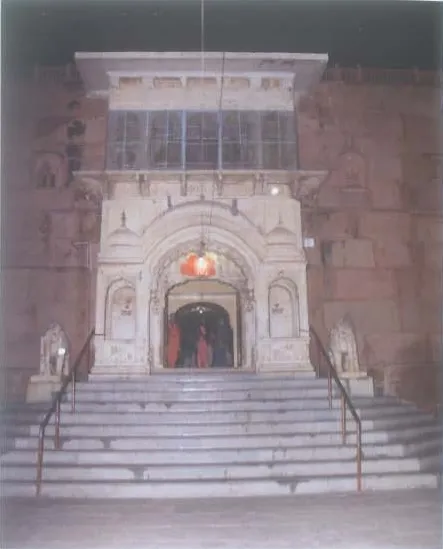
- What it is
- The Śrījī Mandira is a large temple of the Nimbārka sampradāya, one of the four Vaiṣṇava lines of disciplic succession, in Vṛndāvana town, near the eastern end of Loī-bāzār.
- Visiting
- Vṛndāvana, the Playground of God (2010) places the temple about one hundred metres to the right from the eastern end of Loī-bāzār, on the left-hand side of the road, and describes a large building …
In short
The Śrījī Mandira is a large temple of the Nimbārka sampradāya, one of the four Vaiṣṇava lines of disciplic succession, in Vṛndāvana town, near the eastern end of Loī-bāzār.[1 +2] Śrī Vraja-maṇḍala Parikramā (2007) counts it among the modern temples of Vṛndāvana.[3 +1] A queen of Jaipur built it in the 1820s; the sources give the year as 1823, 1826 or 1827.[5 +1] Its main Deities are Śrī Ānanda-manohara and Śrī Vṛndāvana-candra.[2 +1] It is not the Śrījī temple of Varṣāṇā. No scripture or Gosvāmī text mentions the temple, and Śrīla Prabhupāda does not speak of it by name.[3 +1]
Key facts
| Kind | temple |
|---|---|
| Region · area | Vṛndāvana |
Why it is glorified
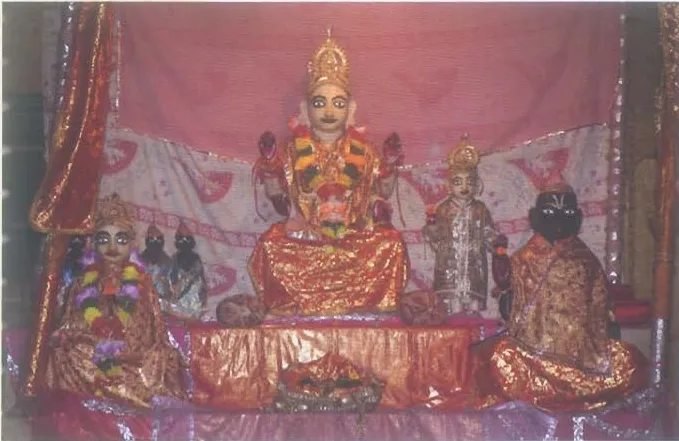
Vṛndāvana, the Playground of God (2010) prints a photograph of Lord Haṁsa in the temple, with Śrī Nimbārka below.
Vṛndāvana, the Playground of God (2010) prints a photograph of Lord Haṁsa in the temple, with Śrī Nimbārka below.[2 +1] Śrīmad-Bhāgavatam tells who Lord Haṁsa is: when Lord Brahmā could not answer a question of his sons, the sages headed by Sanaka, he fixed his mind on the Lord, who appeared before him in the form of Haṁsa, the swan, and answered them. The verse does not mention the temple.[2 +1]
sa mām acintayad devaḥ praśna-pāra-titīrṣayā / tasyāhaṃ haṃsa-rūpeṇa sakāśam agamaṃ tadā
Lord Brahmā desired to attain the answer to the question that was puzzling him, and thus he fixed his mind on Me, the Supreme Lord. At that time, in My form of Haṁsa, I became visible to Lord Brahmā.
Translation: Śrīla Prabhupāda's disciples (BBT)Śrīla Prabhupāda
Śrīla Prabhupāda writes that the disciplic succession of the four Kumāras, the same sages, is still maintained as the Nimbārka sampradāya. This is a general statement, not about this temple:[8]
General teaching (does not name the place)“As we have already explained, they have their sampradāya (disciplic succession), and even to date the sampradāya is being maintained and is known as the Nimbārka sampradāya. Out of the four sampradāyas of the Vaiṣṇava ācāryas, the Nimbārka sampradāya is one.”
Śrīla Prabhupāda, Śrīmad-Bhāgavatam, 4.22.12, purport · vedabase.io
Visiting today
Vṛndāvana, the Playground of God (2010) places the temple about one hundred metres to the right from the eastern end of Loī-bāzār, on the left-hand side of the road, and describes a large building with a big library of old Sanskrit and Hindi works. Śrī Vraja-maṇḍala Parikramā (2007) says that the Varddhamāna Mahārāja-kuñja stands opposite, across the road (below).[2 +1]
Śrī Vraja-maṇḍala Parikramā names two sets of Deities, Śrī Ānanda-manohara and Śrī Vṛndāvana-candra; Vṛndāvana, the Playground of God names them with Śrī Rādhā and adds Haṁsa-Gopāla on another altar.[2 +1] The Color Guide (2000) printed the darśana times as 9 am to 12 noon and 5 to 8 pm, with maṅgala-ārati at 5 am; they may have changed since.[1]
The Varddhamāna Mahārāja-kuñja
The Varddhamāna Mahārāja-kuñja is a temple house across the road from the Śrījī Mandira. Varddhamāna is Burdwan in Bengal. According to the Bengali Vṛndāvana-kathā (1920), it was established by Rājarājeśvarī Devī, the queen of Mahārāja Kīrticā̃d of Burdwan, who also had Pāvana-sarovara at Nandagrāma lined with stone.[3 +3] No scripture, statement of Śrīla Prabhupāda or song about the place has been found, and no source gives the year it was built.[3 +3]
The Vṛndāvana-kathā lists the kuñja among the works of the Rājās of Burdwan (summarised here, not translated). It calls the building a ṭhākura-bāṛī, a house for the Deity, says that in its day it was not so fine to look at, and adds that a few guests were served there every day, in good order. It gives no date.[11]
৪র্থ—বর্দ্ধমানের রাজাদিগের কীর্ত্তি—শ্রীজীর মন্দিরের সম্মুখে, রাস্তার অপরপার্শ্বে, বর্দ্ধমানের স্বর্গীয় মহারা[জ] কীর্ত্তিচাঁদ বাহাদুরের রাণী—রাজরাজেশ্বরী দেবীর প্রতিষ্ঠিত ঠাকুর-বাড়ী আছে। এটী দেখিতে তত সুন্দর না হইলেও এখানে প্রতিদিন কয়েকজন করিয়া অতিথির সেবা হয়। সেই সেবাও সুশৃঙ্খলায় চলে। রাজরাজেশ্বরী দেবী, নন্দগ্রামের পাবন-সরোবরটীকে পাথর দিয়া বাঁধাইয়া দিয়াছিলেন।
4rtha—barddhamānera rājādigera kīrtti—śrījīra mandirera sammukhe, rāstāra aparapārśbe, barddhamānera sbargīẏa mahārā[ja] kīrtticām̐da bāhādurera rāṇī—rājarājeśbarī debīra pratiṣṭhita ṭhākura-bāṛī āche| eṭī dekhite tata sundara nā haileo ekhāne pratidina kaẏekajana kariẏā atithira sebā haẏa| sei sebāo suśṛṅkhalāẏa cale| rājarājeśbarī debī, nandagrāmera pābana-sarobaraṭīke pāthara diẏā bām̐dhāiẏā diẏāchilena|
Śrī Vraja-maṇḍala Parikramā also names the kuñja opposite the Śrījī temple, but its entries here follow the order of the 1920 book, so the two may be one witness rather than two. None of the other sources consulted mentions a Burdwan kuñja in Vṛndāvana.[3 +3]
Who the Burdwan builder was, and whether the queen was the wife or the mother of Kīrticand, the sources tell differently: the Vṛndāvana-kathā (1920) and the 2007 guidebook call her his queen, while an inscription at Pāvana-sarovara, as historians report it, names her his mother. The accounts, most of which concern that lake's ghāṭas, are set side by side on the Pāvana-sarovara page.[3 +3]
Location
| Where it is | 'about one hundred meters to the right from the eastern end of Loi Bazaar, on the left hand side of the road'[13] |
|---|
Places at Śrījī Mandira (Vṛndāvana)
1 places
Also described on this page
Nearby places
Loī-bāzār
Pictures
1 pictures
History
The historian A. W. Entwistle (1987) dates the temple, which he calls Śrījī Kuñja, the temple of Ānanda-manohara, to 1827. He names its builder as Mahārānī Ānanda Kuṁvarī, a wife of Savāī Jagat Singh of Jaipur and mother of Savāī Jai Singh III, and says that she apparently built it as a thanksgiving for the birth of her husband's son after his death.[5 +1] The guidebooks give other years, and one of them describes the queen differently (see below). No inscription for the year has been seen.
The Color Guide to Vṛndāvana (2000) calls it the main temple of the Nimbārka sampradāya in Vṛndāvana, Vṛndāvana, the Playground of God (2010) one of the major Nimbārka temples.[1 +1]
Where the sources differ
When and by whom the Śrījī temple of Vṛndāvana was built or opened.
Accounts differ When and by whom the Śrījī temple of Vṛndāvana was built or opened.
- Śrī Vraja-maṇḍala Parikramā (2007), printed p. 648Mahārānī Ānandakumarī-devī, the Queen of Jaya Singh, a king of Jaipura, had this temple constructed in 1826 AD.
- Vṛndāvana, the Playground of God (2010)It was opened by the Queen of Jaipur in 1823 (no name).
- Entwistle (1987), pp. 408 and 220Built in 1827 by Mahārānī Ānanda Kuṁvarī (Anand Kunwari), a wife of Savāī Jagat Singh (1803-18) and mother of Savāī Jai Singh III of Jaipur, apparently as a thanksgiving for the birth of her husband's posthumous son (source: A. K. …
Whether it is the main Nimbārka temple of Vṛndāvana or one of the major ones.
Accounts differ Rank of the Śrījī temple among the Nimbārka temples of Vṛndāvana.
- The Color Guide to Vṛndāvana (2000), printed p. 88This is the main temple of the Nimbarka Vaiṣṇava sampradāya in Vṛndāvana.
- Vṛndāvana, the Playground of God (2010)The Śrījī temple is one of the major Nimbārka temples in Vṛndāvana.
References
13 references
- The Color Guide to Vṛndāvana (2000), Written and Photographed by Rājaśekhara dāsa Brahmacārī, PDF p. 102
- Vṛndāvana, the Playground of God (2010), Bhakti Caitanya Svāmī, PDF p. 186
- Śrī Vraja-maṇḍala Parikramā (2007), PDF p. 337
- Śrī Vraja-maṇḍala Parikramā (2007), PDF p. 322
- A. W. Entwistle, ch. 8 §66.22 'Shriji Kunj', printed p. 408, Egbert Forsten, Groningen, 1987
- A. W. Entwistle, ch. 5 §37 'The Nimbark Sampraday in modern times', printed p. 220, Egbert Forsten, Groningen, 1987
- Śrīmad-Bhāgavatam 11.13.19, GRETIL
- Śrīla Prabhupāda, Śrīmad-Bhāgavatam, 4.22.12, purport · vedabase.io
- Mathurá (1883), F. S. Growse, B.C.S., M.A. Oxon., C.I.E. (as the title page gives him
- Muttra (1911), D. L. Drake-Brockman, I.C.S. (edited and compiled)
- Pulinbihārī Datta, ch. 20 (viṁśa pariccheda), item 4 'Barddhamāner rājādiger kīrtti' (the works of the Rājās of Burdwan), printed p. 245
- Pulinbihārī Datta, ch. 20 (viṁśa pariccheda), item 4 'Barddhamāner rājādiger kīrtti' (the works of the Rājās of Burdwan), printed p. 245
- Vṛndāvana, the Playground of God (2010), Bhakti Caitanya Svāmī, p. 186