Śyāmānanda Paṇḍita's puṣpa-samādhi
श्यामानन्द पण्डित की पुष्प-समाधि Hindi name proposed
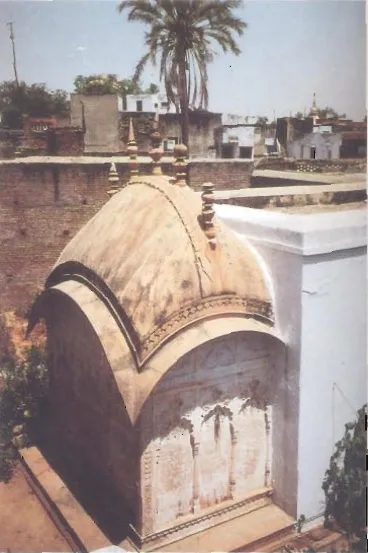
- What it is
- A small memorial of Śrīla Śyāmānanda Paṇḍita stands across the road from the entrance of the Rādhā-Śyāmasundara temple in Vṛndāvana, beside the Tilaka-sthāna, where according to the local tradition …
- Visiting
- Śrī Vraja-maṇḍala Parikramā (2007) places the samādhi opposite the entrance door of the Rādhā-Śyāmasundara temple; Vṛndāvana, the Playground of God (2010) and Vṛndāvana-Dhāma Ki Jaya!
In short
A small memorial of Śrīla Śyāmānanda Paṇḍita stands across the road from the entrance of the Rādhā-Śyāmasundara temple in Vṛndāvana, beside the Tilaka-sthāna, where according to the local tradition recorded in the guidebooks he received his tilaka.[1 +7] Some guidebooks call it his puṣpa-samādhi, a memorial that holds flowers from a devotee's body rather than the body itself; others call it simply his samādhi, and the sources differ on which it is.[1 +6] Two sources report a kīrtana that goes on day and night in his honour.[9 +2] No scripture or Gosvāmī text mentions the memorial, Śrīla Prabhupāda does not speak of it by name, and no source says who built it or when.[1 +5]
Key facts
| Kind | puṣpa-samādhi |
|---|---|
| Region · area | Vṛndāvana |
| Ācāryas | Śyāmānanda Paṇḍita (Duḥkhī Kṛṣṇadāsa) |
The Gosvāmīs and ācāryas
Śrīla Śyāmānanda Paṇḍita
Śrīla Prabhupāda names Duḥkhī Kṛṣṇadāsa, as Śrīla Śyāmānanda Paṇḍita was first called, among the devotees whom Śrīla Jīva Gosvāmī inspired to preach Kṛṣṇa consciousness in Bengal.[14]
General teaching (does not name the place)“Later, Śrīla Jīva Gosvāmī inspired Śrīnivāsa Ācārya, Narottama dāsa Ṭhākura and Duḥkhī Kṛṣṇadāsa to preach Kṛṣṇa consciousness in Bengal.”
Śrīla Prabhupāda, Śrī Caitanya-caritāmṛta, Ādi-līlā 10.85, purport · vedabase.io
How he found Śrī Rādhā's anklet and received his new name and tilaka is told very differently in the older Bengali works and the guidebooks; the Tilaka-sthāna page gives the accounts.[1 +5] Read more: How Śrīla Śyāmānanda Paṇḍita found Śrī Rādhā's anklet →
A song of Śrīla Narahari Cakravartī Ṭhākura in the Bhakti-ratnākara tells that he wandered through the twelve forests of Vraja, studied the books and became very skilled in service. Then, by way of Gauḍa and Ambikā, he went to Utkala (Orissa) and stayed there by the order of the Gosvāmīs (summarised here, not translated).[12 +2]
ভ্রমিলা দ্বাদশ বন, কৈলা গ্রন্থ অধ্যয়ন, হৈলা অতি নিপুণ সেবায়। শ্রীগৌড়- অম্বিকা হৈয়া, রহিলা উৎকলে গিয়া, শ্রীগোস্বামিগণের আজ্ঞায়॥
bhramilā dbādaśa bana, kailā grantha adhyaẏana, hailā ati nipuṇa sebāẏa| śrīgauṛa- ambikā haiẏā, rahilā utkale giẏā, śrīgosbāmigaṇera ājñāẏa||
The undated parikramā notes Vṛndāvana say that he entered samādhi, that is, left this world, while preaching in Orissa. The pages of the Bhakti-ratnākara that were read do not tell of his passing, and no source the editors have seen says where or when he passed away.[12 +2]
Śrīla Prabhupāda
Śrīla Prabhupāda does not speak of this memorial by name.
Śrīla Prabhupāda does not speak of this memorial by name. On a morning walk in Vṛndāvana in 1972, at the temple built by Śrīla Jīva Gosvāmī, he said, speaking in general, what a puṣpa-samādhi is:[11]
General teaching (does not name the place)“Later on, several other devotees, they are not entombed like them. Flowers from their body, they were placed. It is called puṣpa-samādhi. But here, the original bodies.”
Śrīla Prabhupāda, Morning Walk, Vṛndāvana, 15 October 1972 · vedabase.io
Visiting today
Śrī Vraja-maṇḍala Parikramā (2007) places the samādhi opposite the entrance door of the Rādhā-Śyāmasundara temple; Vṛndāvana, the Playground of God (2010) and Vṛndāvana-Dhāma Ki Jaya! (c. 1986) put it across the road from the temple.[1 +3] The Color Guide to Vṛndāvana (2000) and the undated notes report an akhaṇḍa (unbroken) kīrtana held there in his honour, open day and night. Whether it still goes on has not been checked.[9 +2]
The guidebooks print photographs: a seated, garlanded figure that Vṛndāvana, the Playground of God calls the samādhi Deity of Śyāmānanda, and a small garlanded memorial that The Color Guide captions "Śyāmānanda's Samādhi Mūrti". They may show this memorial, but that has not been checked on the spot.[2 +3]
The lists of the guidebooks and notes name other places with it: Śrīla Śyāmānanda Paṇḍita's Tilaka-sthāna next to it, the puṣpa-samādhi of Śrīla Rasikānanda beside it, and, in Śrī Vraja-maṇḍala Parikramā, Śrīla Śyāmānanda Prabhu's samāja-bāḍī near the temple, which may belong to the same compound.[3 +4]
Location
| Where it is | across the road from the entrance to the Rādhā-Śyāmasundara Mandira[18] |
|---|
Nearby places
Rādhā-Śyāmasundara Mandira (Vṛndāvana) · Śyāmānanda Tilaka-sthāna
Pictures
2 pictures
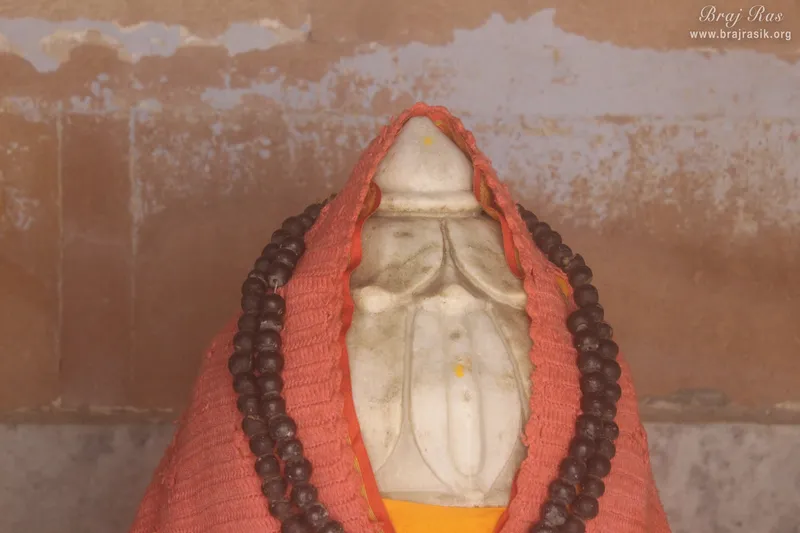
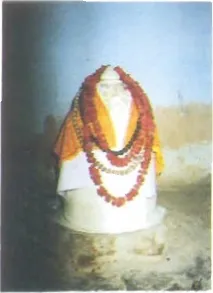
Where the sources differ
Accounts differ What kind of memorial it is: a flower (puṣpa) samādhi, or a samādhi in the full sense.
- Vṛndāvana, the Playground of God (2010)'His puṣpa-samādhi is next to it' (entry 40, 'Śyāmānanda Tilāka Sthāna and Samādhī'); caption: 'The samādhī of Śyāmānanda Paṇḍita, across the road from the Śyāmasundara temple'.
- The Color Guide to Vṛndāvana (2000)'This is the puṣpa (flower) samādhi of Śyāmānanda Paṇḍita' (entry 38A).
- the undated parikramā notes VṛndāvanaHeading 'Śyāmānanda Paṇḍita Puṣpa Samādhi'; a 24-hour kīrtana 'in honour of Śyāmānanda, who entered samādhi while preaching in Orissa'.
- Śrī Vraja-maṇḍala Parikramā (2007)'Opposite the entrance door of the temple is the samādhi of Śrī Śyāmānanda Prabhu'; it defines a samādhi as 'where the body of a highly elevated devotee is placed after his departure from this world' and lists his 'place (samāja-bāḍī)' near the temple; it does not call this memorial a puṣpa-samādhi.
More on this place
How Śrīla Śyāmānanda Paṇḍita found Śrī Rādhā's anklet
References
18 references
- Śrī Vraja-maṇḍala Parikramā (2007), PDF p. 333
- Vṛndāvana, the Playground of God (2010), Bhakti Caitanya Svāmī, PDF p. 98
- Vṛndāvana, the Playground of God (2010), Bhakti Caitanya Svāmī, PDF p. 162
- Vṛndāvana-Dhāma Ki Jaya! (c. 1986), by Dhruva Mahārāja dāsa, PDF p. 68
- the undated parikramā notes Vṛndāvana, ¶106
- the undated parikramā notes Vṛndāvana, ¶106
- the undated parikramā notes Vṛndāvana, ¶124
- Śrī Vraja-maṇḍala Parikramā (2007), PDF p. 345
- The Color Guide to Vṛndāvana (2000), Written and Photographed by Rājaśekhara dāsa Brahmacārī, PDF p. 95
- the undated parikramā notes Vṛndāvana, ¶121-¶122
- Śrīla Prabhupāda, Morning Walk, Vṛndāvana, 15 October 1972 · vedabase.io
- The Color Guide to Vṛndāvana (2000), Written and Photographed by Rājaśekhara dāsa Brahmacārī, PDF p. 96
- the undated parikramā notes Vṛndāvana, ¶122
- Śrīla Prabhupāda, Śrī Caitanya-caritāmṛta, Ādi-līlā 10.85, purport · vedabase.io
- Śrīla Narahari Cakravartī, Bhakti-ratnākara, Fifteenth Wave (pañcadaśa taraṅga), 1912 ed. p. 1060, lines 2-4 (end of the song in rāga Kāmoda begun on p. 1059), 2nd ed., 1912
- Śrīla Narahari Cakravartī, Bhakti-ratnākara, Fifteenth Wave (pañcadaśa taraṅga), 1912 ed. p. 1060, lines 2-4 (end of the song in rāga Kāmoda begun on p. 1059), 2nd ed., 1912
- Vṛndāvana, the Playground of God (2010), Bhakti Caitanya Svāmī, PDF p. 99
- Vṛndāvana-Dhāma Ki Jaya! (c. 1986), by Dhruva Mahārāja dāsa, p. 50