Śyāmasundara Mandira (Rādhā-kuṇḍa)
श्यामसुन्दर मन्दिर (राधा-कुण्ड) Hindi name proposed
Also called Śrī Śrī Rādhā Śyāmasundara Maṇḍira, Rādhā Śyāmasundara Maṇḍira, Śrī Śyāmasundara Temple (Rādhā-kuṇḍa)
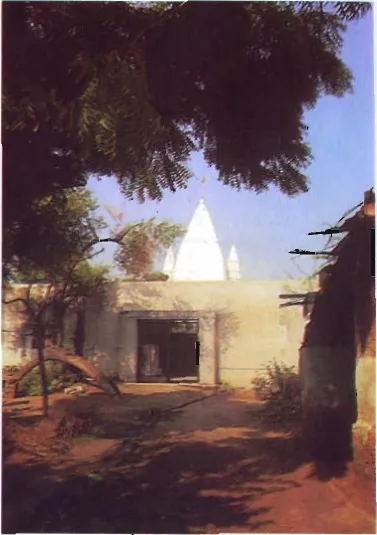
- What it is
- The Śyāmasundara Mandira is the temple of Rādhā-Śyāmasundara in the village of Rādhā-kuṇḍa, near Śyāma-kuṇḍa.
- Visiting
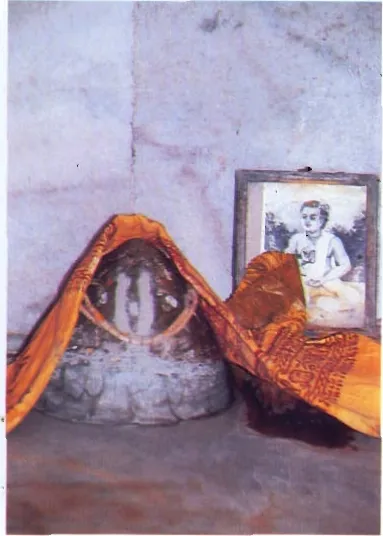
- The Colour Guide (1999) says that in this temple one can see the puṣpa-samādhi of Śrīla Śyāmānanda Paṇḍita next to the Deity room, and prints a photograph of it.
- Places here
- Śyāmānanda Paṇḍita's puṣpa-samādhi (Rādhā-kuṇḍa)
In short
The Śyāmasundara Mandira is the temple of Rādhā-Śyāmasundara in the village of Rādhā-kuṇḍa, near Śyāma-kuṇḍa. According to The Colour Guide to Rādhā-kuṇḍa (1999), it holds the pratibhū (representative) images of the Rādhā-Śyāmasundara whose original temple in Vṛndāvana Śrīla Śyāmānanda Paṇḍita founded, and his puṣpa-samādhi, a memorial, stands next to the Deity room.[1 +4] Śrīla Prabhupāda writes that Śrīla Śyāmānanda Paṇḍita built the Śyāmasundara temple in Vṛndāvana.[1 +1] The oldest dated record found of the temple at Rādhā-kuṇḍa is a list of 1987; no source gives its founder or year.[6]
Key facts
| Kind | temple |
|---|---|
| Region · area | Rādhā-kuṇḍa |
| Also part of | Rādhā-kuṇḍa (village) |
| Ācāryas | Śrī Śyāmānanda Paṇḍita |
The Gosvāmīs and ācāryas
According to the Bhakti-ratnākara, Śrīla Śyāmānanda Paṇḍita came from Govardhana to the bank of Rādhā-kuṇḍa and wept at the beauty of Rādhā-kuṇḍa and Śyāma-kuṇḍa. The Vrajavāsīs then took him to Śrīla Raghunātha dāsa Gosvāmī. Later, while he lived in Vṛndāvana, he went to the two kuṇḍas from time to time to see him.[7 +1] The work names no temple, Deity or samādhi of his at Rādhā-kuṇḍa.[7]
Śrīla Prabhupāda
Śrīla Prabhupāda names the Śyāmasundara temple in Vṛndāvana among the temples built after Śrīla Rūpa Gosvāmī and Śrīla Sanātana …
Śrīla Prabhupāda names the Śyāmasundara temple in Vṛndāvana among the temples built after Śrīla Rūpa Gosvāmī and Śrīla Sanātana Gosvāmī came there; he does not speak of the temple at Rādhā-kuṇḍa.[1 +1]
General teaching (does not name the place)“When Rūpa Gosvāmī and Sanātana Gosvāmī went to Vṛndāvana, there was not a single temple, but by their preaching they were gradually able to construct various temples. … and Śyāmānanda Gosvāmī constructed the Śyāmasundara temple.”
Śrīla Prabhupāda, Śrī Caitanya-caritāmṛta, Ādi-līlā 7.164, purport · vedabase.io
Visiting today
The Colour Guide (1999) says that in this temple one can see the puṣpa-samādhi of Śrīla Śyāmānanda Paṇḍita next to the Deity room, and prints a photograph of it. No other source mentions it, and none says when or by whom it was set up.[1 +2] A puṣpa-samādhi holds flowers from a departed devotee's body rather than the body itself, as Śrīla Prabhupāda explained on a morning walk in Vṛndāvana in 1972, speaking of other tombs.[9]
Location
| Where it is | Text: 'in the north-western part of Śrī Kṛṣṇa-kuṇḍa'; map key 3: beside a lane north of Rādhā-kuṇḍa (directions differ)[10] |
|---|
Places at Śyāmasundara Mandira (Rādhā-kuṇḍa)
1 places
Nearby places
Rādhā-Dāmodara Mandira (Rādhā-kuṇḍa) · Rādhā-Kṛṣṇa Mandira (Rādhā-kuṇḍa) · Rādhā-kuṇḍa · Śyāma-kuṇḍa (Rādhā-kuṇḍa)
Pictures
2 pictures
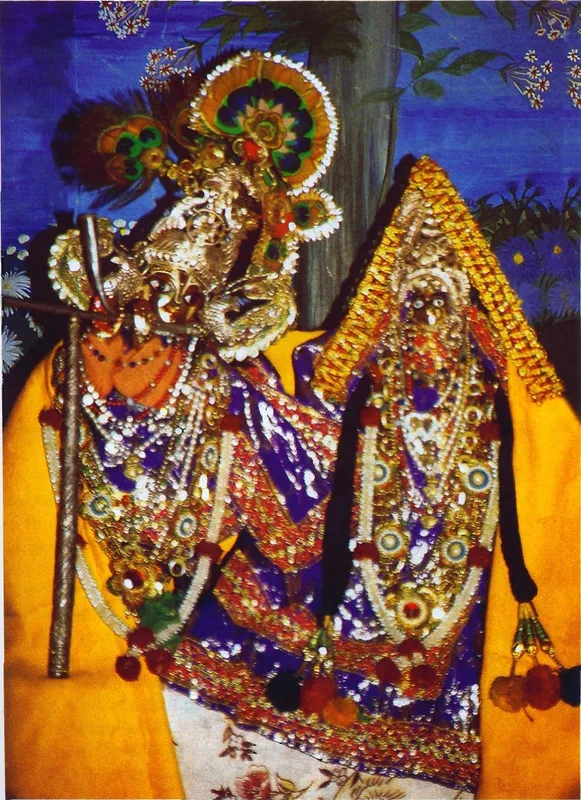
History
The Colour Guide (1999) counts Rādhā-Śyāmasundara in its table of pratibhū (representative) Deities. It cites no document for this, so it is not certain.[3]
The historian A. W. Entwistle (1987) lists a Śyāmasundara temple among the temples of Rādhā-kuṇḍa that correspond to larger Gauḍīya temples in Vṛndāvana. He gives no builder, date or position, and does not mention Śrīla Śyāmānanda Paṇḍita or a samādhi.[6] The guidebook Śrī Vraja-maṇḍala Parikramā (2007) calls the Deity the worshipful Deity of Śrīla Śyāmānanda Paṇḍita and does not say whether it is the original or a representative.[1 +2]
Where the sources differ
Where the temple stands: Śrī Vraja-maṇḍala Parikramā (2007) places it one way in its text and another way on its map.
Where the temple stands: Śrī Vraja-maṇḍala Parikramā (2007) places it one way in its text and another way on its map.
Accounts differ Position of the Śyāmasundara temple at Rādhā-kuṇḍa within Śrī Vraja-maṇḍala Parikramā (2007).
- Śrī Vraja-maṇḍala Parikramā (2007), textIn the north-western part of Śrī Kṛṣṇa-kuṇḍa (Śyāma-kuṇḍa).
- Śrī Vraja-maṇḍala Parikramā (2007), key 3Beside a lane north of Rādhā-kuṇḍa.
References
10 references
- The Colour Guide to Rādhā-kuṇḍa (1999), Rājaśekhara dāsa Brahmacārī, PDF p. 80
- The Colour Guide to Rādhā-kuṇḍa (1999), Rājaśekhara dāsa Brahmacārī, PDF p. 81
- The Colour Guide to Rādhā-kuṇḍa (1999), Rājaśekhara dāsa Brahmacārī, PDF p. 63
- Śrī Vraja-maṇḍala Parikramā (2007), PDF p. 90
- Śrīla Prabhupāda, Śrī Caitanya-caritāmṛta, Ādi-līlā 7.164, purport · vedabase.io
- A. W. Entwistle, ch. 8, gazetteer entry '12 Radhakund' (Govardhana area), printed p. 340, Egbert Forsten, Groningen, 1987
- Śrīla Narahari Cakravartī, Bhakti-ratnākara, Sixth Wave (ṣaṣṭha taraṅga), 1912 ed. p. 456, 2nd ed., 1912
- Śrīla Narahari Cakravartī, Bhakti-ratnākara, Sixth Wave (ṣaṣṭha taraṅga), 1912 ed. p. 462, 2nd ed., 1912
- Śrīla Prabhupāda, Morning Walk, Vṛndāvana, 15 October 1972 · vedabase.io
- Śrī Vraja-maṇḍala Parikramā (2007), p. 154-155