Śyāma-kuṇḍa (Rādhā-kuṇḍa)
श्याम-कुण्ड (राधा-कुण्ड) Hindi name proposed
Also called Syāma-kuṇḍa, Kṛṣṇa-kuṇḍa
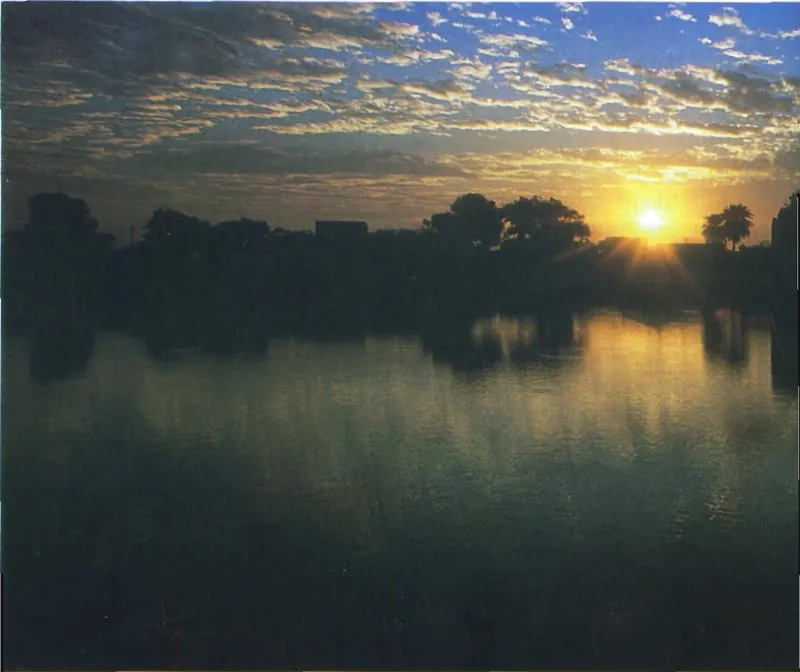
- What it is
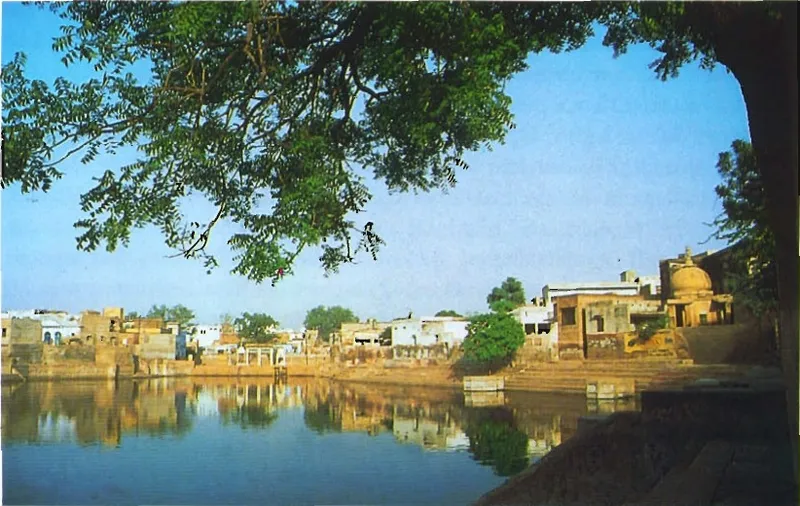
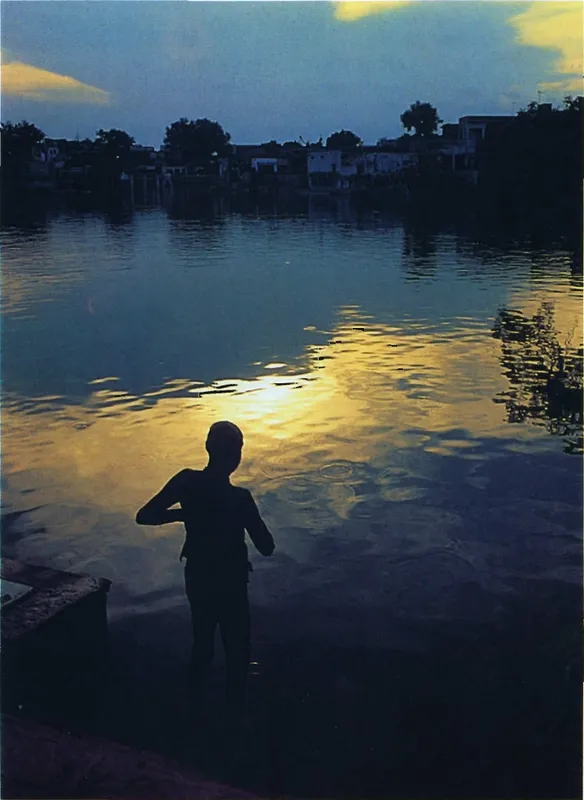
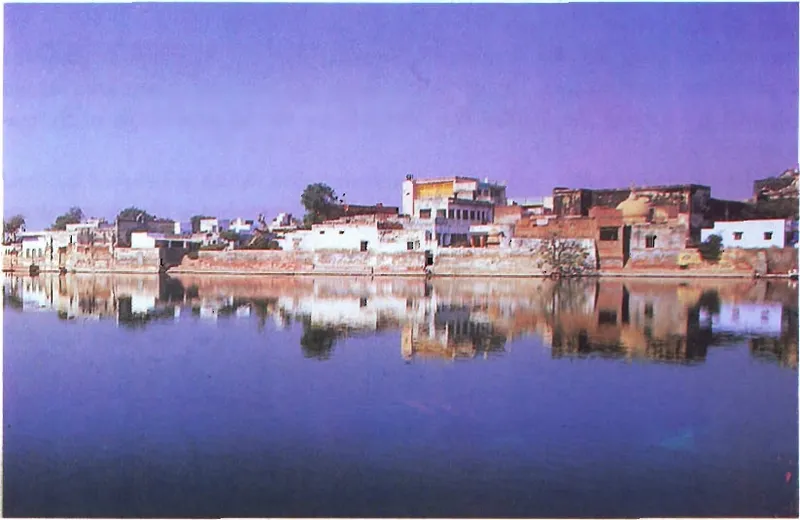
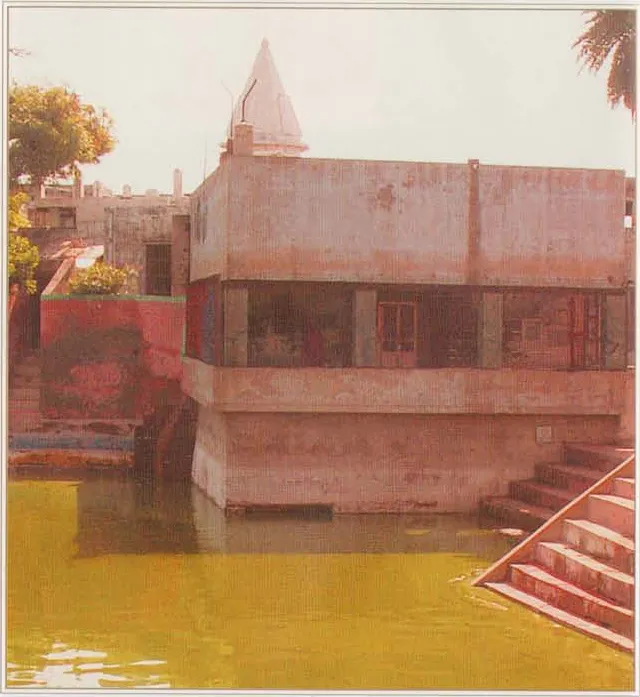
- Śyāma-kuṇḍa, also called Kṛṣṇa-kuṇḍa, is Kṛṣṇa's lake beside Rādhā-kuṇḍa at the foot of Govardhana Hill.
- Visiting
- According to Śrīla Nārāyaṇa Bhaṭṭa Gosvāmī's Vraja-bhakti-vilāsa, one bathes first in Rādhā-kuṇḍa, which grants every aim, and then in Kṛṣṇa-kuṇḍa, which destroys all sins; the guidebooks report the …
- Parikramā
- Govardhana parikramā, station 2
- Places here
- Madhumaṅgalānandada-kuñja, Arjunānandada-kuñja, Gandharvānandada-kuñja, Bhṛṅgānandada-kuñja, Dakṣasanandānanda-kuñja +31 more
In short
Śyāma-kuṇḍa, also called Kṛṣṇa-kuṇḍa, is Kṛṣṇa's lake beside Rādhā-kuṇḍa at the foot of Govardhana Hill. It lies on the east side, and the two kuṇḍas (sacred ponds) meet where their banks touch.[1 +5] The Varāha Purāṇa says that Kṛṣṇa made it with a blow of His heel after He killed the bull-demon Ariṣṭa, and calls it Ariṣṭa; according to the Bhakti-ratnākara, this is the kuṇḍa that everyone calls Śyāma-kuṇḍa.[7 +6] In the verses that Śrīla Viśvanātha Cakravartī Ṭhākura sets down in his commentary on the Bhāgavatam, Kṛṣṇa calls all the holy places into it.[14 +5] Śrī Caitanya Mahāprabhu found it again in a paddy field, and according to the Bhakti-ratnākara Śrīla Raghunātha dāsa Gosvāmī had it dug out.[20 +7]
Key facts
| Kind | kuṇḍa |
|---|---|
| Region · area | Rādhā-kuṇḍa |
| Also part of | Govardhana, Rādhā-kuṇḍa (village) |
| On the parikramā | Govardhana parikramā, station 2 · the route |
| Ācāryas | Śrī Caitanya Mahāprabhu, Śrīla Raghunātha dāsa Gosvāmī, Śrīla Jīva Gosvāmī |
Why it is glorified
Śrīla Viśvanātha Cakravartī Ṭhākura wrote the Kṛṣṇa-kuṇḍāṣṭaka, eight verses in praise of living at this kuṇḍa; each verse ends …
Śrīla Viśvanātha Cakravartī Ṭhākura wrote the Kṛṣṇa-kuṇḍāṣṭaka, eight verses in praise of living at this kuṇḍa; each verse ends with the prayer that our home may be at Kṛṣṇa-kuṇḍa. In the last verse he ranks Śrī Hari's lake above the hill that Kṛṣṇa held up, the forest where He lived, Mathurā, where He was born, and Vaikuṇṭha: the same ladder that Śrīla Rūpa Gosvāmī uses for Rādhā-kuṇḍa (summarised here, not translated).[28 +2]
माथुरं विकुण्ठतोऽपि जन्मधामदुर्लभं
वास्काननन्ततोऽपि पाणिना धृतो गिरिः ।
श्रीहरेस्ततोऽपि यत्परं सरोऽतिपावनं
तत्र कृष्णकुण्ड एव संस्थितिः स्तुतास्तु नः ॥ ८॥
māthuraṁ vikuṇṭhato'pi janmadhāmadurlabhaṁ vāskānanantato'pi pāṇinā dhṛto giriḥ
śrīharestato'pi yatparaṁ saro'tipāvanaṁ tatra kṛṣṇakuṇḍa eva saṁsthitiḥ stutāstu naḥ || 8 ||
Śrīla Raghunātha dāsa Gosvāmī worships the dear lake named Ariṣṭa, which arose from Kṛṣṇa's lotus foot when He killed Ariṣṭa, and whose steps Rādhā had made out of love (Vraja-vilāsa-stava 58). In his Govardhanāśraya-daśaka he says that Govardhana carries on its bowed head the kuṇḍa born from Kṛṣṇa's foot, greater than ten million Gaṅgās, together with the jewel Rādhā-kuṇḍa. Both are summarised here, not translated.[10 +1]
The Varāha Purāṇa says that a bath in the Ariṣṭa and Rādhā kuṇḍas brings the merit of the Rājasūya and Aśvamedha, two great Vedic sacrifices, and Śrīla Rūpa Gosvāmī quotes that verse in his Mathurā-māhātmya.[8 +3] The Nārada Purāṇa names the well-known Ariṣṭa-kuṇḍa at the place where the bull was killed, and says that a bath in it alone gives liberation.[33]
Śrīla Jīva Gosvāmī, in the opening of his Gopāla-campū, sees the joined pair of kuṇḍas of Hari and Rādhā as Their love made visible in liquid form.[34 +2] Śrīla Viśvanātha Cakravartī Ṭhākura writes in his Vraja-rīti-cintāmaṇi that, as he understands it, Rādhā and Kṛṣṇa melted with joy at the sight of each other and became the two kuṇḍas, and that this is why the kuṇḍas bear Their names.[35 +4] He and Śrīla Kṛṣṇadāsa Kavirāja Gosvāmī both call the two lakes the eyes of Govardhana, while the Garga-saṁhitā makes Kṛṣṇa-kuṇḍa the hill's chin; the other descriptions of the hill as a body are on the Govardhana page.[38 +3]
Divine pastimes
The killing of Ariṣṭa
Śrīmad-Bhāgavatam (10.36) tells how the bull-demon Ariṣṭa came to the cowherd village, tearing up the earth with his hooves. Kṛṣṇa seized him by the horns, threw him down, pulled out one of his horns and struck him with it until he died, and then entered the village with Balarāma. The Bhāgavatam names no kuṇḍa and no place other than the village; Śrīla Prabhupāda's Kṛṣṇa book, which retells the chapter, names no kuṇḍa either.[44 +4]
tam āpatantaṃ sa nigṛhya śṛṅgayoḥ padā samākramya nipātya bhū-tale / niṣpīḍayām āsa yathārdram ambaraṃ kṛtvā viṣāṇena jaghāna so 'patat
asṛg vaman mūtra-śakṛt samutsṛjan kṣipaṃś ca pādān anavasthitekṣaṇaḥ / jagāma kṛcchraṃ nirṛter atha kṣayaṃ puṣpaiḥ kiranto harim īḍire surāḥ
evaṃ kukudminaṃ hatvā stūyamānaḥ dvijātibhiḥ / viveśa goṣṭhaṃ sa-balo gopīnāṃ nayanotsavaḥ
Having thus killed the bull demon Ariṣṭa, He who is a festival for the gopīs’ eyes entered the cowherd village with Balarāma.
Translation: Śrīla Prabhupāda's disciples (BBT)Śrīla Jīva Gosvāmī explains in his commentary (summarised here, not translated) that Kṛṣṇa, coming from Govardhana, called the demon to Himself far from the village, to keep the fight away from it.[7 +5] Earlier in the Bhāgavatam the cows grazing on top of Govardhana see their calves "near Vraja" and run down to them. Śrīla Jīva Gosvāmī places that spot near the Ariṣṭa-mardana-kuṇḍa at the north-eastern corner of Govardhana; the name, "the kuṇḍa of the crusher of Ariṣṭa", most likely means Kṛṣṇa's kuṇḍa.[51 +3]
The kuṇḍa made with Kṛṣṇa's heel
The Varāha Purāṇa, in its account of the Govardhana circuit, says that at the place of the great fight, after killing Ariṣṭa, Kṛṣṇa angrily struck the ground with His heel and a tīrtha, a holy bathing place, flowed out. It calls this tīrtha Ariṣṭa.[7 +5]
अरिष्टेन समं यत्र महद्युद्धं प्रवर्त्तितम् ।। घातयित्वा ततश्चेममरिष्टं वृषरूपिणम् ॥ 32 ॥ कोपेन पार्ष्णिघातेन मह्यां तीर्थं प्रवर्तितम् ।। वृषभस्य वधाज्ज्ञेयं तीर्थं सुमहदद्भुतम् ॥ 33 ॥
ariṣṭena samaṁ yatra mahadyuddhaṁ pravarttitam
ghātayitvā tataścemamariṣṭaṁ vṛṣarūpiṇam kopena pārṣṇighātena mahyāṁ tīrthaṁ pravartitam
vṛṣabhasya vadhājjñeyaṁ tīrthaṁ sumahadadbhutam
Śrīla Sanātana Gosvāmī and Śrīla Jīva Gosvāmī quote these lines in their commentaries on the Bhāgavatam (summarised here, not translated). Śrīla Sanātana Gosvāmī calls the heel-made tīrtha the Ariṣṭa-kuṇḍa, and Śrīla Jīva Gosvāmī sets it north of the Mānasa-gaṅgā.[7 +5] Śrīla Jīva Gosvāmī adds that Kṛṣṇa bathed there with the cowherds only in imitation of a purification, since no sin had touched Him, saying that a great tīrtha had risen from Pātāla, the lower world. That night, on the path of the rāsa dance where Ariṣṭa had been killed, Kṛṣṇa joked to Rādhā that He had gained merit by making a tīrtha, and She then made Her own kuṇḍa close by.[14 +1] Both commentators say that the pair of kuṇḍas could still be seen in their day, at the eastern or north-eastern edge of Govardhana.[14]
In his Gopāla-campū Śrīla Jīva Gosvāmī tells it again, following the Purāṇas, as he says: the ground split by Kṛṣṇa's heel became a tīrtha, and Kṛṣṇa bathed in it with His friends. He then showed the kuṇḍa He had made to His beloved and joked that She had done no such pious act.[36 +1]
The twenty verses
Commenting on the same chapter, Śrīla Viśvanātha Cakravartī Ṭhākura sets down in twenty verses what he calls the story of the Purāṇas, without naming a Purāṇa; the BBT edition prints them with ŚB 10.36.16.[14 +4] In them the gopīs, the cowherd girls, joking with Kṛṣṇa, tell Him not to touch them: having killed a bull, they say, He must atone by bathing in every holy place. Kṛṣṇa answers that He will bring all the holy places here, and strikes the ground with His heel.[14 +5]
kiṁ paryaṭāmi bhuvanāny adhunaiva sarvā
ānīya tīrtha-vitatīḥ karavāṇi tāsu
snānaṁ vilokayata tāvad idaṁ mukundaḥ
procyaiva tatra kṛtavān bata pārṣṇi-ghātam
[Kṛṣṇa replied,] ‘Why should I have to wander throughout the entire universe? I will at once bring all the countless pilgrimage places here and take My bath in them. Just watch!’ With this, Lord Mukunda struck His heel on the ground.
Translation: Śrīla Prabhupāda's disciples (BBT)About this place: In the loving exchange after the killing of the bull-demon Ariṣṭa, Kṛṣṇa answers the gopīs that He need not travel through the universe to the holy places: He will bring all of them here and bathe in them, and He strikes the ground with His heel. The purport introduces these twenty verses as describing the origin of Rādhā-kuṇḍa and Śyāma-kuṇḍa, Rādhā's and Kṛṣṇa's bathing ponds.
The holy places come into the water and announce themselves to the doubting gopīs: the salt ocean, the ocean of milk, the Śoṇa, the Sindhu, Puṣkara, the Sarasvatī, the Godāvarī, the Yamunā, Prayāga, the Revā and others. Kṛṣṇa bathes and boasts of His pond that holds all the holy places.[14 +6] Rādhā and Her friends then dig their own pond in a ditch left by Ariṣṭa's hooves, just west of Kṛṣṇa's, so that Śyāma-kuṇḍa lies east of Rādhā-kuṇḍa.[1 +2] With Rādhā's leave, the holy places that live in Kṛṣṇa's pond break through its wall and fill Hers.[16 +6] Kṛṣṇa wishes Her pond to become better known than His own, and Rādhā answers with a blessing on His:[26 +2]
rādhābravīd aham api sva-sakhībhir etya
snāsyāmy ariṣṭa-śata-mardanam astu tasya
yo ’riṣṭa-mardana-sarasy uru-bhaktir atra
snāyād vasen mama sa eva mahā-priyo ’stu
Rādhā replied, ‘I will come to bathe in Your pond as well, even though You may kill hundreds of Ariṣṭa demons here. In the future, anyone who has intense devotion for this lake, which is on the spot where You chastised Ariṣṭāsura, and who bathes or resides here is sure to become very dear to Me.
Translation: Śrīla Prabhupāda's disciples (BBT)Śrīla Rūpa Gosvāmī calls Rādhā, among Her 108 names, the one who had a lake made for a joke about the killing of Ariṣṭa. Śrīla Baladeva Vidyābhūṣaṇa explains that the joke was the gopīs' refusal to let Kṛṣṇa touch them after the killing, that the lake is Śyāma-kuṇḍa, and that Kṛṣṇa bathed in it, as the Purāṇa tells.[32] According to the Bhakti-ratnākara, it was Rādhā who, in this exchange, told Kṛṣṇa that killing a demon in a bull's shape had made Him impure. He struck the ground with His foot, the kuṇḍa filled with the waters of all the holy places, and all this was over by midnight.[60 +3] The sources differ on who raised the matter; Śrīla Jīva Gosvāmī explains that no sin touched Kṛṣṇa and that His bath only imitated a purification (see below).[14 +3] Read more: How Rādhā-kuṇḍa appeared: the accounts side by side →
The eternal pastimes
Śrīla Kṛṣṇadāsa Kavirāja Gosvāmī's Govinda-līlāmṛta describes the Ariṣṭa-kuṇḍa, born from Kṛṣṇa's lotus foot, at the side of Rādhā-kuṇḍa and joined with it. Kṛṣṇa's friends Subala, Madhumaṅgala, Ujjvala, Arjuna and others built kuñjas (groves) around it, each bearing its builder's name, and gave them to Rādhā, Lalitā and the other sakhīs, Rādhā's companions (summarised here, not translated).[12 +2] According to the Bhakti-ratnākara, the kuñjas of Subala and the other friends lie on all sides of Śyāma-kuṇḍa, as those of Lalitā and the other sakhīs lie around Rādhā-kuṇḍa.[67 +5] Read more: The kuñjas of the sakhīs around Rādhā-kuṇḍa →
The Govinda-līlāmṛta places Subala's kuñja, Subalānandadā, in the north-west of Kṛṣṇa's lake. Its bathing place is Mānasa-pāvana, and there Rādhā bathes every day with Her friends.[68 +2] The guidebook Śrī Vraja-maṇḍala Parikramā (2007), naming this work and the Kṛṣṇa-bhāvanāmṛta, describes Rādhikā's bathing place in the north-western part of Śyāma-kuṇḍa as made of diamonds, emeralds and other jewels, with Subala's kuñja to its north; the Govinda-līlāmṛta mentions no jewels.[26 +2] According to The Colour Guide to Rādhā-kuṇḍa (1999), which ascribes this to Śrīla Kṛṣṇadāsa Kavirāja Gosvāmī, Rādhā and Her friends bathe at Mānasa-pāvana-ghāṭa at noon; the Govinda-līlāmṛta gives no hour, so the time is not certain. No source says whether the jewelled bathing place and Mānasa-pāvana-ghāṭa are one place.[68 +3]
The Govinda-līlāmṛta says that Rādhā-kuṇḍa joins Kṛṣṇa's lake between the east and the south-east, with a bridge on pillars above the junction.[4] Śrīla Viśvanātha Cakravartī Ṭhākura's Kṛṣṇa-bhāvanāmṛta describes a golden causeway there by which the two lakes meet, the playground of all the holy places, with the great Ariṣṭa-kuṇḍa beyond it, surrounded by the kuñjas of Subala and the others. Its commentary says that this causeway is known as the Saṅgama, the meeting.[40] According to the Bengali Bhaktamāla of Kṛṣṇadāsa Bābājī (1905), the two kuṇḍas are the forms of the divine pair, and a jewelled throne stands on their meeting place.[75]
In the last part of Śrīla Jīva Gosvāmī's Gopāla-campū, Kṛṣṇa, back in Vraja, tells Rādhā that the pair of kuṇḍas that the two of Them made long ago, and left during the long separation caused by Kaṁsa, shines like two crest-jewels on the head of Govardhana.[76]
Śrī Caitanya Mahāprabhu finds the kuṇḍa
The Caitanya-caritāmṛta tells how Śrī Caitanya Mahāprabhu came to Āriṭ-grāma and found Rādhā-kuṇḍa and Śyāma-kuṇḍa in two paddy fields with only a little water, and bathed there.[20 +2] Śrīla Prabhupāda writes in his purport that Āriṭ-grāma is also called Ariṣṭa-grāma, and that Mahāprabhu understood that Kṛṣṇa had killed Ariṣṭāsura in that village.[20] He explains how the kuṇḍas were found:[20 +2]
Names this place“Śrī Caitanya Mahāprabhu could then understand that the holy places known as Rādhā-kuṇḍa and Śyāma-kuṇḍa were at that time lost to everyone’s vision. He therefore discovered Rādhā-kuṇḍa and Śyāma-kuṇḍa, which were two reservoirs of water in two paddy fields.”
Śrīla Prabhupāda, Śrī Caitanya-caritāmṛta, Madhya-līlā 18.3, purport · vedabase.io
According to the Bhakti-ratnākara, Mahāprabhu first sat under a tamāla tree at the kuṇḍas, and afterwards the villagers said that they had called the two fields Kālī and Gaurī. The work does not say which field became which kuṇḍa; later guidebooks make Kālī-kheta the former Śyāma-kuṇḍa.[60 +3] Whether Mahāprabhu found the kuṇḍas Himself or was shown them is told differently; the accounts are set side by side on the Rādhā-kuṇḍa page.[20 +2] The Colour Guide (1999) and the undated parikramā notes Rādhā-kuṇḍa date the visit to 1515, but the Caitanya-caritāmṛta gives no year, so the date is not certain.[79 +1] Read more: How Rādhā-kuṇḍa was found and dug out again →
Traditional accounts
According to the Bhakti-ratnākara, Śrīla Raghunātha dāsa Gosvāmī once wished that the two kuṇḍas were full of water and then …
How the kuṇḍa was dug out again
According to the Bhakti-ratnākara, Śrīla Raghunātha dāsa Gosvāmī once wished that the two kuṇḍas were full of water and then reproached himself for the wish. A wealthy man, told in a dream by Nārāyaṇa of Badarikāśrama, brought him coins at Āriṭ-grāma, and the two kuṇḍas were dug out.[23 +4]
The same work tells why Śyāma-kuṇḍa was left crooked. An old tree on its bank was to be cut the next day, but King Yudhiṣṭhira told Śrīla Raghunātha dāsa Gosvāmī in a dream that the five Pāṇḍavas lived there as trees, and asked him to go to Mānasa-pāvana-ghāṭa in the morning and protect them. At daybreak he saw "in one tree five trees" and stopped the cutting.[24 +2] The guidebooks describe the outline of the kuṇḍa in different ways (see below), and the Pāṇḍava trees have their own page.[24 +2]
Śrīla Prabhupāda writes in one purport that Śrīla Rūpa Gosvāmī and Śrīla Sanātana Gosvāmī renovated Rādhā-kuṇḍa on Mahāprabhu's direction, and in another that Mahāprabhu's devotees, headed by the Six Gosvāmīs, excavated it.[82 +1] These and the other accounts of the digging are set side by side on the Rādhā-kuṇḍa page.[23 +4] According to the Sādhana-dīpikā of the Govinda temple, Raghunātha (taken here to be Śrīla Raghunātha dāsa Gosvāmī) offered the care of the two kuṇḍas and the land around them to Śrī Govinda.[84]
Vajra-kuṇḍa
According to the local tradition recorded in The Colour Guide (1999), Vajranābha built a sandstone wall, eight feet high and sixty feet square, around the original kuṇḍa, and the wall can be seen when Śyāma-kuṇḍa is emptied or its water is low; the accounts of what Vajranābha built differ, and they are set side by side on the Vajranābha-kuṇḍa page.[81 +2] According to local sādhus quoted in the same book, the name Vajra-kuṇḍa of the original kuṇḍa may come either from Vajranābha or from Indra's thunderbolt (vajra), which Indra threw there to help Kṛṣṇa make the kuṇḍa.[85]
The Gosvāmīs and ācāryas
The Bhakti-ratnākara tells that Śrīla Raghunātha dāsa Gosvāmī lived here under a tree, day and night.
Śrīla Raghunātha dāsa Gosvāmī
The Bhakti-ratnākara tells that Śrīla Raghunātha dāsa Gosvāmī lived here under a tree, day and night. One day Śrīla Sanātana Gosvāmī came from Vṛndāvana to Śrī Gopāla Bhaṭṭa Gosvāmī's lodging here and went to bathe at Mānasa-pāvana-ghāṭa. He saw a tiger drink there and pass close to Śrīla Raghunātha dāsa Gosvāmī, who sat absorbed in meditation, and afterwards asked him to live in a hut.[24] The guidebooks tell this story differently; the accounts are set side by side on the Mānasa-pāvana-ghāṭa page.[24] His bhajana-kuṭī has its own page.
Visitors in the Bhakti-ratnākara
According to the Bhakti-ratnākara, Śrīla Rāghava Paṇḍita showed Śrīla Śrīnivāsa Ācārya the village of Āriṭ, the two kuṇḍas, the tamāla under which Mahāprabhu sat and the meeting of the two kuṇḍas, and told him how the kuṇḍas arose, were found and were dug out.[22 +4] Śrīla Śrīnivāsa Ācārya and Śrīla Narottama dāsa Ṭhākura then bathed at Mānasa-pāvana-ghāṭa, which the work places north of Śyāma-kuṇḍa at Subala's kuñja. It calls the ghāṭa very dear to Rādhikā and says that the five Pāṇḍavas stay there as trees.[22 +2]
The same work tells that Śrīla Śyāmānanda Paṇḍita wept on first seeing the two kuṇḍas, and later came from Vṛndāvana from time to time to see Śrīla Raghunātha dāsa Gosvāmī. Śrīla Rāmacandra Kavirāja bathed in both kuṇḍas and bowed down to him. Śrīla Vīracandra Prabhu was overwhelmed with love where Mahāprabhu had sat under the tamāla, and danced in saṅkīrtana at Rādhā-kuṇḍa, Śyāma-kuṇḍa and Govardhana.[22 +5] Śrīla Narahari Cakravartī Ṭhākura, its author, also put into the work a song of his own on the beauty of Ghanaśyāma's lake and the kuñjas of Subala and the others around it.[66 +1] In his Narottama-vilāsa he tells that Śrīla Jāhnavā-devī saw Rādhā-kuṇḍa and Śyāma-kuṇḍa on her way to the Mānasa-gaṅgā and Govardhana.[100]
Other ācāryas
- Śrīla Nārāyaṇa Bhaṭṭa Gosvāmī tells in his Vraja-bhakti-vilāsa that Kṛṣṇa called the holy places into the kuṇḍa.[101 +1]
- Śrīla Viśvanātha Cakravartī Ṭhākura set down the twenty verses on the two kuṇḍas and wrote the Kṛṣṇa-kuṇḍāṣṭaka; his bhajana-kuṭī has its own page.[14 +6]
- Śrīla Jīva Gosvāmī told the kuṇḍa's origin in his Gopāla-campū; Śrī Vraja-maṇḍala Parikramā (2007) says that he bathed daily at the ghāṭa named after him during his stay here, though no older source for the stay has been found, so it is not certain.[34 +2]
Śrīla Prabhupāda
In a purport to the Caitanya-caritāmṛta Śrīla Prabhupāda writes that Rādhā's ponds are as dear to Kṛṣṇa as She is …
In a purport to the Caitanya-caritāmṛta Śrīla Prabhupāda writes that Rādhā's ponds are as dear to Kṛṣṇa as She is:[103]
Names this place“Śrīmatī Rādhikā is very dear to Lord Kṛṣṇa, and similarly Her ponds, namely, Śyāma-kuṇḍa and Rādhā-kuṇḍa, are also very dear to the Supreme Personality of Godhead.”
Śrīla Prabhupāda, Śrī Caitanya-caritāmṛta, Ādi-līlā 7.18–19, purport · vedabase.io
In a lecture in San Francisco in 1971 he spoke of the two lakes that Mahāprabhu found:[104]
Names this place“There is Śyāma-kuṇḍa also. The Śyāma-kuṇḍa, Rādhā-kuṇḍa, two lakes are still existing. Hundreds..., thousands of people, devotees, go to see that lake every day.”
Śrīla Prabhupāda, Lecture, San Francisco, 28 June 1971 · vedabase.io
On a parikramā in Vṛndāvana in November 1971, asked what Śyāma-kuṇḍa and Rādhā-kuṇḍa are, he answered in a few words that Kṛṣṇa and Rādhārāṇī would bathe there and meet.[105] In 1972, at a recording session in Los Angeles in his presence, the song Jaya Rādhe jaya Kṛṣṇa jaya Vṛndāvana was sung, whose second verse names Śyāma-kuṇḍa, Rādhā-kuṇḍa and Govardhana.[106]
Songs
Śrīla Viśvanātha Cakravartī Ṭhākura's Kṛṣṇa-kuṇḍāṣṭaka: its third verse retells how Kṛṣṇa called the holy places and bathed in …
Śrīla Viśvanātha Cakravartī Ṭhākura's Kṛṣṇa-kuṇḍāṣṭaka: its third verse retells how Kṛṣṇa called the holy places and bathed in the lake born of His heel, and every verse prays to live at Kṛṣṇa-kuṇḍa.[28 +3]
go-vadhasya niskrtis triloka-tirtha-kotibhi
radhayety avadi tena ta harih samahvayan
yatra parsni-ghataje mamajja ca svayam muda
tatra krsna-kunda eva samsthitih stutastu nah
In a song credited to Śrīla Narottama dāsa Ṭhākura, the singer longs to bathe in Rādhā-kuṇḍa and to stay at Śyāma-kuṇḍa.[108]
jamunāra jala jena amṛta samāna hena
kabe piba udara pūriyā
kabe rādhā-kuṇḍa-jale snāna kari kutūhale
śyama-kuṇḍe rahiba paḍiyā
Visiting today
Bathing
According to Śrīla Nārāyaṇa Bhaṭṭa Gosvāmī's Vraja-bhakti-vilāsa, one bathes first in Rādhā-kuṇḍa, which grants every aim, and then in Kṛṣṇa-kuṇḍa, which destroys all sins; the guidebooks report the order a little differently.[102 +2] The Bhakti-ratnākara says that even in its day people bathed in the kuṇḍa as Kṛṣṇa had done.[60 +2]
The southern bank
- Tamāla-talā-ghāṭa, beside Tamāla-talā: Śrī Vraja-maṇḍala Parikramā (2007) says that Mahāprabhu sat under a tamāla here, asked the villagers about the kuṇḍas and bathed here; the Bhakti-ratnākara tells of the tamāla but names no ghāṭa.[3 +7]
- Lord Caitanya's footprint shrine: Vṛndāvana-Dhāma Ki Jaya! (c. 1986) says that a small mandira on the bank of Śyāma-kuṇḍa holds His lotus footprints. The Colour Guide (1999) describes a newly built shrine with an impression of His footprints at Tamāla-talā and records the local belief that Śrīla Bhaktisiddhānta Sarasvatī Ṭhākura set it up. Neither says whether they are one shrine, and the older accounts of the discovery mention no footprints.[20 +3]
- Aṣṭa-sakhī-ghāṭa: Śrī Vraja-maṇḍala Parikramā lists it between Gayā-ghāṭa and Tamāla-talā and maps it on the south-eastern bank; it says nothing more about it.[3 +1]
- Vallabha-ghāṭa, west of Tamāla-talā: both modern guides record a sitting place (baiṭhaka) of Śrī Vallabhācārya on the bank of Śyāma-kuṇḍa, one at Vallabha-ghāṭa and the other at Pāśa-khela-ghāṭa, and three older books, of 1920, 1966 and 1987, record a memorial of his at Rādhā-kuṇḍa without a date.[3 +7] He is Śrī Vallabha Bhaṭṭa, who, the Caitanya-caritāmṛta tells, came to see Mahāprabhu at Āḍāila near Prayāga.[118 +2]
- The choharā tree at Vallabha-ghāṭa: only Śrī Vraja-maṇḍala Parikramā mentions it, as the tree under which Śrī Vallabhācārya traditionally sat with his associates; it does not say whether the tree still stands.[112 +1]
- Madana-mohana-ghāṭa, on the south-west bank: the ghāṭa of the Rādhā Madana-mohana temple, which stands south of it.[3 +2]
The east corner
- Gayā-ghāṭa, also called Dhana-mādhava-gherā-ghāṭa: Śrī Vraja-maṇḍala Parikramā maps it at the east corner of Śyāma-kuṇḍa and lists Śrīla Mādhavendra Purī's baiṭhaka and Śrī Harirāma Vyāsa's place of bhajana as near it; their exact positions are not certain. No source explains either name of the ghāṭa.[3 +2]
- Śrī Harirāma Vyāsa's place of bhajana, near Gayā-ghāṭa: according to the local tradition recorded in Śrī Vraja-maṇḍala Parikramā (2007), Śrī Harirāma Vyāsa performed bhajana, chanting and worship here; the book does not describe the place, and no older source names it, so it is not certain.[3 +2] In 1966 the historian Prabhudayāl Mītal named, among the memorials that saints of the other sampradāyas (Vaiṣṇava lines) of Vraja left at Rādhā-kuṇḍa, a gherā, an enclosure, of Śrī Harirāma Vyāsa near Śrī Hita Harivaṁśa's baiṭhaka at Rādhā-Vallabha-ghāṭa; he gave no date and no description. The two books name different ghāṭas, and no source says whether they mean the same spot.[120] Śrī Vraja-maṇḍala Parikramā also names a Harirāma Vyāsajī in Vṛndāvana, through whom, the book says, the Yugala-kiśora Deity at Kiśorīvana, or Vyāsa-gherā, was revealed; it does not say that he is the Harirāma Vyāsa of Rādhā-kuṇḍa, and no other source settles it, so the identity is not certain.[126]
The northern bank
- Jīva Gosvāmī-ghāṭa, at the north-east corner, next to Śrīla Jīva Gosvāmī's bhajana-kuṭī, as Śrī Vraja-maṇḍala Parikramā maps it.[3 +1]
- Pañca Pāṇḍava-ghāṭa: Śrī Vraja-maṇḍala Parikramā lists it in the northern part, joined to Mānasa-ghāṭa, and says that the Pāṇḍavas, as trees, showed themselves to Śrīla Raghunātha dāsa Gosvāmī above it. The Bhakti-ratnākara places the trees at Mānasa-pāvana-ghāṭa and does not use this name.[24 +6] The same guidebook lists Mānasa-pāvana-ghāṭa separately and does not say whether Mānasa-ghāṭa is another name for it.[73]
- The Arjuna tree and the Bhīma tree-trunk: the Bhakti-ratnākara tells of the five Pāṇḍava trees but names no single tree; the guidebooks of 1999 and 2007 disagree on whether any of them still stands; the accounts are set side by side on the Pāṇḍava trees page.[131 +1]
- Madhumaṅgala-ghāṭa: Śrī Vraja-maṇḍala Parikramā says that above it is Madhumaṅgala's kuñja, Madhumaṅgalānandada, which he gave to Lalitā, and it places the sitting place of Śrī Hita Harivaṁśa Gosvāmī here, which no other source confirms, so it is not certain; the book does not mark the ghāṭa on its maps. The Govinda-līlāmṛta places Madhumaṅgala's kuñja in the north of Kṛṣṇa's lake.[73 +1]
- Śrī Hita Harivaṁśa Gosvāmī's baiṭhaka: the same book names a Hita Harivaṁśa as the servant of the Rādhā-Vallabha Deity in Vṛndāvana, probably the same person, though it does not say so.[73 +2]
- Rādhā-Vallabha-ghāṭa: named in the same book only as a landmark, with a rāsa-maṇḍala north of it in the northern part of Śyāma-kuṇḍa.[73 +1]
- Rādhā-vinoda-ghāṭa: known only from two photographs in The Colour Guide (1999), one of which shows it with Pañca Pāṇḍava-ghāṭa and the ghāṭa of Śrīla Jīva Gosvāmī.[127 +1]
Location
| Where it is | Right next to Rādhā-kuṇḍa; joined to it at the saṅgam; canal to Lalitā-kuṇḍa.[137] |
|---|---|
| On the numbered Govardhana chart | 2 (printed as “Syama Kunda”)[138] |
Places at Śyāma-kuṇḍa (Rādhā-kuṇḍa)
39 places
- ↳Madhumaṅgalānandada-kuñjakuñja›
- ↳Arjunānandada-kuñjakuñja›
- ↳Gandharvānandada-kuñjakuñja›
- ↳Bhṛṅgānandada-kuñjakuñja›
- ↳Dakṣasanandānanda-kuñjakuñja›
- ↳Kokilānandada-kuñjakuñja›
- ↳Arjuna tree (Śyāma-kuṇḍa)tree›
- ↳Bhīma tree-trunk (Śyāma-kuṇḍa)tree›
- ↳Aṣṭa-sakhī-ghāṭaghāṭa›
- ↳Caitanya's footprint mandira (Rādhā-kuṇḍa)shrine›
- ↳Tamāla-talābaiṭhaka›
- ↳Gayā-ghāṭaghāṭa›
- ↳Mādhavendra Purī's baiṭhaka (Rādhā-kuṇḍa)baiṭhaka›
- ↳Madhumaṅgala-ghāṭaghāṭa›
- ↳Jīva Gosvāmī-ghāṭaghāṭa›
- ↳Madana-mohana-ghāṭaghāṭa›
- ↳Mānasa-ghāṭaghāṭa›
- ↳Mānasa-pāvana-ghāṭaghāṭa›
- ↳Saṅgama-ghāṭaghāṭa›
- ↳Pañca Pāṇḍava-ghāṭaghāṭa›
- ↳Pāṇḍava trees (Śyāma-kuṇḍa)tree›
- ↳Vajranābha-kuṇḍakuṇḍa›
- ↳Rādhikā's bathing place (Śyāma-kuṇḍa)pastime site›
- ↳Tamāla-talā-ghāṭaghāṭa›
- ↳Pāśa-khela-ghāṭaghāṭa›
- ↳Vallabha-ghāṭa (Rādhā-kuṇḍa)ghāṭa›
- ↳Rādhā-Vallabha-ghāṭaghāṭa›
- ↳Rādhā-vinoda-ghāṭaghāṭa›
- ↳Pilu bush (Mānasa-pāvana-ghāṭa)tree›
- ↳Raghunātha dāsa Gosvāmī's bhajana-kuṭībhajana-kuṭīra›
- ↳Sanātana Gosvāmī's baiṭhaka (Rādhā-kuṇḍa)baiṭhaka›
- ↳Rāsa-maṇḍala (north of Rādhā-Vallabha-ghāṭa, Śyāma-kuṇḍa)rāsa-sthalī›
- ↳Subalānandada-kuñjakuñja›
- ↳Ujjvalānandada-kuñjakuñja›
- ↳Vidagdhānandada-kuñjakuñja›
- ↳Sanānda-kuñjakuñja›
Also listed here
- Choharā tree (Vallabha-ghāṭa) tree
- Harirāma Vyāsa's place of bhajana
- Hitahari-vaṁśa Gosvāmī's baiṭhaka baiṭhaka
Nearby places
Rādhā-kuṇḍa · Lalitā-kuṇḍa (Rādhā-kuṇḍa)
Pictures
8 pictures
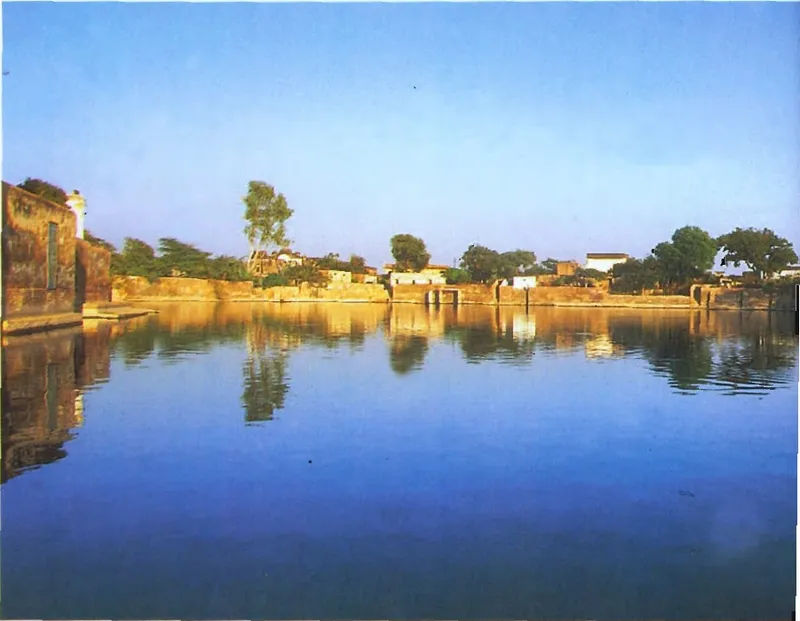
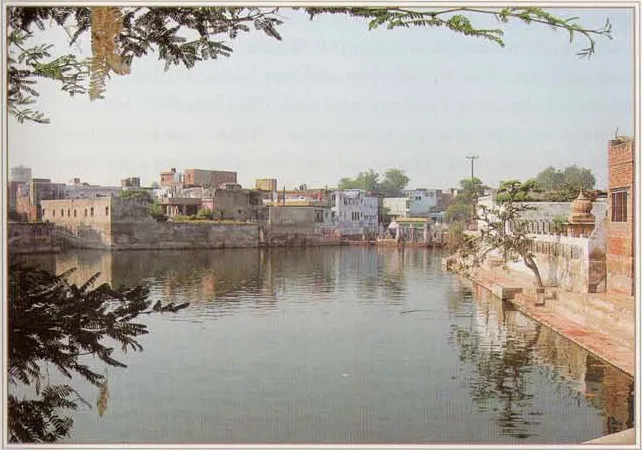
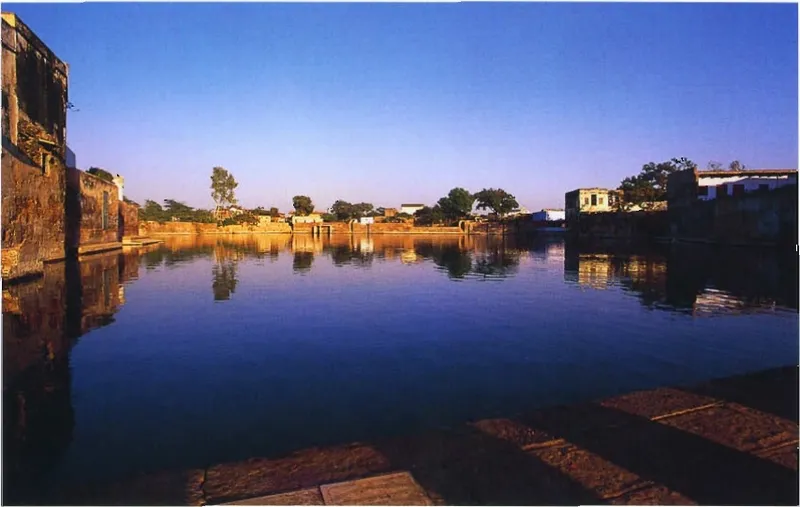
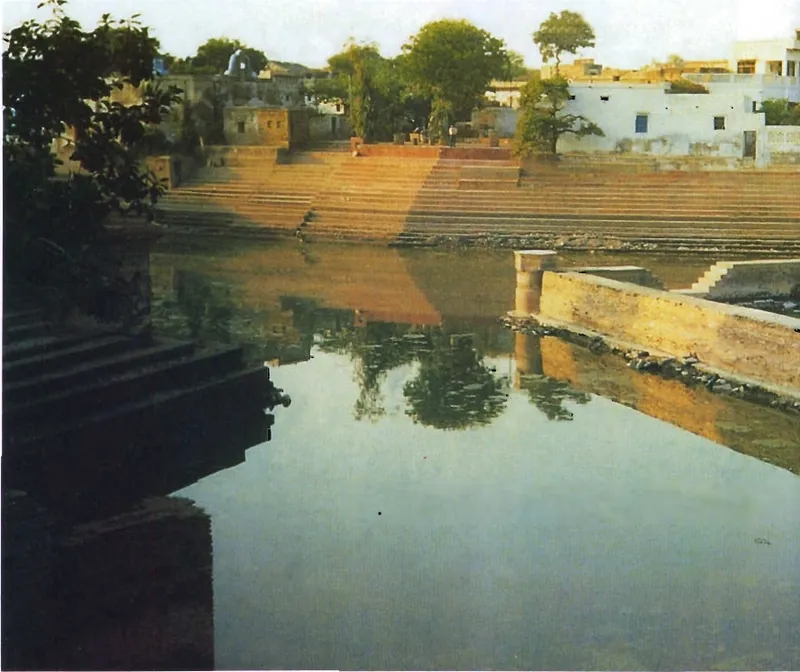
History
Two historians, A. W. Entwistle (1987) and Prabhudayāl Mītal (1966), credit the masonry steps (ghāṭas) at the kuṇḍas to Lālā Bābū (Kṛṣṇacandra Siṁha) in the nineteenth century; Entwistle says that he rebuilt the steps around both tanks and the causeway between them. Neither gives a year.[87 +2]
The other dates come from modern guidebooks and are not certain. The Colour Guide (1999) and The Color Guide to Vṛndāvana (2000) give 1545 for the purchase of the fields and the start of the digging and 1554 for its end; The Colour Guide alone gives 1591 for steps added by Rājā Mān Singh of Jaipur together with a canal joining Śyāma-kuṇḍa to Lalitā-kuṇḍa, and 1817 for more steps by Lālā Bābū.[25 +5] Who bought what land in 1545 is told differently by The Colour Guide and by Entwistle (1987), who reports a record that has not been independently examined; the two accounts are set side by side on the Rādhā-kuṇḍa page.[25 +1]
Where the sources differ
How Kṛṣṇa's kuṇḍa came to be and who bathed in it is told differently.
Accounts differ How Kṛṣṇa's kuṇḍa came to be and who bathed in it is told differently.
- Varāha Purāṇa 164.32-37After killing the bull, Kṛṣṇa made a tīrtha flow with a blow of His heel and bathed there; a kuṇḍa named after Rādhā was made nearby; bathing in the Ariṣṭa and Rādhā kuṇḍas gives the fruit of the Rājasūya and Aśvamedha sacrifices.
- Verses quoted by Śrīla Viśvanātha Cakravartī 'from the Purāṇas' (ŚB 10.36.16 purport)The gopīs demand atonement; Kṛṣṇa strikes His heel, calls all holy places, bathes and boasts; Rādhā digs Her own pond at Ariṣṭa's hoof-ditch west of His, refuses His pond's water, and the holy places in Kṛṣṇa's pond break through with Her permission and fill Hers.
- Gopāla-campū (Śrīla Jīva Gosvāmī), Pūrva 31Following 'vaiṣṇavaṃ vārāham api purāṇam' (the Viṣṇu and Varāha Purāṇas, or the Vaiṣṇava Varāha Purāṇa): the ground split by Kṛṣṇa's heel became a tīrtha risen from Pātāla, and He bathed there with all His (male) friends, then showed the gopīs the kuṇḍa He had made.
- Vraja-bhakti-vilāsa (Śrīla Nārāyaṇa Bhaṭṭa), pp. 84-85Kṛṣṇa first bathed with the sixty-eight tīrthas at the Lalitā and Mohana kuṇḍas; as Rādhā still refused Him, He called the tīrthas into this kuṇḍa and bathed there.
The wording of these accounts is our summary of the sources, not a published translation.
Who spoke of sin after Ariṣṭa's killing, and why Kṛṣṇa bathed: Śrīla Jīva Gosvāmī explains that no sin touched Him.[14 +1]
Accounts differ Whether killing the bull-shaped Ariṣṭa made Kṛṣṇa sinful, and why He bathed in His kuṇḍa.
- Śrīmad-Bhāgavatam 10.36.13–15Tells the killing; the demigods honour Kṛṣṇa with flowers and He enters the village; it says nothing of sin, atonement or a bath.
- Varāha Purāṇa text, 164.35After killing the bull, Kṛṣṇa bathed there; the verse speaks in the language of the sin of killing a bull (vṛṣa-hatyā), which Śrīla Jīva Gosvāmī explains as a purification only imitated (next account).
- The same Ādi-varāha passage as Śrīla Jīva Gosvāmī quotes it on ŚB 10.36.15, with his explanationŚrīla Jīva Gosvāmī explains that no sin arose for Kṛṣṇa at all: the bull He killed was a demon only in a bull's shape, and His bath, which the Purāṇa describes as for His purification, only imitated a purification and showed the glory of His tīrtha (Vaṁśīdhara repeats this).
- Śrīla Sanātana Gosvāmī on ŚB 10.36.15Rādhā's kuṇḍa was made after a joke (narman) of Hers about the bull-killing; he does not discuss sin.
The wording of these accounts is our summary of the sources, not a published translation.
Accounts differ Who composed the twenty verses on the origin of the two kuṇḍas.
- BBT purport to ŚB 10.36.16 (Śrīla Prabhupāda's disciples)'From the Purāṇas, Śrīla Viśvanātha Cakravartī Ṭhākura has quoted twenty verses …'; no Purāṇa is named.
- Śrīla Viśvanātha Cakravartī's own introduction (Sārārtha-darśinī on ŚB 10.36.15)The Purāṇic (paurāṇikī) story of the origin of the two kuṇḍas 'is set down (nibadhyate) in twenty verses'; he names no Purāṇa and does not say whether the verses are a Purāṇa's own words or his setting of a Purāṇic story.
- Rādhā-kuṇḍotpatti-varṇana, Grantha Mandira textIts heading and colophon call the verses composed (viracitam) by Śrī Viśvanātha Cakravartī Ṭhākura and say that they are included in his commentary on ŚB 10.36.15.
- Varāha Purāṇa text and the other texts readThe Varāha tells a short version (the heel-made tīrtha; Rādhā's kuṇḍa close by) but contains none of the twenty verses; lines of the verses occur in no text read except Śrīmad-Bhāgavatam canto 10, part 5, with ten commentaries and Rādhā-kuṇḍotpatti-varṇana.
The wording of these accounts is our summary of the sources, not a published translation.
Accounts differ Rādhā's benediction on those who bathe in Kṛṣṇa's kuṇḍa is worded differently.
- Verse quoted in the ŚB 10.36.16 purport (verse 19)Anyone who has intense devotion for this lake 'on the spot where You chastised Ariṣṭāsura', and who bathes or resides here, will become very dear to Rādhā.
- The Colour Guide to Rādhā-kuṇḍa (1999)Anyone who takes bath in Śyāma-kuṇḍa will achieve the same ecstatic love that Kṛṣṇa has for Rādhā.
- Govardhana Hill: India's Most Sacred Mountain (2001)Anyone who bathes in Śyāma-kuṇḍa will develop love for Rādhā on the same level as Kṛṣṇa's love.
Accounts differ The names of the two paddy fields that Mahāprabhu identified as the kuṇḍas.
- Bhakti-ratnākara, Fifth Wave p. 195The villagers had called the fields 'Kālī' and 'Gaurī'; it does not say which became which kuṇḍa.
- Śrī Vraja-maṇḍala Parikramā (2007); the undated parikramā notes Rādhā-kuṇḍaKālī-kheta and Gaurī-kheta; Mahāprabhu addressed Kālī-kheta as Śyāma-kuṇḍa and Gaurī-kheta as Rādhā-kuṇḍa.
- The Colour Guide to Rādhā-kuṇḍa (1999)The kuṇḍas had become known as 'gauri' (golden) and 'kari' (blackish).
- Caitanya-caritāmṛta Madhya 18.5 (Śrīla Prabhupāda's edition)Two paddy fields with little water; no names given.
Accounts differ The outline of Śyāma-kuṇḍa is described differently.
- Bhakti-ratnākara, Fifth Wave p. 196Tells how Śyāma-kuṇḍa became crooked (বক্র); after the trees were spared it 'remained চৌরস' (sense unclear). The typed 1913 text (Bhakti-ratnākara, taraṅgas 1–8, pañcama taraṅga v.552) reads 'caurasa nahila' (did not remain caurasa), where the 1912 print reads রহিল.
- The Colour Guide to Rādhā-kuṇḍa (1999)'Unusual triangular shape' (its own diagram, printed p. 58, draws an octagon).
- Śrī Vraja-maṇḍala Parikramā (2007)'Crooked'; drawn irregular and many-angled on its kuñja map and five-sided on its town map.
- Vṛndāvana-Dhāma Ki Jaya! (c. 1986); the undated parikramā notes Rādhā-kuṇḍa'Irregular'.
The wording of these accounts is our summary of the sources, not a published translation.
At which ghāṭa Śrī Vallabhācārya's sitting place is: the two modern guides name different ghāṭas, as above; the accounts are set side by side on the page of Pāśa-khela-ghāṭa.[109 +3]
More on this place
How Rādhā-kuṇḍa appeared: the accounts side by side · How Rādhā-kuṇḍa was found and dug out again · The kuñjas of the sakhīs around Rādhā-kuṇḍa
References
138 references
- Śrīmad-Bhāgavatam 10.36.16, purport, verse 7 of the twenty quoted verses, online edition · vedabase.io
- The Colour Guide to Rādhā-kuṇḍa (1999), Rājaśekhara dāsa Brahmacārī, PDF p. 30
- Śrī Vraja-maṇḍala Parikramā (2007), PDF p. 101
- Śrīla Kṛṣṇadāsa Kavirāja Gosvāmī, Govinda-līlāmṛta, sarga 7, verse 6 (in the 26-verse kulaka 7.1–26 on Rādhā-kuṇḍa), after the editions of Haridas Das and Haridas Shastri
- Garga-saṁhitā, Girirāja-khaṇḍa (3), adhyāya 7, verse 8, Sanskrit Wikisource
- Garga-saṁhitā, Mādhurya-khaṇḍa (4), adhyāya 19, verse 41, Sanskrit Wikisource
- Varāha Purāṇa, adhyāya 164, verses 32-33, Sanskrit Wikisource
- Śrīla Narahari Cakravartī, Bhakti-ratnākara, Pañcama-taraṅga (5th wave), printed page 193, 2nd ed., 1912
- Varāha Purāṇa, adhyāya 164, verses 35-37, Sanskrit Wikisource
- Śrīla Raghunātha dāsa Gosvāmī, Vraja-vilāsa-stava, verse 58
- Śrīla Raghunātha dāsa Gosvāmī, Govardhanāśraya-daśaka, verse 5
- Śrīla Kṛṣṇadāsa Kavirāja Gosvāmī, Govinda-līlāmṛta, sarga 7, verse 26 (last verse of the kulaka 7.1–26 on Rādhā-kuṇḍa), after the editions of Haridas Das and Haridas Shastri
- Govinda-līlāmṛta, sarga 18, verse 59, with the ṭīkā, after Haridas Shastri's edition, 1981
- Śrīla Viśvanātha Cakravartī Ṭhākura: commentary on ŚB 10.36.15, Bhagavata Vidya Pith edition, ed. Bhagavata Rishi and Krishna Shankar Shastri, 1996
- Śrīmad-Bhāgavatam 10.36.16, purport, verse 2 of the twenty quoted verses, online edition · vedabase.io
- Śrīmad-Bhāgavatam 10.36.16, purport, verse 3 of the twenty quoted verses, online edition · vedabase.io
- Śrīmad-Bhāgavatam 10.36.16, purport, verse 6 of the twenty quoted verses, online edition · vedabase.io
- Śrī Vraja-maṇḍala Parikramā (2007), PDF p. 84
- The Colour Guide to Rādhā-kuṇḍa (1999), Rājaśekhara dāsa Brahmacārī, PDF p. 29
- Śrīla Prabhupāda, Śrī Caitanya-caritāmṛta, Madhya-līlā 18.3, purport · vedabase.io
Show all 138 references
- Śrīla Prabhupāda, Śrī Caitanya-caritāmṛta, Madhya-līlā 18.5, translation · vedabase.io
- Śrīla Narahari Cakravartī, Bhakti-ratnākara, Pañcama-taraṅga (5th wave), printed page 194, 2nd ed., 1912
- Śrīla Narahari Cakravartī, Bhakti-ratnākara, Fifth Wave, 1912 ed. p. 195, 2nd ed., 1912
- Śrīla Narahari Cakravartī, Bhakti-ratnākara, Fifth Wave, 1912 ed. p. 196, 2nd ed., 1912
- The Colour Guide to Rādhā-kuṇḍa (1999), Rājaśekhara dāsa Brahmacārī, PDF p. 42
- Śrī Vraja-maṇḍala Parikramā (2007), PDF p. 87
- Vṛndāvana-Dhāma Ki Jaya! (c. 1986), by Dhruva Mahārāja dāsa, PDF p. 31
- Śrīla Viśvanātha Cakravartī Ṭhākura, Kṛṣṇa-kuṇḍāṣṭaka, verse 3
- Śrīla Viśvanātha Cakravartī Ṭhākura, Kṛṣṇa-kuṇḍāṣṭaka, verse 8
- Śrīla Viśvanātha Cakravartī Ṭhākura, Kṛṣṇa-kuṇḍāṣṭaka, verse 2 (the index counts the hymn as part 26 of the Stavāmṛta-laharī)
- Śrīla Rūpa Gosvāmī, Mathurā-māhātmya, v.418, under the heading 'śrī-rādhā-kuṇḍādikasya'
- Śrīla Rūpa Gosvāmī, Stava-mālā, Prema-sudhā-satra, verse 23, with Baladeva's comment, after the edition of Bhakti Saranga Goswami and Purushottam Das, Vrindavan, 1959
- Nārada Purāṇa, उत्तरार्धः/अध्यायः 80 v.66–67 (Uttara-bhāga, chapter 80, verses 66–67)
- Śrīla Jīva Gosvāmī, Gopāla-campū, Pūrva-campū 1.9, GRETIL
- The Colour Guide to Rādhā-kuṇḍa (1999), Rājaśekhara dāsa Brahmacārī, PDF p. 19
- Śrīla Jīva Gosvāmī, Gopāla-campū, Pūrva-campū, pūraṇa 31 (Ariṣṭa episode), prose [56], [59], [60], GRETIL
- Śrīla Viśvanātha Cakravartī Ṭhākura, Vraja-rīti-cintāmaṇi, sarga 3, verses 34–35
- Śrīla Viśvanātha Cakravartī Ṭhākura, Vraja-rīti-cintāmaṇi 3.29
- Śrīla Viśvanātha Cakravartī Ṭhākura, Kṛṣṇa-bhāvanāmṛta, sarga 6 (bhojana-kautukānumodana), verse 11, with the ṭīkā, after the edition of Radhikanath Goswami, Vrindavan, 1906
- Śrīla Viśvanātha Cakravartī Ṭhākura, Kṛṣṇa-bhāvanāmṛta, sarga 14 (jala-vihāra-līlāsvādana), verse 15, with the ṭīkā, after the edition of Radhikanath Goswami, Vrindavan, 1906
- Śrīla Viśvanātha Cakravartī Ṭhākura, Vraja-rīti-cintāmaṇi, third sarga, verse 23
- Śrīla Kṛṣṇadāsa Kavirāja Gosvāmī, Govinda-līlāmṛta, sarga 7, v. 109, after the editions of Haridas Das and Haridas Shastri
- Garga-saṁhitā, Girirāja-khaṇḍa (3), adhyāya 8, verse 5, Sanskrit Wikisource
- Śrīmad-Bhāgavatam 10.36.1, GRETIL
- Śrīmad-Bhāgavatam 10.36.9, GRETIL
- Śrīmad-Bhāgavatam 10.36.13-15, GRETIL
- Śrīla Prabhupāda, Kṛṣṇa, the Supreme Personality of Godhead (Kṛṣṇa book), Chapter 36, 'Kaṁsa Sends Akrūra for Kṛṣṇa' · vedabase.io
- Garga-saṁhitā, Mādhurya-khaṇḍa (4), adhyāya 24, verse 21, Sanskrit Wikisource
- Śrīla Sanātana Gosvāmī: commentary on ŚB 10.36.9, Bhagavata Vidya Pith edition, ed. Bhagavata Rishi and Krishna Shankar Shastri, 1996
- Śrīla Jīva Gosvāmī: commentary on ŚB 10.36.5–6, Bhagavata Vidya Pith edition, ed. Bhagavata Rishi and Krishna Shankar Shastri, 1996
- Śrīmad-Bhāgavatam 10.36.16, purport, verse 19 of the twenty quoted verses, online edition · vedabase.io
- Śrīmad-Bhāgavatam 10.13.29, GRETIL
- Śrīla Prabhupāda, Kṛṣṇa, the Supreme Personality of Godhead (Kṛṣṇa book), Chapter 13, The Stealing of the Boys and Calves by Brahmā · vedabase.io
- Śrīla Sanātana Gosvāmī, Śrīla Jīva Gosvāmī: commentary on ŚB 10.13.29, Bhagavata Vidya Pith edition, ed. Bhagavata Rishi and Krishna Shankar Shastri, 1996
- Śrīla Jīva Gosvāmī, Gopāla-campū, Pūrva-campū, pūraṇa 31, prose [65]-[66], GRETIL
- Śrīla Viśvanātha Cakravartī Ṭhākura: commentary on ŚB 10.36.15, verses iv–v, Bhagavata Vidya Pith edition, ed. Bhagavata Rishi and Krishna Shankar Shastri, 1996
- Śrīla Viśvanātha Cakravartī Ṭhākura: commentary on ŚB 10.36.15, verses xv–xvi, Bhagavata Vidya Pith edition, ed. Bhagavata Rishi and Krishna Shankar Shastri, 1996
- Śrīmad-Bhāgavatam 10.36.16, purport, verse 17 of the twenty quoted verses, online edition · vedabase.io
- Śrīla Narahari Cakravartī, Bhakti-ratnākara, Fifth Wave, 1912 ed. p. 191, 2nd ed., 1912
- Śrī Vraja-maṇḍala Parikramā (2007), PDF p. 85
- The Colour Guide to Rādhā-kuṇḍa (1999), Rājaśekhara dāsa Brahmacārī, PDF p. 31
- the undated parikramā notes Rādhā-kuṇḍa, ¶79
- Śrīmad-Bhāgavatam 10.36.16, purport, verse 14 of the twenty quoted verses, online edition · vedabase.io
- Śrīmad-Bhāgavatam 10.36.16, purport, verse 18 of the twenty quoted verses, online edition · vedabase.io
- Śrīla Narahari Cakravartī, Bhakti-ratnākara, Fifth Wave (pañcama taraṅga), 1912 ed. p. 190, 2nd ed., 1912
- Śrīla Narahari Cakravartī, Bhakti-ratnākara, Fifth Wave (pañcama taraṅga), 1912 ed. p. 191, 2nd ed., 1912
- Śrīla Kṛṣṇadāsa Kavirāja Gosvāmī, Govinda-līlāmṛta, sarga 7, verses 111–113, after the editions of Haridas Das and Haridas Shastri
- Śrīla Kṛṣṇadāsa Kavirāja Gosvāmī, Govinda-līlāmṛta, sarga 7, verses 114–115, after the editions of Haridas Das and Haridas Shastri
- Śrīla Narahari Cakravartī, Bhakti-ratnākara, Fifth Wave, 1912 ed. p. 191, after the quotation of Vraja-vilāsa-stava 52, 2nd ed., 1912
- Śrīla Narahari Cakravartī, Bhakti-ratnākara, Fifth Wave, 1912 ed. pp. 192-193, second song 'rāga sāraṅga', 2nd ed., 1912
- Śrī Vraja-maṇḍala Parikramā (2007), PDF p. 88
- Śrī Vraja-maṇḍala Parikramā (2007), PDF p. 89
- Śrī Vraja-maṇḍala Parikramā (2007), PDF p. 97
- The Colour Guide to Rādhā-kuṇḍa (1999), Rājaśekhara dāsa Brahmacārī, PDF p. 116
- Śrī Śrī Bhakta-māla grantha, printed p. 333, right-hand column, first four lines
- Śrīla Jīva Gosvāmī, Gopāla-campū, Uttara-campū, pūraṇa 37, prose [84], verse 116
- Śrīla Narahari Cakravartī, Bhakti-ratnākara, Fifth Wave, 1912 ed. p. 194, lines 3-4 and 8-10, 2nd ed., 1912
- Śrīla Narahari Cakravartī, Bhakti-ratnākara, Fifth Wave, 1912 ed. p. 195, lines 4-5, 2nd ed., 1912
- The Colour Guide to Rādhā-kuṇḍa (1999), Rājaśekhara dāsa Brahmacārī, PDF p. 37
- the undated parikramā notes Rādhā-kuṇḍa, ¶81
- The Colour Guide to Rādhā-kuṇḍa (1999), Rājaśekhara dāsa Brahmacārī, PDF p. 44
- Śrīla Prabhupāda, Śrī Caitanya-caritāmṛta, Ādi-līlā 10.90, purport · vedabase.io
- Śrīla Prabhupāda, The Nectar of Instruction (Śrī Upadeśāmṛta), Text 9, purport · vedabase.io
- Śrī Rādhā-kṛṣṇa Gosvāmī, Sādhana-dīpikā, prathama-kakṣā (first part), prose after v.21
- The Colour Guide to Rādhā-kuṇḍa (1999), Rājaśekhara dāsa Brahmacārī, PDF p. 35
- The Colour Guide to Rādhā-kuṇḍa (1999), Rājaśekhara dāsa Brahmacārī, PDF p. 40
- A. W. Entwistle, ch. 8 §12 'Radhakund', printed p. 339, Egbert Forsten, Groningen, 1987
- A. W. Entwistle, ch. 5 §35 'Patronage in the nineteenth century' (Krishna Chandra Sinha, 'Lala Babu'), printed p. 216, Egbert Forsten, Groningen, 1987
- Prabhudayāl Mītal, part 2 ('Braj kā itihās'), 'Ādhunik kāl': 'Braj ke samṛddhiśālī bhakt jan', Kṛṣṇacandra Siṁha (Lālā Bābū), printed p. 275
- The Color Guide to Vṛndāvana (2000), Written and Photographed by Rājaśekhara dāsa Brahmacārī, PDF p. 159
- A. W. Entwistle, ch. 5 §7 'The Six Goswamis and other contemporary Gaudiya devotees', printed p. 148, Egbert Forsten, Groningen, 1987
- The Colour Guide to Rādhā-kuṇḍa (1999), Rājaśekhara dāsa Brahmacārī, PDF p. 43
- Muttra (1911), D. L. Drake-Brockman, I.C.S. (edited and compiled)
- Śrīla Narahari Cakravartī, Bhakti-ratnākara, Fifth Wave, 1912 ed. p. 198, 2nd ed., 1912
- Śrīla Narahari Cakravartī, Bhakti-ratnākara, Fifth Wave (pañcama taraṅga), 1912 ed. p. 199, 2nd ed., 1912
- Śrīla Narahari Cakravartī, Bhakti-ratnākara, Sixth Wave (ṣaṣṭha taraṅga), 1912 ed. p. 456, 2nd ed., 1912
- Śrīla Narahari Cakravartī, Bhakti-ratnākara, Sixth Wave (ṣaṣṭha taraṅga), 1912 ed. p. 462, 2nd ed., 1912
- Śrīla Narahari Cakravartī, Bhakti-ratnākara, Ninth Wave (navama taraṅga), 1912 ed. p. 576, 2nd ed., 1912
- Śrīla Narahari Cakravartī, Bhakti-ratnākara, Thirteenth Wave (trayodaśa taraṅga), 1912 ed. p. 1022, 2nd ed., 1912
- Śrīla Narahari Cakravartī, Narottama-vilāsa, Navama-vilāsa, vv. 50–52, printed page 79, right column, 1st ed., Baṅgābda 1314
- Śrīla Nārāyaṇa Bhaṭṭa, Vraja-bhakti-vilāsa, printed p. 85, opening verses of the page, 1st ed., publ. Bābā Kṛṣṇadāsa, Kusuma-sarovara, Saṁvat 2008
- Śrīla Nārāyaṇa Bhaṭṭa, Vraja-bhakti-vilāsa, printed p. 85, section on the Rādhā and Kṛṣṇa kuṇḍas (ending '॥ ५ ॥'), 1st ed., publ. Bābā Kṛṣṇadāsa, Kusuma-sarovara, Saṁvat 2008
- Śrīla Prabhupāda, Śrī Caitanya-caritāmṛta, Ādi-līlā 7.18–19, purport · vedabase.io
- Śrīla Prabhupāda, Lecture, San Francisco, 28 June 1971 · vedabase.io
- Śrīla Prabhupāda, Parikramā on the Way to Gokula, Vṛndāvana, 28 November 1971 · vedabase.io
- Śrīla Prabhupāda, Jaya Rādhe Jaya Kṛṣṇa (recording), Los Angeles, 25 September 1972 · vedabase.io
- Kim tapaś cacāra tīrtha (Śrī Kṛṣṇa-kuṇḍāṣṭaka) (Viśvanātha Cakravartī Ṭhākura (as the song book credits it)) · song book
- Hari hari! āra kabe pālaṭibe daśā (v3) (Narottama dāsa Ṭhākura (as the song book credits it)) · song book
- Śrī Vraja-maṇḍala Parikramā (2007), PDF p. 100
- The Colour Guide to Rādhā-kuṇḍa (1999), Rājaśekhara dāsa Brahmacārī, PDF p. 158
- Śrī Vraja-maṇḍala Parikramā (2007), PDF p. 98
- Śrī Vraja-maṇḍala Parikramā (2007), PDF p. 99
- Śrīla Kṛṣṇadāsa Kavirāja Gosvāmī, Śrī Caitanya-caritāmṛta, Madhya-līlā 18.5, online edition · vedabase.io
- The Colour Guide to Rādhā-kuṇḍa (1999), Rājaśekhara dāsa Brahmacārī, PDF p. 147
- The Colour Guide to Rādhā-kuṇḍa (1999), Rājaśekhara dāsa Brahmacārī, PDF p. 149
- The Colour Guide to Rādhā-kuṇḍa (1999), Rājaśekhara dāsa Brahmacārī, PDF p. 150
- The Colour Guide to Rādhā-kuṇḍa (1999), Rājaśekhara dāsa Brahmacārī, PDF p. 152
- The Colour Guide to Rādhā-kuṇḍa (1999), Rājaśekhara dāsa Brahmacārī, PDF p. 153
- Vṛndāvana-kathā, chapter 8 (aṣṭama pariccheda), entry 'Rādhākuṇḍa', printed pp. 121-122
- Prabhudayāl Mītal, 'Braj-yātrā', fourth halt (Rādhā-kuṇḍa and Kusuma-sarovara): 'Rādhā-kuṇḍa', printed p. 104
- A. W. Entwistle, ch. 8, gazetteer entry '12 Radhakund' (Govardhana area), printed p. 340, Egbert Forsten, Groningen, 1987
- Śrīla Prabhupāda, Śrī Caitanya-caritāmṛta, Madhya-līlā 19.61, purport · vedabase.io
- Govardhana Hill: India's Most Sacred Mountain (2001), Rajasekhara dasa Brahmacari, PDF p. 143
- The Colour Guide to Rādhā-kuṇḍa (1999), Rājaśekhara dāsa Brahmacārī, PDF p. 156
- The Colour Guide to Rādhā-kuṇḍa (1999), Rājaśekhara dāsa Brahmacārī, PDF p. 142
- Śrī Vraja-maṇḍala Parikramā (2007), PDF p. 335
- The Colour Guide to Rādhā-kuṇḍa (1999), Rājaśekhara dāsa Brahmacārī, PDF p. 106
- The Colour Guide to Rādhā-kuṇḍa (1999), Rājaśekhara dāsa Brahmacārī, PDF p. 117
- the undated parikramā notes Rādhā-kuṇḍa, ¶25
- the undated parikramā notes Rādhā-kuṇḍa, ¶67
- Śrīla Narahari Cakravartī, Bhakti-ratnākara, Fifth Wave, 1912 ed. p. 199, 2nd ed., 1912
- Śrīla Narahari Cakravartī, Bhakti-ratnākara, Fifth Wave, 1912 ed. p. 196, lines 7-12, 2nd ed., 1912
- Śrīla Kṛṣṇadāsa Kavirāja Gosvāmī, Govinda-līlāmṛta, 7.112–7.113 (a pair of verses marked 'yugmakam') and 7.116 (saptamaḥ sargaḥ), after the editions of Haridas Das and Haridas Shastri
- Śrī Vraja-maṇḍala Parikramā (2007), PDF p. 345
- Śrī Vraja-maṇḍala Parikramā (2007), PDF p. 102
- The Colour Guide to Rādhā-kuṇḍa (1999), Rājaśekhara dāsa Brahmacārī, PDF p. 105
- The Colour Guide to Rādhā-kuṇḍa (1999), Rājaśekhara dāsa Brahmacārī, p. 11
- Numbered list of the Govardhana sites (key of the Govardhana chart)