Taḍāsa-vālā Mandira
तरास-वाला मन्दिर Hindi name proposed
Also called Taḍāsa Temple, Taḍāsa
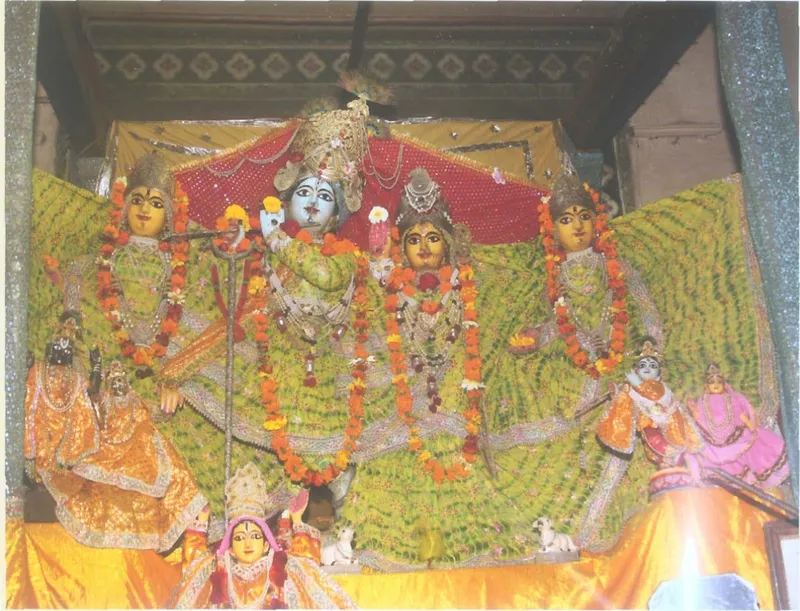
- What it is
- The Taḍāsa-vālā Mandira, also called the Taras Temple, is the temple of Śrī Rādhā-vinoda, known as Jamāī Ṭhākura, "the son-in-law Ṭhākura", in Vṛndāvana town.
- Visiting
- Śrī Vraja-maṇḍala Parikramā (2007) also calls the temple the Ṭhākura-bāḍī of Rājarṣi Rāya Vanamālī dāsa and places it on the left side of an unpaved lane, some distance from the main road from …
In short
The Taḍāsa-vālā Mandira, also called the Taras Temple, is the temple of Śrī Rādhā-vinoda, known as Jamāī Ṭhākura, "the son-in-law Ṭhākura", in Vṛndāvana town. It is named after Taḍāsa, the estate of its builder, Rājarṣi Rāya Vanamālī, and stands not far from the Jaipur Mandira.[1 +3] A Bhāgavatam edition printed in Vṛndāvana in saṁvat 1964 (1907–08) names him ruler of Taḍāsa in Bengal, devoted to the service of Śrī Rādhā-vinoda.[5] The books tell different stories of how the Deity came to him and why He is called the son-in-law. No scripture or statement of Śrīla Prabhupāda about the temple has been found.[1 +3]
Key facts
| Kind | temple |
|---|---|
| Region · area | Vṛndāvana |
| Ācāryas | Bhakti Prajñāna Keśava Gosvāmī (no profile on nandgramdham.org/acharyas/) |
Visiting today
Śrī Vraja-maṇḍala Parikramā (2007) also calls the temple the Ṭhākura-bāḍī of Rājarṣi Rāya Vanamālī dāsa and places it on the left side of an unpaved lane, some distance from the main road from Vṛndāvana to Mathurā. Vṛndāvana, the Playground of God (2010) places it not far from the Jaipur temple.[1 +3]
The 2010 book shows a hookah standing before the Deities and says that it is offered to Kṛṣṇa every day. It adds that smoking is not a standard Vaiṣṇava practice at all and is not to be imitated.[3 +1]
Location
| Where it is | left of an unpaved lane some distance from the Vṛndāvana–Mathurā road[9] 'not far from the Jaipur temple'[10] |
|---|
Nearby places
Jaipur Mandira (Vṛndāvana)
History
The builder
Two title pages of an edition of the Śrīmad-Bhāgavatam (the first half of the Tenth Canto, parts 3 and 4) say that it was edited by Śrī Nityasvarūpa Brahmacārī, published with the complete help of Rājarṣi Rāya Śrī Vanamālī Rāya Bahādur, ruler of Taḍāsa in Bengal and devoted to the loving service of Śrī Rādhā-vinoda, and printed at the editor's press in Vṛndāvana in saṁvat 1964.[5] According to Śrī Vraja-maṇḍala Parikramā (2007), Śrī Bhakti Prajñāna Keśava Gosvāmī Mahārāja collected a set of his Bhāgavatam from this temple in about 1954.[5]
The temple
According to the Bengali Vṛndāvana-kathā (1920), the Rājarṣi bought a large garden on the road from Vṛndāvana to Mathurā, which the Seths of Mathurā had given to their guru, and built a temple at one side of it. The family's principal temple, the book says, stood on the bank of Rādhā-kuṇḍa, and they brought the Ṭhākura to the garden from time to time for festivals. It gives no date.[6]
The historian Prabhudayāl Mītal (1966) writes that Banamālī Bābū, as he calls him, a wealthy landowner of Tarāś in Pabna district, came to Vraja with his family and his Deity. He first lived at Rādhā-kuṇḍa, where he built a temple in saṁvat 1956 (about 1899–1900) and the Deity stayed until saṁvat 1961 (about 1904–05). After that he lived in Vṛndāvana, built the temple of Ṭhākura Rādhāvinodajī there with a school, a dispensary, a pilgrims' rest-house and a free kitchen, and died in Vṛndāvana in saṁvat 1972 (about 1915–16). Mītal gives no year for the Vṛndāvana temple.[7 +1]
Where the sources differ
How the Deity came to Vanamālī Rāya, and why He is called the son-in-law: the guidebooks tell two different stories, and …
How the Deity came to Vanamālī Rāya, and why He is called the son-in-law: the guidebooks tell two different stories, and Vṛndāvana, the Playground of God says that it cannot vouch for its own.[1 +3]
Accounts differ How the Deity came to Vanamālī Rāya, what happened to his daughter, and why the Deity is called Jamāī Ṭhākura (the son-in-law Ṭhākura).
- Śrī Vraja-maṇḍala Parikramā (2007)The Deity was found in a river by Vāñchārāma and came 'By His own will' to Vanamālī Rāya's house; the king's daughter Rādhā fell ill and died as a cedar-wood Rādhā Deity was installed and married to Him; Vanamālī Rāya later brought the Deity to Vṛndāvana.
- Vṛndāvana, the Playground of God (2010)Kṛṣṇa of the Rādhā-Mādhava Deities of Vṛndāvana followed the childless king home; the daughter Vinodinī, born by His mercy, married Kṛṣṇa at a svayaṁvara and was revealed as Śrīmatī Rādhārāṇī in the palace temple; the Deities were 'later' moved back to Vṛndāvana.
- Vṛndāvana-kathā (Pulinbihārī Datta, 1920), printed p. 253 (an attributed tradition)A daughter of the family was exceedingly devoted to the service of their Ṭhākura Rādhāvinoda, and for that reason many have given Him the name 'Jāmāi Ṭhākura'; nothing is said of how the Deity came to the family, of a marriage or of a death.
Where Vanamālī Rāya's estate was.[5]
Accounts differ Where Vanamālī Rāya's state (Taḍāsa / Tarar) was.
- Śrī Vraja-maṇḍala Parikramā (2007)Śrī Vāñchārāma was 'an official in the Taḍāsa state in Bengal'; the Deity came to Vanamālī Rāya's house.
- Vṛndāvana, the Playground of God (2010)'a king named Vanamālī Rāya ruling a state named Tarar in North India'; the temple is called the Taras Temple 'Because of the connection with the state of Tarar'.
- Title pages of the Śrīmad-Bhāgavatam edition, saṁvat 1964'vaṅgadeśāntargata tāḍāsa bhūpati' — ruler of Tāḍāsa within Bengal.
- Prabhudayāl Mītal, Braj kā sāṁskṛtik itihās (1966), printed p. 289Banamālī Bābū ('Tarāś-vālā') was a wealthy zamindar of Tarāś in Pabna district ('East Pakistan' in 1966).
Where the family's Deity was installed, and so when this temple was built.[6 +2]
Accounts differ Where the Deity of Rāya Vanamālī's family (the zamindars of Taḍās / Tarāś), Rādhāvinoda, was installed: the temple in Vṛndāvana (this place), a temple at Rādhā-kuṇḍa, or one after the other; it bears on when this temple was built and the Deity installed here.
- Vṛndāvana-kathā (Pulinbihārī Datta, 1920), printed p. 253The family's principal temple stands on the bank of Rādhā-kuṇḍa; the Ṭhākura is brought from time to time for festivals to the spacious garden on the road from Vṛndāvana to Mathurā, which the Rājarṣi bought and where he built a temple at one side.
- Prabhudayāl Mītal (1966), printed p. 289A temple built at Rādhā-kuṇḍa in Saṁvat 1956; Ṭhākura Rādhāvinodajī there until Saṁvat 1961; then Banamālī Bābū lived in Vṛndāvana and built the Rādhāvinoda temple there.
- Śrī Vraja-maṇḍala Parikramā (2007)Vanamālī Rāya went to Vṛndāvana, brought Śrī Rādhā-Vinoda-bihārī Ṭhākurajī with him, built a temple 'at this place' and installed Him; no temple at Rādhā-kuṇḍa is mentioned.
The wording of these accounts is our summary of the sources, not a published translation.
How many commentaries his Bhāgavatam edition has.[5]
Accounts differ The Bhāgavatam edition connected with Vanamālī Rāya: its commentaries and who published it.
- Śrī Vraja-maṇḍala Parikramā (2007)'He published one edition of Śrīmad-Bhāgavatam with eight commentaries in the devanāgarī script'.
- Title page of Daśama-skandha pūrvārdha, part 3Fourteen commentaries and a vernacular translation; edited by Nityasvarūpa Brahmacārī; published with the complete assistance of Vanamāli Rāya Bahādur; Devakīnandana press, Vṛndāvana, saṁvat 1964.
- Title page of Daśama-skandha pūrvārdha, part 4Nine commentaries and a vernacular translation; same editor, patron, press and year.
- Prabhudayāl Mītal (1966), a historianMītal says that Banamālī Bābū had an edition of the Śrīmad-Bhāgavatam carrying eight commentaries printed, along with other devotional books, and had them given away free.
The wording of these accounts is our summary of the sources, not a published translation.
References
10 references
- Śrī Vraja-maṇḍala Parikramā (2007), PDF p. 338
- Śrī Vraja-maṇḍala Parikramā (2007), PDF p. 322
- Vṛndāvana, the Playground of God (2010), Bhakti Caitanya Svāmī, PDF p. 134
- Vṛndāvana, the Playground of God (2010), Bhakti Caitanya Svāmī, PDF p. 135
- Śrī Vraja-maṇḍala Parikramā (2007), PDF p. 339
- Pulinbihārī Datta, ch. 20 (বিংশ পরিচ্ছেদ), list of Vṛndāvana’s temples, entry 18, printed p. 253
- Prabhudayāl Mītal, section 'Ādhunik kāl' (running head), entry 'Banamālī bābū (Tarāś vālā)', printed p. 289
- Prabhudayāl Mītal, section 'Bhakta jan' (running head), end of the entry 'Banamālī bābū (Tarāś vālā)' begun on p. 289, printed p. 290
- Śrī Vraja-maṇḍala Parikramā (2007), p. 650-651
- Vṛndāvana, the Playground of God (2010), Bhakti Caitanya Svāmī, p. 134