Jaipur Mandira (Vṛndāvana)
जयपुर मन्दिर (वृन्दावन) Hindi name proposed
Also called Jaipura Temple, Jaipur Mandir
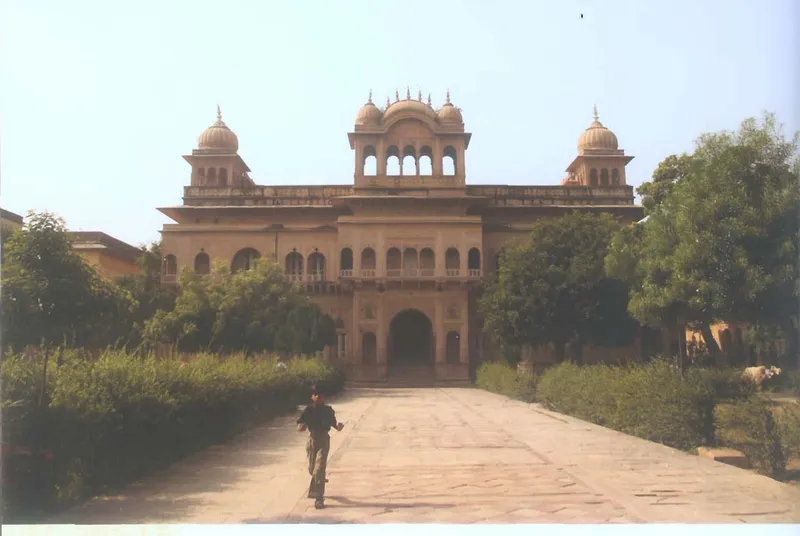
- What it is
- The Jaipur Mandira is a large sandstone temple of Rādhā-Mādhava and Ānanda-Bihārī in Vṛndāvana, beside the road to Mathurā.
- Visiting
- The Color Guide (2000) describes fine hand-carved sandstone, roof pillars each carved from one solid stone, and marble work on the altars; Śrī Vraja-maṇḍala Parikramā notes that the main temple has …
In short
The Jaipur Mandira is a large sandstone temple of Rādhā-Mādhava and Ānanda-Bihārī in Vṛndāvana, beside the road to Mathurā. The Mahārāja of Jaipur, Mādho Singh, built it over about thirty years, and the Bengali Vṛndāvana-kathā (1920), written in his reign, says that the Deities were installed in 1916 (two later guides differ and give 1917).[1 +6] It is a temple of the twentieth century, so no scripture or Gosvāmī work speaks of it. Śrīla Prabhupāda named it among the big temples of Vṛndāvana that came after the seven old temples of the Gosvāmīs.[8]
Key facts
| Kind | temple |
|---|---|
| Region · area | Vṛndāvana |
Śrīla Prabhupāda
Śrīla Prabhupāda spoke of the temple in passing, in Paris in 1974, when he listed the temples of Vṛndāvana for a visiting scholar. He gives no builder, date or Deity.[8]
Names this place“These are old seven temples. Later on, other big, big temples, Raṅganātha temple and Gaekwar temple, like that, Jaipur temple, they came into existence.”
Śrīla Prabhupāda, Room Conversation with Professor Olivier Lacombe, Paris, 14 June 1974 · vedabase.io
Visiting today
The Color Guide (2000) describes fine hand-carved sandstone, roof pillars each carved from one solid stone, and marble work on the altars; Śrī Vraja-maṇḍala Parikramā notes that the main temple has three doors, and the 2010 book shows the entrance from the main street.[1 +2] The temple of Taḍāsa-vālā is not far away.[1 +2]
The 2000 guide gave these hours (check them before you go):[1 +2]
Location
| Where it is | entrance from the main street[11] |
|---|
Nearby places
Taḍāsa-vālā Mandira
Pictures
3 pictures
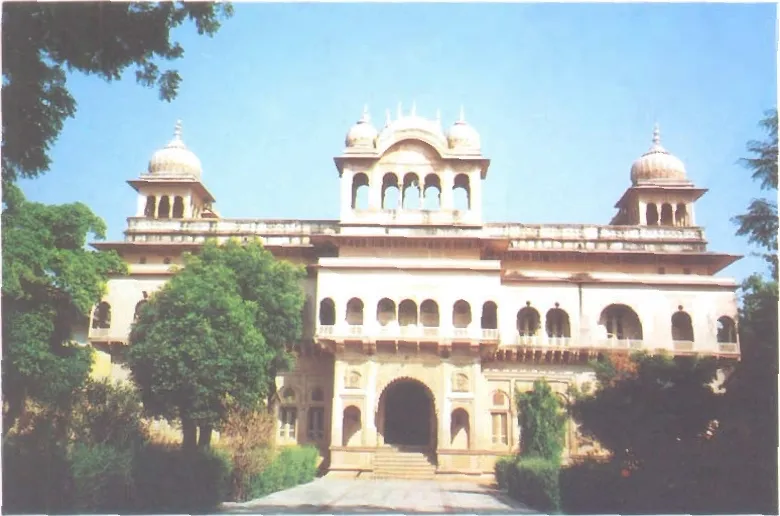
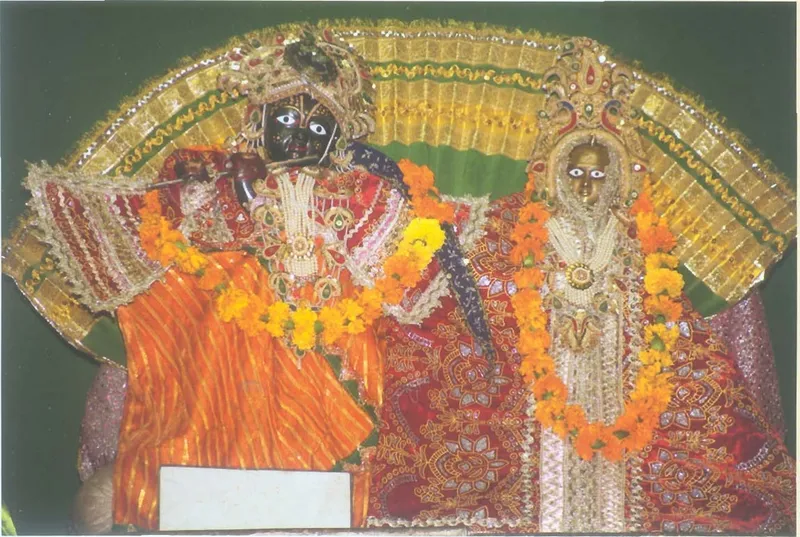
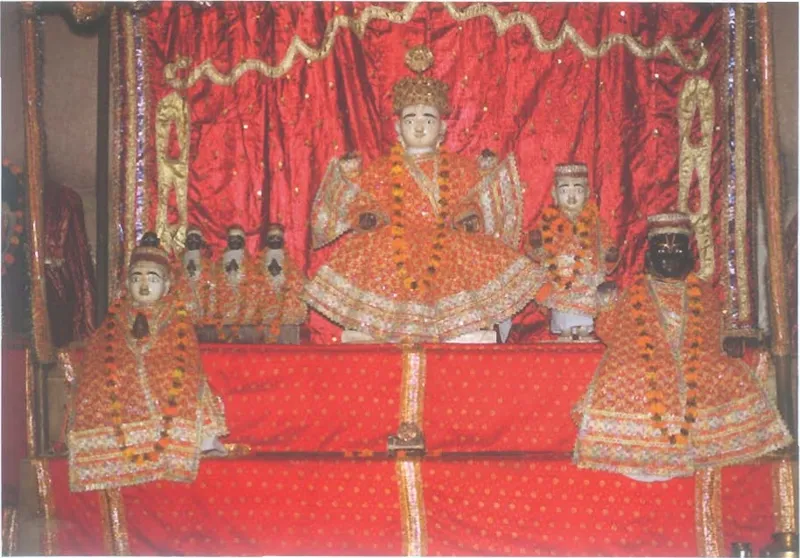
History
The builder
All the guidebooks agree that the Mahārāja of Jaipur built the temple over about thirty years; Śrī Vraja-maṇḍala Parikramā (2007) calls him Mādho Singh, and Vṛndāvana, the Playground of God (2010) and The Color Guide to Vṛndāvana (2000) call him Savāī Mādhav Singh.[1 +5] The district gazetteer of 1911 recorded the temple as still being built by the Mahārāja of Jaipur and unfinished, on the Mathurā road about three-quarters of a mile from the town.[1 +5] The historian A. W. Entwistle (1987) names the builder as Savāī Mādho Singh II and calls the temple Mādhava-vilāsa, dedicated to Kṛṣṇa as Rādhā-Mādhava; he gives no year.[6]
The Vṛndāvana-kathā (1920) says that the building cost the Mahārāja many lakhs of rupees, and that rooms for the staff and the royal family stand around the courtyard. People said, the book adds, that he had spent his childhood in Vṛndāvana and founded the temple in memory of it.[5 +1]
The Nimbārka connection
Vṛndāvana, the Playground of God says that the king was then a follower of the Nimbārka-sampradāya, that Haṁsa-Gopāla is usually worshipped in the major Nimbārka temples, and that he also built the Jaipur temple at Varṣāṇā.[2 +2] The Vṛndāvana-kathā says that before he became king he lived in the Brahmacārī's temple, the Rādhā-Gopāla Mandira, and became a disciple of its mohānta (the head of the temple); Entwistle names that teacher, Brahmacārījī, as the one under whose inspiration the temple was built.[2 +2]
Where the sources differ
The year: the Vṛndāvana-kathā (1920) and Śrī Vraja-maṇḍala Parikramā give 1916 for the installation of the Deities, while the …
The year: the Vṛndāvana-kathā (1920) and Śrī Vraja-maṇḍala Parikramā give 1916 for the installation of the Deities, while the 2000 and 2010 guides give 1917 for the building. The two that say 1916 are probably one witness, since the 2007 book follows the 1920 one closely.[1 +4]
Accounts differ Date of the Jaipur temple.
- Śrī Vraja-maṇḍala Parikramā (2007)The Deities were installed in 1916 AD (after almost thirty years of building).
- Vṛndāvana-kathā (Pulinbihārī Datta), 1920, p. 251 (written while Mādho Siṁha reigned)The Deities were installed in this temple in 1916 (গত ১৯১৬ খৃঃ অঃ); the gate and the gardens were not yet finished.
- Vṛndāvana, the Playground of God (2010); The Color Guide to Vṛndāvana (2000)Built in 1917 (The Color Guide to Vṛndāvana (2000): after thirty years of labour).
- Muttra district gazetteer, 1911 (p. 249)A large temple 'now being built by the Maharaja of Jaipur and still in an incomplete condition'.
The Deities: all the sources name Rādhā-Mādhava and Ānanda-Bihārī, but they differ on the third altar.[1 +4]
Accounts differ Deities of the Jaipur temple.
- Śrī Vraja-maṇḍala Parikramā (2007)Ānanda-Bihārījī (north), Rādhā-Mādhavajī (centre); Nitya-Gopālajī, Giridhārījī, Nārada and the four Kumāras (south).
- Vṛndāvana-kathā (Pulinbihārī Datta), 1920, p. 251Ānanda-bihārī in the north; Rādhā-Mādhava in the middle; in the southern room Nṛtya-gopāla, Giridhārī, Sanaka, Sanātana, Sananda, Sanatkumāra, Nārada and others (no Haṁsa-gopāla named).
- Vṛndāvana, the Playground of God (2010)Rādhā-Mādhava, Ānanda-Bihārī and Haṁsa-Gopāla; caption: Haṁsa-Gopāla with the four Kumāras and 'black Nimbarka'.
- The Color Guide to Vṛndāvana (2000)Rādhā-Mādhava, Ānanda-bihārī and Hansa-gopāla.
References
11 references
- Śrī Vraja-maṇḍala Parikramā (2007), PDF p. 337
- Vṛndāvana, the Playground of God (2010), Bhakti Caitanya Svāmī, PDF p. 132
- The Color Guide to Vṛndāvana (2000), Written and Photographed by Rājaśekhara dāsa Brahmacārī, PDF p. 67
- Muttra: A Gazetteer, District Gazetteers of the United Provinces of Agra and Oudh vol. VII
- Vṛndāvana-kathā, ch. 20 (viṁśa pariccheda, temples founded in the English period), item 11, printed p. 250
- A. W. Entwistle, ch. 5 §37 'The Nimbark Sampraday in modern times', printed p. 220, Egbert Forsten, Groningen, 1987
- Vṛndāvana-kathā, ch. 20 (viṁśa pariccheda), item 11 (continued), printed p. 251
- Śrīla Prabhupāda, Room Conversation with Professor Olivier Lacombe, Paris, 14 June 1974 · vedabase.io
- Vṛndāvana-kathā, ch. 20 (viṁśa pariccheda), item 5 'Brahmacārīr ṭhākura-bāṛī' (pp. 245-246), printed p. 246
- Vṛndāvana, the Playground of God (2010), Bhakti Caitanya Svāmī, PDF p. 133
- Vṛndāvana, the Playground of God (2010), Bhakti Caitanya Svāmī, p. 132