Viśvanātha Cakravartī Ṭhākura's samādhi
विश्वनाथ चक्रवर्ती ठाकुर की समाधि Hindi name proposed
Also called Viśvanātha Cakravartī Samādhi
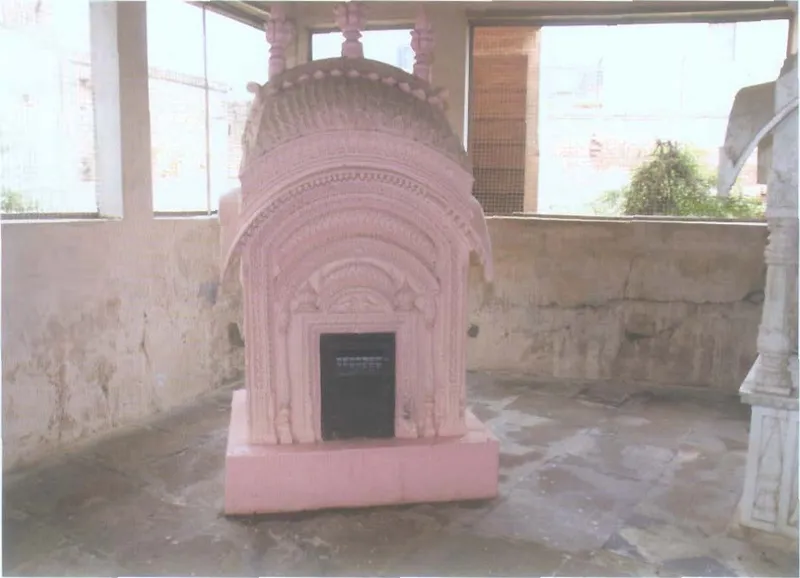
- What it is
- The samādhi, the tomb, of Śrīla Viśvanātha Cakravartī Ṭhākura stands in the samādhi garden of the Rādhā-Gokulānanda Mandira in Vṛndāvana, next to Śrīla Lokanātha Gosvāmī's samādhi.
- Visiting
- The guidebooks place the tomb just outside the Rādhā-Gokulānanda temple, in its samādhi garden, beside Śrīla Lokanātha Gosvāmī's samādhi.
In short
The samādhi, the tomb, of Śrīla Viśvanātha Cakravartī Ṭhākura stands in the samādhi garden of the Rādhā-Gokulānanda Mandira in Vṛndāvana, next to Śrīla Lokanātha Gosvāmī's samādhi. All the guidebooks agree on the place.[1 +7] They remember him as the author of many books and songs, among them the Stavāmṛta-laharī and the Gurvaṣṭaka, the prayers to the spiritual master sung every morning in ISKCON temples.[4 +4] His own verses show him living and writing at Rādhā-kuṇḍa in 1678; no source says where he passed away, or why his tomb is in Vṛndāvana town.[13 +2]
Key facts
| Kind | samādhi |
|---|---|
| Region · area | Vṛndāvana · Samādhi Garden (Rādhā-Gokulānanda) |
| Ācāryas | Śrīla Viśvanātha Cakravartī Ṭhākura |
Traditional accounts
According to The Color Guide to Vṛndāvana (2000), his sacred body is entombed here; the other guidebooks say only "samādhi", so this is not certain.[4 +2] The guidebooks place the tomb in the same garden as the memorial of Śrīla Narottama dāsa Ṭhākura, his puṣpa-samādhi.[1 +6]
No older text mentions the tomb, and Śrīla Prabhupāda does not speak of it by name. The Bengali Bhaktamāla of Kṛṣṇadāsa Bābājī (1905) and the Vṛndāvana-kathā of 1920 name the tombs of Śrīla Lokanātha Gosvāmī and Śrīla Narottama dāsa Ṭhākura in this garden, but none of Śrīla Viśvanātha Cakravartī Ṭhākura. The historian Prabhudayāl Mītal (1966) is the first found to name his samādhi here, and A. W. Entwistle (1987) describes it as a memorial without saying whether it holds his body.[1 +7]
The Gosvāmīs and ācāryas
Śrīla Prabhupāda writes in his summary of the disciplic succession that Śrīla Narottama dāsa Ṭhākura accepted Śrīla Viśvanātha …
Śrīla Prabhupāda writes in his summary of the disciplic succession that Śrīla Narottama dāsa Ṭhākura accepted Śrīla Viśvanātha Cakravartī Ṭhākura as his servitor, and that Śrīla Viśvanātha Cakravartī Ṭhākura accepted Śrīla Jagannātha dāsa Bābājī.[2 +2]
General teaching (does not name the place)“The direct disciple of Śrīla Kṛṣṇadāsa Kavirāja Gosvāmī was Śrīla Narottama dāsa Ṭhākura, who accepted Śrīla Viśvanātha Cakravartī as his servitor. Śrīla Viśvanātha Cakravartī Ṭhākura accepted Śrīla Jagannātha dāsa Bābājī,”
Śrīla Prabhupāda, Śrī Caitanya-caritāmṛta, Ādi-līlā, Chapter 1, introduction (summary of the disciplic succession) · vedabase.io
According to the opening verse of his commentary on the five chapters of the rāsa dance, Śrīla Viśvanātha Cakravartī Ṭhākura bows to his gurus and praises Śrī Gaurāṅga, the Lord of Śrīla Narottama, naming the ācārya whose memorial now stands in the same garden as his tomb (summarised here, not translated).[18]
Śrīla Prabhupāda
Śrīla Prabhupāda writes that he especially followed Śrīla Viśvanātha Cakravartī Ṭhākura's commentary on Bhagavad-gītā 2.41: a …
Śrīla Prabhupāda writes that he especially followed Śrīla Viśvanātha Cakravartī Ṭhākura's commentary on Bhagavad-gītā 2.41: a disciple must strictly follow the orders of his spiritual master. He says this in general, not about the tomb.[10 +2]
General teaching (does not name the place)“We followed the principles especially explained by Śrīla Viśvanātha Cakravartī Ṭhākura in his commentary on the Bhagavad-gītā verse beginning vyavasāyātmikā buddhir ekeha kuru-nandana. According to this instruction of Viśvanātha Cakravartī Ṭhākura, it is the duty of a disciple to follow strictly the orders of his spiritual master.”
Śrīla Prabhupāda, Śrī Caitanya-caritāmṛta, Ādi-līlā 12.8, purport · vedabase.io
In his purport to that verse he quotes Śrīla Viśvanātha Cakravartī Ṭhākura's prayers to the spiritual master, the Gurvaṣṭaka.[4 +4]
Visiting today
The guidebooks place the tomb just outside the Rādhā-Gokulānanda temple, in its samādhi garden, beside Śrīla Lokanātha Gosvāmī's samādhi.[1 +5]
Nearby places
Rādhā-Gokulānanda Mandira (Vṛndāvana)
History
Śrīla Viśvanātha Cakravartī Ṭhākura dates two of his own works. The closing verse of his Nikuñja-keli-virudāvalī says that it came forth on the bank of Rādhā's lake, and that of his Surata-kathāmṛta gives the same year; in words that stand for numbers, both give the Śaka year 1600, that is 1678 CE. In the Surata-kathāmṛta he also calls residence on the bank of Rādhā-kuṇḍa a great wealth (summarised here, not translated).[13 +2]
In the verses that close his commentary on the Tenth Canto, the Sārārtha-darśinī, he says that he completed it on the twelfth day of the dark fortnight of Māgha on the bank of the "Rādhā-Kṛṣṇa sarit", probably the two kuṇḍas; he gives no year (summarised here, not translated).[15] These verses tell where he wrote, not where he passed away.[13 +2] Read more: Śrīla Viśvanātha Cakravartī Ṭhākura at Rādhā-kuṇḍa →
Where the sources differ
The year of Śrīla Viśvanātha Cakravartī Ṭhākura's passing: the guidebooks give 1708, about 1704 or 1654, and his own verses show …
The year of Śrīla Viśvanātha Cakravartī Ṭhākura's passing: the guidebooks give 1708, about 1704 or 1654, and his own verses show him alive in 1678, so 1654 cannot be right; the other two years are not certain.[4 +4]
Accounts differ The year of Śrīla Viśvanātha Cakravartī Ṭhākura's passing.
- The Color Guide to Vṛndāvana (2000), p. 100He 'disappeared from this world in the year 1708'; born 1638.
- Vṛndāvana, the Playground of God (2010), pp. 93-94Appeared 'in about 1638'; 'left this world in about 1704'.
- the undated parikramā notes Vṛndāvana'He entered samādhi in 1654' (no birth year; 1654 is sixteen years after the birth year the two books give).
- Śrīla Viśvanātha Cakravartī Ṭhākura's own closing versesNo year of passing. Two of his works were completed in Śaka 1600 (1678 CE; our reading of the number words), so he was alive and writing in 1678, twenty-four years after the 1654 of the undated parikramā notes Vṛndāvana.
Where he was born, and whether he went back to Bengal after he first came to Vṛndāvana: according to the guidebooks and a Bengali book of 1920 the details differ, and it is not certain which is right.[4 +5]
Accounts differ Where Viśvanātha was born and whether he went back to Bengal after first coming to Vṛndāvana.
- Vṛndāvana, the Playground of God (2010), p. 93Born in the Rāḍhādeśa area of West Bengal; after his marriage he left for Vṛndāvana 'and remained there for the rest of his life', with Rādhā-kuṇḍa as his base.
- The Color Guide to Vṛndāvana (2000), p. 100Born in the Nadia district; stayed at Rādhā-kuṇḍa, returned to Bengal, where his guru kept him for a time, and was then sent back to Vṛndāvana (Rādhā-kuṇḍa).
- The Colour Guide to Rādhā-kuṇḍa (1999), pp. 108-109Born in Bengal in 1638; after a short stay at Rādhā-kuṇḍa he went back to Bengal and later returned to his own kuṭīra there.
- Pulinbihārī Datta, Vṛndāvana-kathā (1920, Vṛndāvana-kathā (Pulinbihārī Datta), Bengali, 1920), printed pp. 227-228Born at Devagrāma in Nadia district; went to Vṛndāvana in his youth and lived on the bank of Rādhā-kuṇḍa at Āriṭ; the last part of his life was completed in Vṛndāvana (no return to Bengal mentioned).
More on this place
Śrīla Viśvanātha Cakravartī Ṭhākura at Rādhā-kuṇḍa
References
25 references
- Śrī Vraja-maṇḍala Parikramā (2007), PDF p. 333
- Śrī Vraja-maṇḍala Parikramā (2007), PDF p. 345
- Vṛndāvana, the Playground of God (2010), Bhakti Caitanya Svāmī, PDF p. 92
- The Color Guide to Vṛndāvana (2000), Written and Photographed by Rājaśekhara dāsa Brahmacārī, PDF p. 114
- Vṛndāvana-Dhāma Ki Jaya! (c. 1986), by Dhruva Mahārāja dāsa, PDF p. 70
- The Colour Guide to Rādhā-kuṇḍa (1999), Rājaśekhara dāsa Brahmacārī, PDF p. 115
- Vṛndāvana-Dhāma Ki Jaya! (c. 1986), by Dhruva Mahārāja dāsa, PDF p. 71
- Prabhudayāl Mītal, part 1 ('ब्रज-संस्कृति की भूमिका'), 'Braj-yātrā', Vṛndāvana: 'Śrī Rādhāvinoda jī tathā Śrī Gokulānanda jī', printed p. 137
- Vṛndāvana, the Playground of God (2010), Bhakti Caitanya Svāmī, PDF p. 93
- Vṛndāvana, the Playground of God (2010), Bhakti Caitanya Svāmī, PDF p. 94
- Śrīla Viśvanātha Cakravartī Ṭhākura, Stavāmṛta-laharī no. 13 (as numbered on the page), Śrī Gopīnāthadevāṣṭaka, verses 7-8 and colophon
- Śrīla Prabhupāda, Bhagavad-gītā As It Is, 2.41, purport · vedabase.io
- Śrīla Viśvanātha Cakravartī Ṭhākura, Stavāmṛta-laharī, Nikuñja-keli-virudāvalī v.72, its closing verse (index 'part 21 v.72'; no. (22) on the sanskritdocuments.org page, sanskritdocuments.org Gauḍīya stotra texts)
- Śrīla Viśvanātha Cakravartī Ṭhākura, Stavāmṛta-laharī, Surata-kathāmṛta vv.103 and 105, closing verses (index 'part 22 v.103' and 'part 22 v.105'; no. (23) on the sanskritdocuments.org page, sanskritdocuments.org Gauḍīya stotra texts)
- Śrīla Viśvanātha Cakravartī Ṭhākura: commentary closing verses of the commentary on canto 10, after the comment on ŚB 10.90.50, Bhagavata Vidya Pith edition, ed. Bhagavata Rishi and Krishna Shankar Shastri, 1996
- A. W. Entwistle, ch. 8 §66.32 'Radhavinod and Gokulanand', printed p. 413, Egbert Forsten, Groningen, 1987
- Vṛndāvana-kathā, chapter 19 (ūnaviṁśa pariccheda), printed p. 227
- Śrīla Viśvanātha Cakravartī Ṭhākura: commentary on ŚB 10.29.1, first opening verse of the rāsa chapters
- Śrīla Prabhupāda, Śrī Caitanya-caritāmṛta, Ādi-līlā, Chapter 1, introduction (summary of the disciplic succession) · vedabase.io
- the undated parikramā notes Vṛndāvana, ¶216
Show all 25 references
- Śrīla Viśvanātha Cakravartī Ṭhākura: commentary on ŚB 10.29.1, first opening verse of the rāsa chapters
- Śrīla Prabhupāda, Śrī Caitanya-caritāmṛta, Ādi-līlā 12.8, purport · vedabase.io
- The Colour Guide to Rādhā-kuṇḍa (1999), Rājaśekhara dāsa Brahmacārī, PDF p. 112
- The Color Guide to Vṛndāvana (2000), Written and Photographed by Rājaśekhara dāsa Brahmacārī, p. 100
- Vṛndāvana, the Playground of God (2010), Bhakti Caitanya Svāmī, p. 93