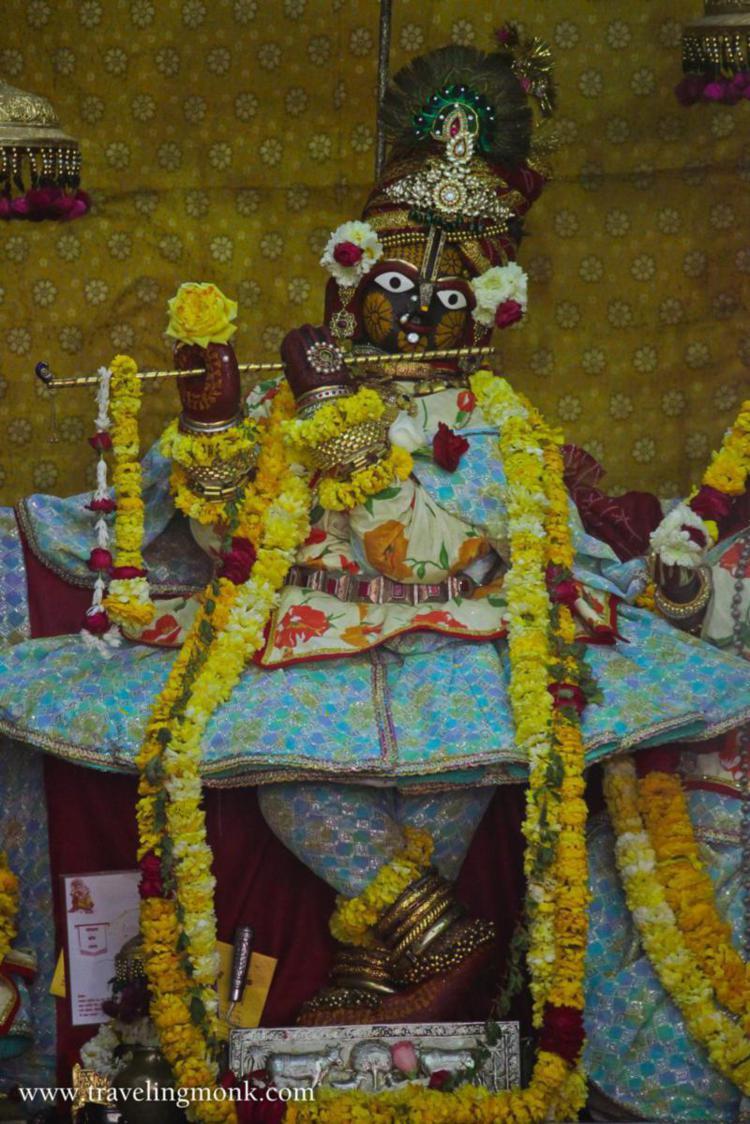
The Deities of Govinda, Gopinatha and Madana-mohana had not always been in Jaipur. Srila Prabhupada explained the background in a lecture. These Deities were originally worshiped in Vrindavana. They were moved to Jaipur for safekeeping when the emperor Aurangzeb's campaign against Hindu temples reached Vraja. The Bengali Gaudiya priests who served them travelled with them. The Jaipur king who received them was himself a Vaishnava, and worship continued there for years without trouble. Then a formal challenge disturbed this settled arrangement. So the dispute that Baladeva was drawn into was not just a philosophical argument. It was a real threat to Deities and priests who had already survived one forced move from their home.
"They Have No Commentary" #
Scholars of the Sri Sampradaya raised an objection at the Jaipur court. Most accounts identify them specifically as Ramanandis, followers of Ramanuja, though Srila Prabhupada's own lecture on the subject describes the objectors more broadly as smarta brahmanas. They said that every genuine Vedanta school had produced its own commentary on the Brahma-sutra: Shankaracharya his Shariraka-bhashya, Ramanujacharya his Sri-bhashya, Madhvacharya his Purna-prajna-bhashya, Nimbarka's line its Parijata-saurabha-bhashya, and Vishnusvami's Rudra Sampradaya its Sarvajna-bhashya. The Gaudiya Vaishnavas, they pointed out, had none. Without one, they argued, the Gaudiya lineage could not be considered a bona fide Vedic school. So it had no right to continue worshiping Govindaji. They also claimed separately that scripture did not allow Srimati Radharani to be worshiped alongside Him at all. For the Gaudiyas this second objection was very serious. Worship of Radha and Krishna together, as inseparable, was central to Sri Chaitanya Mahaprabhu's own theology. So a ruling against it would have struck at something far more important than a temple custom.
The Gaudiya position came from Sri Chaitanya Mahaprabhu himself. It was that a separate commentary had never been necessary. Mahaprabhu held that Vyasadeva composed Srimad-Bhagavatam under Narada's instruction, as his own explanation of the short verses of his own Vedanta-sutra. So the Bhagavatam already served as the natural and true commentary. Krishnadasa Kaviraja Goswami records this teaching directly in the Chaitanya-charitamrita. Baladeva made exactly this argument when the debate opened, citing Jiva Gosvami's Sat-sandarbha in support. It did not satisfy the assembly. "He admits there is no direct commentary," the challengers are said to have declared. "Their sampradaya is bogus."
An Ultimatum #
Baladeva had been sent to represent the Gaudiya Vaishnavas, because Vishvanatha Chakravarti Thakura was by then too old to make the journey himself. Faced with that response, Baladeva did not go back to arguing about why a commentary should not be required. He promised the assembly, on the spot, a direct Vedanta-sutra commentary of the Gaudiyas' own. One account states he was given eighteen days to produce it. Whatever the exact figure, the challengers clearly expected him to fail. They also doubted that any text produced so quickly could be genuine. A great deal was at risk, and at once. While the matter was under dispute, the king had already been forced to have Radharani's deity removed from the altar for a time. He had also stopped the Bengali pujaris from Deity service until the outcome was known. So Baladeva was not arguing about an idea. He was working to restore worship that had already been interrupted.
A Contested Timeline #
Even the basic dates of this episode are disputed. We say so plainly here, and do not pick one date and present it as settled. Devotional biographies place the Jaipur assembly anywhere from 1706 to 1718. They often cite as evidence the Saka-era date in the closing note of the finished Govinda-bhashya itself (1628 Shakabda). Some modern historians are more doubtful. They note that the earliest surviving documents that mention Baladeva Vidyabhusana by name date only to the 1740s. So they argue it is unlikely he had any role in a Jaipur debate before the 1730s at the earliest. That would put the whole episode a full generation later than the popular telling. But the king would be the same in both cases, Maharaja Sawai Jai Singh II of Jaipur, whose long reign spanned both possible dates. Neither the earlier nor the later dating can be considered proven. Both possibilities deserve to stand, because the evidence really supports both. What happened next, the writing of the commentary itself, is covered on the Govinda-bhashya page.
