Srila Baladeva Vidyabhusana
Author of the Govinda-bhashya
The complete life, on one page: The main biography and every pastime page, in order, in one place
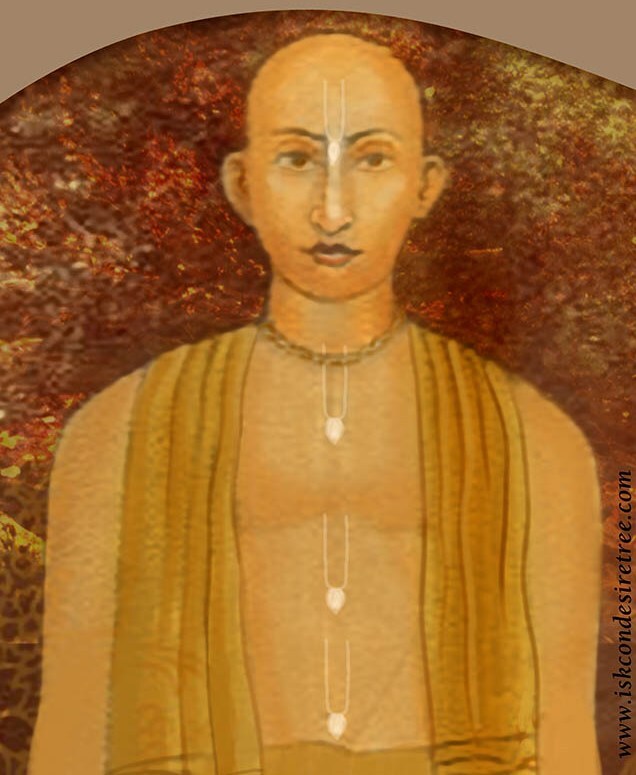
Introduction
vidyā-rūpaṁ bhūṣaṇaṁ me pradāya kīrtiṁ nityāṁ tena yo mad-udāraḥ
śrī-govinda-svapna-nirdiṣṭa-bhāṣyo rādhā-bandhur bandhu-raṅgaḥ sa jīyāt
"By his mercy Sri Govinda revealed this commentary to me in a dream, and for this the learned gave me the name Vidyabhushana, yet all credit belongs to Him, the dearest friend of Srimati Radhika. May that Govinda be forever glorified."
Baladeva Vidyabhushana composed this verse himself, in the closing lines of the Govinda-bhashya. It tells us a great deal about him. Even while describing the achievement that made him famous, he turned the credit away from his own scholarship and gave it to Sri Govindaji.
Srila Baladeva Vidyabhusana came into the Gaudiya Vaishnava parampara from an unexpected direction. He was already an accomplished scholar of the rival Madhva, or Tattvavada, school of Vedanta when he converted, in mid-life, to the teachings of Sri Chaitanya Mahaprabhu. That unusual background turned out to be exactly what the Gaudiya sampradaya needed a generation later. At the royal court of Jaipur, its right to worship the Deities of Govinda and Gopinatha was challenged, because it had no formal Vedanta-sutra commentary. Tradition says that within a remarkably short time Baladeva supplied one, the Govinda-bhashya. It has stood as the philosophical foundation of Gaudiya Vaishnavism ever since.
| Detail | Description |
|---|---|
| Born | c. early 18th century (exact year unknown), a village near Remuna, Balasore region, Odisha |
| Family | A vaishya (farming) family; his forefathers were agriculturists |
| Diksha guru | Radha-Damodara Gosvami, at Jagannatha Puri |
| Siksha guru | Vishvanatha Chakravarti Thakura, in Vrindavana |
| Chief work | Govinda-bhashya, the first Vedanta-sutra commentary of the Gaudiya sampradaya |
| Also known as | Govinda Dasa |
| Disappeared | Traditionally dated 1768; some scholars place it as late as 1793 (disputed), Vrindavana |
At a Glance
- Spent years as a Tattvavada (Madhva) sannyasi and travelling debater before he ever heard the teachings of Sri Chaitanya Mahaprabhu.
- Converted and took initiation from Radha-Damodara Gosvami at Jagannatha Puri, then went on to Vrindavana to study under Vishvanatha Chakravarti Thakura.
- Represented the Gaudiya Vaishnavas when their worship of Govindaji was formally challenged at the Jaipur court.
- Composed the Govinda-bhashya, earning the title "Vidyabhushana," ornament of learning.
- Left behind two dozen or more works of Vedanta, poetry, grammar and scriptural commentary, and is still quoted by Srila Prabhupada as an authority.
Chapter 1
Early Life in the Madhva Tradition
A farmer's son from Odisha becomes a travelling champion of Madhvacharya's Vedanta
Almost everything about Baladeva Vidyabhusana's childhood is uncertain, and the biographies that survive say so plainly. They do not invent details to fill the gap. He is usually said to have been born in the early eighteenth century in a village near Remuna, in the Balasore region of Odisha. One older account names the village as Baleshvara, but no other source confirms this. His parents' names, and even his name before initiation, were never recorded. What is agreed is his family background. He was born into a vaishya, or farming, household. Srila Prabhupada mentioned this directly in a lecture on Baladeva's appearance day, noting that "he appeared in the family of a vaishya community. His forefathers were agriculturists."
A Prodigy in Sanskrit Learning #
From an early age Baladeva showed an unusual talent for scholarship. He mastered Sanskrit grammar, poetry, rhetoric (alankara) and logic (nyaya), the usual subjects of a serious Sanskrit education. He did this so well that he began travelling to centers of learning across India, instead of settling down to teach in his own area. At some point in his travels he came to stay at a temple of the Tattvavadi followers of Madhvacharya. There his life took its next direction.
Training in the Tattvavada School #
Living among the Tattvavadis, Baladeva learned their theology thoroughly. Their teaching, which goes back to Madhvacharya, is that the individual soul, the material world and the Supreme Lord are eternally and completely different from one another. He accepted sannyasa within this line while still young. Then he began preaching Tattvavada philosophy with the same energy he had brought to his studies. Several accounts describe him at this stage as a dig-vijaya pandit, literally a "conqueror of all directions," a travelling debater. Such a debater would challenge the leading scholars of a region, defeat them in open philosophical argument, and move on. This was not easy or narrow work. To succeed at it he needed a strong knowledge of the Vedanta-sutra, the principal Upanishads, the major Puranas and the arguments the rival Vedanta schools used against one another, since any of these might come up in debate.
One historian of the Dvaita (Madhva) school, B.N.K. Sharma, later noted something important. Long after Baladeva had left the Tattvavada school for Gaudiya Vaishnavism, his writings still drew heavily on Madhva source texts. He quoted the Brahma-sutra-bhashya of Madhvacharya directly, and he took key arguments from Vyasa Tirtha's Nyayamrita. In his own later work, the Prameya-ratnavali, Baladeva openly admitted what he owed to Madhvacharya. He opens by praising "Ananda Tirtha" (Madhvacharya) as "the abode of joy... the ship to cross the ocean of transmigratory existence," and he also states clearly that the nine principles he lays out in that book were taught by Madhvacharya, and later confirmed by Sri Chaitanya Mahaprabhu. Even his name presents a small puzzle. Some traditions hold that the title "Vidyabhushana" was given to him only after his victory at Jaipur. But manuscripts of his earlier Tattvavada-period writings, such as the Karika-bhashya, are already signed "Vidyabhushana," and this suggests he may have earned the title as a Tattvavadi debater, well before he ever heard of the Gaudiya sampradaya.
One devotional account of these years adds another detail. Before he ever took sannyasa in the Tattvavada line, Baladeva is said to have carefully studied the commentaries of both Shankaracharya and Madhvacharya. This gave him a wider knowledge of rival Vedanta schools than a Tattvavadi debater really needed. The same account opens by calling him a niskincana-parama-bhagavata, a fully renounced, topmost devotee of Krishna. It says that this renunciation is the reason for his silence about his own birth and family. Because he had no desire for name or fame, he never wrote about his own lineage or personal life.
For a decade or more, Baladeva was trained in strict scholarship and hard debate. This was unusual preparation for a future Gaudiya Vaishnava acharya. But it is exactly what later made him able to do something no Gaudiya Vaishnava had yet done. He produced a Vedanta-sutra commentary that could stand up to its strongest critics. His conversion to Gaudiya Vaishnavism came only after this long training in a rival school. It did not replace that training.
What the Biographies Do Not Say #
Even the earliest Gaudiya biographical accounts claim very little about these years, and they are consistently open about this. None gives a birth year with any confidence. None names his parents. None records what he was called before he took sannyasa. One biography says this directly. It notes that Baladeva "didn't have a spot of desire for name and fame" and so "never wrote about his birth, parents, lineage, personal life" himself. So this silence is seen as part of his character, not as a gap to be embarrassed about or quietly filled in. Some later writers have tried to give more exact dates, placing his birth anywhere from the 1670s to the early 1700s. But none of these estimates is based on a recorded date. They are worked out backward from the years when he is known to have been active in Jaipur and Vrindavana. The honest answer is that we can only say, in a very general way, that Baladeva Vidyabhusana's early life belongs to the eighteenth century. Anything more exact should be read as tradition, not as established fact.
Chapter 3
The Jaipur Challenge
Ramanandi scholars challenge the Gaudiya Vaishnavas' right to worship Govindaji
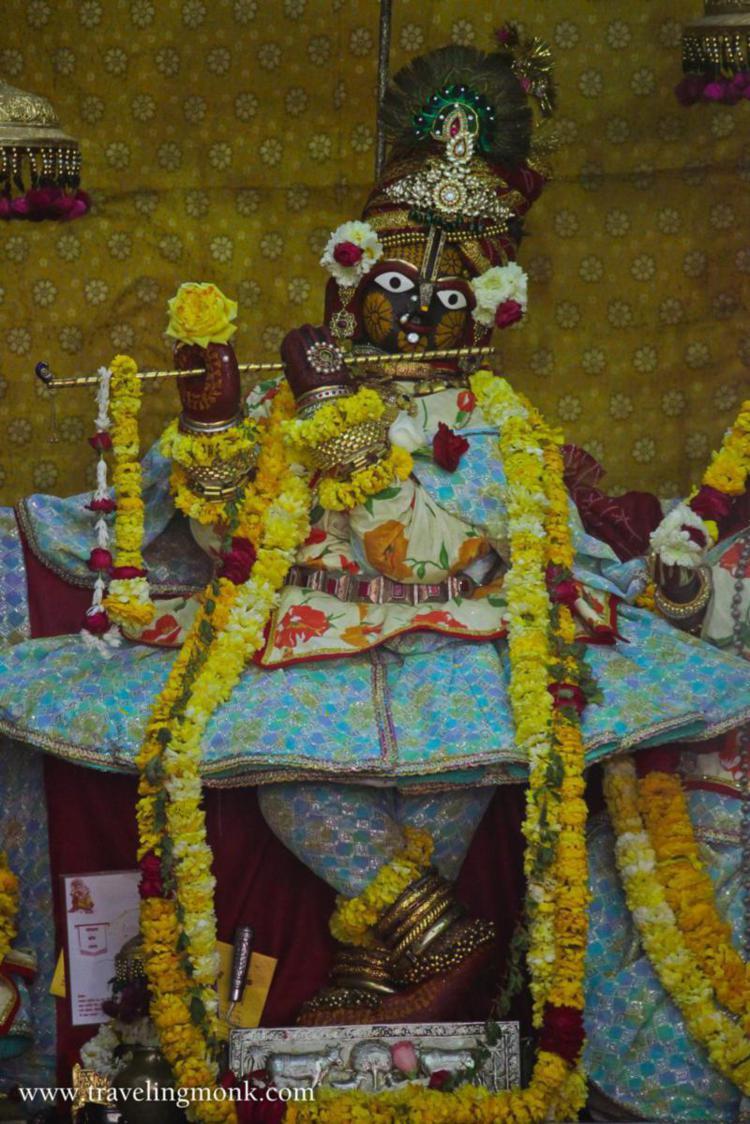
The Deities of Govinda, Gopinatha and Madana-mohana had not always been in Jaipur. Srila Prabhupada explained the background in a lecture. These Deities were originally worshiped in Vrindavana. They were moved to Jaipur for safekeeping when the emperor Aurangzeb's campaign against Hindu temples reached Vraja. The Bengali Gaudiya priests who served them travelled with them. The Jaipur king who received them was himself a Vaishnava, and worship continued there for years without trouble. Then a formal challenge disturbed this settled arrangement. So the dispute that Baladeva was drawn into was not just a philosophical argument. It was a real threat to Deities and priests who had already survived one forced move from their home.
"They Have No Commentary" #
Scholars of the Sri Sampradaya raised an objection at the Jaipur court. Most accounts identify them specifically as Ramanandis, followers of Ramanuja, though Srila Prabhupada's own lecture on the subject describes the objectors more broadly as smarta brahmanas. They said that every genuine Vedanta school had produced its own commentary on the Brahma-sutra: Shankaracharya his Shariraka-bhashya, Ramanujacharya his Sri-bhashya, Madhvacharya his Purna-prajna-bhashya, Nimbarka's line its Parijata-saurabha-bhashya, and Vishnusvami's Rudra Sampradaya its Sarvajna-bhashya. The Gaudiya Vaishnavas, they pointed out, had none. Without one, they argued, the Gaudiya lineage could not be considered a bona fide Vedic school. So it had no right to continue worshiping Govindaji. They also claimed separately that scripture did not allow Srimati Radharani to be worshiped alongside Him at all. For the Gaudiyas this second objection was very serious. Worship of Radha and Krishna together, as inseparable, was central to Sri Chaitanya Mahaprabhu's own theology. So a ruling against it would have struck at something far more important than a temple custom.
The Gaudiya position came from Sri Chaitanya Mahaprabhu himself. It was that a separate commentary had never been necessary. Mahaprabhu held that Vyasadeva composed Srimad-Bhagavatam under Narada's instruction, as his own explanation of the short verses of his own Vedanta-sutra. So the Bhagavatam already served as the natural and true commentary. Krishnadasa Kaviraja Goswami records this teaching directly in the Chaitanya-charitamrita. Baladeva made exactly this argument when the debate opened, citing Jiva Gosvami's Sat-sandarbha in support. It did not satisfy the assembly. "He admits there is no direct commentary," the challengers are said to have declared. "Their sampradaya is bogus."
An Ultimatum #
Baladeva had been sent to represent the Gaudiya Vaishnavas, because Vishvanatha Chakravarti Thakura was by then too old to make the journey himself. Faced with that response, Baladeva did not go back to arguing about why a commentary should not be required. He promised the assembly, on the spot, a direct Vedanta-sutra commentary of the Gaudiyas' own. One account states he was given eighteen days to produce it. Whatever the exact figure, the challengers clearly expected him to fail. They also doubted that any text produced so quickly could be genuine. A great deal was at risk, and at once. While the matter was under dispute, the king had already been forced to have Radharani's deity removed from the altar for a time. He had also stopped the Bengali pujaris from Deity service until the outcome was known. So Baladeva was not arguing about an idea. He was working to restore worship that had already been interrupted.
A Contested Timeline #
Even the basic dates of this episode are disputed. We say so plainly here, and do not pick one date and present it as settled. Devotional biographies place the Jaipur assembly anywhere from 1706 to 1718. They often cite as evidence the Saka-era date in the closing note of the finished Govinda-bhashya itself (1628 Shakabda). Some modern historians are more doubtful. They note that the earliest surviving documents that mention Baladeva Vidyabhusana by name date only to the 1740s. So they argue it is unlikely he had any role in a Jaipur debate before the 1730s at the earliest. That would put the whole episode a full generation later than the popular telling. But the king would be the same in both cases, Maharaja Sawai Jai Singh II of Jaipur, whose long reign spanned both possible dates. Neither the earlier nor the later dating can be considered proven. Both possibilities deserve to stand, because the evidence really supports both. What happened next, the writing of the commentary itself, is covered on the Govinda-bhashya page.
Scriptural evidence for this chapter (1)
ataeva bhāgavata — sūtrera 'artha'-rūpa
nija-kṛta sūtrera nija-'bhāṣya'-svarūpa
Word for word
ataeva: therefore; bhāgavata: Śrīmad-Bhāgavatam; sūtrera: of the Brahma-sūtra; artha: of the meaning; rūpa: the form; nija-kṛta: made by himself; sūtrera: of the Vedānta-sūtra; nija-bhāṣya: of his own commentary; svarūpa: the original form.
Śrīmad-Bhāgavatam gives the actual meaning of the Vedānta-sūtra. The author of the Vedānta-sūtra is Vyāsadeva, and he himself has explained those aphorisms in the form of Śrīmad-Bhāgavatam.
This is the verse Krishnadasa Kaviraja Goswami records as Sri Chaitanya Mahaprabhu's own teaching that Srimad-Bhagavatam is Vyasadeva's natural commentary on his own Vedanta-sutra, the very position the Ramanandi scholars at Jaipur exploited when they demanded a separate, formal Vedanta-sutra bhashya from the Gaudiya sampradaya, which Baladeva Vidyabhusana then had to supply.
Chapter 4
Composing the Govinda-bhashya
Baladeva writes the Gaudiya sampradaya's first Vedanta-sutra commentary in a matter of days
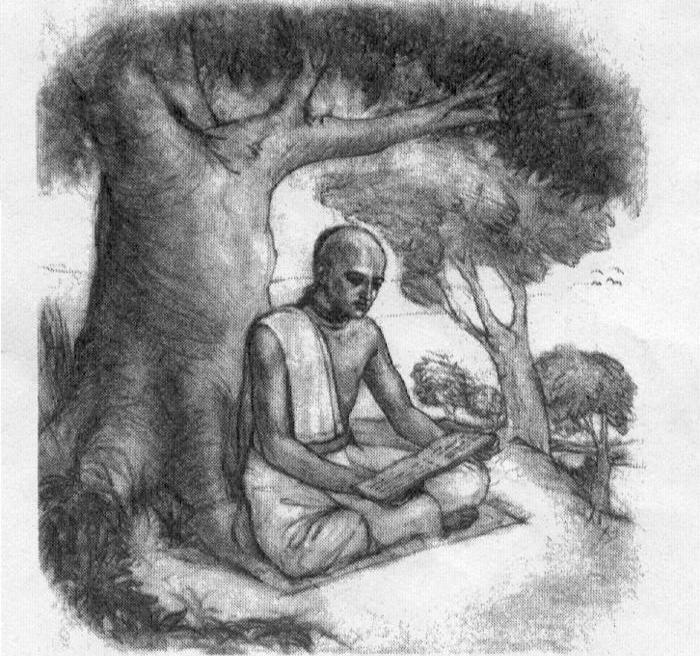
Baladeva had promised the Jaipur assembly a Vedanta-sutra commentary that he had not yet written. So he went straight to the temple of Govindaji in Jaipur, the very Deity whose worship was under dispute, and laid out the whole situation. Several biographies describe this moment in much the same way, though the details differ slightly. Srila Prabhupada's own lecture describes Baladeva lying flat in obeisance before the Deity for three continuous days. He took no food or water, and asked permission before he would even begin. The Gaudiya History biographies instead describe a dream on a single night, in which Govindaji spoke to him directly. But every version agrees on the main point of the answer: "You write, and I will dictate to you what to write. No one will be able to refuse it."
Writing Under Pressure #
Baladeva began the next morning. Every account says that his mind was fixed on the feet of Govindaji, not on his own scholarship. He completed the work in a matter of days. This was an extraordinarily short time to produce a careful and exact Vedanta-sutra commentary that could stand up to strict questioning by trained Sri Sampradaya pandits, who opposed him. He titled it the Govinda-bhashya, after the Deity he credited with its content.
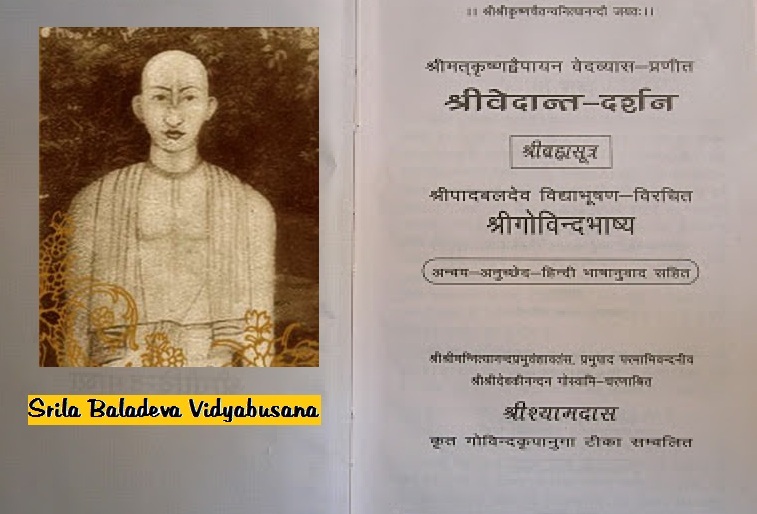
At the end of the finished work, Baladeva appended a verse in his own words describing what had happened:
"By his mercy Sri Govinda revealed this commentary to me in a dream, and for this the learned gave me the name Vidyabhushana, yet all credit belongs to Him, the dearest friend of Srimati Radhika. May that Govinda be forever glorified."
Vindication at Court #
Baladeva returned to the assembly with the finished commentary. The accounts say that the Ramanandi pandits, who had been so certain he would fail, were left speechless. None of them could find any reason to fault the work. The Gaudiya sampradaya's position was upheld, and with it the Bengali priests' right to continue worshiping Govindaji and Gopinatha at Jaipur. Several sources record that it was then that the pandits themselves gave Baladeva the title "Vidyabhushana," ornament of learning, to honour his scholarship. But other evidence suggests he may already have carried this title from his Tattvavada years. If so, the Jaipur naming confirmed the title again, and was not the first time it was given.
The defeated Ramanandi scholars are then said to have asked to become his disciples. Baladeva's answer says as much about his character as the debate itself. He declined. He explained that the Sri Sampradaya was itself a genuine and respected Vaishnava lineage, devoted to dasya-bhakti, service to the Lord. To accept their surrender would show disrespect toward that sampradaya, and he had no wish to show it. Returning to Vrindavana, he reported the victory to Vishvanatha Chakravarti Thakura. By every account, Vishvanatha received the news with great joy and gave his blessing to the disciple he had sent to Jaipur in his place. Some biographies add that Baladeva installed a Deity called Vijaya Gopala at the Golta assembly site in memory of the victory. But no one knows where that Deity is today, if it ever existed as described.
A small temple bearing Baladeva Vidyabhushana's name still stands at Galta, just outside Jaipur. It has a collection of nearly a hundred Shaligrama-shilas associated with him, near the spot where a spring is said to come out of solid rock. Tradition also holds that when Baladeva returned to Vrindavana with news of the victory, he did not stop to rest. He took up his pen again almost immediately. He began what would become his commentary on Jiva Gosvami's Tattva-sandarbha. This was part of the same Sat-sandarbha literature that Radha-Damodara Gosvami had first set him to study at Puri.
What the Commentary Achieved #
The Govinda-bhashya did not replace Srimad-Bhagavatam as the Gaudiya sampradaya's main scriptural authority. Chaitanya Mahaprabhu taught that Srimad-Bhagavatam is itself Vyasadeva's own commentary on his Vedanta-sutra (recorded in Chaitanya-charitamrita, Madhya-lila 25.142). This teaching remained the sampradaya's basic position. What Baladeva gave was something extra. He gave formal proof, in the accepted style and language of Vedanta debate, that the Gaudiya understanding of the Vedanta-sutra could be defended against any rival school, using that school's own methods. Srila Prabhupada later said of this achievement that Baladeva "gave us the Govinda-bhashya" specifically because the challenge demanded a direct commentary. It was not because the Bhagavatam's authority had ever been in doubt among Gaudiya Vaishnavas themselves.
Baladeva himself did not treat the Govinda-bhashya as a finished project that stood alone. He went on to write the Siddhanta-ratna specifically to support and explain points in the Govinda-bhashya. He also wrote the Vedanta-syamantaka, a further and separate explanation of the same Vedanta-sutra material. It was as if he was determined that no future challenger would ever again be able to say that the Gaudiya sampradaya had produced only one weak proof that it was genuine. Those later works, along with the rest of Baladeva's writings, are the subject of the other literary works page.
Chapter 5
Other Literary Works
A survey of the more than twenty works Baladeva Vidyabhusana left behind
The Govinda-bhashya is what Baladeva Vidyabhusana is remembered for, but it is only a small part of what he wrote. Different biographies say he wrote anywhere from about twenty to more than thirty titles. The exact count depends on how his commentaries and sub-commentaries are grouped. But every list covers the same range of subjects: Vedanta philosophy, poetics, grammar, ritual prayers, and commentary on the Goswamis' own writings.
Restating and Defending the Govinda-bhashya #
Several works were written specifically to support the Govinda-bhashya's conclusions. Baladeva wrote the Siddhanta-ratna on purpose to strengthen points made in the Govinda-bhashya. The Vedanta-syamantaka explains Vedanta-sutra topics again, separately, in six chapters. It deals with the standard subjects of pramana (evidence) and the five prameyas (God, souls, matter, time and karma). It quotes Madhvacharya extensively, even while it argues for Gaudiya conclusions. At the close of the Vedanta-syamantaka, Baladeva credits his diksha-guru directly: "I have been sent here to Vrindavan by one brahmana guru, Sri Radha-Damodara Deva, to present a composition... for the pleasure of Srimati Radharani," and this is one of the few places in his surviving writing where he names his own guru. The Siddhanta-darpana sums up Gaudiya Vaishnava principles more broadly. It includes Baladeva's teaching on transcendental sound and on the Lord's three potencies of knowing, feeling and willing.
A Summary of Shared Philosophy #
The Prameya-ratnavali is somewhat different from the rest. It does not argue for a Gaudiya position against rivals. Instead, it sets out nine principles that Baladeva presents as shared by the Madhva and Gaudiya schools. They include these teachings: that Krishna (Hari) is the Supreme Lord, knowable through the Vedas; that the material world is real; that souls are eternally distinct from God and by nature His servants; that liberation means attaining loving service to Krishna; and that truth is known through direct perception, inference and Vedic authority. Baladeva clearly presents these as Madhvacharya's own teachings, later confirmed by Sri Chaitanya Mahaprabhu. This is a fitting summary from a writer who felt that he belonged to both lines at once.
Commentary on Other Acharyas' Works #
Beyond his own original works, Baladeva wrote commentaries on a wide range of earlier Gaudiya and Vedic literature. The Gitabhushana is his full commentary on the Bhagavad-gita. He wrote commentaries on the Isha Upanishad and the other principal Upanishads, and on the Gopala-tapani Upanishad specifically. He wrote a commentary on the Vishnu-sahasra-nama, and a Vaishnava-nandini-tika on Srimad-Bhagavatam. He also commented on Jiva Gosvami's Tattva-sandarbha, on Rupa Gosvami's Stava-mala, and on works of poetics, including Jayadeva Gosvami's Chandraloka. He also wrote original works of his own on poetics and grammar, including the Sahitya-kaumudi, the Kavya-kaustubha, and the Vyakarana-kaumudi. He is also credited with a commentary on Rupa Gosvami's Laghu-bhagavatamrita, with the Nataka-chandrika, and with the Shyamananda-shataka. This is a hundred-verse tribute to Shyamananda Pandita, from whose spiritual line Baladeva's own diksha-guru came. Among his own independent compositions on poetics are the Aishvarya-kadambini and the Chandah-kaustubha, a work on Sanskrit metre. One devotional account notes how Baladeva opened each of these works. First he bowed to Rupa Gosvami and Sanatana Gosvami, describing them as clouds that dispel the duststorms of mayavada. Only then did he turn to his own argument. He did this in nearly everything he wrote.
Recurring Themes Across the Corpus #
A few teachings appear again and again in these otherwise very different works. On the nature of evidence, Baladeva accepted seven recognized ways of establishing truth: direct perception, inference, verbal testimony, interpretation, negative inference, probability and historical report. Of these, he held that verbal testimony in the specific form of shruti, the Vedic revelation, stands highest. This is because the Vedas alone are free of the four defects that limit ordinary human knowledge: the tendency to err, to cheat, to be deluded, and to perceive imperfectly. On the Lord's energies, he taught a threefold division into para-shakti (the Lord's internal, spiritual potency), kshetrajna-shakti (the potency by which living beings exist) and maya-shakti (the external potency that keeps conditioned souls in illusion). He based this division on the Vishnu Purana. And several of his works describe Srimati Radharani as Paradevata, the Supreme Goddess. Her transcendental nature is so completely filled with Krishna that She is called Krishnamayi, full of Krishna. Every other form of Lakshmi ranks below Her.
Taken together, these works show that decades after his conversion, Baladeva was still doing exactly what he had trained to do as a young Tattvavada debater. He read everything, argued precisely, and left as little ground as possible for a future challenger to attack. Two disciples from his later years in Vrindavana are remembered by name, Uddhava Dasa and Nandana Mishra. But Baladeva wrote very little about himself, and in the same way almost nothing else is recorded about either of them.
Most of these works were written in Sanskrit and have mainly been read in Sanskrit. This likely explains why Baladeva is known today mostly for the Govinda-bhashya, and much less for the rest of his writings. It is the one work of his that Srila Prabhupada named directly and repeatedly in English-language lectures and in the dedication of a widely read book. This made it well known, in a way the other two dozen titles have never been outside small circles of specialists.
Chapter 6
Teacher at Radha-Shyamsundar Temple
Baladeva's later decades in Vrindavana, and the large Deities he helped install
More than one Goswami-era temple of Vrindavana enters Baladeva Vidyabhusana's story, and they are easy to mix up. So we should be clear about which temple he is actually associated with. His teacher Vishvanatha Chakravarti Thakura founded and served at the Radha-Gokulananda temple. According to Gaudiya History's biography, Baladeva personally worshiped the Deities of Jaya and Vijaya Govinda kept there during his training years. But in his later life Baladeva himself became most closely and lastingly connected with a different temple, Radha-Shyamsundar. It was founded by followers of Shyamananda Pandita. This was the very spiritual line that had produced Baladeva's own diksha-guru, Radha-Damodara Gosvami, two generations after Shyamananda.
Installing the Large Deities #
According to the temple's own historical account, Baladeva Vidyabhusana obtained permission from the mahanta of the time, Sri Brajajanananda Deva Gosvami, to install larger Deities at Radha-Shyamsundar. It is said that he was inspired by the splendour of the large Deities of Radha-Govindaji that he had come to know at Jaipur. A block of stone from the Nilgiri hills was carved into the form of Shyamsundar, while Srimati Radharani's deity was made from ashta-dhatu, the traditional eight-metal alloy. These Deities were installed on the altar on Vasanta Panchami of 1719, and they remain the temple's central Deities today. Some accounts also say that Baladeva installed Radha-Shyamasundara Deities associated with Shyamananda Prabhu's line. But this is less certain. Even devotional sources describe it as "the opinion of some devotees," not as settled fact.
If the 1719 date for this installation is accurate, it fits the early end of the range of possible dates proposed for the Jaipur debate. It would mean that Baladeva may have brought the memory of Jaipur's grand Deity worship back to Vrindavana within a few years of the events that made him famous there, and not decades afterward. The two episodes fit together quite naturally in this way. This is one of the few points in Baladeva's life where an early date for the Jaipur controversy seems to fit the story better than a later one. But this detail only suggests it. It is not proof either way.
A Long Vrindavana Career #
Apart from these specific episodes, the record of Baladeva's years at Vrindavana gives few events and only general descriptions. He is remembered as living to a great age, and as continuing to write and to teach the philosophy of Sri Chaitanya Mahaprabhu to whoever came to hear it. One biography notes that he immersed himself in the literature of all six Goswamis of Vrindavana: Rupa, Sanatana, Jiva, Raghunatha Bhatta, Gopala Bhatta and Raghunatha Dasa. He did not study only Jiva Gosvami's Sat-sandarbha, which had been his introduction to Gaudiya theology at Puri. Several sources say that after Vishvanatha Chakravarti Thakura's own disappearance, Baladeva became in practice the senior acharya of the Gaudiya sampradaya in Vrindavana for the rest of his life. But, as with so much else in his biography, no source gives an exact date for when this change happened. No source names anyone who might be considered his own direct successor in that role either.
Why the Distinction Between Temples Matters #
It would be easy to blur Radha-Gokulananda and Radha-Shyamsundar into a single general "Baladeva's temple," especially since popular retellings of his life often summarize his Vrindavana years without naming either specifically. But the difference shows something true about how Gaudiya Vaishnavism was actually organized in this period. Each of the major Goswami-founded temples of Vrindavana had its own line of acharyas and its own community of worshipers. So a great scholar like Baladeva could be trained at one temple, be closely tied to a second by lineage and later be responsible for major decisions there, and also help to protect a third. His life did not center on any single temple. It connects three separate temple communities: Vishvanatha Chakravarti Thakura's Radha-Gokulananda, the Radha-Shyamsundar of his own guru-parampara, and, less directly, the Jaipur temple of Govindaji, whose right to worship he helped to secure.
Radha-Shyamsundar is counted, along with Radha-Damodara, Radha-Govindadeva, Radha-Gokulananda, Radha-Madana-mohana, Radha-Gopinatha and Radha-Raman, among the seven principal Goswami-founded temples of Vrindavana. One account of these seven temples says plainly how Baladeva came to be in charge of this temple. It says that once Baladeva had helped establish Gaudiya Vaishnavism as a genuine sampradaya, he "was awarded the stewardship of Radha-Shyamasundara's temple, a service that he performed up to his last breath." So Baladeva was connected with two of these seven temples. He was a student at one, and he was in charge of another for the rest of his life. For a man who had entered the Gaudiya sampradaya as an outsider only decades before, this placed him unusually close to its central temples.
Chapter 7
Disappearance and Legacy
A contested date of passing, and a commentary still relied on three centuries later
Like most of the rest of his life, Baladeva Vidyabhusana's disappearance cannot be dated exactly. Gaudiya Vaishnava tradition generally gives 1768 as the year, and this is the figure repeated in most temple and devotional biographies. Wikipedia's account, which uses more academic sources, says instead that he lived until around 1793. That is a difference of twenty-five years. As far as the available sources show, no scholar has yet been able to settle it. Both years are given here, instead of quietly choosing one, because neither has strong evidence in its favor.
What Srila Prabhupada Said of Him #
Srila Prabhupada spoke about Baladeva Vidyabhusana directly on at least one occasion that was recorded and preserved in full. This was a lecture given in Los Angeles on June 14, 1970, for Baladeva's appearance day. In it, Prabhupada called Baladeva "a fourth-generation acharya from Lord Chaitanya, fourth or fifth". So he left even this count in the parampara slightly open. He told the full story of the Jaipur controversy from memory, and he ended by describing Baladeva's family background as vaishya agriculturists. He also placed Baladeva in the same rank as the Vedanta commentators of the other major sampradayas, noting that "other Vaishnava acharyas like Ramanujacharya, Madhvacharya, they have given commentary on Bhagavad-gita. But we Madhva-Gaudiya sampradaya, we are benedicted by this Baladeva Acharya prabhu." Prabhupada honoured Baladeva even more visibly at the very front of the major literary work of his life. The dedication page of Bhagavad-gita As It Is reads, "To Srila Baladeva Vidyabhushana, who presented so nicely the Govinda-bhashya commentary on Vedanta philosophy," and this tribute from Srila Prabhupada comes before even the first verse of the Gita begins.
A Disciple Line Worth Naming Carefully #
One Gaudiya History account traces a specific line of disciples forward from Baladeva. His disciple was Uddhava Dasa Babaji. Uddhava Dasa's disciple was Madhusudana Dasa Babaji, who in turn had a disciple named Jagannatha Dasa. It is tempting to read this last name as the famous Jagannatha Dasa Babaji, who was later honoured as a siksha-guru of Bhaktivinoda Thakura. But the source does not clearly say that they are the same person. The names involved are quite common, and the span of time is long. So it is better to leave the connection open than to assume it. We can only say that some devotional record of the lineage, which may not be reliable, places a disciple named Jagannatha Dasa three generations after Baladeva Vidyabhusana.
A Place in Bhaktivinoda Thakura's Vision of the Parampara #
Generations later, Bhaktivinoda Thakura wrote about Baladeva in the Navadvipa-dhama-mahatmya. There he identified Baladeva Vidyabhusana as none other than Gopinatha Acharya, the brother-in-law of Sarvabhauma Bhattacharya, in the pastimes of Sri Chaitanya Mahaprabhu. He also identified him as the eternal maidservant Ratnavali Devi in Krishna's own Vraja pastimes. This is a devotional identification, not a historical claim in the ordinary sense. But it shows how fully later Gaudiya tradition took Baladeva into the sampradaya's own inner life. It did not see him merely as a useful convert from outside, who happened to arrive with the right scholarly training at the right moment.
A Verse He Lived By #
Baladeva is remembered as having lived by the meaning of a single verse from the Bhagavad-gita, one in which Krishna speaks of Himself:
vedaiś ca sarvair aham eva vedyo
vedānta-kṛd veda-vid eva cāham
"By all the Vedas I am to be known; I am indeed the compiler of Vedanta, and I am the knower of the Vedas." (Bhagavad-gita 15.15)
This verse fit Baladeva naturally. He had spent a lifetime defending Gaudiya Vaishnavism's claim to be based on Vedanta. Yet in his own closing verse to the Govinda-bhashya, he insisted that the achievement was Govindaji's mercy and not the result of his own learning. Whatever Baladeva accomplished as a Vedanta-acharya, he understood that it belonged to the Lord he had spent his life explaining.
The Commentary That Outlasted the Debate #
Whatever the exact year of his disappearance, the result of Baladeva's central achievement has never been in doubt. To this day, the Govinda-bhashya remains the standard Vedanta-sutra commentary of the Gaudiya Vaishnava sampradaya. Someone may again raise a challenge like the one at Jaipur, asking whether the tradition of Sri Chaitanya Mahaprabhu rests on a serious Vedantic foundation. Then this is the text a Gaudiya Vaishnava points to. Srila Prabhupada took this legacy very seriously. In the early years of establishing his own movement, he began work on a planned Vedanta-sutra commentary of his own, to be called the Bhaktivedanta-bhashya. He was clearly building on the foundation Baladeva had laid two centuries earlier. In this way a direct line runs from the eighteenth-century Jaipur court to a twentieth-century writing desk.
Few single scholarly achievements in the sampradaya's history have had such a direct and lasting effect. A debate was called in one royal court to settle a dispute over Deity worship. It ended up producing the philosophical text that an entire tradition still relies on, three centuries later.
Closing
Early Life and a Rival Vedanta School #
Almost nothing is reliably known about Baladeva's birth. He is generally said to have appeared in the early eighteenth century in a village near Remuna, in the Balasore region of Odisha. He was the son of a vaishya farming family. Srila Prabhupada himself mentions that "his forefathers were agriculturists." Even the name he had before initiation is not recorded. All sides agree that he mastered Sanskrit grammar, poetry, rhetoric and logic at an early age. He then took sannyasa in the Tattvavada line founded by Madhvacharya. He travelled across India as a dig-vijaya pandit, a scholar who toured the great centres of learning of the country and defeated rival logicians in open debate.
Conversion at the Feet of Radha-Damodara Gosvami #
Baladeva's life changed at Jagannatha Puri, when he was already deep into his career as a Madhva debater. There he met Radha-Damodara Gosvami, a disciple of Rasikananda Prabhu in the line of Shyamananda Pandita, one of Chaitanya Mahaprabhu's own associates. Baladeva heard Radha-Damodara Gosvami explain Mahaprabhu's teaching and the Gaudiya understanding of Vedanta and Srimad-Bhagavatam, and it left a deep impression on him. Within days Baladeva accepted initiation from him into the Radha-Krishna mantra, and he studied Jiva Gosvami's Sat-sandarbhas at his feet. His guru then sent him on to Vrindavana for deeper training under Vishvanatha Chakravarti Thakura. Vishvanatha kept the promising scholar close and personally taught him the achintya-bheda-abheda philosophy of Sri Chaitanya. They were so close that Srila Prabhupada, in a lecture on Baladeva's appearance day, described Baladeva as one who "happened to be just like his disciple."
The Challenge at the Jaipur Court #
The most important episode of Baladeva's life took place at the court of Jaipur. There, Ramanandi scholars of the Sri Sampradaya argued that the Gaudiya Vaishnavas had produced no commentary of their own on the Vedanta-sutra. So, they said, the Gaudiyas were not a bona fide school and had no right to the Deity worship of Govindaji, which had been entrusted to Bengali priests there. Vishvanatha Chakravarti Thakura was by then too old to travel, so he sent Baladeva to answer the challenge in his place. Even the date of this episode is disputed among scholars. The years proposed range from the early 1700s to the 1730s or 1740s.
The Govinda-bhashya #
Baladeva now had to produce a direct Vedanta-sutra commentary, although none of his sampradaya's acharyas had written one. He took his difficulty to the Deity of Govindaji and, tradition holds, was answered in a dream. What followed was the Govinda-bhashya. He composed it with such speed and force that the assembled pandits could find no fault in it. In a closing verse, Baladeva himself gave the credit for the achievement to the Deity, not to his own scholarship.
Other Writings #
The Govinda-bhashya was only the best known of a large body of work. Baladeva also wrote the Prameya-ratnavali, a short summary of the nine philosophical principles shared by the Madhva and Gaudiya schools. His Siddhanta-ratna and Vedanta-syamantaka support and restate the conclusions of the Govinda-bhashya. The Gitabhushana is his full commentary on the Bhagavad-gita. He also wrote commentaries on the Isha and Gopala-tapani Upanishads, the Vishnu-sahasra-nama, and Jiva Gosvami's Tattva-sandarbha, among more than twenty other titles.
Years at Vrindavana #
After his years of training and the victory at Jaipur, Baladeva remained in Vrindavana for the rest of his life. He was closely tied to the Radha-Shyamsundar temple established by followers of Shyamananda Pandita. This was the same spiritual line that his own diksha-guru belonged to. There, tradition holds, he obtained permission to install the large Deities of Radha-Shyamsundar, who are still worshiped today. In this he remained separate from his teacher Vishvanatha Chakravarti Thakura, whose own temple was a different one, Radha-Gokulananda.
Disappearance and Legacy #
Sources disagree sharply on when Baladeva Vidyabhusana passed from this world: Gaudiya Vaishnava tradition generally gives 1768, while some modern historical accounts place his disappearance as late as 1793, a gap of twenty-five years that remains unresolved. What is beyond dispute is his lasting influence. Srila Prabhupada dedicated his Bhagavad-gita As It Is "To Srila Baladeva Vidyabhushana, who presented so nicely the Govinda-bhashya commentary on Vedanta philosophy," and repeatedly cited him in lectures as the Gaudiya sampradaya's own Vedanta-acharya.
