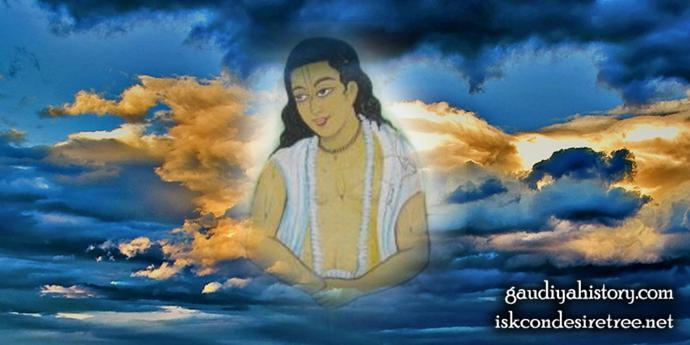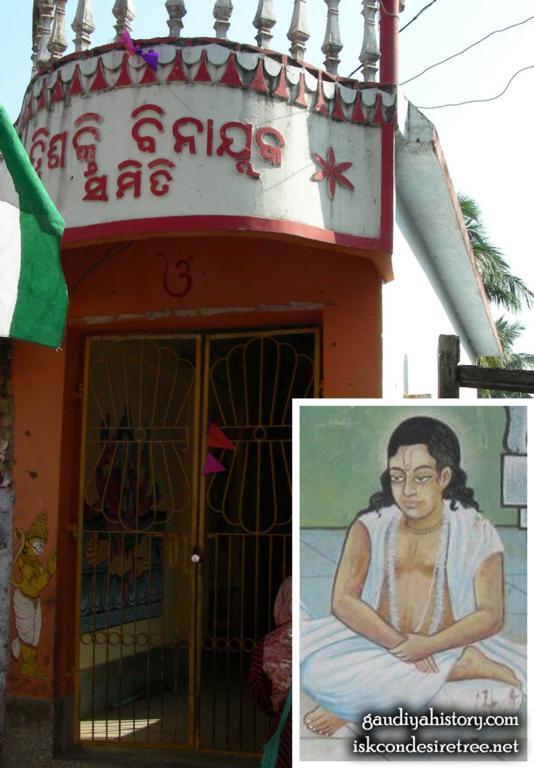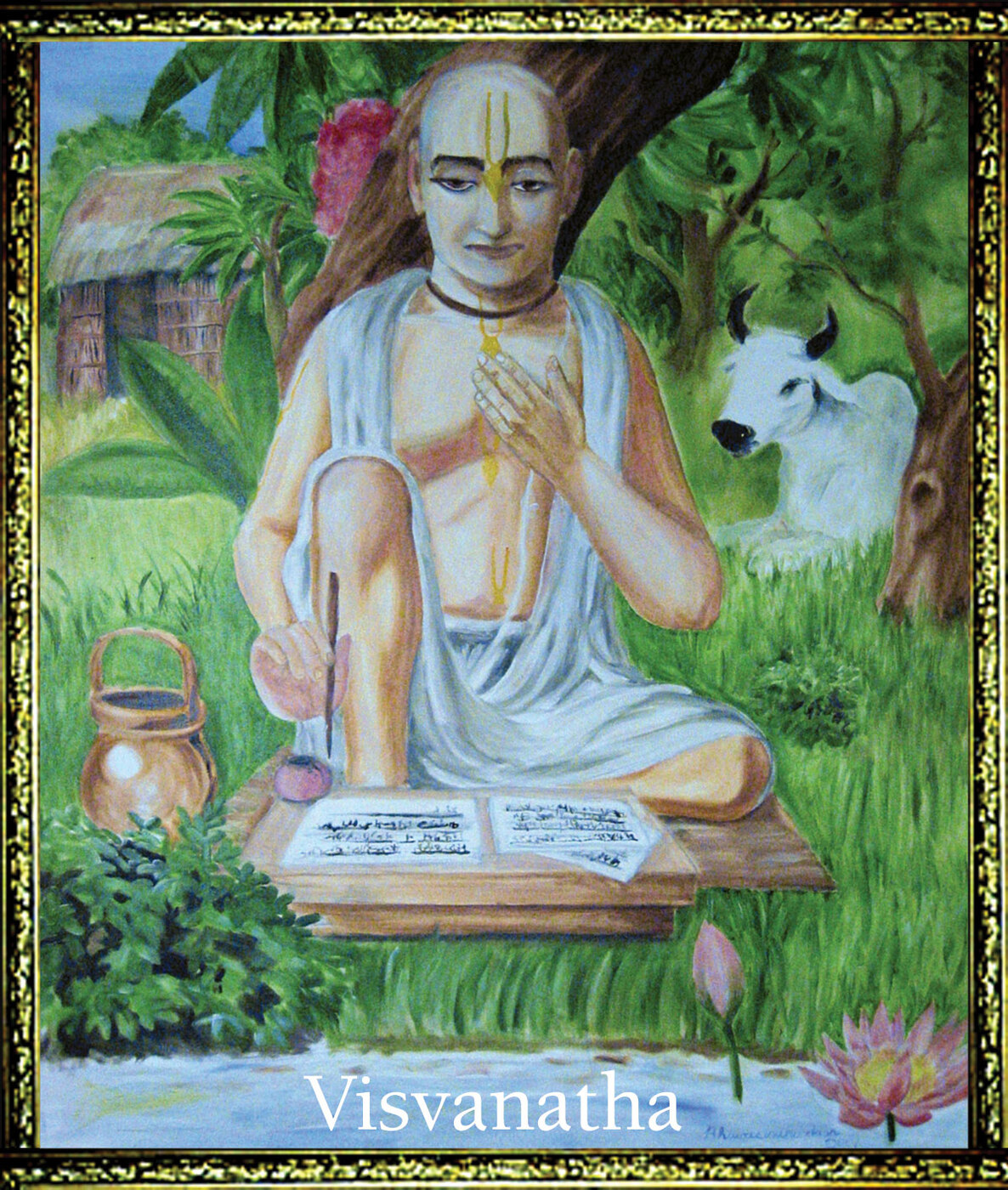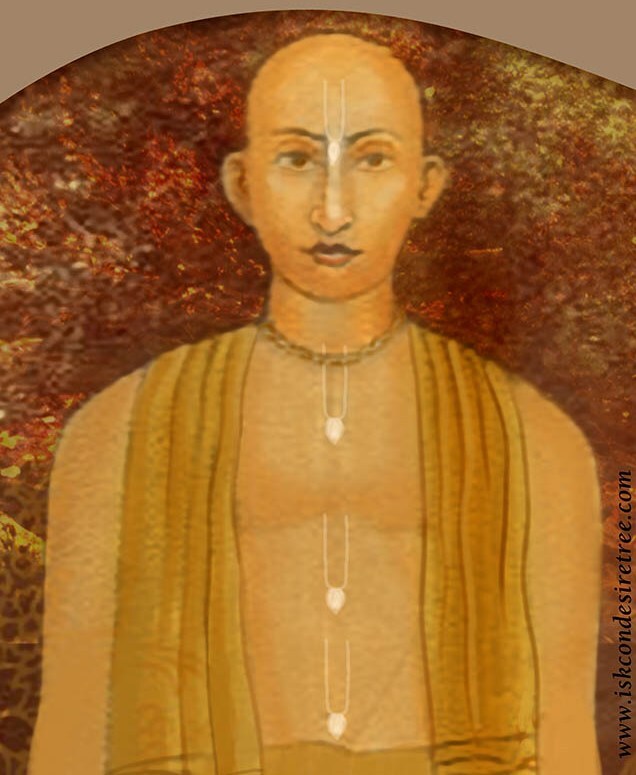
Srila Baladeva Vidyabhusana
Author of the Govinda-bhashya
Also known as Baladeva Vidyabhushana, Govinda Dasa, Vidyabhusana
“By his mercy Sri Govinda revealed this commentary to me in a dream, and for this the learned gave me the name Vidyabhushana - yet all credit belongs to Him, the dearest friend of Srimati Radhika. May that Govinda be forever glorified.”
Baladeva Vidyabhusana's own closing verse appended to the Govinda-bhashya, describing how the commentary was revealed to him in a dream by the Deity of Govindaji
vidyā-rūpaṁ bhūṣaṇaṁ me pradāya kīrtiṁ nityāṁ tena yo mad-udāraḥ
śrī-govinda-svapna-nirdiṣṭa-bhāṣyo rādhā-bandhur bandhu-raṅgaḥ sa jīyāt
"By his mercy Sri Govinda revealed this commentary to me in a dream, and for this the learned gave me the name Vidyabhushana, yet all credit belongs to Him, the dearest friend of Srimati Radhika. May that Govinda be forever glorified."
Baladeva Vidyabhushana composed this verse himself, in the closing lines of the Govinda-bhashya. It tells us a great deal about him. Even while describing the achievement that made him famous, he turned the credit away from his own scholarship and gave it to Sri Govindaji.
Srila Baladeva Vidyabhusana came into the Gaudiya Vaishnava parampara from an unexpected direction. He was already an accomplished scholar of the rival Madhva, or Tattvavada, school of Vedanta when he converted, in mid-life, to the teachings of Sri Chaitanya Mahaprabhu. That unusual background turned out to be exactly what the Gaudiya sampradaya needed a generation later. At the royal court of Jaipur, its right to worship the Deities of Govinda and Gopinatha was challenged, because it had no formal Vedanta-sutra commentary. Tradition says that within a remarkably short time Baladeva supplied one, the Govinda-bhashya. It has stood as the philosophical foundation of Gaudiya Vaishnavism ever since.
| Detail | Description |
|---|---|
| Born | c. early 18th century (exact year unknown), a village near Remuna, Balasore region, Odisha |
| Family | A vaishya (farming) family; his forefathers were agriculturists |
| Diksha guru | Radha-Damodara Gosvami, at Jagannatha Puri |
| Siksha guru | Vishvanatha Chakravarti Thakura, in Vrindavana |
| Chief work | Govinda-bhashya, the first Vedanta-sutra commentary of the Gaudiya sampradaya |
| Also known as | Govinda Dasa |
| Disappeared | Traditionally dated 1768; some scholars place it as late as 1793 (disputed), Vrindavana |
At a Glance
- Spent years as a Tattvavada (Madhva) sannyasi and travelling debater before he ever heard the teachings of Sri Chaitanya Mahaprabhu.
- Converted and took initiation from Radha-Damodara Gosvami at Jagannatha Puri, then went on to Vrindavana to study under Vishvanatha Chakravarti Thakura.
- Represented the Gaudiya Vaishnavas when their worship of Govindaji was formally challenged at the Jaipur court.
- Composed the Govinda-bhashya, earning the title "Vidyabhushana," ornament of learning.
- Left behind two dozen or more works of Vedanta, poetry, grammar and scriptural commentary, and is still quoted by Srila Prabhupada as an authority.
Early Life and a Rival Vedanta School #
Almost nothing is reliably known about Baladeva's birth. He is generally said to have appeared in the early eighteenth century in a village near Remuna, in the Balasore region of Odisha. He was the son of a vaishya farming family. Srila Prabhupada himself mentions that "his forefathers were agriculturists." Even the name he had before initiation is not recorded. All sides agree that he mastered Sanskrit grammar, poetry, rhetoric and logic at an early age. He then took sannyasa in the Tattvavada line founded by Madhvacharya. He travelled across India as a dig-vijaya pandit, a scholar who toured the great centres of learning of the country and defeated rival logicians in open debate.
Conversion at the Feet of Radha-Damodara Gosvami #
Baladeva's life changed at Jagannatha Puri, when he was already deep into his career as a Madhva debater. There he met Radha-Damodara Gosvami, a disciple of Rasikananda Prabhu in the line of Shyamananda Pandita, one of Chaitanya Mahaprabhu's own associates. Baladeva heard Radha-Damodara Gosvami explain Mahaprabhu's teaching and the Gaudiya understanding of Vedanta and Srimad-Bhagavatam, and it left a deep impression on him. Within days Baladeva accepted initiation from him into the Radha-Krishna mantra, and he studied Jiva Gosvami's Sat-sandarbhas at his feet. His guru then sent him on to Vrindavana for deeper training under Vishvanatha Chakravarti Thakura. Vishvanatha kept the promising scholar close and personally taught him the achintya-bheda-abheda philosophy of Sri Chaitanya. They were so close that Srila Prabhupada, in a lecture on Baladeva's appearance day, described Baladeva as one who "happened to be just like his disciple."
The Challenge at the Jaipur Court #
The most important episode of Baladeva's life took place at the court of Jaipur. There, Ramanandi scholars of the Sri Sampradaya argued that the Gaudiya Vaishnavas had produced no commentary of their own on the Vedanta-sutra. So, they said, the Gaudiyas were not a bona fide school and had no right to the Deity worship of Govindaji, which had been entrusted to Bengali priests there. Vishvanatha Chakravarti Thakura was by then too old to travel, so he sent Baladeva to answer the challenge in his place. Even the date of this episode is disputed among scholars. The years proposed range from the early 1700s to the 1730s or 1740s.
The Govinda-bhashya #
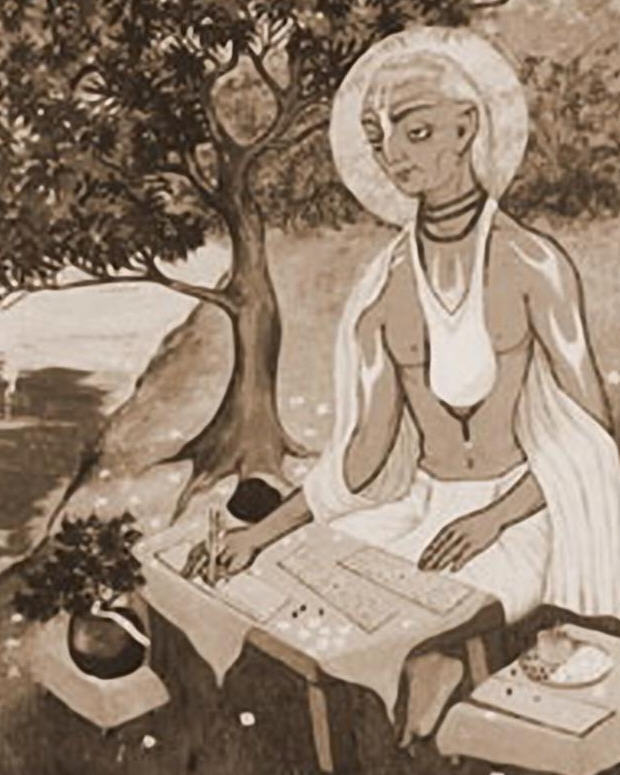
Baladeva now had to produce a direct Vedanta-sutra commentary, although none of his sampradaya's acharyas had written one. He took his difficulty to the Deity of Govindaji and, tradition holds, was answered in a dream. What followed was the Govinda-bhashya. He composed it with such speed and force that the assembled pandits could find no fault in it. In a closing verse, Baladeva himself gave the credit for the achievement to the Deity, not to his own scholarship.
Other Writings #
The Govinda-bhashya was only the best known of a large body of work. Baladeva also wrote the Prameya-ratnavali, a short summary of the nine philosophical principles shared by the Madhva and Gaudiya schools. His Siddhanta-ratna and Vedanta-syamantaka support and restate the conclusions of the Govinda-bhashya. The Gitabhushana is his full commentary on the Bhagavad-gita. He also wrote commentaries on the Isha and Gopala-tapani Upanishads, the Vishnu-sahasra-nama, and Jiva Gosvami's Tattva-sandarbha, among more than twenty other titles.
Years at Vrindavana #
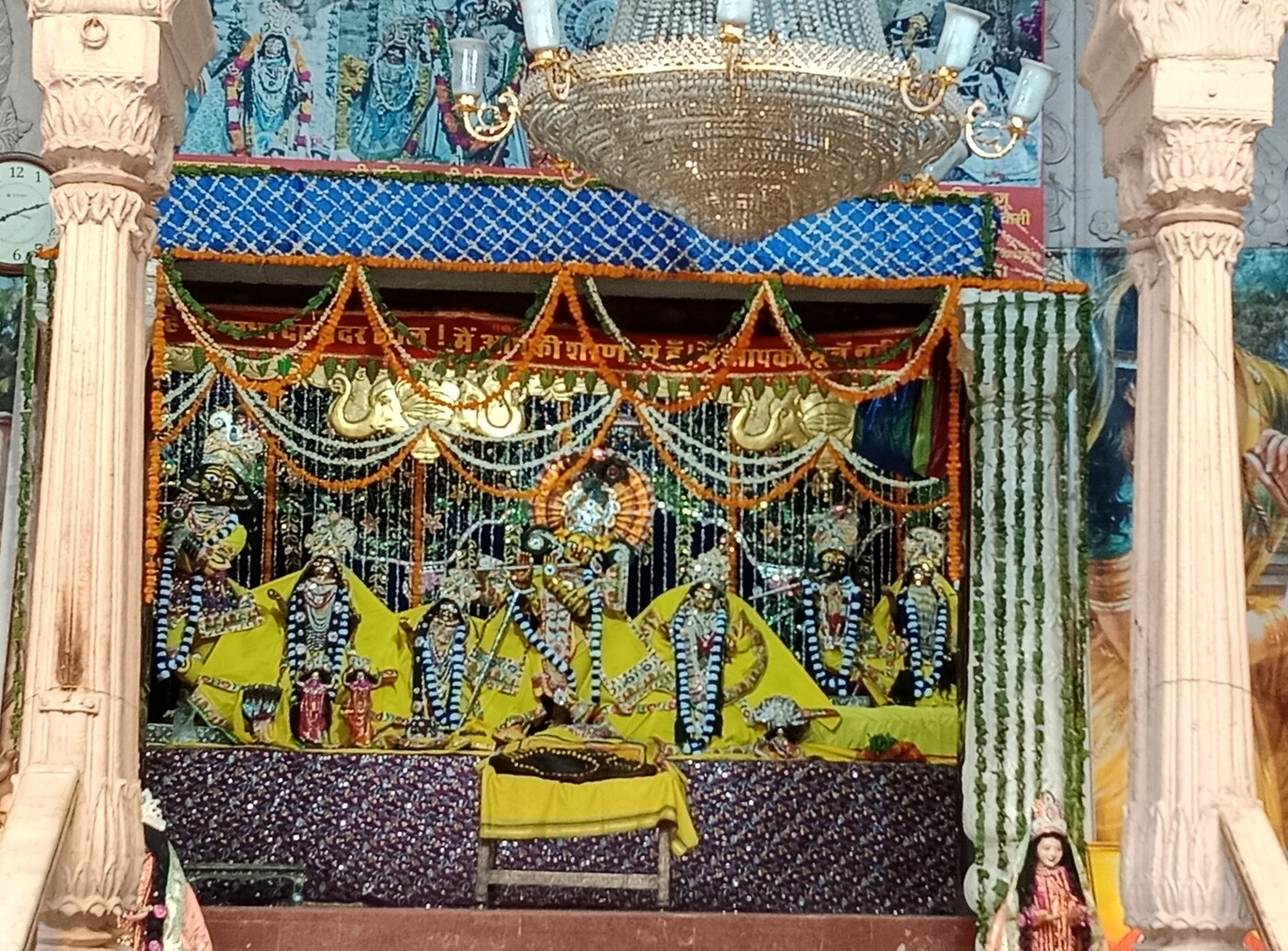
After his years of training and the victory at Jaipur, Baladeva remained in Vrindavana for the rest of his life. He was closely tied to the Radha-Shyamsundar temple established by followers of Shyamananda Pandita. This was the same spiritual line that his own diksha-guru belonged to. There, tradition holds, he obtained permission to install the large Deities of Radha-Shyamsundar, who are still worshiped today. In this he remained separate from his teacher Vishvanatha Chakravarti Thakura, whose own temple was a different one, Radha-Gokulananda.
Disappearance and Legacy #
Sources disagree sharply on when Baladeva Vidyabhusana passed from this world: Gaudiya Vaishnava tradition generally gives 1768, while some modern historical accounts place his disappearance as late as 1793, a gap of twenty-five years that remains unresolved. What is beyond dispute is his lasting influence. Srila Prabhupada dedicated his Bhagavad-gita As It Is "To Srila Baladeva Vidyabhushana, who presented so nicely the Govinda-bhashya commentary on Vedanta philosophy," and repeatedly cited him in lectures as the Gaudiya sampradaya's own Vedanta-acharya.
What Srila Prabhupada said
So today is the birthday of Baladeva Vidyābhūṣaṇa? So Baladeva Vidyābhūṣaṇa, you have seen in my Bhagavad-gītā his name: dedicated to Baladeva Vidyābhūṣaṇa, who has written the commentary on Brahma-sūtra, Govinda-bhāṣya. Śrī Baladeva Vidyābhūṣaṇa is our ācārya. Baladeva Vidyābhūṣaṇa is a fourth-generation ācārya from Lord Caitanya—fourth or fifth.
Frequently asked
When was Srila Baladeva Vidyabhusana born?
Srila Baladeva Vidyabhusana appeared c. early 18th century (exact year unknown) in a village near Remuna, Balasore region, Odisha.
Who was the guru of Srila Baladeva Vidyabhusana?
The spiritual master of Srila Baladeva Vidyabhusana was Srila Vishvanatha Chakravarti Thakura.
When and where did Srila Baladeva Vidyabhusana disappear?
Srila Baladeva Vidyabhusana disappeared traditionally 1768; some scholars place it as late as 1793 (disputed) at Vrindavana.
What are the main pastimes of Srila Baladeva Vidyabhusana?
The pastimes covered here include: Early Life in the Madhva Tradition, Conversion to Gaudiya Vaishnavism, The Jaipur Challenge, Composing the Govinda-bhashya, Other Literary Works, Teacher at Radha-Shyamsundar Temple, Disappearance and Legacy.