Sri Gadadhara Pandit
The Lord's Own Pleasure Potency
The complete life, on one page: The main biography and every pastime page, in order, in one place
Introduction
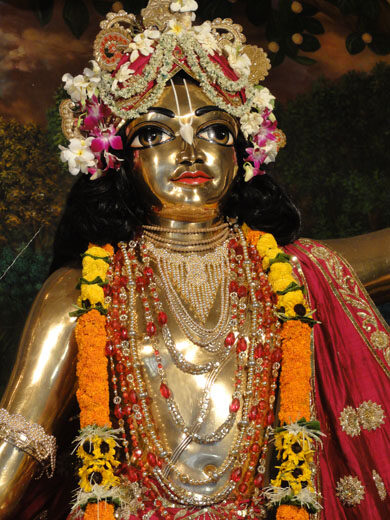
Sri Gadadhara Pandit is the fourth member of the Panca-tattva. In Gaudiya theology He represents the Lord's internal pleasure potency, the shakti-tattva. While Sri Chaitanya Mahaprabhu is Krishna in the mood of Srimati Radharani, Gadadhara Pandit is understood to be Radharani herself, present alongside Him throughout His life. The tradition understands Gadadhara's constant attendance on Mahaprabhu in exactly this light.
| Detail | Description |
|---|---|
| Appearance | Around 1486, the same year as Mahaprabhu, at Nabadwip |
| Parents | Madhava Mishra and Ratnavati Devi |
| Family origin | Chittagong |
| Identity | Krishna's pleasure potency, Srimati Radharani; the bhakta-shakti of the Panca-tattva (Gaura-ganoddesha-dipika 11, 147; Chaitanya-charitamrita Adi 10.15) |
| Spiritual master | Pundarika Vidyanidhi |
| Life's service | The Deity of Tota Gopinatha at Jagannatha Puri |
Scriptural evidence for the introduction (3)
अस्यार्थो विवृतस्तैर्यः स सङ्क्षिप्य विलिख्यते ।
भक्तरूपो गौरचन्द्रो यतोऽसौ नन्दनन्दनः ॥
भक्तस्वरूपो नित्यानन्दो व्रजे यः श्रीहलायुधः ।
भक्तावतार आचार्योऽद्वैतो यः श्रीसदाशिवः ॥
भक्ताख्याः श्रीनिवासाद्या यतस्ते भक्तरूपिनः ।
भक्तशक्तिर्द्विजाग्रण्यः श्रीगदाधरपण्डितः ॥११॥
asyārtho vivṛtas tair yaḥ sa saṅkṣipya vilikhyate |
bhakta-rūpo gauracandro yato’sau nanda-nandanaḥ ||
bhakta-svarūpo nityānando vraje yaḥ śrī-halāyudhaḥ |
bhaktāvatāra ācāryo’dvaito yaḥ śrī-sadāśivaḥ ||
bhaktākhyāḥ śrīnivāsādyā yatas te bhakta-rūpinaḥ |
bhakta-śaktir dvijāgraṇyaḥ śrī-gadādhara-paṇḍitaḥ ||11||
I shall now summarily explain the meaning of these words. In this Panca-tattva, the bhakta-rupa (form of a devotee) is Lord Caitanya Mahaprabhu, who formerly appeared as Lord Krsna, the son of Nanda Maharaja. The bhakta-svarupa (devotional incarnation) is Lord Nityananda, who formerly appeared in Vrajabhumi as Lord Balarama. The bhaktavatara (devotional manifestation) is Lord Advaita Acarya, who is not different from Lord Sadasiva. The bhaktakhya (pure devotee) is Srinivasa and the other great devotees as well. The bhakta-sakti (devotional energy) is Gadadhara Pandita, the foremost of brahmanas.
From the purport: All the devotees headed by Śrīvāsa Ṭhākura are His marginal energy, whereas the devotees headed by Gadādhara Paṇḍita are manifestations of His internal potency.
Kavi Karnapura's summary of the Panca-tattva: Gadadhara Pandit is the bhakta-shakti, the devotional energy. Sanskrit: diacritic edition of the Gaura-ganoddesha-dipika; English translation as published at bvmlu.org. Purport excerpt: Srila Prabhupada, Chaitanya-charitamrita Adi 17.301.
श्रीराधा प्रेमरूपा या पुरा वृन्दावनेश्वरी ।
सा श्रीगदाधरो गौरवल्लभः पण्डिताख्यकः ॥१४७॥
śrī-rādhā prema-rūpā yā purā vṛndāvaneśvarī |
sā śrī-gadādharo gaura-vallabhaḥ paṇḍitākhyakaḥ ||147||
Śrī Kṛṣṇa's pleasure potency, formerly known as Vṛndāvaneśvarī, is now personified in the form of Śrī Gadādhara Paṇḍita in the pastimes of Lord Caitanya Mahāprabhu.
From the purport: Formerly, as Lalitā-sakhī, she was always devoted to Śrīmatī Rādhārāṇī. Thus Gadādhara Paṇḍita is simultaneously an incarnation of Śrīmatī Rādhārāṇī and Lalitā-sakhī.
Identifies Gadadhara Pandit as Sri Radha, the queen of Vrindavana; the following verses (148-153) add that Lalita-sakhi also entered him. Sanskrit: diacritic edition of the Gaura-ganoddesha-dipika; translation: Srila Prabhupada, Chaitanya-charitamrita Adi 10.15 purport.
বড় শাখা,—গদাধর পণ্ডিত–গোসাঞি ।
তেঁহো লক্ষ্মীরূপা, তাঁর সম কেহ নাই ॥ ১৫ ॥
baḍa śākhā, — gadādhara paṇḍita-gosāñi
teṅho lakṣmī-rūpā, tāṅra sama keha nāi
Gadādhara Paṇḍita, the fourth branch, is described as an incarnation of the pleasure potency of Śrī Kṛṣṇa. No one, therefore, can equal him.
From the purport: Śrī Kṛṣṇa's pleasure potency, formerly known as Vṛndāvaneśvarī, is now personified in the form of Śrī Gadādhara Paṇḍita in the pastimes of Lord Caitanya Mahāprabhu.
Krishnadasa Kaviraja Goswami calls Gadadhara Pandit lakshmi-rupa, the incarnation of Krishna's pleasure potency.
Chapter 1
The Advent and Childhood of Gadadhara Pandit
Born in the same year and the same neighbourhood as Nimai, and about as unlike Him in temperament as a boy could be
Most of the Vaishnavas of the generation in which Gadadhara Pandit grew up had come to Nabadwip from somewhere else. In the fifteenth century, learned brahmana families in Bengal often moved from place to place. Nabadwip, as the most famous seat of Sanskrit study in the province, drew them in. The family of Gadadhara Pandit came from the far east of the region, from the Chittagong district, in what is now Bangladesh. There they belonged to the group of brahmanas known as Varendra. His father was Madhava Mishra and his mother was Ratnavati Devi. He had a younger brother, Baninath. The family considered itself part of the Kashyapa gotra.
| Detail | Description |
|---|---|
| Year of birth | Saka 1408, or 1486 of the Western calendar |
| Father | Madhava Mishra |
| Mother | Ratnavati Devi |
| Younger brother | Baninath |
| Family origin | Varendra brahmanas of the Chittagong district |
| Gotra | Kashyapa |
Two Accounts of His Birthplace #
The biographies differ on one point of detail, and we record both versions here instead of smoothing over the difference. Some accounts, including the life compiled by Bhakti Ballabh Tirtha Maharaja, place his birth in the village of Beleti in Chittagong in the Saka year 1408, or 1486 of the Western calendar. They say that the family moved to Nabadwip when the boy was twelve. Other accounts say the family had already settled on the Ganges bank at Mayapur before he was born, a few doors from the house of Jagannatha Mishra. They describe Ratnavati Devi as being like a sister to Sachi Devi and constantly in and out of her house. The whole body of stories about Gadai and Nimai as inseparable small boys rests on this second version, and it is the version most Gaudiya Vaishnavas know. All the accounts agree that he was born in the same year as Chaitanya Mahaprabhu, or within a year of it. They also agree that from a very early age the two were in each other's company.
Nimai and Gadadhara as Boys #
This near-equal age matters, because almost nothing else about the two boys matched. Nimai was famous for His love of fighting with words. His memory was amazing. By His teens His command of grammar and logic was so strong that no scholar in the town would willingly meet Him in argument. He also enjoyed argument for its own sake. The biographies describe Him tearing down a position and then building it up again better than its author had, purely to show that He could. Gadadhara was the opposite kind of person. He was quiet, serious, physically slight and not interested in debate. Every source insists that from childhood he did not care for the ordinary pleasures of the world. He was drawn instead to the older Vaishnavas of Nabadwip. They were a little circle who met at Advaita Acharya's house to read the Bhagavatam and chant the holy names. At that time this circle counted for very little in the town, where religious respect belonged to ritualists and logicians.
Nimai's Question About Liberation #
Vrindavana Dasa Thakura preserves an exchange from those school years. Looking back, it reads like a joke the Lord was playing on Himself. Nimai had a habit of stopping devotionally minded students in the street and tangling them in questions they did not want to answer. He asked Gadadhara to define liberation. Gadadhara answered as a student of Nyaya would answer: liberation is the final and absolute cessation of all misery. Nimai then took the definition apart. The devotees standing by are said to have watched this display. They thought how wonderful it would be if such a brilliant young man ever became a devotee. At that stage they had entirely given up hope of this. It is the same pairing that would define the two men for the rest of their lives, with the terms reversed: the one who could out-argue anybody, and the one who never argued at all.
Isvara Puri and the Krishna-lilamrita #
Something else belongs to this period. Isvara Puri was the Vaishnava sannyasi who would later give Mahaprabhu initiation at Gaya. He spent some months in Nabadwip during these years. The accounts say he was struck by the young Gadadhara's detachment and personally taught him his own composition, the Krishna-lilamrita. It is only a short mention, but it places Gadadhara inside the Madhavendra Puri line of devotion well before the sankirtana movement began. It also explains why he needed no persuading when the movement did begin.
A Lifelong Brahmachari #
Gadadhara Pandit never married. He remained a brahmachari for his whole life. In a society where almost every brahmana married as a matter of course, this was very noticeable. It also made possible the kind of life he later lived: the move to Jagannatha Puri, the vow to remain there, and the decades of Deity service with no household to divide him.
The Pleasure Potency in the Panca-tattva #
Gaudiya theology places him fourth among the five features of the Panca-tattva, and defines that place quite exactly. Krishnadasa Kaviraja writes that three of the five, Chaitanya Mahaprabhu, Nityananda Prabhu and Advaita Acharya, are to be worshipped by all living beings. He writes that the fourth is to be understood as their worshipper. Elsewhere he writes that Gadadhara Pandit is an incarnation of the pleasure potency of Krishna, with whom no one is to be compared. Kavi Karnapura, in the Gaura-ganoddesa-dipika, is more specific still. He says that the pleasure potency who was formerly the queen of Vrindavana is present in Chaitanya Mahaprabhu's pastimes as Gadadhara Pandit. He adds that something of Lalita, Radharani's closest friend, has entered him as well. So the tradition does not understand him as an unusually devoted friend of the Lord. It understands him as the Lord's own internal energy in a male brahmana body, the shakti standing beside the shaktiman. This is why the Deity pair worshipped in a great many Bengali temples is not Gaura alone but Gaura-Gadadhara.
Whether or not a reader shares that theology, it is worth noticing what the tradition chose to say it with. It could have located the pleasure potency of God in some visibly extraordinary figure. Instead it located her in a retiring, unassertive boy from the next street who was no good at debate, who never founded anything, and whose entire public career consisted of standing next to somebody else. The friendship that began in those Nabadwip lanes is taken up here.
Scriptural evidence for this chapter (5)
বড় শাখা,—গদাধর পণ্ডিত–গোসাঞি ।
তেঁহো লক্ষ্মীরূপা, তাঁর সম কেহ নাই ॥ ১৫ ॥
baḍa śākhā, — gadādhara paṇḍita-gosāñi
teṅho lakṣmī-rūpā, tāṅra sama keha nāi
Word for word
baḍa śākhā: big branch; gadādhara paṇḍita-gosāñi: the descendants or disciplic succession of Gadādhara Paṇḍita; teṅho: Gadādhara Paṇḍita; lakṣmī-rūpā: incarnation of the pleasure potency of Lord Kṛṣṇa; tāṅra: his; sama: equal; keha: anyone; nāi: there is none.
Gadādhara Paṇḍita, the fourth branch, is described as an incarnation of the pleasure potency of Śrī Kṛṣṇa. No one, therefore, can equal him.
Gadadhara Pandit named as the fourth branch of the Chaitanya tree and an incarnation of the pleasure potency of Krishna, with whom none can be equated.
এই তিন তত্ত্ব,—‘সর্বারাধ্য’ করি মানি ।
চতুর্থ যে ভক্ততত্ত্ব,—‘আরাধক’ জানি ॥ ১৫ ॥
ei tina tattva, — ‘sarvārādhya’ kari māni
caturtha ye bhakta-tattva, — ‘ārādhaka’ jāni
Word for word
ei tina tattva: all three of these truths; sarva-ārādhya: worshipable by all living entities; kari māni: accepting such; caturtha: fourth; ye: who is; bhakta-tattva: in the category of devotees; ārādhaka: worshiper; jāni: I understand.
The three predominators [Caitanya Mahāprabhu, Nityānanda Prabhu and Advaita Prabhu] are worshipable by all living entities, and the fourth principle [Śrī Gadādhara Prabhu] is to be understood as Their worshiper.
The three predominators of the Panca-tattva are worshipable by all; the fourth principle is to be understood as their worshipper.
গদাধর–পণ্ডিতাদি প্রভুর ‘শক্তি’–অবতার ।
অন্তরঙ্গ–ভক্ত’ করি’ গণন যাঁহার ॥ ১৭ ॥
gadādhara-paṇḍitādi prabhura ‘śakti’-avatāra
‘antaraṅga-bhakta’ kari’ gaṇana yāṅhāra
Word for word
gadādhara: Gadādhara; paṇḍita: of the learned scholar; ādi: headed by; prabhura: of the Lord; śakti: potency; avatāra: incarnation; antaraṅga: very confidential; bhakta: devotee; kari’: accepting; gaṇana: counting; yāṅhāra: of whom.
The devotees headed by Gadādhara Paṇḍita are to be considered incarnations of the internal potency of the Lord. They are confidential devotees engaged in the service of the Lord.
The devotees headed by Gadadhara Pandit are incarnations of the internal potency, the shakti-tattva definition of his position.
গদাধর পণ্ডিতাদি—প্রভুর নিজশক্তি ।
তাঁ’ সবার চরণে মোর সহস্র প্রণতি ॥ ৪১ ॥
gadādhara-paṇḍitādi — prabhura nija-śakti
tāṅ’-sabāra caraṇe mora sahasra praṇati
Word for word
gadādhara-paṇḍita-ādi: headed by Śrī Gadādhara Paṇḍita; prabhura: of the Supreme Lord; nija-śakti: internal potencies; tāṅ’-sabāra: of all of them; caraṇe: unto the lotus feet; mora: my; sahasra: thousands; praṇati: respectful obeisances.
I offer my respectful obeisances unto the internal potencies of the Lord, of whom Śrī Gadādhara Prabhu is the foremost.
Krishnadasa Kaviraja's obeisances to the internal potencies of the Lord, of whom Gadadhara Prabhu is foremost.
শ্রীচৈতন্য, নিত্যানন্দ, অদ্বৈত,—তিন জন ।
শ্রীবাস–গদাধর–আদি যত ভক্তগণ ॥ ১৬৯ ॥
śrī-caitanya, nityānanda, advaita, — tina jana
śrīvāsa-gadādhara-ādi yata bhakta-gaṇa
Word for word
śrī-caitanya, nityānanda, advaita: Śrī Caitanya Mahāprabhu, Nityānanda Prabhu and Advaita Prabhu; tina: these three; jana: personalities; śrīvāsa-gadādhara: Śrīvāsa and Gadādhara; ādi: etc.; yata: all; bhakta-gaṇa: the devotees.
While chanting the Pañca-tattva mahā-mantra, one must chant the names of Śrī Caitanya, Nityānanda, Advaita, Gadādhara and Śrīvāsa with their many devotees. This is the process.
The Panca-tattva mantra, in which Gadadhara is named fourth, the form in which most devotees encounter him daily.
Chapter 2
Friendship with Nimai Pandita
Playmates, then fellow students, then something the biographies had no ordinary word for
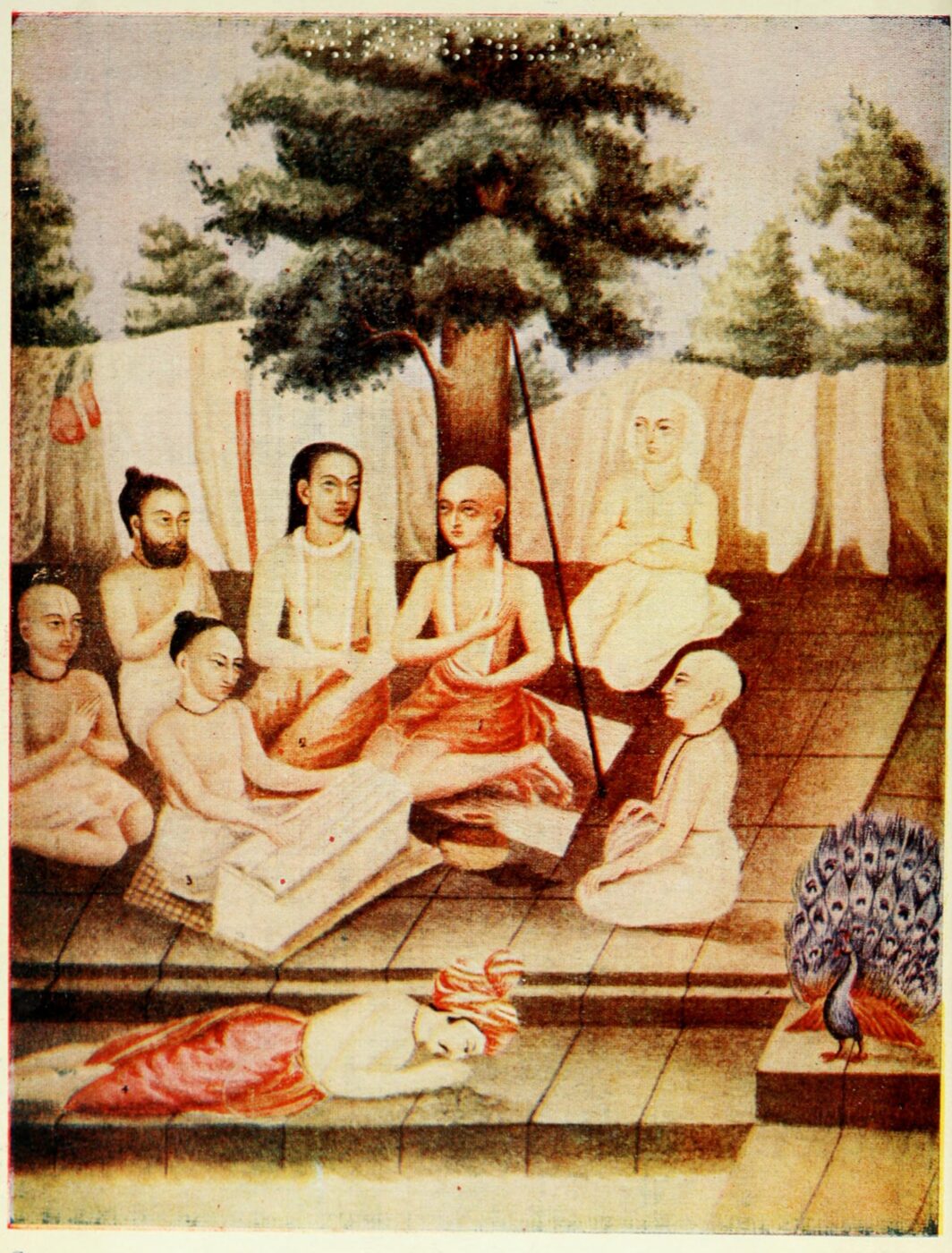
Two boys of the same age who live a few houses apart on the bank of the Ganges will naturally spend a lot of time together, whether they suit each other or not. Gadai and Nimai were together from the very beginning. The Vaishnava biographies describe them as inseparable in childhood. People in Bengal still lovingly call them by the joint name Gadai-Gauranga, and this name goes back to that early period, not to anything later.
Asked to Define Liberation #
What the friendship looked like in the school years is best shown by an incident that Vrindavana Dasa Thakura records. Nimai was studying at the tol of Gangadasa Pandit. By His mid-teens His fame as a logician had made Him a trouble to many in the town. He would stop scholars in the road and challenge them to debate. He especially enjoyed challenging those who were inclined to devotion. They thought all this arguing was a waste of life, and they would take a longer route home to avoid Him. Mukunda Datta and Srivasa Pandit were among those who avoided Him. But Gadadhara was His neighbour and friend, so he could not avoid Him. One day Nimai asked Gadadhara to define liberation. Gadadhara gave the standard Nyaya answer, that liberation is the final end of all misery. Nimai then tore his answer apart in front of everyone. The devotees who were present are said to have thought privately what a great devotee this boy would become if He ever turned to devotion.
The Change After the Journey to Gaya #
Nimai's great change came in 1508 or thereabouts, on the journey to Gaya. Bhaktivinoda Thakura's summary of what happened next is helpful here, because it describes Him as the men who had known Him before saw Him. On His return to Nadia He was no longer a contending logician, a wrangling ritualist or a critical rhetorician. He fainted at the name of Krishna and behaved like a man under the power of something. Advaita Acharya, Srivasa and the others who had been Vaishnavas for years were astonished at the change. Most people in Nabadwip were not astonished but embarrassed, and they thought He had lost His mind.
Fainting at Shuklambara Brahmachari's House #
Gadadhara's place among the devotees was clear almost at once. The Chaitanya-bhagavata describes the first time Mahaprabhu revealed His identity to the devotees, at the house of Shuklambara Brahmachari. Gadadhara came and stayed quietly out of the way. When he saw the Lord overcome by the holy names, he fainted. The tradition still remembers what Mahaprabhu said to him then. He said that Gadadhara was fortunate, because from earliest childhood his mind had been fixed on Krishna's feet, while He Himself had wasted a human birth on useless learning. Mahaprabhu had just been revealed as the Supreme Lord, so these words were not modesty. The tradition understands them as the shaktiman acknowledging the shakti.
Nights of Kirtana in Srivasa's Courtyard #
In those first years the heart of the movement was the courtyard of Srivasa Thakura's house, a couple of hundred yards up the bank from where Nimai and Gadadhara lived. For the whole year that the kirtana was held there behind closed doors, Gadadhara was present every night. He saw the great revelations of that period. One night Srivasa formally bathed and worshipped Mahaprabhu as one installs a Deity. On another night Nityananda Prabhu arrived and was shown first the six-armed form and then the two-armed cowherd of Vrindavana. There were also the twenty-one unbroken hours of ecstasy that Krishnadasa Kaviraja records without trying to describe. In none of these scenes was Gadadhara just an onlooker who happened to be let in. The devotees around him understood that his presence was part of what made these scenes possible.
This is because, in the house of Srivasa Thakura, Gadadhara had a special and practical duty. He was the one who could bring the Lord back to outward awareness. Mahaprabhu's ecstatic states in that period were violent as well as beautiful, and dangerous to Himself. One night, when He was crying out to know where Krishna was, Gadadhara told Him that Krishna was hidden in His own heart. At this the Lord began to tear at His own chest to reach Krishna. Gadadhara had to seize His hands and hold Him, saying that Krishna would come shortly and that He must be patient. Sachi Devi, watching, asked Gadadhara to stay always at her son's side. In practice Gadadhara did so for the next twenty-six years.
Making Garlands and Sandalwood Paste #
Besides this, his services in the Nabadwip period were household and personal ones. He made garlands of forest flowers for the Lord, prepared sandalwood paste for His body, and looked after His room and His bed. The biographers make this comparison on purpose. As Radharani dressed and decorated Krishna in Vrindavana, so Gadadhara dressed and decorated Gauranga in Nadia. The accounts say he was present at everything. He was at the water sports on the Ganges after the deliverance of Jagai and Madhai, at the great revelations in Srivasa's courtyard, at the night procession to the house of the Kazi, and at Katwa when the Lord took sannyasa.
The Play at Chandrasekhara Acharya's House #
One episode from those years is remembered with special affection. Chandrasekhara Acharya's house was the place of a dramatic performance of Krishna's pastimes. In it Mahaprabhu Himself took the part of Rukmini, Srivasa played Narada Muni and Haridasa Thakura played the village constable. In the second act Gadadhara also appeared dressed as a woman. Mahaprabhu then remarked that Gadadhara belonged to His own family in the spiritual world. It was a light remark in the middle of a village play, but the tradition has never treated it as light.
Worshipping Gaura and Gadadhara Together #
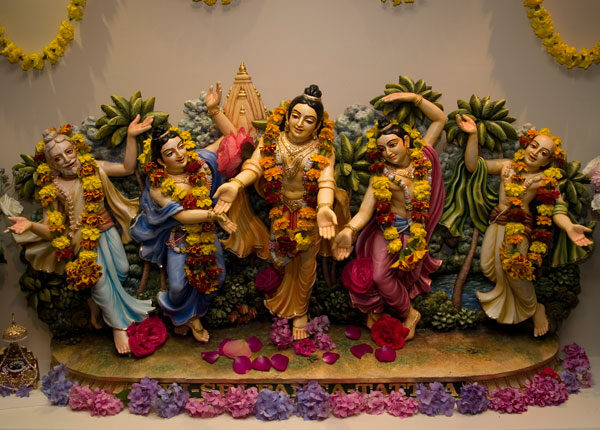
It is also from this period that the biographers date the practice, still followed across Bengal, of worshipping the two together. The tradition understands that Radha and Krishna came to Nabadwip as Gaura and Gadadhara. It sees the groves along the Ganges, where the young men sat and sang, as that same pastime continuing under other names. Whether one reads this as theology or as the way a community remembers an extraordinary friendship, it explains a fact about Gaudiya pictures and temple images that could otherwise seem strange. Chaitanya Mahaprabhu is very often not shown alone.
After the Sannyasa at Katwa #
Then, in January 1510, the Lord took sannyasa at Katwa at the age of twenty-four, and the household life of Nabadwip ended for everyone. Nityananda Prabhu was later sent back to Bengal to preach. Advaita Acharya stayed on at his home in Shantipura. Srivasa moved to Kumarahatta and came south once a year. Gadadhara went to Jagannatha Puri behind Mahaprabhu and stayed there for the rest of his life, which is the subject of another page.
Gaudiya theology sees this friendship as a necessity, not a happy accident. In this understanding, Chaitanya Mahaprabhu is Krishna who has taken the complexion and the inner feelings of Radharani, so that He can taste His own sweetness from the devotee's side. If that is so, then the potency by which He tastes it cannot be left behind in Vrindavana. She must be present, and present in a form that does not compete with Him or draw attention. Gadadhara Pandit is that presence. This is the reason Bengali temples so often worship the pair and not the single figure. It is also the reason one of Mahaprabhu's names is simply Gadadhara-prananatha, the life and soul of Gadadhara. How Gadadhara came to take formal initiation, and from whom, is told here.
Scriptural evidence for this chapter (5)
পণ্ডিতের ভাব-মুদ্রা কহন না যায় ।
গদাধর-প্রাণনাথ’ নাম হৈল যায় ॥ ১৬৩ ॥
paṇḍitera bhāva-mudrā kahana nā yāya
‘gadādhara-prāṇa-nātha’ nāma haila yāya
Word for word
paṇḍitera: of Gadādhara Paṇḍita; bhāva-mudrā: characteristics and ecstatic love; kahana nā yāya: cannot be described; gadādhara-prāṇa-nātha: the Lord of the life of Gadādhara; nāma: name; haila: became; yāya: goes.
No one can describe the characteristics and ecstatic love of Gadādhara Paṇḍita. Therefore another name for Śrī Caitanya Mahāprabhu is Gadādhara-prāṇanātha, “the life and soul of Gadādhara Paṇḍita.”
Mahaprabhu is called Gadadhara-prananatha, the life and soul of Gadadhara Pandit, because his ecstatic love cannot be described.
পণ্ডিতে প্রভুর প্রসাদ কহন না যায় ।
গদাইর গৌরাঙ্গ’ বলি’ যাঁরে লোকে গায় ॥ ১৬৪ ॥
paṇḍite prabhura prasāda kahana nā yāya
‘gadāira gaurāṅga’ bali’ yāṅre loke gāya
Word for word
paṇḍite: upon Gadādhara Paṇḍita; prabhura: of Śrī Caitanya Mahāprabhu; prasāda: mercy; kahana nā yāya: no one can explain; gadāira gaurāṅga: the Gaurāṅga of Gadādhara Paṇḍita; bali’: as; yāṅre: whom; loke gāya: people say.
No one can say how merciful the Lord is to Gadādhara Paṇḍita, but people know the Lord as Gadāira Gaurāṅga, “the Lord Gaurāṅga of Gadādhara Paṇḍita.”
The people know the Lord as Gadaira Gauranga, the Gauranga who belongs to Gadadhara.
প্রভুর অভিষেক তবে করিল শ্রীবাস ।
খাটে বসি’ প্রভু কৈলা ঐশ্বর্য প্রকাশ ॥ ১১ ॥
prabhura abhiṣeka tabe karila śrīvāsa
khāṭe vasi’ prabhu kailā aiśvarya prakāśa
Word for word
prabhura: of the Lord; abhiṣeka: worship; tabe: after that; karila: did; śrīvāsa: Śrīvāsa; khāṭe: on the cot; vasi’: sitting; prabhu: Lord Śrī Caitanya Mahāprabhu; kailā: did; aiśvarya: opulence; prakāśa: manifestation.
Śrīvāsa Ṭhākura then worshiped Lord Caitanya Mahāprabhu by the process of abhiṣeka. Sitting on a cot, the Lord exhibited transcendental opulence.
The abhiseka at Srivasa's house, one of the great Nabadwip revelations at which Gadadhara was present.
তবে আচার্যের ঘরে কৈল কৃষ্ণলীলা ।
রুক্মিণী–স্বরূপ প্রভু আপনে হইলা ॥ ২৪১ ॥
tabe ācāryera ghare kaila kṛṣṇa-līlā
rukmiṇī-svarūpa prabhu āpane ha-ilā
Word for word
tabe: thereafter; ācāryera: of Śrī Candraśekhara Ācārya; ghare: in the house; kaila: performed; kṛṣṇa-līlā: pastimes of Lord Kṛṣṇa; rukmiṇī: of Rukmiṇī; svarūpa: form; prabhu: the Lord; āpane: personally; ha-ilā: became.
Thereafter a dramatization of Kṛṣṇa’s pastimes was performed in the house of Śrī Candraśekhara Ācārya. The Lord personally took the part of Rukmiṇī, the foremost of Kṛṣṇa’s queens.
The drama at Chandrasekhara Acharya's house in which Mahaprabhu took the part of Rukmini.
পুনঃ পুনঃ পিয়াইয়া হয় মহামত্ত ।
নাচে, কান্দে, হাসে, গায়, যৈছে মদমত্ত ॥ ২২ ॥
punaḥ punaḥ piyāiyā haya mahāmatta
nāce, kānde, hāse, gāya, yaiche mada-matta
Word for word
punaḥ punaḥ: again and again; piyāiyā: causing to drink; haya: becomes; mahā-matta: highly ecstatic; nāce: dances; kānde: cries; hāse: laughs; gāya: chants; yaiche: as if; mada-matta: one is drunk.
Śrī Pañca-tattva themselves danced again and again and thus made it easier to drink nectarean love of Godhead. They danced, cried, laughed and chanted like madmen, and in this way they distributed love of Godhead.
The members of the Panca-tattva danced, wept, laughed and chanted together and so distributed love of God, the corporate act in which Gadadhara's Nabadwip years consisted.
Chapter 3
Initiation from Pundarika Vidyanidhi
A young ascetic misjudges a devotee by his furniture, and is corrected
Some time during the Nabadwip years, Chaitanya Mahaprabhu was heard weeping and calling out for a man whom none of the devotees present had met. He said that Pundarika was His father, and asked when He would see him again. The devotees asked who this was. They were told that a great Vaishnava named Pundarika Vidyanidhi would soon be coming to Nabadwip.
| Detail | Description |
|---|---|
| Native place | Mekhala, near Hathazari in the Chittagong district |
| Father | Banesvara, or by another account Shuklambara Brahmachari |
| Mother | Gangadevi |
| Community | Varendra brahmanas |
| Identity in Krishna's pastimes | Vrishabhanu, the father of Srimati Radharani |
| Title from Mahaprabhu | Premanidhi |
Who Pundarika Vidyanidhi Was #
Like so many of Mahaprabhu's associates, Pundarika Vidyanidhi came from eastern Bengal, from Mekhala, near Hathazari in the Chittagong district. His father is named as Banesvara, or by another account Shuklambara Brahmachari, and his mother as Gangadevi. The family belonged to the Varendra brahmanas. At some point they had been put out of caste in one of the quarrels that broke out from time to time between the Varendra and Radhiya groups. So the family's social standing was lower than its learning deserved. Kavi Karnapura identifies him as Vrishabhanu, the father of Srimati Radharani, in Krishna's Vrindavana pastimes. This is why Mahaprabhu addressed him as father and gave him the title Premanidhi. Krishnadasa Kaviraja names him the third great branch of the Chaitanya tree and records that in his absence the Lord would sometimes weep.
None of this was visible when he arrived. Pundarika Vidyanidhi came to Nabadwip in the character of a wealthy man of the world and made no attempt to look like anything else. Mukunda Datta, who had lived in Chittagong and knew him, told Gadadhara one day that he was going to introduce him to a most exceptional Vaishnava, and took him along.
Gadadhara's Disappointment at the Opulence #
Gadadhara found a man reclining on an expensive bed under a three-tiered canopy. The sheets, the accounts say, were as white as the foam of milk. Scented pan lay in a jewelled box within reach, there were brass spittoons on either side, and two servants were fanning him. Pundarika received them warmly and talked. Gadadhara was twenty years old and a brahmachari. Since childhood he had not cared for comfort, and by nature he was inclined to take outward appearances seriously. So he could not match any of this with what he had been told. Srila Prabhupada, summarising the episode, states the young man's mistake bluntly: Gadadhara Pandit at first took Pundarika Vidyanidhi for an ordinary pounds-and-shillings man.
The Verse About Putana and Its Effect #
Mukunda saw the doubt on his face and did the one thing that would settle it. He recited aloud the verse from the Third Canto of the Bhagavatam in which Uddhava marvels that Krishna gave the position of a nurse to the witch Putana. She had come with poison on her breast to murder Him. Uddhava asks where a more merciful shelter than that is to be found. The verse affected Pundarika Vidyanidhi at once and completely. He cried out and fell to the ground. All the ecstatic symptoms listed in the Vaishnava books appeared on his body. He tore the fine bedding to pieces, wailing that the Lord was infinitely merciful and yet had held back His mercy from him. Several men together could not hold him down. When the storm finally passed, he was unconscious for some hours.
Mahaprabhu's Correction and the Initiation #
Gadadhara understood at once what he had done. It was not just a private misjudgement. In Vaishnava terms it was an offence at the feet of a devotee, the kind of fault the tradition treats as most serious of all. The remedy came from Mahaprabhu. Here the sources give the order of events slightly differently. In Srila Prabhupada's note, Chaitanya Mahaprabhu corrects Gadadhara, and as a result Gadadhara becomes Pundarika Vidyanidhi's disciple. In the fuller Chaitanya-bhagavata account, the recited verse itself shows Gadadhara his mistake. Afterwards Mahaprabhu advises Gadadhara that the way to be free of the offence is to take initiation from the man he had misjudged. The two accounts agree on everything that matters. Pundarika Vidyanidhi came back to outward consciousness calm again, giving no sign of what had just happened. He then initiated Gadadhara Pandit, and remained his spiritual master for life.
The Second Initiation at Jagannatha Puri #
The story has a final part at Jagannatha Puri. Krishnadasa Kaviraja records that in a later year Pundarika Vidyanidhi stayed on in Puri when the other Bengali devotees went home. He records that Pundarika was a close friend of Svarupa Damodara Goswami, and that he initiated Gadadhara Pandit a second time. In the same passage Krishnadasa Kaviraja also records another incident. On the day of Odana-shashthi, Pundarika Vidyanidhi saw a starched cloth put on Lord Jagannatha and thought critically of the temple servants for it. That night Jagannatha and Balarama visited him and, smiling, slapped his cheeks until they swelled. Pundarika was privately delighted. So the tradition does not present him as flawless. It presents him as someone whose devotion was real, and whose outward appearance could mislead people either way.
Why External Renunciation Is Not the Measure #
The tradition draws a specific lesson from this episode, and it is easy to understand only half of it. The lesson is not that wealth is a qualification, or that renunciation does not matter. Gadadhara Pandit himself lived austerely to the end of his life and took a vow to live at Puri that he never broke. The lesson is that outward renunciation is not the way to measure a Vaishnava, because it measures the wrong thing. Mukunda's verse did not reveal a simple man hiding beneath the silk. The silk was real enough. What the verse revealed was a condition of the heart that had nothing to do with the silk. The fault that goes with this, judging a devotee by his circumstances, is called an offence in the Vaishnava literature, not just an error. This incident is the story most often told to show it.
Gadadhara also appears to have learned this lesson about himself. Late in his life at Puri, the learned Vallabha Bhatta pressed him for initiation. Gadadhara refused, saying that the work of acting as a spiritual master was not possible for him. He accepted the disciple only afterwards, when Mahaprabhu gave permission. The man who had once been too quick to judge another Vaishnava had become very slow to judge himself. His long service at Puri is described here.
Scriptural evidence for this chapter (5)
পুণ্ডরীক বিদ্যানিধি—বড়শাখা জানি ।
যাঁর নাম লঞা প্রভু কান্দিলা আপনি ॥ ১৪ ॥
puṇḍarīka vidyānidhi — baḍa-śākhā jāni
yāṅra nāma lañā prabhu kāndilā āpani
Word for word
puṇḍarīka vidyānidhi: Puṇḍarīka Vidyānidhi; baḍa-śākhā: another big branch; jāni: I know; yāṅra nāma: whose name; lañā: taking; prabhu: the Lord; kāndilā: cried; āpani: Himself.
Puṇḍarīka Vidyānidhi, the third big branch, was so dear to Lord Caitanya Mahāprabhu that in his absence Lord Caitanya Himself would sometimes cry.
Pundarika Vidyanidhi named as the third great branch; the purport records Gadadhara's initial misjudgement, Mahaprabhu's correction, and his becoming the disciple.
अहो बकी यं स्तनकालकूटं
जिघांसयापाययदप्यसाध्वी ।
लेभे गतिं धात्र्युचितां ततोऽन्यं
कं वा दयालुं शरणं व्रजेम ॥ २३ ॥
aho bakī yaṁ stana-kāla-kūṭaṁ
jighāṁsayāpāyayad apy asādhvī
lebhe gatiṁ dhātry-ucitāṁ tato ’nyaṁ
kaṁ vā dayāluṁ śaraṇaṁ vrajema
Word for word
aho: alas; bakī: the she-demon (Pūtanā); yam: whom; stana: of her breast; kāla: deadly; kūṭam: poison; jighāṁsayā: out of envy; apāyayat: nourished; api: although; asādhvī: unfaithful; lebhe: achieved; gatim: destination; dhātrī-ucitām: just suitable for the nurse; tataḥ: beyond whom; anyam: other; kam: who else; vā: certainly; dayālum: merciful; śaraṇam: shelter; vrajema: shall I take.
Alas, how shall I take shelter of one more merciful than He who granted the position of mother to a she-demon [Pūtanā] although she was unfaithful and she prepared deadly poison to be sucked from her breast?
Uddhava's verse on the mercy that gave Putana the position of a nurse, the verse Mukunda Datta recited, which broke Pundarika Vidyanidhi's disguise.
গদাধর-পণ্ডিতে তেঁহো পুনঃ মন্ত্র দিল ।
ওড়ন-ষষ্ঠীর দিনে যাত্রা যে দেখিল ॥ ৭৮ ॥
gadādhara-paṇḍite teṅho punaḥ mantra dila
oḍana-ṣaṣṭhīra dine yātrā ye dekhila
Word for word
gadādhara-paṇḍite: unto Gadādhara Paṇḍita; teṅho: Puṇḍarīka Vidyānidhi; punaḥ: again, the second; mantra: initiation; dila: gave; oḍana-ṣaṣṭhīra dine: on the day of performing the Oḍana-ṣaṣṭhī function; yātrā: festival; ye: indeed; dekhila: he saw.
Puṇḍarīka Vidyānidhi initiated Gadādhara Paṇḍita for the second time, and on the day of Oḍana-ṣaṣṭhī Puṇḍarīka Vidyānidhi saw the festival.
Pundarika Vidyanidhi initiated Gadadhara Pandit for the second time, at Jagannatha Puri.
পণ্ডিতের ঠাঞি চাহে মন্ত্রাদি শিখিতে ।
পণ্ডিত কহে, — “এই কর্ম নহে আমা হৈতে ॥ ১৫০ ॥
paṇḍitera ṭhāñi cāhe mantrādi śikhite
paṇḍita kahe, — “ei karma nahe āmā haite
Word for word
paṇḍitera ṭhāñi: from Gadādhara Paṇḍita; cāhe: wanted; mantra-ādi śikhite: to be initiated; paṇḍita kahe: Gadādhara Paṇḍita said; ei karma: this work; nahe āmā haite: is not possible for me.
Vallabha Bhaṭṭa wanted to be initiated by Gadādhara Paṇḍita, but Gadādhara Paṇḍita refused, saying, “The work of acting as a spiritual master is not possible for me.
Gadadhara Pandit refusing to initiate Vallabha Bhatta on the ground that acting as spiritual master was not possible for him.
তাহাঁই বল্লভ-ভট্ট প্রভুর আজ্ঞা লৈল ।
পণ্ডিত-ঠাঞি পূর্বপ্রার্থিত সব সিদ্ধি হৈল ॥ ১৭১ ॥
tāhāṅi vallabha-bhaṭṭa prabhura ājñā laila
paṇḍita-ṭhāñi pūrva-prārthita saba siddhi haila
Word for word
tāhāṅi: there; vallabha-bhaṭṭa: Vallabha Bhaṭṭa; prabhura ājñā: the permission of Śrī Caitanya Mahāprabhu; laila: took; paṇḍita-ṭhāñi: from Gadādhara Paṇḍita; pūrva-prārthita: as previously petitioned; saba siddhi haila: everything was perfectly executed.
There Vallabha Bhaṭṭa took permission from Lord Caitanya Mahāprabhu, and his desire to be initiated by Gadādhara Paṇḍita was thus fulfilled.
Vallabha Bhatta's initiation finally granted, with Mahaprabhu's permission.
Chapter 4
Service at Tota Gopinatha
A vow never to leave the holy place, a Deity in a garden by the sea, and a Bhagavatam read aloud for twenty-four years
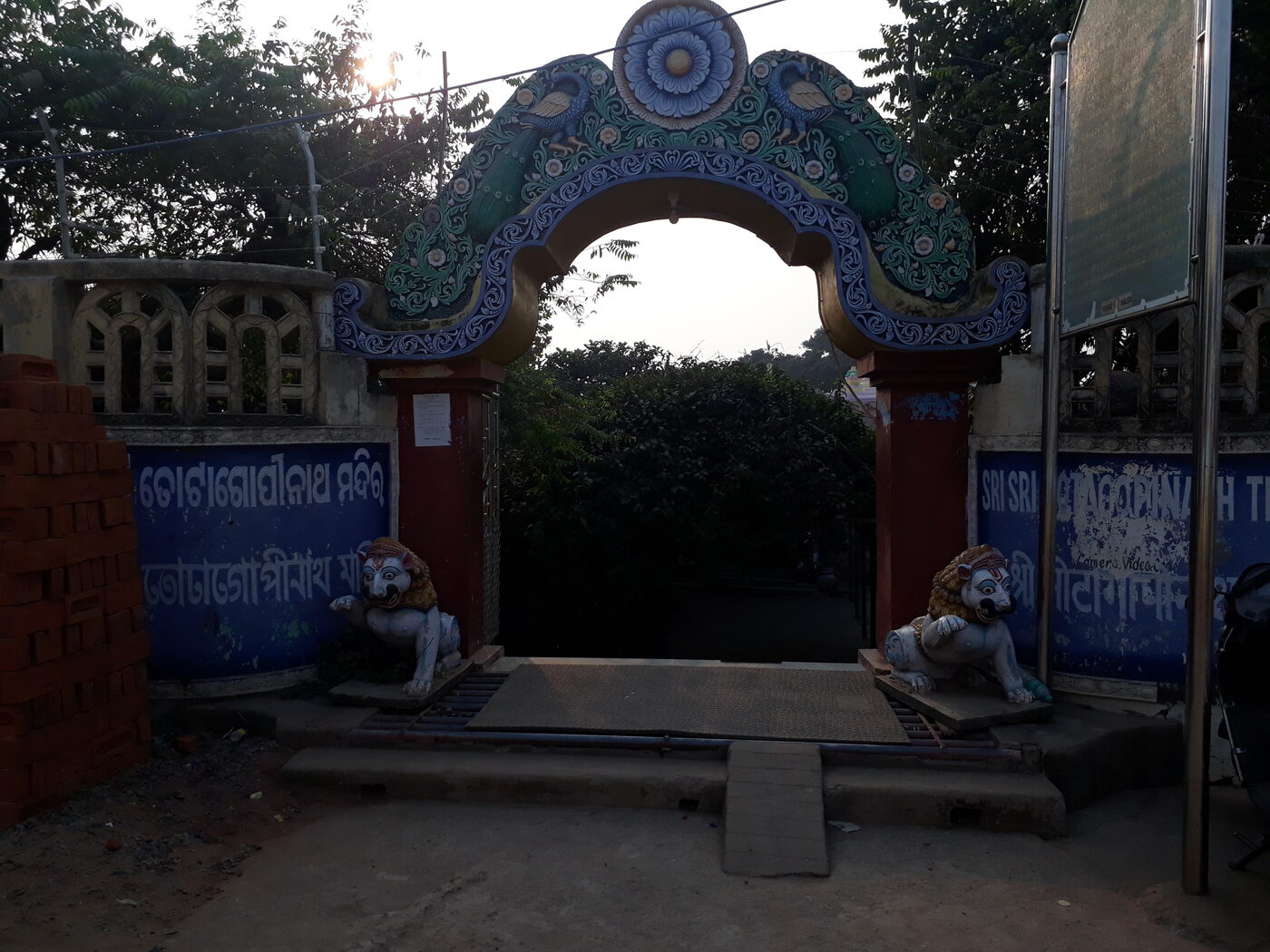
When Chaitanya Mahaprabhu accepted sannyasa at Katwa early in 1510 and settled soon afterwards at Jagannatha Puri, the community that had formed around Him in Nabadwip broke up. It formed again, but with its members living far apart. Nityananda Prabhu was later sent back into Bengal to preach, and spent the rest of his life there. Advaita Acharya kept his household and his home at Shantipura on the Ganges. Srivasa Thakura could not bear to stay in Nabadwip without Mahaprabhu, who had been its centre. So he moved to Kumarahatta and came south once a year with the Bengali party for the Ratha-yatra. Gadadhara Pandit went to Puri and did not come back.
The Vow of Kshetra-sannyasa #
He made this formal by taking what the tradition calls kshetra-sannyasa. This is not the sannyasa of the staff and the wandering life. It is the vow of a man who leaves household life to live permanently in a holy place, Jagannatha Puri, Nabadwip or Mathura, and does not leave it. Sarvabhauma Bhattacharya lived under the same vow at Puri, and Bhaktivinoda Thakura considered it the form of retirement best suited to this age. Some accounts simply say that Gadadhara took sannyasa. Since he had never married, the practical difference was small. What the vow really bound him to was a place: he would die within the boundaries of the kshetra.
The Garden and the Deity of Tota Gopinatha #
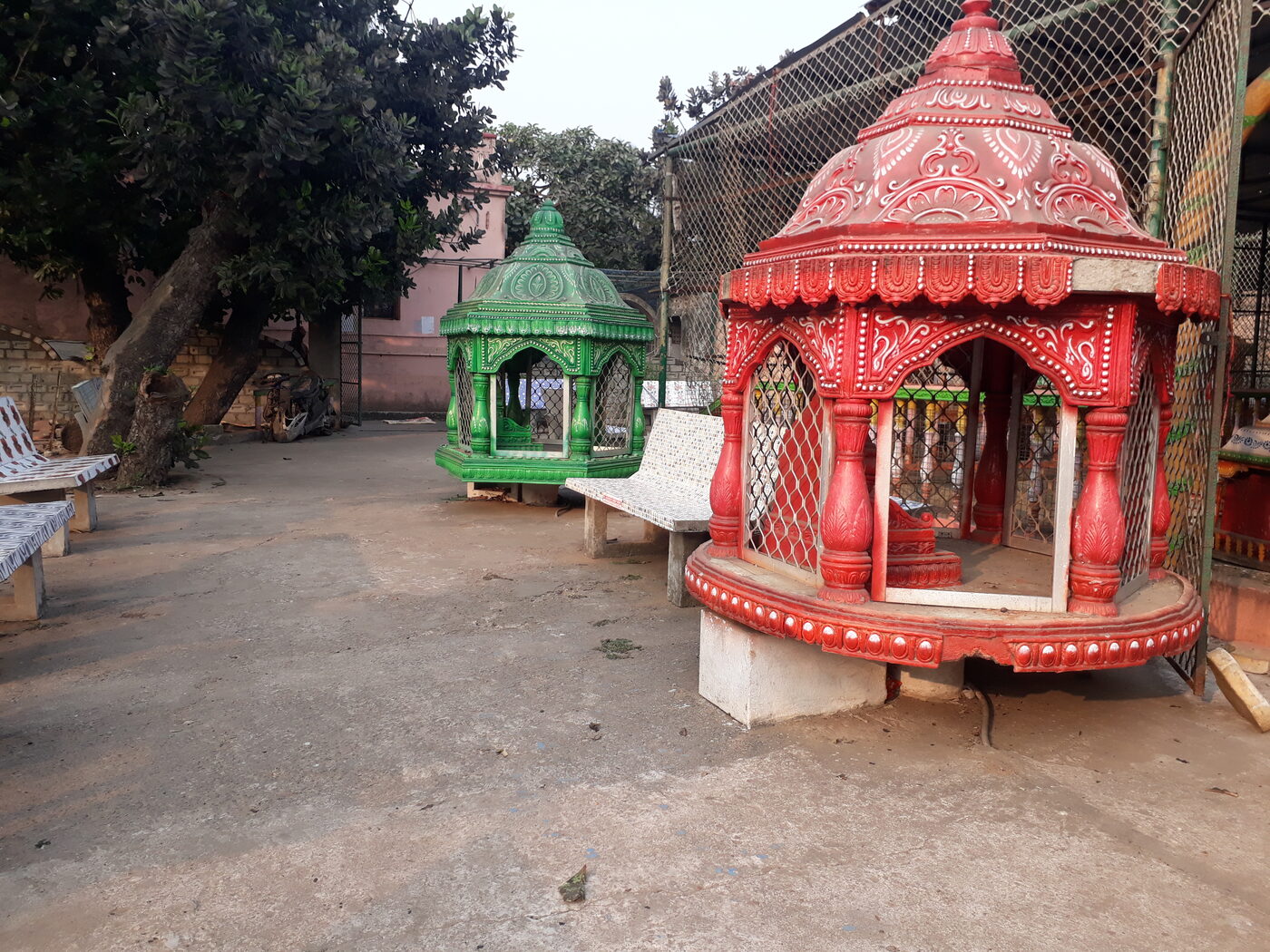
Mahaprabhu gave him a service to go with it. Krishnadasa Kaviraja records that Gadadhara Pandit remained near the Lord and was given a place to live at Yamesvara, on the south-west side of the Jagannatha temple. There was a small garden there and a stretch of sandy beach known as the Yamesvara Tota. The word tota simply means garden, and the Deity in his charge takes His name from that garden: Tota Gopinatha, Gopinatha of the garden. Serving that Deity was the whole of Gadadhara Pandit's outward work for the next twenty-four years. The Chaitanya-bhagavata tells a homely story about it. When Gadadhara heard that Nityananda Prabhu had come to Puri, he invited Him to take the Deity's prasada. Nityananda brought fine rice from Bengal for the offering. Gadadhara cooked it with greens and vegetables from his own garden. While the offering was being made, Mahaprabhu arrived unannounced, and so the three of them ate together.
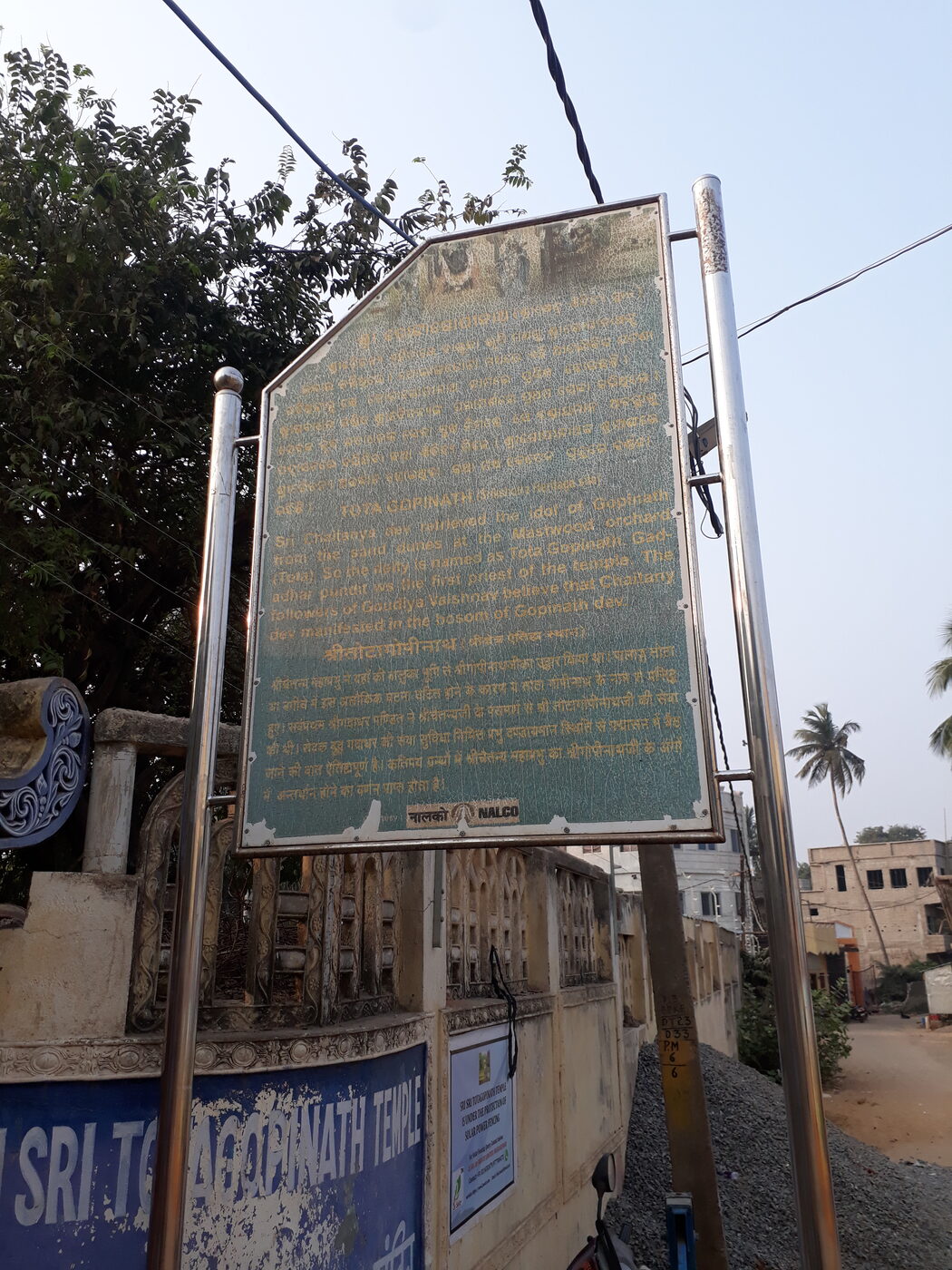
Reading the Bhagavatam to the Lord #
The other service, and the one for which the Puri years are chiefly remembered, was reading. Mahaprabhu lived a mile away, in the rooms at Kashi Mishra's house that came to be called the Gambhira. He came regularly to hear Gadadhara Pandit read the Bhagavatam aloud. Gadadhara was not teaching. He was reading to a listener who knew the text far better than he did. The reading was meant to create a mood. The tradition remembers one thing about those sessions. According to the accounts, the reader wept continuously as he read. At last, it was said, his tears had washed away the letters of the manuscript in his hands, so that it could no longer be read. Whether one takes that as a physical fact or as the devotees' way of saying what the reading was like, it is the picture the Gaudiya world keeps of Gadadhara Pandit. He is a man in a garden, reading a book whose letters he could no longer see, to a listener who had no need of it.
The Broken Vow and the Parting at Kataka #
One episode shows how much the vow cost him, and Krishnadasa Kaviraja gives it in detail. In 1516 Mahaprabhu set out from Puri intending to go to Vrindavana. Gadadhara Pandit began to walk with Him, and was forbidden. He was not to abandon his kshetra-sannyasa. His answer was that wherever the Lord was staying was Jagannatha Puri, and that his so-called vow could go to hell. When he was told to stay and serve Gopinatha, he replied that simply seeing the Lord's feet was a million times more service to Gopinatha. He was refused permission to travel with the party. So he travelled alone, keeping pace with it but apart from it, and at Kataka the Lord called him in. Krishnadasa Kaviraja comments that nobody can understand the close love between the two, and that Gadadhara gave up his vow and his Deity service as a man flicks away a straw. Mahaprabhu was pleased, but did not intend to show it. He took Gadadhara's hand and spoke to him in the anger of love. He said that the vow was broken and the service abandoned, and He asked whether Gadadhara wanted his own happiness or the Lord's. Then He got into a boat, and Gadadhara Pandit fell down unconscious on the bank. Sarvabhauma Bhattacharya was left to revive him. He told Gadadhara to get up, because such were the Lord's pastimes, and took him back to Puri. The text says that both of them were grief-stricken.
The Lord's own verdict on that episode came later, when the journey had been abandoned and He was back at Puri. He said, in front of everyone, that He had left Gadadhara Pandit behind and Gadadhara had become unhappy, and that for this reason He had not been able to go to Vrindavana.
Vallabha Bhatta and the Lord's Feigned Coldness #
One more episode belongs here, because the tradition uses it to explain Gadadhara's character. Late in the Puri years the Vedantist Vallabha Bhatta arrived. He found Mahaprabhu cool towards his scholarship, so he began to seek Gadadhara's friendship instead. He visited constantly and read Gadadhara his own commentary at length, whether he wanted to hear it or not. Mahaprabhu let it be known that He was displeased with Gadadhara too, and Gadadhara, who had done nothing, was terrified. Krishnadasa Kaviraja explains what the Lord was doing. He wanted to see Gadadhara's affectionate anger, but could never provoke it. Gadadhara was always aware of who Mahaprabhu was, and that awareness never let such anger come. His love, the text says, was of the kind Rukmini had for Krishna: too reverent for quarrelling. So the Lord pretended to be cold towards him instead. Gadadhara wept at His feet and was embraced, and the whole thing was over. It is a small, homely episode, and it is also the reason two of Mahaprabhu's names are Gadadhara-prananatha and Gadai-Gauranga.
What the Puri Years Amounted To #
Gaudiya Vaishnavas take the Puri years as the model of a particular kind of religious life. Gadadhara Pandit preached to nobody, converted nobody, wrote no book that survives under his name, and never left Puri except for that one journey as far as Kataka. By the usual standards used to measure a religious life, he had nothing to show. He kept a Deity, cooked, read aloud, and was there. Krishnadasa Kaviraja sums him up as celebrated everywhere for gentle behaviour, brahminical qualities and steady love. In these words the tradition gives its careful judgement that this was enough. What happened at the end of those years is told here.
Scriptural evidence for this chapter (5)
গদাধর-পণ্ডিত রহিলা প্রভুর পাশে ।
যমেশ্বরে প্রভু যাঁরে করাইলা আবাসে ॥ ১৮৩ ॥
gadādhara-paṇḍita rahilā prabhura pāśe
yameśvare prabhu yāṅre karāilā āvāse
Word for word
gadādhara-paṇḍita: Gadādhara Paṇḍita; rahilā: remained; prabhura pāśe: along with Śrī Caitanya Mahāprabhu; yameśvare: at Yameśvara; prabhu: Śrī Caitanya Mahāprabhu; yāṅre: unto whom; karāilā: made to take; āvāse: residence.
Gadādhara Paṇḍita remained with Śrī Caitanya Mahāprabhu, and he was given a place to live at Yameśvara.
Gadadhara Pandit remained with the Lord and was given a residence at Yamesvara; the purport describes the garden and beach known as Yamesvara Tota.
গদাধর-পণ্ডিত যবে সঙ্গেতে চলিলা ।
ক্ষেত্র-সন্ন্যাস না ছাড়িহ’ — প্রভু নিষেধিলা ॥ ১৩০ ॥
gadādhara-paṇḍita yabe saṅgete calilā
‘kṣetra-sannyāsa nā chāḍiha’ — prabhu niṣedhilā
Word for word
gadādhara-paṇḍita: Gadādhara Paṇḍita; yabe: when; saṅgete: with Śrī Caitanya Mahāprabhu; calilā: started to go; kṣetra-sannyāsa: the renounced order of life at a holy place of pilgrimage; nā chāḍiha: do not give up; prabhu niṣedhilā: Lord Śrī Caitanya Mahāprabhu forbade.
When Gadādhara Paṇḍita started to go with the Lord, he was forbidden to come and was asked not to give up the vow of kṣetra-sannyāsa.
Gadadhara forbidden to accompany the Lord and told not to give up his vow of kshetra-sannyasa; the purport defines what that vow is.
পণ্ডিতের গৌরাঙ্গ-প্রেম বুঝন না যায় ।
প্রতিজ্ঞা’, ‘শ্রীকৃষ্ণ-সেবা’ ছাড়িল তৃণপ্রায় ॥ ১৩৭ ॥
paṇḍitera gaurāṅga-prema bujhana nā yāya
‘pratijñā’, ‘śrī-kṛṣṇa-sevā’ chāḍila tṛṇa-prāya
Word for word
paṇḍitera: of Gadādhara Paṇḍita; gaurāṅga-prema: the love for Śrī Caitanya Mahāprabhu; bujhana: understanding; nā yāya: is not possible; pratijñā: a vow; śrī-kṛṣṇa-sevā: the service of the Lord; chāḍila: gave up; tṛṇa-prāya: almost like straw.
No one can understand the loving intimacy between Gadādhara Paṇḍita and Śrī Caitanya Mahāprabhu. Gadādhara Paṇḍita gave up his vow and service to Gopīnātha just as one gives up a piece of straw.
No one can understand the intimacy between them; Gadadhara gave up vow and service like a straw.
গদাধরে ছাড়ি’ গেনু, ইঁহো দুঃখ পাইল ।
সেই হেতু বৃন্দাবন যাইতে নারিল ॥” ২৭৮ ॥
gadādhare chāḍi’ genu, iṅho duḥkha pāila
sei hetu vṛndāvana yāite nārila
Word for word
gadādhare chāḍi’: leaving aside Gadādhara Paṇḍita; genu: I went; iṅho: Gadādhara Paṇḍita; duḥkha pāila: became unhappy; sei hetu: for that reason; vṛndāvana: to Vṛndāvana-dhāma; yāite nārila: I was unable to go.
“I left Gadādhara Paṇḍita here, and he became very unhappy. For this reason I could not go to Vṛndāvana.”
The Lord's own statement that He could not go to Vrindavana because Gadadhara had been made unhappy.
পণ্ডিতের সৌজন্য, ব্রহ্মণ্যতা-গুণ ।
দৃঢ় প্রেমমুদ্রা লোকে করিলা খ্যাপন ॥ ১৬৬ ॥
paṇḍitera saujanya, brahmaṇyatā-guṇa
dṛḍha prema-mudrā loke karilā khyāpana
Word for word
paṇḍitera saujanya: the gentle behavior of Gadādhara Paṇḍita; brahmaṇyatā-guṇa: the attributes of a perfect brāhmaṇa; dṛḍha: firm; prema-mudrā: characteristic of love; loke: people; karilā khyāpana: proclaimed.
Gadādhara Paṇḍita is celebrated all over the world for his gentle behavior, his brahminical attributes and his steady love for Śrī Caitanya Mahāprabhu.
Gadadhara Pandit celebrated for gentle behaviour, brahminical attributes and steady love, the summary verdict on his life.
Chapter 5
The Disappearance of Gadadhara Pandit
Eleven months after the Lord, in the garden where he had served, at about forty-nine
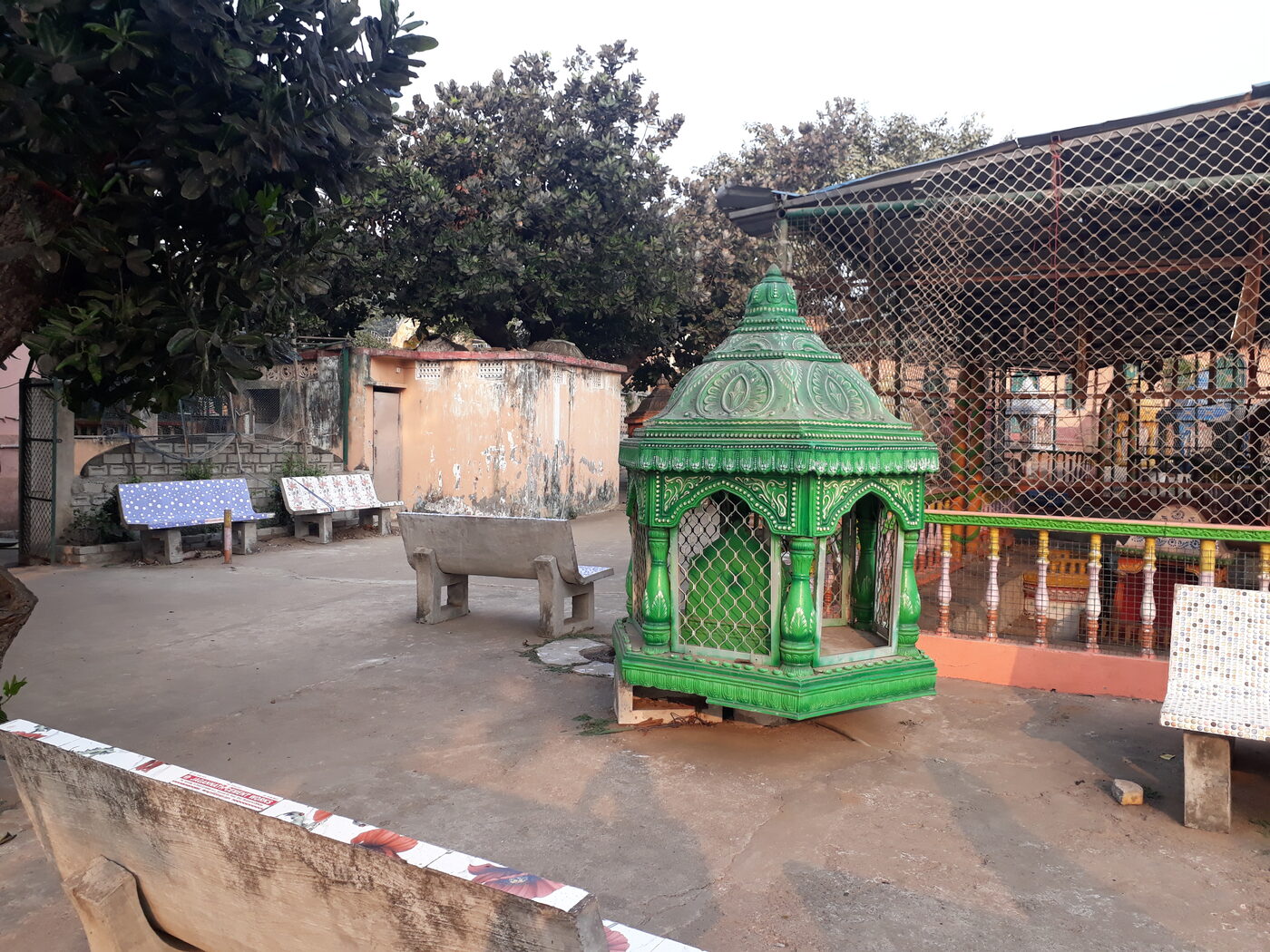
Chaitanya Mahaprabhu's manifest pastimes ended at Jagannatha Puri in 1534, in His forty-eighth year. The tradition says unusually little about how. Krishnadasa Kaviraja had every reason to describe it, and he could speak with those who were there. Yet he closes the Chaitanya-charitamrita without describing the departure at all. Among the accounts that do circulate there is more than one version. Some place it in the sea, some in the Gundicha temple, and some speak of Mahaprabhu being absorbed into Lord Jagannatha. The version that has become standard in the Gaudiya line is also the one Bhaktivinoda Thakura gives. After eighteen years lived mostly at Kashi Mishra's house, He disappeared during sankirtana in the temple of Tota Gopinatha. That is, He disappeared in the garden where Gadadhara Pandit had served the Deity for twenty-four years, in front of the Deity Mahaprabhu had given him.
| Detail | Description |
|---|---|
| Date of disappearance | Dark moon day of Jyestha, Saka 1456, which is 1535 |
| Place | Jagannatha Puri |
| Age | About forty-nine (he was about the Lord's own age, and left eleven months after Him) |
| Time after Mahaprabhu | About eleven months |
| Relic | A tooth enshrined in a samadhi at Vrindavana, near the Vamsi Gopala temple |
The Months of Separation #
However the Lord's departure took place, Gadadhara Pandit was the one left behind. All that the sources say about the months that followed comes to the same thing. He did not recover, and he did not try to. Narahari Chakravarti, writing later in the Bhakti-ratnakara, describes him as an old man sitting with his eyes closed, repeating the name of Gaurasundara. His breath came hot as flame, and his body barely moved. Narahari gives only one reason why he was still alive at all. He was waiting to give his mercy to Srinivasa Acharya, the young Vaishnava who would carry the Gaudiya literature back into Bengal. The Bhakti-ratnakara's judgement is that no one but the Lord could know what Gadadhara Pandit suffered in that separation.
Why Tota Gopinatha Is a Seated Deity #
He had been about the Lord's own age, so he was roughly forty-eight when Mahaprabhu departed. The accounts say he grew old very quickly in the time that remained. From this period there is a tradition about the Deity that is dear to pilgrims. It should be reported for what it is: a local temple tradition, and a disputed one. It is said that Gadadhara had become too weak to lift his arms high enough to place a garland around Gopinatha's neck. So the Deity sat down, to make His servant's service possible. Tota Gopinatha is in fact a seated form of Krishna, which is rare enough that visitors notice it, and this is the explanation the temple gives.
His Disappearance at Puri #
Gadadhara Pandit survived Mahaprabhu by about eleven months. He disappeared at Puri on the dark moon day of the month of Jyestha in the Saka year 1456, which is 1535. Some accounts say that he entered his Deity, as the Lord is held to have done before him. A tooth relic of his is enshrined in a samadhi at Vrindavana, near the Vamsi Gopala temple.
Waiting to Give Mercy to Srinivasa Acharya #
Srinivasa Acharya needs a few words here, because he links two eras. Srinivasa was a young man from Bengal who had set out to meet the associates of Mahaprabhu, but every time he arrived too late. The Bhakti-ratnakara is largely the record of those missed meetings. He reached Puri to find Mahaprabhu gone and Haridasa Thakura's tomb already standing by the sea. Gadadhara Pandit is said to have held on to life especially to receive him. This is the tradition's way of saying that the passing down of the teaching did not break. The last of the Nabadwip circle deliberately handed something on to the next generation, who would collect the Vrindavana literature and carry it back into Bengal.
The Gadadhara Parivara and Its Disputed Claims #
He left behind him a line. The Gadadhara parivara is one of the traditional Chaitanya lineages, alongside the Advaita parivara and the others, that has continued unbroken to the present day. His disciple Bhugarbha Goswami is its best-recorded source. Some within that line hold that Rupa Goswami and Sanatana Goswami themselves took initiation from Gadadhara Pandit. As evidence they point to a verse of the Sadhana-dipika and to the authorship given for the Gadadharashtaka. Others, including scholars who favour the claim, admit that the evidence is not conclusive. They also admit that the more common view places the initiation of Rupa and Sanatana elsewhere. It is honest to leave that question open. What is not disputed is that a great many Bengali temples worship on their central altar not Gauranga alone but Gaura-Gadadhara. It is also said that the first Deity of Srimati Radharani installed in Vrindavana was sent there by him.
Viraha and the Meaning of Those Months #
The eleven months themselves have a place in Gaudiya thought that is easy to miss. In this tradition separation, viraha, is not treated as the failure of devotion. It is treated as devotion in its most intense condition. The literature of the movement is largely a literature of separation. Mahaprabhu's own last years at the Gambhira are described in exactly these terms, and so are the songs of the Goswamis at Vrindavana. So when Narahari Chakravarti describes Gadadhara Pandit in 1534 and 1535, the tradition does not see a broken old man who could not bear his loss. It sees the same relationship continuing in the only way still left to it. That reading may be accepted or not, but it is the reason the tradition records the eleven months at all, instead of passing over them as a sad ending.
What the Tradition Honours in Him #
What the tradition honours in him is not the usual thing, so it should be stated plainly. Gadadhara Pandit founded no institution. He wrote nothing that has come down under his name. He preached to no one and travelled nowhere after 1510. By the ordinary measures of a religious career, he had nothing to show. He was Mahaprabhu's exact contemporary and neighbour. He went where He went, held His hands when He tore at Himself, read to Him, cooked for Him, and stayed. Once there was a chance to break that pattern and follow the Lord to Vrindavana. Gadadhara took it at once, and was sent back. Afterwards the Lord said publicly that Gadadhara's unhappiness was the reason the journey never happened.
Gaudiya theology explains the pattern by saying that this is what the pleasure potency does. The three predominators of the Panca-tattva are worshipped; the fourth worships. Chaitanya Mahaprabhu came into the world to taste a certain love, and that love had to be tasted through someone. It is tasted not through a doctrine but through a person. That person stands to one side, quietly and without show, doing small things well for a very long time. Gaudiya Vaishnavas everywhere chant the Panca-tattva mantra before the maha-mantra. Every time it is chanted, Gadadhara's name is the fourth of the five. It is in the same position he held all his life: after the Lord, before the devotees, at neither end.
Scriptural evidence for this chapter (4)
এই ত’ কহিলুঁ হরিদাসের বিজয় ।
যাহার শ্রবণে কৃষ্ণে দৃঢ়ভক্তি হয় ॥ ১০১ ॥
ei ta’ kahiluṅ haridāsera vijaya
yāhāra śravaṇe kṛṣṇe dṛḍha-bhakti haya
Word for word
ei ta’: thus; kahiluṅ: I have spoken; haridāsera: of Haridāsa Ṭhākura; vijaya: victory; yāhāra śravaṇe: by hearing which; kṛṣṇe: unto Lord Kṛṣṇa; dṛḍha-bhakti: firm devotional service; haya: becomes.
Thus I have spoken about the victorious passing away of Haridāsa Ṭhākura. Anyone who hears this narration will certainly fix his mind firmly in devotional service to Kṛṣṇa.
The purport locates the Tota Gopinatha temple at Jagannatha Puri and the ground between it and the sea, the setting of the last years.
তাঁর শিষ্য–উপশিষ্য,—তাঁর উপশাখা ।
এইমত সব শাখা–উপশাখার লেখা ॥ ১৬ ॥
tāṅra śiṣya-upaśiṣya, — tāṅra upaśākhā
eimata saba śākhā-upaśākhāra lekhā
Word for word
tāṅra: his; śiṣya: disciples; upaśiṣya: granddisciples and admirers; tāṅra: his; upaśākhā: subbranches; eimata: in this way; saba: all; śākhā: branches; upaśākhāra: subbranches; lekhā: to describe by writing.
His disciples and granddisciples are his subbranches. To describe them all would be difficult.
The disciples and grand-disciples of Gadadhara Pandit form his sub-branches, too numerous to describe, the scriptural warrant for the Gadadhara parivara.
এই তিন তত্ত্ব,—‘সর্বারাধ্য’ করি মানি ।
চতুর্থ যে ভক্ততত্ত্ব,—‘আরাধক’ জানি ॥ ১৫ ॥
ei tina tattva, — ‘sarvārādhya’ kari māni
caturtha ye bhakta-tattva, — ‘ārādhaka’ jāni
Word for word
ei tina tattva: all three of these truths; sarva-ārādhya: worshipable by all living entities; kari māni: accepting such; caturtha: fourth; ye: who is; bhakta-tattva: in the category of devotees; ārādhaka: worshiper; jāni: I understand.
The three predominators [Caitanya Mahāprabhu, Nityānanda Prabhu and Advaita Prabhu] are worshipable by all living entities, and the fourth principle [Śrī Gadādhara Prabhu] is to be understood as Their worshiper.
The three predominators are worshipable and the fourth principle is their worshipper, the theological summary of Gadadhara's whole life.
শ্রীচৈতন্য, নিত্যানন্দ, অদ্বৈত,—তিন জন ।
শ্রীবাস–গদাধর–আদি যত ভক্তগণ ॥ ১৬৯ ॥
śrī-caitanya, nityānanda, advaita, — tina jana
śrīvāsa-gadādhara-ādi yata bhakta-gaṇa
Word for word
śrī-caitanya, nityānanda, advaita: Śrī Caitanya Mahāprabhu, Nityānanda Prabhu and Advaita Prabhu; tina: these three; jana: personalities; śrīvāsa-gadādhara: Śrīvāsa and Gadādhara; ādi: etc.; yata: all; bhakta-gaṇa: the devotees.
While chanting the Pañca-tattva mahā-mantra, one must chant the names of Śrī Caitanya, Nityānanda, Advaita, Gadādhara and Śrīvāsa with their many devotees. This is the process.
The Panca-tattva mantra, in which Gadadhara's name is chanted fourth before the maha-mantra.
Closing
Advent and Childhood at Nabadwip #
He appeared around 1486 in Nabadwip, the same year as Mahaprabhu. He was the son of Madhava Mishra and Ratnavati Devi, whose family had come from Chittagong. He and Nimai were near neighbours of exactly the same age, and the biographies describe them as playmates and then as fellow students. But from childhood Gadadhara had a very different nature. Nimai was brilliant, loved to argue and was always ready for a fight with words. Gadadhara was gentle, quiet and already devotional. While Nimai was still defeating pandits in the street, Gadadhara was drawn to the company of the older Vaishnavas of the town.
Initiation From Pundarika Vidyanidhi #
He received initiation from Pundarika Vidyanidhi. The Chaitanya-bhagavata (Madhya-khanda, chapter 7) tells this episode in full, and Srila Prabhupada sums it up in his purport to Chaitanya-charitamrita, Adi-lila 10.14. When Gadadhara first met Pundarika Vidyanidhi, he was disappointed. Pundarika Vidyanidhi lived in great luxury and did not look like a man who had renounced the world. But Mahaprabhu corrected this judgement. He pointed out the deep devotion hidden beneath Pundarika's outward wealth. Gadadhara felt humbled and accepted him as his spiritual master. The tradition often returns to this lesson, that outward renunciation is not the measure of a Vaishnava.
Following the Lord to Jagannatha Puri #
When Mahaprabhu accepted sannyasa and left Nabadwip, Gadadhara Pandit followed Him and did not afterwards leave His side. Gadadhara settled at Jagannatha Puri and remained there for the rest of His own life, serving the Deity of Tota Gopinatha. This constant presence at Puri set Gadadhara apart from the others. Nityananda Prabhu was sent to preach in Bengal. Advaita Acharya kept his household at Shantipura. Srivasa Thakura came and went with the Bengali party each year. But Gadadhara stayed. Vaishnavas understand this as the natural conduct of the Lord's own pleasure potency, which does not go away from Him.
Chaitanya-charitamrita Adi 10.15 states this identity plainly: "Gadādhara Paṇḍita, the fourth branch, is described as an incarnation of the pleasure potency of Śrī Kṛṣṇa. No one, therefore, can equal him." In his purport Srila Prabhupada gives the evidence from Kavi Karnapura's Gaura-ganoddesha-dipika (verse 147):
śrī-rādhā prema-rūpā yā purā vṛndāvaneśvarī
sā śrī-gadādharo gaura-vallabhaḥ paṇḍitākhyakaḥ
"Śrī Kṛṣṇa's pleasure potency, formerly known as Vṛndāvaneśvarī, is now personified in the form of Śrī Gadādhara Paṇḍita in the pastimes of Lord Caitanya Mahāprabhu." (Gaura-ganoddesha-dipika 147, translated by Srila Prabhupada in his Chaitanya-charitamrita Adi 10.15 purport)
The Bhagavatam Worn Away by His Tears #
Gadadhara also shared a special closeness with Mahaprabhu. In the last years at Puri, it was to Gadadhara Pandit that Mahaprabhu would read and speak of Krishna. Gadadhara is also described as weeping with Him through the nights of separation. He is said to have read the Bhagavatam aloud to Mahaprabhu so often that the manuscript's letters were worn away by his tears.
Tota Gopinatha and What He Is Remembered For #
Gadadhara Pandit served the Deity of Tota Gopinatha at Puri. It is traditionally held that Sri Chaitanya Mahaprabhu concluded His manifest pastimes before this Deity. Gadadhara did not live long after Him. Gaudiya Vaishnavas honour him as the model of steady, quiet, lifelong service. He was the devotee who neither preached widely nor wrote learned books. What sets him apart is simply that he never once went away.
Further Reading #
A devotional reflection on his character is also available, titled Sri Gadadhar Pandit: The Tender Heart of Devotion.
