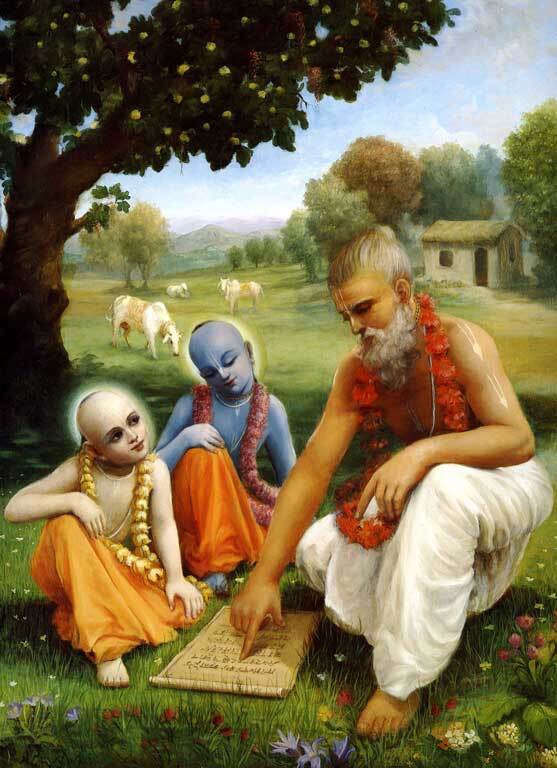
When the boy Nimai told his father Jagannatha Mishra that he wished to study, Jagannatha Mishra took him to Ganga Dasa Pandit. Ganga Dasa Pandit was a respected professor who lived at Ganganagara. This neighborhood lies within the area known as Simantadvipa, close to Navadvipa itself. Tradition remembers that spot with real fondness. During the Navadvipa parikrama, devotees still stop near the Yogapitha temple to hear the story of Ganga Dasa Pandit's home and school, even though the site itself lies a short distance away in Simantadvipa. Ganga Dasa Pandit gladly accepted the boy. Every account says that he began teaching him with the same care he might have given his own son.
A Student Unlike Any Other #
By the time Nimai arrived, Ganga Dasa Pandit had already taught thousands of students over the years. But none of them, as Sri Chaitanya-charitamrita records, had a mind like this one. It states directly that while studying grammar at Ganga Dasa Pandit's school, the Lord would memorize an entire grammatical rule and its explanation simply by hearing it once. This is a small, exact detail in Sri Chaitanya-charitamrita. It is not a vague claim of brilliance, but a precise description of a particular kind of gift. It fits naturally with the wider picture of Nimai's schooldays that Gaudiya Vaishnava literature gives. He was so quick that his classmates could rarely keep pace with him. These classmates included Murari Gupta and others named Krishnananda and Kamala Kanta. He delighted in giving two completely different, equally valid explanations of the same grammatical sutra. This left his fellow students puzzled and, tradition says, full of wonder at him.
The Sandipani Muni Comparison #
Vrindavana Dasa Thakura, the biographer of Ganga Dasa Pandit's most famous student, later gave the world its most memorable description of him. He wrote in Sri Chaitanya-Bhagavata that there was in Navadvipa a wonderful professor named Ganga Dasa Pandit who resembled Krishna's own guru, Sandipani Muni. Let us look at what this comparison means. Sandipani Muni is remembered in Vaishnava tradition as the sage who taught Krishna and Balarama grammar and the sciences during their short stay at his ashram in Ujjain. Tradition holds that the Lord took part in this pastime not because He needed an education, but to set an example. It showed how even the Supreme Person honors the process of learning and the position of a teacher. Srila Bhaktisiddhanta Sarasvati Thakura commented on this same episode in Sri Chaitanya-Bhagavata centuries later. He made the same point directly about Nimai's schooling under Ganga Dasa Pandit. He explained that the Lord accepted human limitations and desired to learn grammar and the arts, just as Krishna did with Sandipani Muni. The Lord did this so that those who make their living as teachers would be reminded to have genuine learning, not merely the appearance of it.
A School Remembered for What It Produced #
Gaudiya Vaishnavas do not remember Ganga Dasa Pandit's school at Ganganagara as an important institution for its own sake, the way they remember some later Vaishnava centers. It is remembered because of exactly one student. That is not a small thing to be remembered for, and this tradition does not treat it as a small thing either. The schooling pastime appears in many sources for a reason. Gaudiya Vaishnavas have always read it as more than a childhood story. For them it is an early, quiet sign of who Nimai was, given years before the people of Navadvipa learned to call him by any other name. The Devotee the Lord Never Stopped Honoring tells what became of that relationship once the schooling ended, and of the ordinary respect a student owes a teacher.
