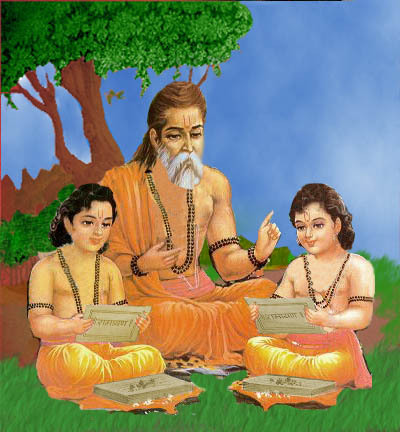
Srila Ganga Dasa Pandit
Boyhood Teacher of Sri Chaitanya Mahaprabhu
Also known as Ganga Das Pandit, Gangadasa Pandita, Ganga Das, Gangadas Pandit
“Pandita Gangadasa was the eighth dear branch of the tree of Sri Chaitanya Mahaprabhu. One who remembers his activities attains freedom from all bondage.”
Sri Chaitanya-charitamrita, Adi-lila 10.29, Krishnadasa Kaviraja Goswami's listing of Sri Chaitanya Mahaprabhu's principal associates as branches of a great tree.
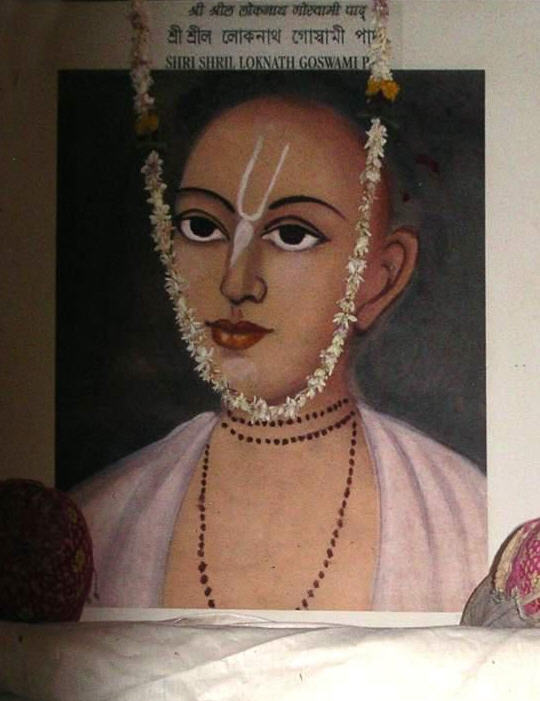
Srila Ganga Dasa Pandit is remembered in Gaudiya Vaishnava tradition mainly for one relationship. He was the schoolteacher of the brilliant Navadvipa boy called Nimai, who would grow up to be Sri Chaitanya Mahaprabhu. This was a relationship of teacher and student, not of initiation. (Ganga Dasa Pandit taught grammar and scripture, not diksha.) But Sri Chaitanya-charitamrita and Sri Chaitanya-Bhagavata both treat it as far more than an ordinary schoolteacher's role. They describe him as one of the Lord's dearest associates. In a devotional sense, they also describe him as a guru whom the Lord Himself continued to honor long after His schooldays ended.
| Detail | Description |
|---|---|
| Role | Schoolteacher (grammar, scripture) of the young Nimai at Navadvipa; not a diksha relationship |
| Birthplace | Radha-desha, Bengal (Sri Chaitanya-charitamrita, Adi 13.61) |
| Home and school | Ganganagara, Simantadvipa, near Navadvipa |
| Identity | Vasishtha Muni, guru of Lord Ramachandra, who appeared by a special manifestation as both Ganga Dasa and Sudarshana (Gaura-ganoddesha-dipika 53) |
| Earliest source | Sri Chaitanya-Bhagavata, the biography of Sri Chaitanya Mahaprabhu (his former student) by Vrindavana Dasa Thakura |
| Birth/disappearance years | Not recorded |
An Elder Who Arrived Before the Lord #
Gaudiya Vaishnava tradition holds that several of Sri Chaitanya Mahaprabhu's closest associates took birth in Navadvipa before Him, so that they would be ready to serve as His elders when the Lord Himself appeared there in 1486. Ganga Dasa Pandit is counted among them. Sri Chaitanya-charitamrita names him, together with Nityananda Prabhu, Murari Gupta and Mukunda Datta, as one of those who took birth in this generation. It also lists him separately as one of the named branches of what Krishnadasa Kaviraja Goswami calls the Caitanya tree. This is the great, spreading list of the Lord's principal devotees, pictured as the branches of one tree. An Elder Descended Before the Lord tells more fully what Gaudiya Vaishnava literature says about who Ganga Dasa Pandit was believed to be, in a spiritual sense, before he appeared as a Navadvipa schoolteacher.
In brief, Srila Kavi Karnapura's Gaura-ganoddesha-dipika (verse 53) gives this identity:
purāsīd raghunāthasya yo vaśiṣṭha munir guruḥ
sa prakāśa-viśeṣeṇa gaṅgādāsa-sudarśanau
"The same person who formerly appeared as Vasistha Muni, the spiritual master of Lord Ramacandra, appeared in Lord Caitanya's pastimes as Gangadasa and Sudarsana." (Gaura-ganoddesha-dipika 53)
Teacher of the Boy Who Was Later Revealed as the Lord #
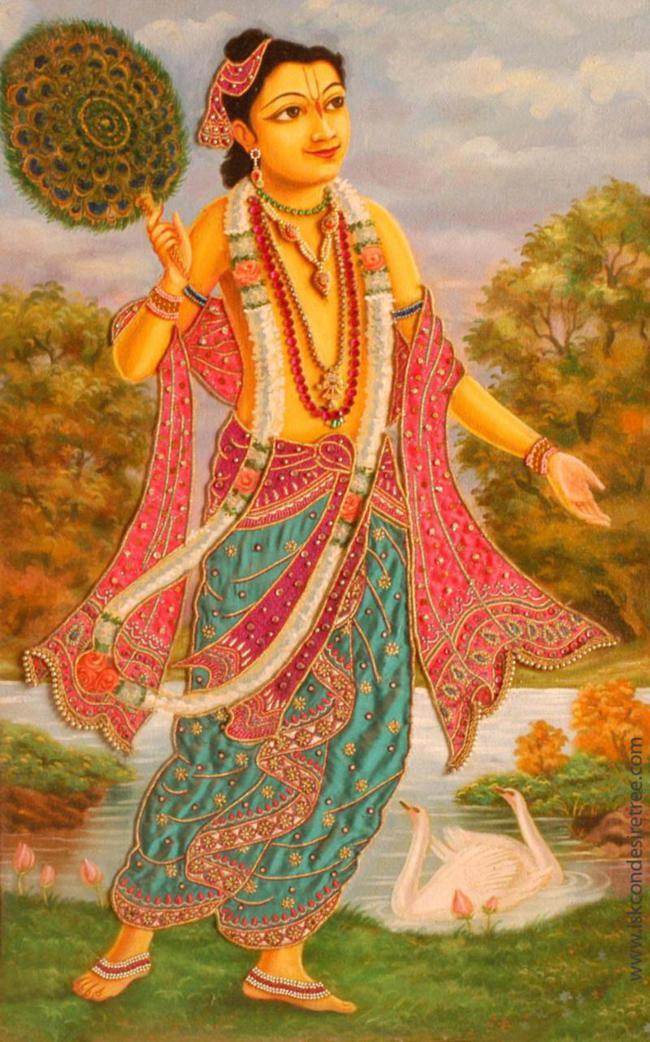
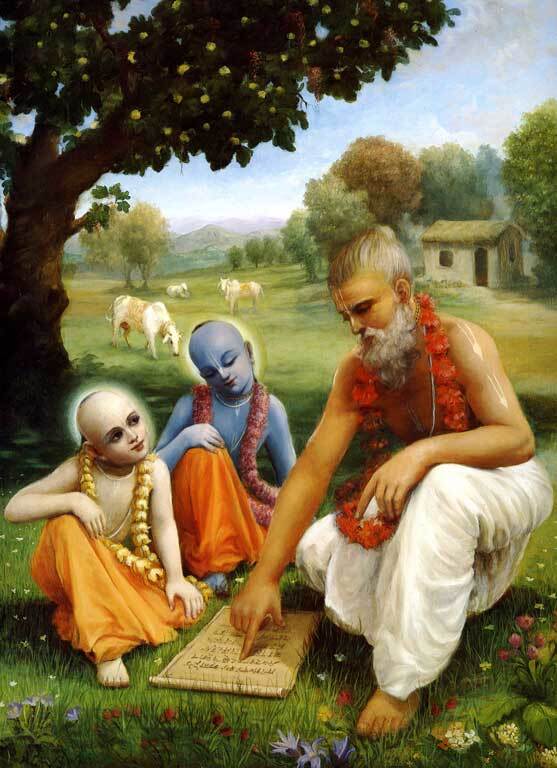
When the boy Nimai wished to study, his father Jagannatha Mishra brought him to Ganga Dasa Pandit's school at Ganganagara. What followed became one of the most fondly remembered episodes of Sri Chaitanya Mahaprabhu's childhood in Navadvipa. The teacher was amazed by a student who could master an entire grammar rule by hearing it once. The boy also delighted in puzzling his classmates, among them Murari Gupta, by explaining the same verse in two clever ways. Vrindavana Dasa Thakura, the author of Sri Chaitanya-Bhagavata, compares Ganga Dasa Pandit directly to Sandipani Muni, the sage who taught Krishna and Balarama grammar and the sciences in Dvapara-yuga. The full story of this schooling, and of the neighborhood where it took place, is in Teaching the Young Nimai.
A Devotee the Lord Never Stopped Honoring #
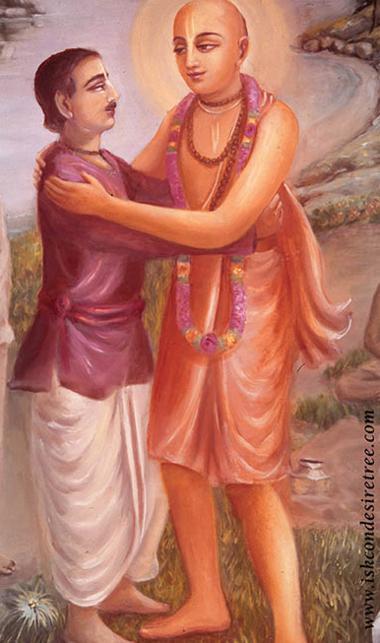
Ganga Dasa Pandit has an unusual place in Gaudiya Vaishnava memory because of what happened after his student no longer needed him as a teacher. When Nimai returned from Gaya as a transformed devotee, He still went to His old teacher's house to offer obeisances at his feet. Ganga Dasa Pandit, in turn, showed Him the same reverence a guru would show a uniquely accomplished disciple. Tradition also remembers a private mercy shown to Ganga Dasa Pandit years earlier, at a time when he was truly afraid for his family's safety. Sri Chaitanya Mahaprabhu later recalled it aloud in front of the assembled Navadvipa devotees during the Mahaprakasha. This was the day He revealed His divine identity at Srivasa Thakura's house. Ganga Dasa Pandit later traveled to Puri as one of the Bengali devotees who came to see the Lord there. He took his place in the kirtan groups before the Jagannatha cart. These episodes, from Navadvipa to Puri, are told in The Devotee the Lord Never Stopped Honoring.
Ganga Dasa Pandit and Vrindavana Dasa Thakura's Book #
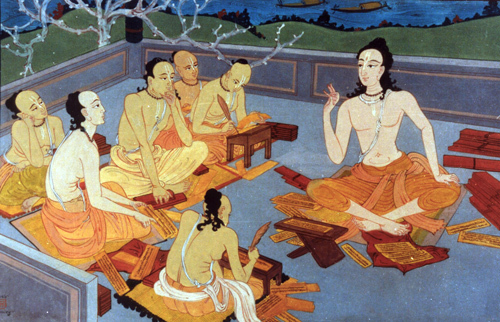
The names of Ganga Dasa Pandit and Vrindavana Dasa Thakura, the author of Sri Chaitanya-Bhagavata, are very often mentioned together. So we should be clear about the actual connection between them. They were not guru and disciple. By Sri Chaitanya-charitamrita's own account, Vrindavana Dasa Thakura's own diksha-guru was Nityananda Prabhu, who accepted him as one of his last disciples. The real connection is of a different kind. Vrindavana Dasa Thakura is the main source for nearly everything known about Ganga Dasa Pandit. In Sri Chaitanya-Bhagavata itself, it was Vrindavana Dasa Thakura who recorded the schooling pastime and the Sandipani Muni comparison. He also recorded Ganga Dasa Pandit's presence at other key moments of the Lord's Navadvipa years. In that sense, Ganga Dasa Pandit is one of Vrindavana Dasa Thakura's subjects, not his teacher.
What Remains Unknown #
Very little is recorded about Ganga Dasa Pandit's own life outside his relationship with Sri Chaitanya Mahaprabhu, and we do not hide that. The sources available here give no year for his birth or disappearance. No literary work of his own is recorded. His fame rests entirely on what others wrote about him, mainly Vrindavana Dasa Thakura and, decades later, Krishnadasa Kaviraja Goswami in Sri Chaitanya-charitamrita. These sources also do not record whether he ever formally initiated disciples, in the ordinary diksha sense. But one thing is recorded well and again and again, in both major biographies of the Lord. It is the relationship described on this page. He was an ordinary Navadvipa schoolteacher who found himself teaching grammar to the Supreme Lord. Later in life, that same Lord honored him, as though the honor ran in the other direction entirely.
Scriptural evidence
Quoted in the text above:
- Verse 53 Gaura-ganoddesha-dipika
Further verses:
prabhura atyanta priya — paṇḍita gaṅgādāsa
yāṅhāra smaraṇe haya sarva-bandha-nāśa
Word for word
prabhura: of the Lord; atyanta: very; priya: dear; paṇḍita gaṅgādāsa: Paṇḍita Gaṅgādāsa; yāṅhāra: who; smaraṇe: by remembering; haya: it becomes; sarva-bandha-nāśa: freedom from all kinds of bondage.
Pandita Gangadasa was the eighth dear branch of the tree of Sri Chaitanya Mahaprabhu. One who remembers his activities attains freedom from all bondage.
The single verse making the strongest devotional claim about Ganga Dasa Pandit found in Sri Chaitanya-charitamrita's own listing of the Lord's principal associates.
- Ganga Dasa Pandit - Biography (Gaudiya History)
- Sri Ganga das Pandit (Shyam Das Baba, Bhakti Siddhanta Vani Seva)
- Sri Chaitanya-charitamrita, Adi-lila 10.29 (Bhaktivedanta VedaBase)
- Sri Chaitanya-charitamrita, Adi-lila 13.61 (Bhaktivedanta VedaBase)
- Sri Chaitanya-charitamrita, Adi-lila 15.5 (Bhaktivedanta VedaBase)
- Sri Chaitanya-charitamrita, Madhya-lila 11.85 (Bhaktivedanta VedaBase)
- Sri Chaitanya-charitamrita, Madhya-lila 13.39 (Bhaktivedanta VedaBase)
Frequently asked
When was Srila Ganga Dasa Pandit born?
Srila Ganga Dasa Pandit appeared Year not recorded; Sri Chaitanya-charitamrita places his birth a generation before Sri Chaitanya Mahaprabhu's own appearance in 1486 in Radha-desha, the part of Bengal away from the Ganges (Sri Chaitanya-charitamrita, Adi-lila 13.61); he later taught and lived at Ganganagara in Simantadvipa, near Navadvipa.
When and where did Srila Ganga Dasa Pandit disappear?
Srila Ganga Dasa Pandit disappeared Not recorded at Not recorded.
What are the main pastimes of Srila Ganga Dasa Pandit?
The pastimes covered here include: An Elder Descended Before the Lord, Teaching the Young Nimai, The Devotee the Lord Never Stopped Honoring.