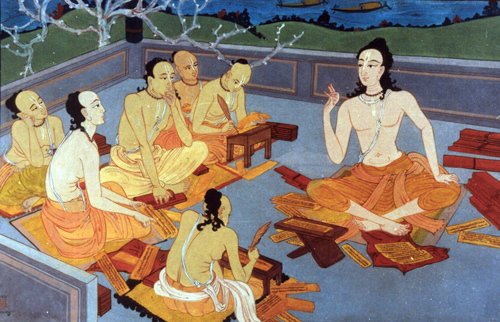
Nimai returned from a pilgrimage to Gaya in 1509 a changed young man, absorbed now in devotion to Krishna rather than in the grammar and logic that had once been his whole world. The Navadvipa devotees, among them Srivasa Thakura, Gadadhara Pandit and others, watched the transformation with amazement and joy. Ganga Dasa Pandit, his old teacher, felt the same. But what Ganga Dasa Pandit did next is a detail that Gaudiya Vaishnava tradition has always remembered.
Bowing to His Own Student #
Even in this changed state, Nimai kept going to Ganga Dasa Pandit's house and offering obeisances at his feet. Tradition says that in this way he set an example of exactly how a disciple ought to honor a teacher, no matter how far beyond ordinary schooling that disciple had since traveled. Ganga Dasa Pandit, in turn, met him not with the plain respect due to a former student, but with the warmth a guru shows a beloved disciple. He embraced him with clear affection. According to Sri Chaitanya-Bhagavata, Ganga Dasa Pandit was overjoyed at the transformation. He told his former pupil that Nimai's own life was now blessed, and that Nimai's ancestors on both his mother's and his father's side were delivered. At the same time, he also told him plainly to keep teaching. It is a small, human moment inside a much larger pastime. Both men understood, in their different ways, that something remarkable had just happened between them. Yet each kept to his own place. One was still a teacher giving instruction. The other, by his own choice, was still a student paying respect.
The Ferryman on the Ganges #
A second episode, from earlier in Ganga Dasa Pandit's life, came to light only years later, and in a striking way. One night Ganga Dasa Pandit fled his home with his wife and children, out of fear of the region's Muslim rulers. He waited by the bank of the Ganges for a ferry that never came. He was terrified that his family would be harmed if no boat arrived before daybreak. When he was close to despair, a ferryman appeared out of nowhere, took his family safely across the river, and vanished. Ganga Dasa Pandit told no one what had truly happened that night until, tradition holds, Sri Chaitanya Mahaprabhu Himself brought it up. This happened during the Mahaprakasha. On that day the Lord revealed His divine identity for some twenty-one hours at Srivasa Thakura's house and called each of His devotees forward in turn. He reminded Ganga Dasa Pandit of the ferry crossing, a private memory that only Ganga Dasa Pandit himself could have known. Hearing it told aloud, Ganga Dasa Pandit is said to have fainted in ecstasy. He understood at last who had carried his family across the river that night.
A Pilgrim at Puri #
After Sri Chaitanya Mahaprabhu accepted sannyasa at Katwa and later settled at Puri, Ganga Dasa Pandit was among the first group of Bengali devotees to make the journey south to see Him there. Sri Chaitanya-charitamrita records that when these Navadvipa devotees arrived, Sarvabhauma Bhattacharya introduced them one by one to King Prataparudra, naming Ganga Dasa Pandit specifically among them. It also records that the Lord Himself praised and embraced him warmly before the assembled Orissan devotees. In the great kirtana processions before Prataparudra's Jagannatha cart, Ganga Dasa Pandit sang in the second kirtan group. He was one of five singers answering Srivasa Thakura's lead, alongside Haridasa Thakura and others. Nityananda Prabhu danced as the group's chief. This is the last clearly dated mention of Ganga Dasa Pandit in the record available here. The former Navadvipa schoolteacher was still singing the Lord's names among the Lord's own devotees, years after the schoolroom at Ganganagara had closed for good.
