Srila Ganga Dasa Pandit
Boyhood Teacher of Sri Chaitanya Mahaprabhu
The complete life, on one page: The main biography and every pastime page, in order, in one place
Introduction
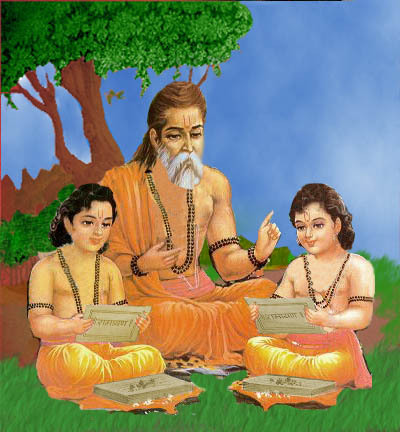
Srila Ganga Dasa Pandit is remembered in Gaudiya Vaishnava tradition mainly for one relationship. He was the schoolteacher of the brilliant Navadvipa boy called Nimai, who would grow up to be Sri Chaitanya Mahaprabhu. This was a relationship of teacher and student, not of initiation. (Ganga Dasa Pandit taught grammar and scripture, not diksha.) But Sri Chaitanya-charitamrita and Sri Chaitanya-Bhagavata both treat it as far more than an ordinary schoolteacher's role. They describe him as one of the Lord's dearest associates. In a devotional sense, they also describe him as a guru whom the Lord Himself continued to honor long after His schooldays ended.
| Detail | Description |
|---|---|
| Role | Schoolteacher (grammar, scripture) of the young Nimai at Navadvipa; not a diksha relationship |
| Birthplace | Radha-desha, Bengal (Sri Chaitanya-charitamrita, Adi 13.61) |
| Home and school | Ganganagara, Simantadvipa, near Navadvipa |
| Identity | Vasishtha Muni, guru of Lord Ramachandra, who appeared by a special manifestation as both Ganga Dasa and Sudarshana (Gaura-ganoddesha-dipika 53) |
| Earliest source | Sri Chaitanya-Bhagavata, the biography of Sri Chaitanya Mahaprabhu (his former student) by Vrindavana Dasa Thakura |
| Birth/disappearance years | Not recorded |
Scriptural evidence for the introduction (2)
prabhura atyanta priya — paṇḍita gaṅgādāsa
yāṅhāra smaraṇe haya sarva-bandha-nāśa
Word for word
prabhura: of the Lord; atyanta: very; priya: dear; paṇḍita gaṅgādāsa: Paṇḍita Gaṅgādāsa; yāṅhāra: who; smaraṇe: by remembering; haya: it becomes; sarva-bandha-nāśa: freedom from all kinds of bondage.
Pandita Gangadasa was the eighth dear branch of the tree of Sri Chaitanya Mahaprabhu. One who remembers his activities attains freedom from all bondage.
The single verse making the strongest devotional claim about Ganga Dasa Pandit found in Sri Chaitanya-charitamrita's own listing of the Lord's principal associates.
पुरासीद्रघुनाथस्य यो वशिष्ठ मुनिर्गुरुः ।
स प्रकाशविशेषेण गङ्गादाससुदर्शनौ ॥५३॥
purāsīd raghunāthasya yo vaśiṣṭha munir guruḥ |
sa prakāśa-viśeṣeṇa gaṅgādāsa-sudarśanau ||53||
The same person who formerly appeared as Vasistha Muni, the spiritual master of Lord Ramacandra, appeared in Lord Caitanya's pastimes as Gangadasa and Sudarsana.
Kavi Karnapura's verse identifying Ganga Dasa, the Lord's grammar teacher, with Vasishtha Muni, the guru of Lord Ramachandra; the verse stands among those naming Mahaprabhu's gurus (verse 52 names Keshava Bharati as Sandipani Muni). Sanskrit: diacritic edition of the Gaura-ganoddesha-dipika; English translation as published at bvmlu.org.
Chapter 1
An Elder Descended Before the Lord
Who Gaudiya Vaishnava tradition says Ganga Dasa Pandit was, in a spiritual sense, before he ever taught a single lesson.
Gaudiya Vaishnava tradition holds that Sri Chaitanya Mahaprabhu's closest associates did not simply happen to be alive in Navadvipa when He appeared there in 1486. Tradition says that many of them took birth on purpose, a little ahead of the Lord. In this way they would already be in place to play the parts that His own pastimes would require: elders, teachers and playmates. Ganga Dasa Pandit is counted among these early arrivals.
Born in Radha-desha #
Sri Chaitanya-charitamrita records the detail plainly. In Radha-desha, the part of Bengal where the Ganges cannot be seen, Nityananda Prabhu, Ganga Dasa Pandit, Murari Gupta and Mukunda Datta all took birth. It is a short and plain verse, almost like a list: four names and a place. But it is one of the very few solid facts about Ganga Dasa Pandit's own life that survive at all, and for that reason it is worth reading carefully. It puts him in the same generation as some of the best-recorded figures of early Gaudiya Vaishnavism, and names him right beside them. How Ganga Dasa Pandit made his way from Radha-desha to Navadvipa is no longer recorded. He settled at Ganganagara, a neighborhood in the area known as Simantadvipa. There he would later open the school that made him famous.
The Eighth Branch of the Tree #
Elsewhere in Sri Chaitanya-charitamrita, Krishnadasa Kaviraja Goswami describes Sri Chaitanya Mahaprabhu at length as a great tree. The Lord's principal devotees are named one after another as its branches and sub-branches. By Krishnadasa's own count, Ganga Dasa Pandit is the eighth dear branch of that tree. The verse naming him also adds a promise about him that is found nowhere else in the text. It says that anyone who simply remembers his activities is freed from all material bondage. This is a striking claim to make about a man whose own recorded life is little more than a schoolroom and a handful of episodes. It shows how seriously Gaudiya Vaishnavas have always taken one idea. In this tradition, greatness is measured by closeness to the Lord's service, not by the length of one's own biography.
Vasishtha Muni in Gaura-Lila #
Kavi Karnapura's Gaura-ganoddesha-dipika gives the fullest account of who Ganga Dasa Pandit was believed to be, in a purely spiritual sense. This work identifies the eternal spiritual identities behind many of Sri Chaitanya Mahaprabhu's associates. There, Ganga Dasa Pandit is named as an expansion of Vasishtha Muni (the sage remembered in the Ramayana as guru to Lord Rama and Lakshmana). It says that Vasishtha appeared a second time, in two forms, as Ganga Dasa Pandit and as a devotee named Sudarshana. A separate tradition recorded in the Gaudiya Vaishnava Abhidhana adds one more, deeper detail. It says that when Krishna Himself appeared in Dvapara-yuga, this same Vasishtha had entered into Sandipani Muni, the sage who personally taught Krishna and Balarama. If that is so, it helps explain something that might otherwise look like a simple poetic touch. When Vrindavana Dasa Thakura describes Ganga Dasa Pandit as Nimai's teacher (see Teaching the Young Nimai), he compares him specifically to Sandipani Muni, not to any other teacher-sage in the tradition. According to this reading, the resemblance was not just poetic. It was, in a sense, the same soul returning to the same role.
A Modest but Genuine Foundation #
None of these spiritual identities changes what can actually be checked about Ganga Dasa Pandit's life on earth. That remains very little: a birth region, a Navadvipa neighborhood, and a place in scripture's list of the Lord's associates. But across independent sources, these identities show clearly and again and again how seriously the Gaudiya Vaishnava tradition regarded him. He was not a minor figure who happened to run a school Nimai once attended. Tradition holds that he was placed in Navadvipa on purpose, ahead of the Lord's own appearance, to do exactly the work he ended up doing.
Scriptural evidence for this chapter (1)
rāḍha-deśe janmilā ṭhākura nityānanda
gaṅgādāsa paṇḍita, gupta murāri, mukunda
Word for word
rāḍha-deśe: the place where there is no Ganges; janmilā: took birth; ṭhākura nityānanda: Nityānanda Prabhu; gaṅgādāsa paṇḍita: Gaṅgādāsa Paṇḍita; gupta murāri: Murāri Gupta; mukunda: Mukunda.
In Radhadesha, the part of Bengal where the Ganges is not visible, Nityananda Prabhu, Gangadasa Pandita, Murari Gupta and Mukunda took birth.
One of the very few hard biographical facts recorded about Ganga Dasa Pandit's own life: his birth region and generation, shared with Nityananda Prabhu, Murari Gupta and Mukunda Datta.
Chapter 2
Teaching the Young Nimai
A Navadvipa schoolroom, a student with an extraordinary memory, and a comparison to Krishna's own guru.
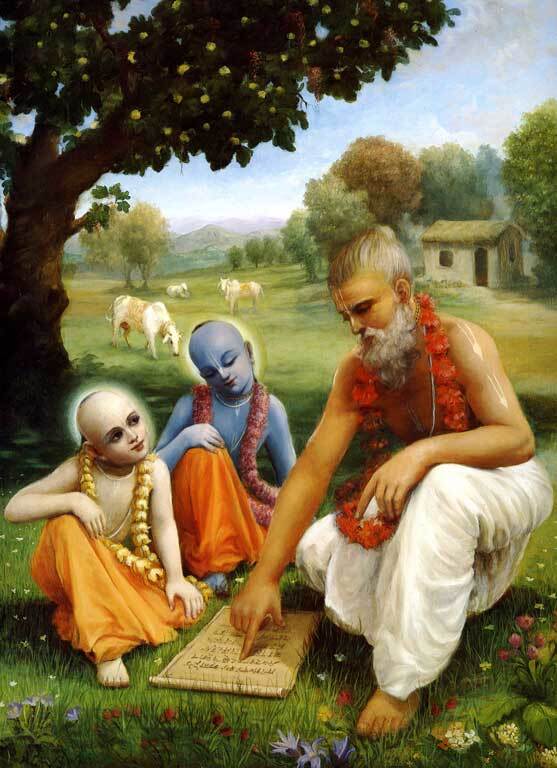
When the boy Nimai told his father Jagannatha Mishra that he wished to study, Jagannatha Mishra took him to Ganga Dasa Pandit. Ganga Dasa Pandit was a respected professor who lived at Ganganagara. This neighborhood lies within the area known as Simantadvipa, close to Navadvipa itself. Tradition remembers that spot with real fondness. During the Navadvipa parikrama, devotees still stop near the Yogapitha temple to hear the story of Ganga Dasa Pandit's home and school, even though the site itself lies a short distance away in Simantadvipa. Ganga Dasa Pandit gladly accepted the boy. Every account says that he began teaching him with the same care he might have given his own son.
A Student Unlike Any Other #
By the time Nimai arrived, Ganga Dasa Pandit had already taught thousands of students over the years. But none of them, as Sri Chaitanya-charitamrita records, had a mind like this one. It states directly that while studying grammar at Ganga Dasa Pandit's school, the Lord would memorize an entire grammatical rule and its explanation simply by hearing it once. This is a small, exact detail in Sri Chaitanya-charitamrita. It is not a vague claim of brilliance, but a precise description of a particular kind of gift. It fits naturally with the wider picture of Nimai's schooldays that Gaudiya Vaishnava literature gives. He was so quick that his classmates could rarely keep pace with him. These classmates included Murari Gupta and others named Krishnananda and Kamala Kanta. He delighted in giving two completely different, equally valid explanations of the same grammatical sutra. This left his fellow students puzzled and, tradition says, full of wonder at him.
The Sandipani Muni Comparison #
Vrindavana Dasa Thakura, the biographer of Ganga Dasa Pandit's most famous student, later gave the world its most memorable description of him. He wrote in Sri Chaitanya-Bhagavata that there was in Navadvipa a wonderful professor named Ganga Dasa Pandit who resembled Krishna's own guru, Sandipani Muni. Let us look at what this comparison means. Sandipani Muni is remembered in Vaishnava tradition as the sage who taught Krishna and Balarama grammar and the sciences during their short stay at his ashram in Ujjain. Tradition holds that the Lord took part in this pastime not because He needed an education, but to set an example. It showed how even the Supreme Person honors the process of learning and the position of a teacher. Srila Bhaktisiddhanta Sarasvati Thakura commented on this same episode in Sri Chaitanya-Bhagavata centuries later. He made the same point directly about Nimai's schooling under Ganga Dasa Pandit. He explained that the Lord accepted human limitations and desired to learn grammar and the arts, just as Krishna did with Sandipani Muni. The Lord did this so that those who make their living as teachers would be reminded to have genuine learning, not merely the appearance of it.
A School Remembered for What It Produced #
Gaudiya Vaishnavas do not remember Ganga Dasa Pandit's school at Ganganagara as an important institution for its own sake, the way they remember some later Vaishnava centers. It is remembered because of exactly one student. That is not a small thing to be remembered for, and this tradition does not treat it as a small thing either. The schooling pastime appears in many sources for a reason. Gaudiya Vaishnavas have always read it as more than a childhood story. For them it is an early, quiet sign of who Nimai was, given years before the people of Navadvipa learned to call him by any other name. The Devotee the Lord Never Stopped Honoring tells what became of that relationship once the schooling ended, and of the ordinary respect a student owes a teacher.
Scriptural evidence for this chapter (1)
gaṅgādāsa paṇḍita-sthāne paḍena vyākaraṇa
śravaṇa-mātre kaṇṭhe kaila sūtra-vṛtti-gaṇa
Word for word
gaṅgādāsa: Gaṅgādāsa; paṇḍita-sthāne: at the place of the teacher; paḍena: studies; vyākaraṇa: grammar; śravaṇa-mātre: simply by hearing; kaṇṭhe: between the neck and the heart; kaila: did; sūtra-vṛtti-gaṇa: the aphorisms and their definitions.
When the Lord was studying grammar at the place of Gangadasa Pandita, He would immediately learn grammatical rules and definitions by heart simply by hearing them once.
The direct scriptural record of Nimai's schooling under Ganga Dasa Pandit and of the extraordinary memory he displayed there.
Chapter 3
The Devotee the Lord Never Stopped Honoring
A student who kept bowing to his teacher, a secret from a night on the Ganges, and a pilgrim's welcome at Puri.
Nimai returned from a pilgrimage to Gaya in 1509 a changed young man, absorbed now in devotion to Krishna rather than in the grammar and logic that had once been his whole world. The Navadvipa devotees, among them Srivasa Thakura, Gadadhara Pandit and others, watched the transformation with amazement and joy. Ganga Dasa Pandit, his old teacher, felt the same. But what Ganga Dasa Pandit did next is a detail that Gaudiya Vaishnava tradition has always remembered.
Bowing to His Own Student #
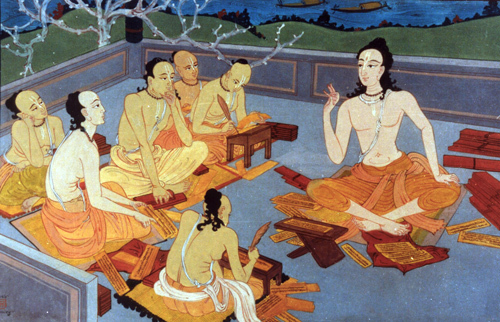
Even in this changed state, Nimai kept going to Ganga Dasa Pandit's house and offering obeisances at his feet. Tradition says that in this way he set an example of exactly how a disciple ought to honor a teacher, no matter how far beyond ordinary schooling that disciple had since traveled. Ganga Dasa Pandit, in turn, met him not with the plain respect due to a former student, but with the warmth a guru shows a beloved disciple. He embraced him with clear affection. According to Sri Chaitanya-Bhagavata, Ganga Dasa Pandit was overjoyed at the transformation. He told his former pupil that Nimai's own life was now blessed, and that Nimai's ancestors on both his mother's and his father's side were delivered. At the same time, he also told him plainly to keep teaching. It is a small, human moment inside a much larger pastime. Both men understood, in their different ways, that something remarkable had just happened between them. Yet each kept to his own place. One was still a teacher giving instruction. The other, by his own choice, was still a student paying respect.
The Ferryman on the Ganges #
A second episode, from earlier in Ganga Dasa Pandit's life, came to light only years later, and in a striking way. One night Ganga Dasa Pandit fled his home with his wife and children, out of fear of the region's Muslim rulers. He waited by the bank of the Ganges for a ferry that never came. He was terrified that his family would be harmed if no boat arrived before daybreak. When he was close to despair, a ferryman appeared out of nowhere, took his family safely across the river, and vanished. Ganga Dasa Pandit told no one what had truly happened that night until, tradition holds, Sri Chaitanya Mahaprabhu Himself brought it up. This happened during the Mahaprakasha. On that day the Lord revealed His divine identity for some twenty-one hours at Srivasa Thakura's house and called each of His devotees forward in turn. He reminded Ganga Dasa Pandit of the ferry crossing, a private memory that only Ganga Dasa Pandit himself could have known. Hearing it told aloud, Ganga Dasa Pandit is said to have fainted in ecstasy. He understood at last who had carried his family across the river that night.
A Pilgrim at Puri #
After Sri Chaitanya Mahaprabhu accepted sannyasa at Katwa and later settled at Puri, Ganga Dasa Pandit was among the first group of Bengali devotees to make the journey south to see Him there. Sri Chaitanya-charitamrita records that when these Navadvipa devotees arrived, Sarvabhauma Bhattacharya introduced them one by one to King Prataparudra, naming Ganga Dasa Pandit specifically among them. It also records that the Lord Himself praised and embraced him warmly before the assembled Orissan devotees. In the great kirtana processions before Prataparudra's Jagannatha cart, Ganga Dasa Pandit sang in the second kirtan group. He was one of five singers answering Srivasa Thakura's lead, alongside Haridasa Thakura and others. Nityananda Prabhu danced as the group's chief. This is the last clearly dated mention of Ganga Dasa Pandit in the record available here. The former Navadvipa schoolteacher was still singing the Lord's names among the Lord's own devotees, years after the schoolroom at Ganganagara had closed for good.
Scriptural evidence for this chapter (2)
ācāryaratna iṅha, paṇḍita-purandara
gaṅgādāsa paṇḍita iṅha, paṇḍita-śaṅkara
Word for word
ācāryaratna: Candraśekhara; iṅha: here; paṇḍita-purandara: Purandara Paṇḍita; gaṅgādāsa paṇḍita: Gaṅgādāsa Paṇḍita; iṅha: here; paṇḍita-śaṅkara: Śaṅkara Paṇḍita.
"Here are Acaryaratna, Purandara Pandita, Gangadasa Pandita and Sankara Pandita."
Part of Sarvabhauma Bhattacharya's introduction of the visiting Bengali devotees to King Prataparudra at Puri, naming Ganga Dasa Pandit among them.
gaṅgādāsa, haridāsa, śrīmān, śubhānanda
śrī-rāma paṇḍita, tāhāṅ nāce nityānanda
Word for word
gaṅgādāsa: Gaṅgādāsa; haridāsa: Haridāsa; śrīmān: Śrīmān; śubhānanda: Śubhānanda; śrī-rāma paṇḍita: Śrī Rāma Paṇḍita; tāhāṅ: there; nāce: dances; nityānanda: Lord Nityānanda.
The five singers who responded to the singing of Srivasa Thakura were Gangadasa, Haridasa, Sriman, Subhananda and Sri Rama Pandita. Sri Nityananda Prabhu was appointed as a dancer.
Records Ganga Dasa Pandit's place in the kirtan groups before the Jagannatha cart at Puri, singing alongside Haridasa Thakura under Srivasa Thakura's lead.
Closing
Ganga Dasa Pandit and Vrindavana Dasa Thakura's Book #
The names of Ganga Dasa Pandit and Vrindavana Dasa Thakura, the author of Sri Chaitanya-Bhagavata, are very often mentioned together. So we should be clear about the actual connection between them. They were not guru and disciple. By Sri Chaitanya-charitamrita's own account, Vrindavana Dasa Thakura's own diksha-guru was Nityananda Prabhu, who accepted him as one of his last disciples. The real connection is of a different kind. Vrindavana Dasa Thakura is the main source for nearly everything known about Ganga Dasa Pandit. In Sri Chaitanya-Bhagavata itself, it was Vrindavana Dasa Thakura who recorded the schooling pastime and the Sandipani Muni comparison. He also recorded Ganga Dasa Pandit's presence at other key moments of the Lord's Navadvipa years. In that sense, Ganga Dasa Pandit is one of Vrindavana Dasa Thakura's subjects, not his teacher.
What Remains Unknown #
Very little is recorded about Ganga Dasa Pandit's own life outside his relationship with Sri Chaitanya Mahaprabhu, and we do not hide that. The sources available here give no year for his birth or disappearance. No literary work of his own is recorded. His fame rests entirely on what others wrote about him, mainly Vrindavana Dasa Thakura and, decades later, Krishnadasa Kaviraja Goswami in Sri Chaitanya-charitamrita. These sources also do not record whether he ever formally initiated disciples, in the ordinary diksha sense. But one thing is recorded well and again and again, in both major biographies of the Lord. It is the relationship described on this page. He was an ordinary Navadvipa schoolteacher who found himself teaching grammar to the Supreme Lord. Later in life, that same Lord honored him, as though the honor ran in the other direction entirely.
- Ganga Dasa Pandit - Biography (Gaudiya History)
- Sri Ganga das Pandit (Shyam Das Baba, Bhakti Siddhanta Vani Seva)
- Sri Chaitanya-charitamrita, Adi-lila 10.29 (Bhaktivedanta VedaBase)
- Sri Chaitanya-charitamrita, Adi-lila 13.61 (Bhaktivedanta VedaBase)
- Sri Chaitanya-charitamrita, Adi-lila 15.5 (Bhaktivedanta VedaBase)
- Sri Chaitanya-charitamrita, Madhya-lila 11.85 (Bhaktivedanta VedaBase)
- Sri Chaitanya-charitamrita, Madhya-lila 13.39 (Bhaktivedanta VedaBase)
