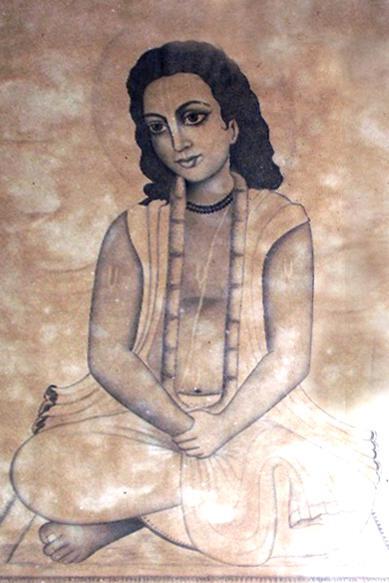
The greatest controversy in Narottama Dasa Thakura's own lifetime had nothing to do with his teaching. It had everything to do with his birth. Sri Chaitanya Mahaprabhu himself had taught that spiritual authority belongs to anyone who truly knows Krishna, whether he is a brahmana or not. But that teaching still went strongly against Bengal's caste-conscious smarta brahmana society, and Narottama Dasa Thakura's own life put it to a direct test. He was born a kayastha, not a brahmana, yet he had taken brahmana disciples. A group of smarta brahmanas could not tolerate this, and they set out to disgrace him in public. They brought in a local king, Raja Narasimha, and a powerful debater named Rupanarayana Pandita. The whole party then set off for Kheturi, where Narottama Dasa Thakura had his headquarters. They meant to expose him as a fraud in front of his own community.
Two Shopkeepers Who Were Not What They Seemed #
Word of the plan reached Ramachandra before the party arrived, and he did not wait for them at Kheturi. He traveled ahead to Kumarapura with a fellow Vaishnava, Ganga Narayana Chakravarti. In the Vaishnava tradition that has come down to us, Ganga Narayana's name appears mainly through this one episode. The plotters would have to pass through Kumarapura. There the two men set up two ordinary market stalls, one selling betel nut and pan, the other selling clay pots. Neither man gave any sign of who he really was. In fact both were skilled Sanskrit scholars, relying on nothing but their disguise.
When the smarta party reached Kumarapura, they sent disciples out to buy supplies. The young men expected simple tradesmen. Instead they found two shopkeepers who answered them in fluent Sanskrit and drew them almost at once into a philosophical argument. The disciples could not hold their own, so they called for their teachers. In the end the whole party came to the two stalls, Raja Narasimha and Rupanarayana Pandita among them. Rupanarayana himself entered the debate, and lost it. The *Bhakti-ratnakara* records that Ramachandra and Ganga Narayana defeated him with arguments firmly based on the Bhagavatam. Given the question being argued, they very likely used its repeated teaching that a person becomes spiritually qualified by character, knowledge and surrender, not by the family he happens to be born into. At last the two "shopkeepers" were asked who they really were. They answered with careful humility that they were two insignificant disciples of Narottama Dasa Thakura Mahasaya. The smarta party had already been beaten in a village marketplace by a kayastha's own disciples. So they lost all wish to face the guru himself, and turned back for home.
A Warning in a Dream #
The story does not end with a debate won. That same night, Raja Narasimha dreamed that Durga-devi herself appeared and scolded him. She warned him that he had committed a grave offense at Narottama Dasa Thakura's feet. Only surrender at those same feet, she said, could save him from what would follow. Rupanarayana Pandita, by the same account, had exactly the same dream. Both men rose at once, bathed, and set out for Kheturi. This time they went to ask forgiveness, not to fight.
They found Narottama Dasa Thakura absorbed in his own bhajana at the Temple of Sri Gauranga. By every account he was overflowing with krishna-prema. Just the sight of him was enough to remove whatever pride had brought them there. Both men fell at his feet in surrender. By nature, Narottama Dasa Thakura presented himself as the most fallen of souls, not as anyone's judge. He received them without any trace of bitterness, and in time he initiated both of them with the Radha-Krishna mantra.
What the Episode Meant #
Later Vaishnava memory treats this less as a story about winning an argument. It sees it as one more proof of how completely Ramachandra had given his own life to Narottama Dasa Thakura's mission. When it mattered, he was willing to give up a poet's dignity for a market stall and a disguise, so that his friend would not stand unprotected. Ramachandra had stood firm for his Vaishnava faith once before, against his own Shakta relatives at home. Here the episode fits naturally with a related teaching: that real devotion, not the family one is born into, is what makes a person qualified to teach and to initiate. Not long afterward, Ramachandra was present at Kheturi itself, for the festival that became the most famous single gathering in early Gaudiya Vaishnava history. That event, and the years that followed it, are told on Kheturi and the Return to Vrindavana.
