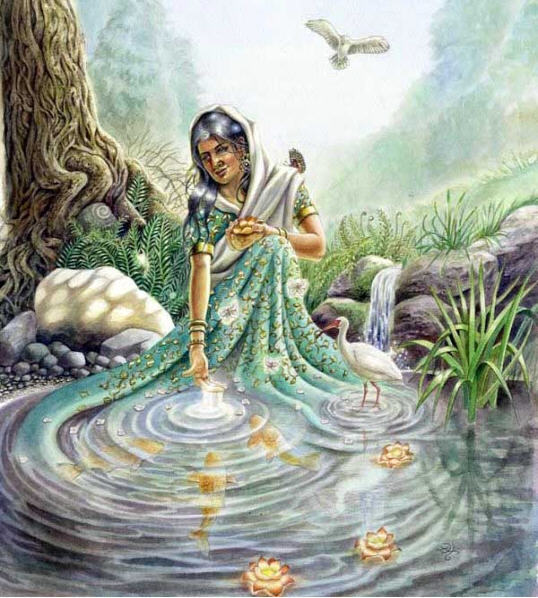
Sachi Devi's guru sent her from Radha-kunda to Jagannatha Puri with a specific task. She was to restore the ruined house of Sarvabhauma Bhattacharya. He was the great Nyaya scholar and Sanskrit logician whose surrender to Chaitanya Mahaprabhu had been one of the turning points of the Lord's own Puri pastimes. There Sachi Devi took kshetra-sannyasa, the vow never to leave the sacred territory of Puri again. This vow is described in full on A Woman's Place Among the Vaishnava Renunciates. She settled into the broken-down building to begin the work her guru had given her.
A Bhagavata Speaker Who Drew a King #
Once she had settled there, she took up worship of a Damodara shalagrama-shila and began giving discourses on Srimad-Bhagavatam. Several sources agree that her explanations of the text made such a strong impression that people began traveling specially to hear her speak. In time her audience grew to include King Mukunda Deva of Puri himself, along with a number of the Jagannatha temple's own priests. This detail is striking on its own. It means that a woman renunciate living in a half-ruined house was already recognized in Puri as a trusted teacher of scripture, even before anything miraculous happened to her.
The Night the Ganges Came to Her #
The episode that gave Sachi Devi her permanent name took place during a major bathing festival connected with the Ganges, on Krishna-trayodashi. The sources describe it as either the Ganga Sagara Mela or the Maha-Varuni bathing day. Lord Jagannatha appeared to her in a dream and told her to bathe that night in the Shveta-ganga, the White Ganges tank inside the temple grounds, even though her own vow did not allow her to wander. She followed the instruction. By every telling of the story, the moment she entered the water she had a vision of Ganga-devi herself. She was carried away by a current that had no ordinary source. At dawn she found herself standing inside the temple's own inner shrine, at the feet of Jagannatha.
The temple's gatekeepers and priests found an unknown woman inside the inner shrine, with no explanation for how she had got there. They assumed she was a thief and had her imprisoned. According to the traditional account, trouble followed for everyone involved except her. The king and the priests are described as falling into distress and illness. Then Jagannatha appeared again, this time to King Mukunda Deva and the head priest together, and explained what had really happened. He said that He Himself had caused the Ganges to flow out from His own feet as caranamrita, to bathe Sachi Devi directly. The king and priests owed her an apology and initiation, not a prison sentence.
Becoming Gangamata #
The king had her released at once and, along with the temple's priests, begged her forgiveness. From that day, Sachi Devi became known as Gangamata, "mother of the Ganges," and Sarvabhauma's restored house took on the name it still carries, the Ganga-mata Math. Srila Prabhupada wrote his purport to Chaitanya-charitamrita Madhya 6.8 centuries later, and he had no reason to add to a local story. That purport confirms the simple fact that can still be seen today: Sarvabhauma Bhattacharya's old residence, he notes, "at present... is used as the monastery of Gangamata."
King Mukunda Deva asked to become her disciple, and she accepted him, giving him the eighteen-syllable Radha-Krishna mantra. A Smarta brahmana scholar named Mahiratha Sharma, from Dhaninjayapura, is also named among her initiated disciples, along with a number of the temple's own priests. The king pressed her to accept land as guru-dakshina, but she refused it. Instead she asked for something far more modest, to be sent daily for the service of the Vaishnavas at her Math: two containers of mahaprasada rice and one of vegetables, a cloth, and a hundred and sixty paisa. Tradition holds that this same daily offering continues from the Jagannatha temple kitchen to the present day.
The Deity of Rasika Raya #
Sometime after this, a Vaishnava brahmana in Jaipur, named Chandra Sharma in one account and Krishna Mishra in Srila Prabhupada's purport to Chaitanya-charitamrita Adi 8.60, received an instruction in a dream from a Deity he had long worshipped. The Deity told him to carry Him to Puri and present Him to Gangamata. The brahmana feared he had committed an offense in his service (seva-aparadha), and doing this would free him from it. He did as instructed. Accounts differ on the Deity's exact name. Most call Him Radha-Rasika Raya, the same name as the Deity still worshipped at the Math today, while one source calls Him Shyama Raya. But they agree on the outcome. King Mukunda Deva renovated Sarvabhauma's house further to receive the new Deity, and worship of Radha-Rasika Raya has continued at the Ganga-mata Math from that day forward.
A Separate Mission from Gopiballabhpur #
We should be clear about what Gangamata's Puri mission was not. Shyamananda Pandit and his disciple Rasikananda Prabhu were building their own Gaudiya Vaishnava mission in Odisha in overlapping decades. It was centered at Gopiballabhpur, near the Mayurbhanj border, and it reached kings, zamindars and even hostile officials across the region. Gangamata's own mission was run from inside Jagannatha Puri itself. It followed a completely separate guru-lineage, through Gadadhara Pandit. It appears nowhere in either of their biographies, and neither of them appears in hers. The two missions worked at the same time, but not together. This is worth saying plainly and not simply assuming, because two famous Odisha missions from the same century could easily be mixed up.
What happened to the Ganga-mata Math after Gangamata's own long life, and how honestly the sources speak about her last years, is told on Disappearance and Legacy.
