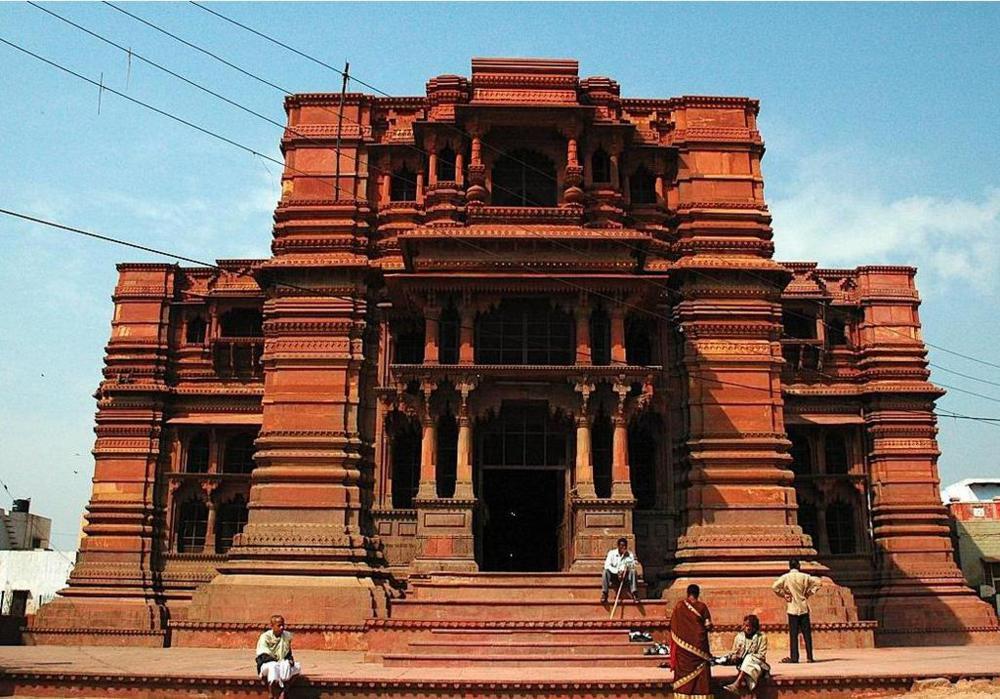
Every biography of Gangamata Goswamini begins in the same place, with a wealthy Bengali household that could not keep her. She was born Sachi Devi, also spelled Saci Devi. She had the same name as Srimati Sachi Devi, the mother of Sri Chaitanya Mahaprabhu, but she was a different woman. She was the only child of Naresha Narayana, the zamindar-raja of Puntiya (also spelled Puthia or Puntaya) in the Rajshahi district of Bengal, in territory now part of Bangladesh. Some later, popular accounts describe Gangamata as a "Rajput princess." The sources that actually name her family do not use that phrase, and there is no recorded connection between the Puntiya zamindari and any Rajput clan of Rajasthan. The recorded account is clear that hers was a Bengali landholding family, not a Rajasthani one.
A Household Turned Toward Krishna #
Naresha Narayana is said to have taken up Vaishnava dharma himself under the influence of Shrinivasa Acharya, one of the three young preachers the Goswamis of Vrindavana sent home to carry Gaudiya Vaishnavism into Bengal and Odisha. If that detail is correct, Sachi Devi's devotion did not go against her father's household. It grew out of it. She grew up inside a family that had already turned toward Chaitanya Mahaprabhu's movement, even if her own devotion soon went far beyond anything her parents expected.
From early childhood Sachi Devi showed little interest in the ordinary business of a zamindar's daughter. By the accounts that survive, she was educated in grammar, poetry and scripture, and she was known for her beauty. But she treated both her education and her looks as less important than the one thing she cared about, which was Krishna. Her parents raised the subject of marriage, as any Bengali landholding family of the time would. She refused outright. She told them she would accept no husband who was subject to death, since she had already given her heart to Krishna alone.
Ruling, Then Renouncing, a Kingdom #
Her parents died without persuading her to change course. As their only heir, Sachi Devi briefly took charge of the family estate herself. She did this only for a short time. The sources do not say exactly how long it lasted or what kind of ruler she was, only that she did it. Once she had completed her immediate family duties, she gave up the zamindari altogether and left home on pilgrimage. She travelled first to Jagannatha Puri and then on to Vrindavana, in search of a guru who could really teach her what she wanted to know.
Meeting Haridasa Pandit at Govindaji #
In Vrindavana, Sachi Devi's pilgrimage led her to Sri Haridasa Pandit Goswami, the chief worshipper of the Radha-Govindaji Deity. This Haridasa Pandit is a different person from the more famous Srila Haridasa Thakura, the namacharya of Puri, and the two should not be confused. Haridasa Pandit did not accept her immediately. As a guru, he had to think about the discipline of his own ashram. Sachi Devi had wealth, a striking appearance and a royal upbringing. From every outward sign, she looked like exactly the kind of person that renunciate life is meant to test. So he had good reason to hesitate before taking her on as a disciple.
By every account, what changed his mind was seeing her really live as a renunciate, not merely talk about wanting to. She gave up her fine clothes for tattered cloth and gave up her ornaments. She lived on madhukari, begging just enough food from more than one house to get through the day, in the traditional way of Vraja's own renunciates. Once Haridasa Pandit was satisfied that her vairagya was not a passing mood, he initiated her at the Govindaji temple itself, on the day of Chaitra Shukla Ekadashi, giving her the eighteen-syllable Radha-Krishna mantra.
A Guru's Own Guru-Lineage #
Haridasa Pandit's own guru was Ananta Acharya Goswami. According to Chaitanya-charitamrita Adi 12.81, Ananta Acharya was the fifth listed branch of Gadadhara Pandit's own disciples. So Sachi Devi's guru-lineage rests on what Krishnadasa Kaviraja Goswami himself wrote down. According to the Gaura-ganoddesha-dipika, as her own Math's tradition remembers it, Ananta Acharya's identity in Krishna's eternal pastimes was Sudevi, one of the eight principal gopis of Vraja. He is also recorded there under a second name, Vinoda-manjari. Haridasa Pandit himself is remembered as Raghu-gopala, or Rasa-manjari.
A year of austerity followed for the newly initiated Sachi Devi. Then her guru decided to send her to live at Radha-kunda. Her life there shows what kind of renunciate life was open to a woman in seventeenth-century Vraja. This part of her story is the subject of A Woman's Place Among the Vaishnava Renunciates.
