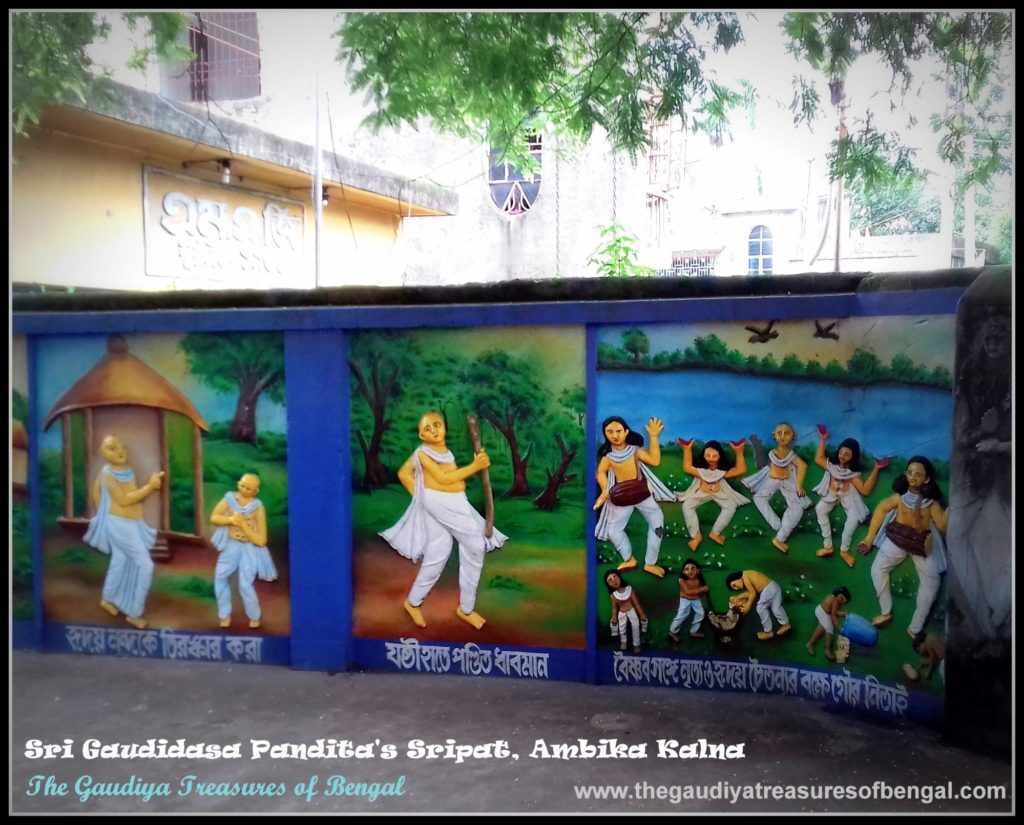
The neem-wood Deities of Sri Sri Gaura-Nitai that appeared at Ambika Kalna did not stay a private household treasure for long. A temple grew up around them. According to Bhaktisiddhanta Sarasvati Thakura's Anubhasya commentary, it was built by the zamindar of Burdwan. The temple has been repaired, rebuilt, and expanded many times across five centuries, and pilgrims still visit it at Ambika Kalna today.
| Detail | Description |
|---|---|
| Deities | Sri Sri Gaura-Nitai, carved from neem wood |
| Temple built by | The zamindar of Burdwan |
| Other relics kept there | A Bhagavad-gita manuscript said to be in Mahaprabhu's own hand; an oar said to be his gift |
| Key later pastime | The Deities and the naming of Hridaya Chaitanya |
| Today | An active Gaudiya Vaishnava pilgrimage site (a "sripat") near Kalna, West Bengal |
A Life Given to Their Service #
Gauridasa Pandit had almost demanded that the Deities stay in his home permanently. He spent the rest of his life showing how serious that demand was. Devotional accounts describe him cooking for the Deities, dressing and ornamenting them, and talking with them as one would with living guests, not carved wood. Several sources also record that even when poverty made fine ornaments impossible, the Deities themselves are said to have provided what was needed. By the same tradition, in his old age the Deities asked him to simplify his elaborate daily cooking to something as plain as shak on a banana leaf. It is a small detail. But later devotees read it as a sign of a relationship so close that the Deities could ask their servant for less, not more.
Two Relics Still Shown to Pilgrims #
Two physical objects at the temple carry their own stories. One is a handwritten copy of the Bhagavad-gita that temple tradition says was written in Mahaprabhu's own hand. Several sources repeat this claim. But at least one of them notes plainly that the attribution "remains disputed by some scholars," and so we report that doubt here instead of passing the claim off as settled. The other object is an oar. It is said to have been given by Mahaprabhu to Gauridasa Pandit with the instruction that he use it to help fallen souls cross the ocean of material existence. By that one sentence, a plain wooden object became a symbol for the rest of Gauridasa Pandit's service.
The Kirtana That the Deities Joined #
The most vivid story connected to the temple concerns Gauridasa Pandit's own foremost disciple, a devotee originally named Chaitanya Dasa. During a sankirtana festival Chaitanya Dasa organized on the riverbank, tradition says the Gaura-Nitai Deities themselves left the altar to dance and chant among the assembled devotees. Gauridasa Pandit discovered the altar empty and went out to bring them back. In some tellings he had a stick in hand and was plainly angry, though only half seriously. The Deities are said to have fled from him and entered his disciple's heart instead. Overcome, Gauridasa Pandit embraced Chaitanya Dasa and gave him a new name on the spot: Hridaya Chaitanya, "one who carries Chaitanya within his heart." Local tradition ties this same pastime to a lasting change in temple practice. Today the Deities are shown to pilgrims only in a brief "jhalak darshan," a glimpse of just a few seconds. This is said to guard against their running off again.
Hridaya Chaitanya's importance went well beyond Ambika Kalna. His own most important disciple was Shyamananda Prabhu, one of the devotees who carried Gaudiya Vaishnavism into Odisha. The pancharatrika line runs from Gauridasa Pandit through Hridaya Chaitanya and Shyamananda Prabhu, and it eventually reaches Baladeva Vidyabhushana, author of the Govinda-bhashya. This connection is followed further on Disappearance and Legacy.
A Pilgrimage Site Today #
Today Ambika Kalna can be reached by train from Howrah in roughly three and a half hours, or by road from Mayapur in about ninety minutes. Devotees who make the trip find a working temple, not a museum. The Gaura-Nitai Deities are still worshiped daily. The tamarind tree under which Mahaprabhu is said to have met Gauridasa Pandit still stands in front of the temple, and lotus footprints preserved beneath it are still shown to visitors. How that ongoing worship depends on Gauridasa Pandit's descendants and on Hridaya Chaitanya's own line of disciples is told on Disappearance and Legacy.
