Two facts about Gauridasa Pandit and Krishnadasa Kaviraja Goswami are certain. A third is often assumed, but it does not hold up when the sources are checked closely. This page keeps the three points separate on purpose.
What Krishnadasa Kaviraja Goswami Actually Wrote #
The first certain fact comes from the text itself. In Sri Chaitanya-charitamrita, Adi-lila 11.26-27, Krishnadasa Kaviraja Goswami names Gauridasa Pandit directly. He praises him in the strongest terms he uses for anyone in that chapter's long list of Nityananda Prabhu's associates: "the emblem of the most elevated devotional service in love of Godhead," a devotee who "sacrificed everything for the service of Lord Nityananda, even the fellowship of his own family." This is real and clear evidence from the text. But it was written by Krishnadasa Kaviraja Goswami decades later at Vrindavana, as part of a trusted account of Mahaprabhu's associates. It is not a record of the two men ever meeting.
Nothing in Chaitanya-charitamrita itself, and nothing in any other available source, describes an actual meeting between Krishnadasa Kaviraja Goswami and Gauridasa Pandit. So this connection is best understood as one of writing and devotion, not a personal one. It is one great Vaishnava writer honoring another great Vaishnava. The timeline also makes a personal meeting unlikely. Gauridasa Pandit belonged to the generation that knew Sri Chaitanya Mahaprabhu directly. Krishnadasa Kaviraja Goswami wrote Chaitanya-charitamrita in his own old age at Vrindavana, by most estimates several decades after Mahaprabhu's disappearance. Gauridasa Pandit lived in the time of the Lord Himself and was older than Him. So he had very likely already passed away by the time Krishnadasa Kaviraja Goswami was writing about him.
The Gauridasa of Antya 6.62 #
There is also a smaller point to note here, for the same reason. Chaitanya-charitamrita's Antya-lila 6.62 also names a "Gauridasa" among the devotees seated around Nityananda Prabhu on a raised platform at Panihati. This was at the festival held by Raghunatha Dasa Goswami, and the verse names him together with Dhananjaya, Jagadisha, Parameshvara Dasa, Mahesha, and Hoda Krishnadasa. The verse itself says nothing more about him. But Srila Prabhupada's purport to Antya 6.63, following Bhaktisiddhanta Sarasvati Thakura's Anubhasya, sends the reader to Adi-lila 11.26 for this Gauridasa, and that is the verse on Gauridasa Pandit. So the commentary treats the Gauridasa of Antya 6.62 as Gauridasa Pandit himself, seated among Nityananda Prabhu's close associates in Bengal.
Checking the Premise: Did Their Paths Cross at Ambika Kalna? #
Krishnadasa Kaviraja Goswami's dramatic turn toward Vrindavana came through a dream in which Nityananda Prabhu ordered him to leave Bengal. It would make a neat story if this had happened at Ambika Kalna, in or near Gauridasa Pandit's own house. But it did not. Chaitanya-charitamrita gives Krishnadasa Kaviraja Goswami's own account, and so does the page on his Early Life and the Call to Vrindavana. Both place his family home at Jhamatpur, a village near Naihati in the Katwa region, not at Ambika Kalna. The sankirtana he hosted, his scolding of his brother Shyamadasa, and Nityananda Prabhu's command in his dream all took place there too. It is easy to assume a connection, because both stories involve Nityananda Prabhu and a Bengali Vaishnava household. But a claim like this should be checked before it is repeated. Here, when we check it, it simply does not hold.
The Real Network: Narottama Dasa Thakura's Visit #
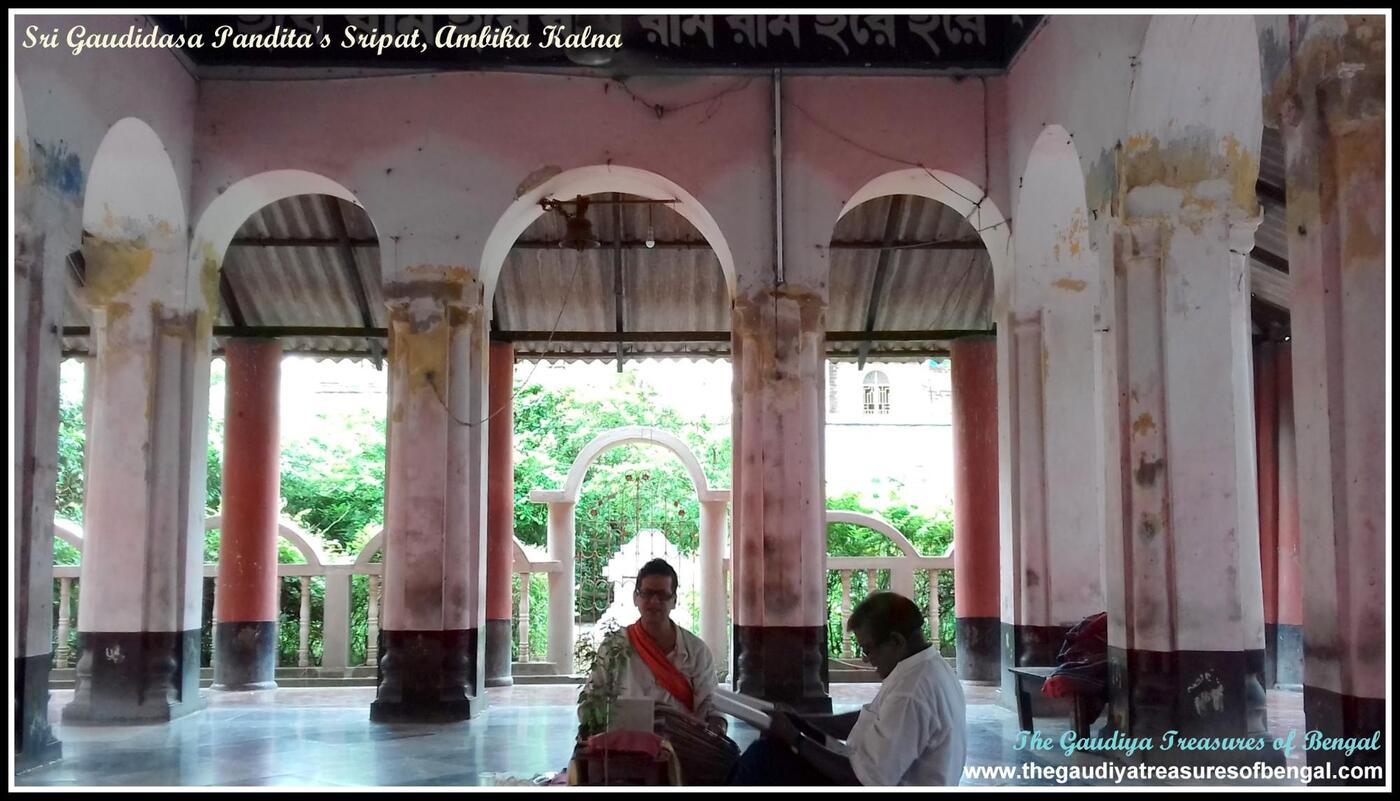
In the generation after Gauridasa Pandit, the real and well-recorded link between Ambika Kalna and the wider Gaudiya Vaishnava world is through a different person, Narottama Dasa Thakura. Traditional accounts of his pilgrimage back from Vrindavana describe him stopping for two days at Shantipur and then going on to Ambika Kalna. There he stayed at the house associated with Gauridasa Pandit, before going on to the great festival he organized at Kheturi. By this time Gauridasa Pandit himself had very likely already passed on. So it is more accurate to say that Narottama Dasa Thakura stopped at the house and temple that Gauridasa Pandit had established. Gauridasa Pandit's disciple Hridaya Chaitanya then carried on the service there. Hridaya Chaitanya is recorded as joining Narottama Dasa Thakura's party for the rest of the journey to Kheturi, along with a number of other Vaishnavas from Ambika Kalna.
That detail matters for the same reason as the Krishnadasa Kaviraja Goswami question. Ambika Kalna remained a real destination for later Bengali Vaishnavas because of Gauridasa Pandit's own household, temple, and chief disciple. It was not because of an invented meeting. What became of that household after his disappearance is the subject of Disappearance and Legacy. That page covers Hridaya Chaitanya's line, the descendants named in the Anubhasya, and the temple's place in Gaudiya Vaishnavism today.
