Srila Gauridasa Pandit
Householder Devotee Who Installed the Gaura-Nitai Deities of Ambika Kalna
The complete life, on one page: The main biography and every pastime page, in order, in one place
Introduction
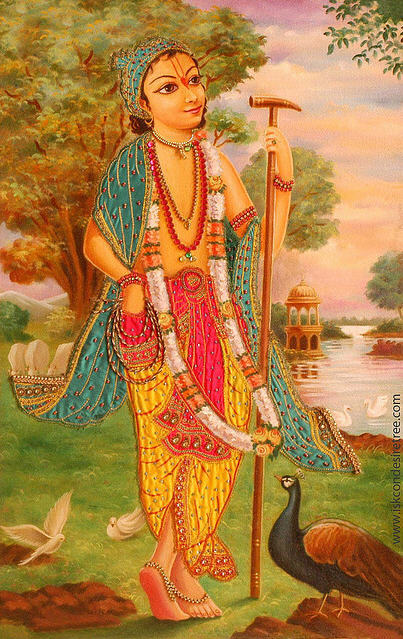
Gauridasa Pandit belonged to the first generation of householder devotees who gathered around Sri Chaitanya Mahaprabhu and Nityananda Prabhu in the closing years of the fifteenth century. He lived at Ambika Kalna, a town on the Ganges directly across from Shantipur. Krishnadasa Kaviraja Goswami praises him in Sri Chaitanya-charitamrita as a devotee unusually gifted at both receiving and giving krishna-prema. But what later tradition remembers most about him is not scholarship or renunciation. It is the great boldness of his love for Nityananda Prabhu. His love was so direct that, by the account his own temple still tells, he once spoke plainly to the Lord and His newly carved Deity form. He said that if the Deity really was as good as the Lord claimed, the Lord was free to stay home with him and send the Deity out to preach instead.
| Detail | Description |
|---|---|
| Also known as | Gauridas Pandit, Gauri Das Pandit, Gaudidasa Pandita |
| Birth | Not recorded; first lived at Saligrama, Bengal |
| Residence | Ambika Kalna, on the Ganges opposite Shantipur |
| Family | Younger brother of Suryadasa Sarakhela, whose daughters Vasudha and Jahnava Devi married Nityananda Prabhu |
| Disappearance | Shukla Ekadashi of Shravana (year not recorded) |
| Deities installed | Sri Sri Gaura-Nitai, still worshiped at Ambika Kalna |
| Identity | Subala, Krishna's dearest cowherd friend in Vraja (Gaura-ganoddesha-dipika 128; Chaitanya-charitamrita Adi 11.26 purport) |
At a Glance
- A Bengali householder brahmana, not a renunciant, whose devotion Krishnadasa Kaviraja Goswami calls unmatched in both receiving and giving divine love.
- Moved from the village of Saligrama to Ambika Kalna, where his own brother's two daughters later married Nityananda Prabhu.
- Installed the neem-wood Deities of Gaura-Nitai that Ambika Kalna still worships today, after demanding that the two Lords never leave him.
- Identified in the Gaura-ganoddesha-dipika as Subala, one of Krishna's closest cowherd friends in Vrindavana.
- Left no surviving writings of his own; almost everything known about him comes through a handful of verses in Sri Chaitanya-charitamrita and later temple tradition.
Scriptural evidence for the introduction (2)
গৌরীদাস পণ্ডিত যাঁর প্রেমোদ্দণ্ডভক্তি ।
কৃষ্ণপ্রেমা দিতে, নিতে, ধরে মহাশক্তি ॥ ২৬ ॥
gauridasa pandita yanra premoddanda-bhakti
krsna-prema dite, nite, dhare mahasakti
Word for word
gauridasa pandita: Gauridasa Pandita; yanra: whose; prema-uddanda-bhakti: the most elevated in love of Godhead and devotional service; krsna-prema: love of Krishna; dite: to deliver; nite: and to receive; dhare: empowered; mahasakti: great potency.
Gauridasa Pandita, the emblem of the most elevated devotional service in love of Godhead, had the greatest potency to receive and deliver such love.
From the purport: Purport excerpt: "Gauridasa Pandita lived in the village of Saligrama, which is situated a few miles from the railway station Mudagacha, and later he came to reside in Ambika-kalana."
This is the single verse in which Krishnadasa Kaviraja Goswami himself describes Gauridasa Pandit's spiritual stature; it is the source of the pull-quote used above.
सुबलो यः प्रियश्रेष्ठः स गौरीदासपण्डितः ।
कमलाकरपिप्पलाइनाम्नासीद्यो महाबलः ॥१२८॥
subalo yaḥ priya-śreṣṭhaḥ sa gaurīdāsa-paṇḍitaḥ |
kamalākara-pippalāi-nāmnāsīd yo mahābalaḥ ||128||
Lord Krsna's dearest friend Subala appeared in Lord Caitanya's pastimes as Gauridasa Pandita. The cowherd boy Mahabala appeared in Lord Caitanya's pastimes as Kamalakara Pippalai.
From the purport: It is stated in the Gaura-gaṇoddeśa-dīpikā (128) that formerly he was Subala, one of the cowherd boyfriends of Kṛṣṇa and Balarāma in Vṛndāvana.
Identifies Gauridasa Pandit as Subala, Krishna's dearest cowherd friend (the second half names Kamalakara Pippalai as Mahabala). Sanskrit: diacritic edition of the Gaura-ganoddesha-dipika; English translation as published at bvmlu.org. Purport excerpt: Srila Prabhupada, Chaitanya-charitamrita Adi 11.26.
Chapter 1
Birth and Early Life at Ambika Kalna
From a household in Saligrama to a home on the Ganges where two Deities would one day be worshipped.
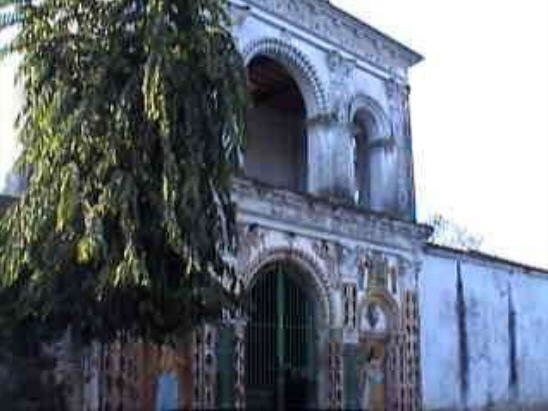
Gauridasa Pandit's story starts in a house in the village of Saligrama, a few miles from the railway station later built at Mudagachha. It does not start in Ambika Kalna at all, the town that almost every later account identifies him with. Bhaktisiddhanta Sarasvati Thakura's Anubhasya commentary on Chaitanya-charitamrita records that, for a time, he was supported by a local ruler, King Krishnadasa, son of Harihoda. This detail places him among Bengal's respectable brahmana households, not among wandering renunciants. It also helps explain why everything remembered about him afterward is the life of a householder, not an ascetic.
| Detail | Description |
|---|---|
| First residence | Saligrama, Bengal, near the later Mudagachha railway station |
| Early patron | King Krishnadasa, son of Harihoda |
| Elder brother | Suryadasa Sarakhela |
| Move to Ambika Kalna | With his elder brother's permission |
| In-law connection | Brother's daughters Vasudha and Jahnava Devi married Nityananda Prabhu |
An Elder Brother Named Sarakhela #
The Anubhasya names Gauridasa Pandit as the younger brother of Suryadasa Sarakhela. "Sarakhela" is a title, not a family name. It means roughly a commander or headman. It is the kind of title a Bengali brahmana family might carry along with land and a respected place in local life. Later, Gauridasa Pandit left Saligrama for a new life on the bank of the Ganges. The Anubhasya is specific that he did so with Suryadasa's permission. He was not renouncing his family and cutting ties with them. It was one brother's household decision, made with the other brother's blessing.
A separate, later biographical tradition gives a fuller picture of the family. It is recorded in the Bhakti-ratnakara of Narahari Chakravarti Thakura and repeated in some modern retellings. It names his parents as Kamsari Mishra and Kamala Devi, and it lists five brothers: Damodara, Jagannatha, Suryadasa, Krishnadasa, and Nrisimha-chaitanya. Suryadasa Sarakhela was one of these five. Bhaktisiddhanta Sarasvati Thakura's Anubhasya, the main source used elsewhere on this page, does not itself name these parents or the other brothers. So this detail is reported here as an additional tradition, not as settled fact.
The Move to Ambika Kalna #
Ambika Kalna sits on the Ganges directly across from Shantipur, a short distance from where the Kalna-korta railway station would later stand. Gauridasa Pandit made his home here, on land that a zamindar of Burdwan would later provide with a proper temple. The move mattered for more than his own life. It placed him, and later his descendants, inside the same small circle of Bengali Vaishnava households. In the generation after Sri Chaitanya Mahaprabhu himself, this circle produced some of the movement's most important marriages and meetings.
A Brother's Daughters, and a Marriage That Shaped Gaudiya History #
Suryadasa Sarakhela had two daughters, Vasudha and Jahnava Devi, and both were given in marriage to Nityananda Prabhu. As her father's younger brother, Gauridasa Pandit was the uncle of Jahnava Devi. She would go on to preside over Gaudiya Vaishnavism's largest early gathering, the Kheturi festival organized by Narottama Dasa Thakura. Available sources do not describe Gauridasa Pandit taking any direct role in arranging that marriage, and it would go beyond what is actually recorded to claim he did. What can be said honestly is that, through his brother, his own household was joined by marriage to Nityananda Prabhu's family.
A Household Life, Not a Renounced One #
Nothing in the sources shows Gauridasa Pandit taking sannyasa, adopting the dress of a renunciant, or leaving family life behind. This is true even after his devotion to Nityananda Prabhu deepened into the strong, demanding love for which the later chapters of his life are remembered. He married, raised children, and by tradition became the head of a household so large that Bhaktisiddhanta Sarasvati Thakura's own Anubhasya lists more than twenty of his descendants by name. The story of that household, and of the extraordinary love for Nityananda Prabhu at the heart of it, is told in full on The Intimate Love of Nityananda Prabhu.
Chapter 2
The Intimate Love of Nityananda Prabhu
A demand made of God Himself, under a tamarind tree that still stands at Ambika Kalna.
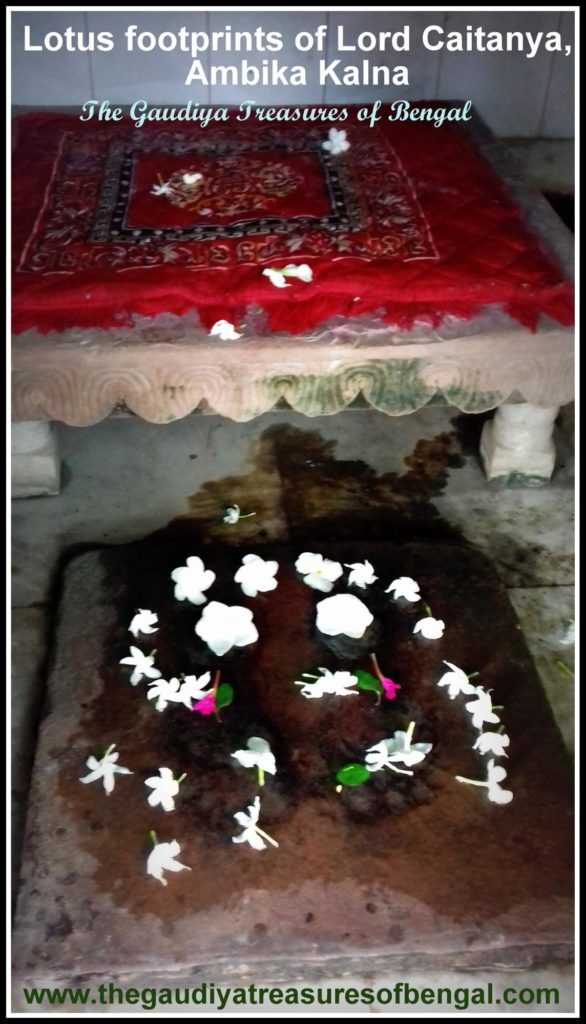
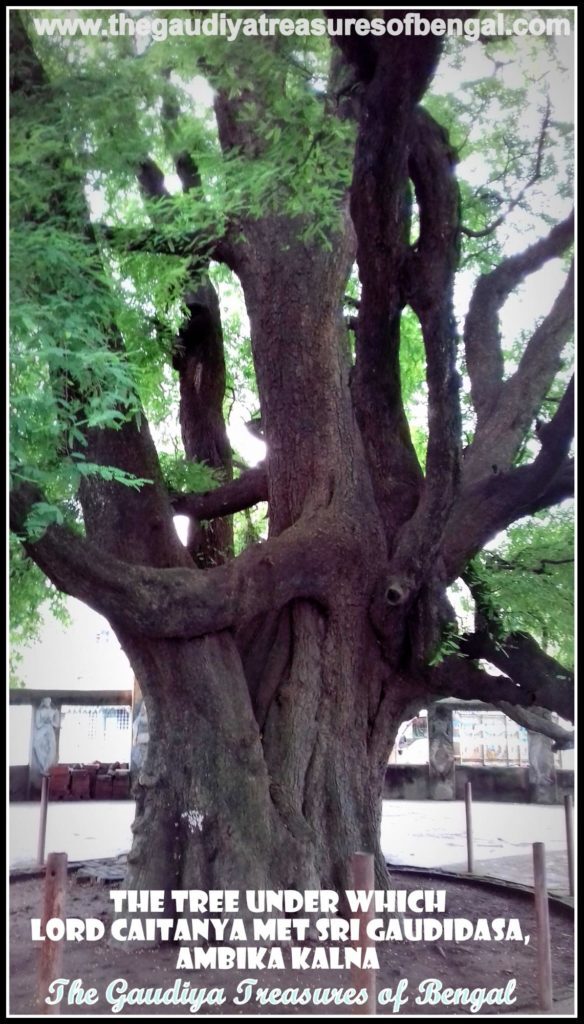
Every account of Gauridasa Pandit's life centres on a single afternoon at Ambika Kalna. Later tradition remembers it so clearly that the spot itself is pointed out to pilgrims today. It is a tamarind tree still standing in front of the temple. Sri Chaitanya Mahaprabhu was preparing to accept sannyasa and leave Bengal. Most accounts place the visit in that same period. He came to see Gauridasa Pandit one last time before that great change in his own life, a change that could not be undone. What happened under that tree is the reason Gauridasa Pandit is remembered at all.
Under the Tamarind Tree #
Devotional tradition at Ambika Kalna describes Mahaprabhu and Gauridasa Pandit sitting together under the tree for hours, talking about Krishna. In the Chaitanya-charitamrita narrative, close friends, and elder and younger devotees too, talk about Krishna in this way again and again. But this was not simply another such conversation. Mahaprabhu was there to say goodbye, and by every account, Gauridasa Pandit could not bear it.
A Demand, Not a Request #
Tradition remembers that he did not quietly accept what was coming. He protested. Gauridasa Pandit wept, and by some tellings he outright refused to accept the coming separation. Mahaprabhu tried to comfort him. Gauridasa Pandit is said to have answered with words that later devotees have repeated for five centuries: if the Deity form the Lord was offering him was really as good as the Lord Himself, then why should the Lord not simply stay home with him and send the Deity out to preach instead? It is a striking thing to say to God. That is exactly the point later Vaishnavas take from it. Gauridasa Pandit's love did not hold back out of caution or formal respect. It made demands, the way a child demands things of a parent it knows will not turn it away.
Kavi Karnapura's identification of Gauridasa Pandit as Subala in Krishna's Vraja pastimes fits naturally with this moment. Subala is remembered in Krishna-lila for exactly this kind of bold, open-hearted closeness with Krishna and Balarama. He has the confidence of a friend who does not measure his words. Whatever else makes Gauridasa Pandit's relationship with Nityananda Prabhu different from ordinary devotion, this same fearless closeness is found in both his identities, as Subala and as Gauridasa Pandit.
The Lord's Answer #
Different retellings of what happened next vary in small details. Some describe Mahaprabhu and Nityananda Prabhu together manifesting Deity forms of themselves on the spot. A fuller version records four Deity forms appearing, and Gauridasa Pandit himself choosing which two to keep. But every version agrees on the outcome. That day, neem-wood Deities of Sri Sri Gaura-Nitai came to be at Ambika Kalna. Gauridasa Pandit was told, in words that later temple tradition still repeats, that the Deity form was no less than the Lord's own presence. He was told that it would remain with him permanently to accept his service. None of the sources trace that exact wording to a verse of Chaitanya-charitamrita itself. It belongs to the oral and written temple tradition at Ambika Kalna, not to Krishnadasa Kaviraja Goswami's own text. So it is reported here as tradition, not as scripture.
Krishnadasa Kaviraja Goswami's own text, directly and in his own words, says something almost as dramatic. Gauridasa Pandit "sacrificed everything for the service of Lord Nityananda, even the fellowship of his own family," making Chaitanya and Nityananda "the Lords of his life." That single line, in Chaitanya-charitamrita, Adi-lila 11.27, carries real weight. Bengali brahmana society at that time still cared a great deal about caste standing and family fellowship. So giving those things up for a wandering, socially unconventional Vaishnava like Nityananda Prabhu was not a small or purely private choice. Krishnadasa Kaviraja Goswami records it with approval, as a sign of exactly the kind of uncompromising devotion just described. He does not treat it as a scandal to be explained away. Whatever the exact words spoken under the tamarind tree, that line alone shows how later Vaishnava tradition understood Gauridasa Pandit's devotion. It had completely rearranged his entire household and social standing around a single, demanding love.
What the Deities Became #
A demand made once, in a moment of grief, turned into a lifetime of worship, and then into centuries of worship. The story of what Gauridasa Pandit did with the Deities he had almost insisted on receiving, and of what became of the temple built around them, is told on Establishing Deity Worship at Kalna.
Scriptural evidence for this chapter (1)
নিত্যানন্দে সমর্পিল জাতি–কুল–পাঁতি ।
শ্রীচৈতন্য–নিত্যানন্দে করি’ প্রাণপতি ॥ ২৭ ॥
nityanande samarpila jati-kula-panti
sri-caitanya-nityanande kari pranapati
Word for word
nityanande: to Lord Nityananda; samarpila: he offered; jati: caste distinction; kula: family; panti: fellowship; sri-caitanya: Lord Caitanya; nityanande: in Lord Nityananda; kari: making; prana-pati: the Lords of his life.
Making Lord Caitanya and Lord Nityananda the Lords of his life, Gauridasa Pandita sacrificed everything for the service of Lord Nityananda, even the fellowship of his own family.
Cited here because this verse is the textual basis for describing Gauridasa Pandit as having given up caste standing and family fellowship for the sake of serving Nityananda Prabhu.
Chapter 3
Establishing Deity Worship at Kalna
How a householder's demand became a temple, with sacred relics and a name still spoken at Ambika Kalna.
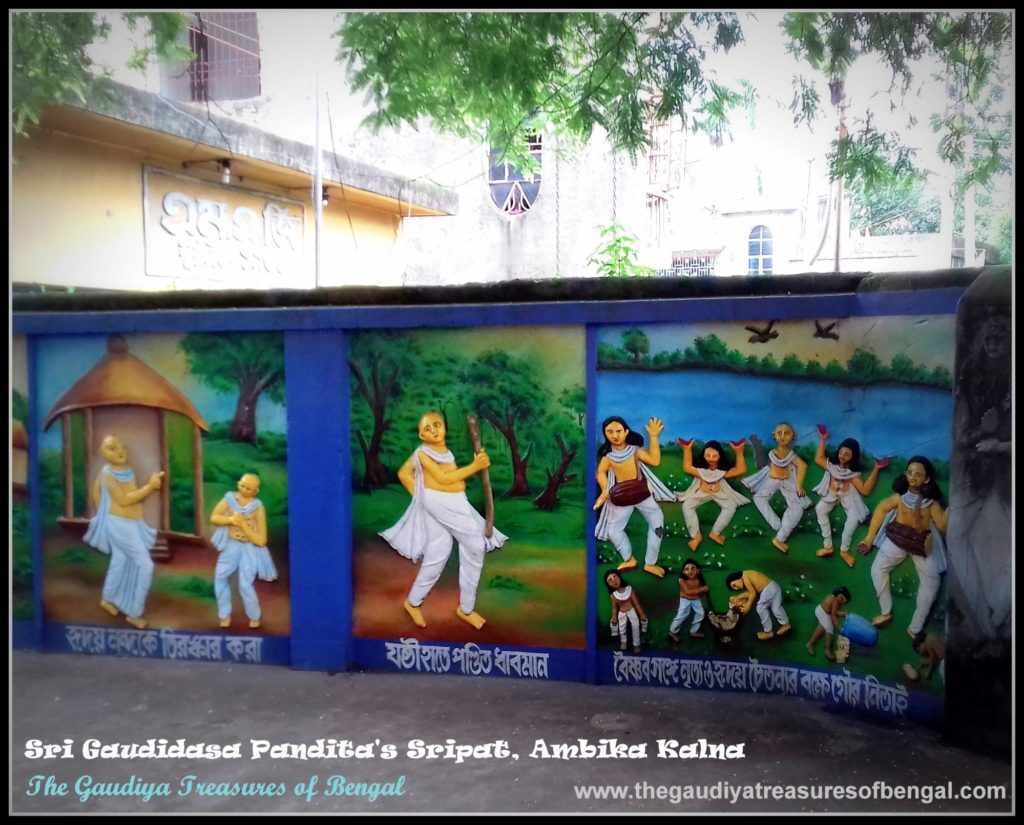
The neem-wood Deities of Sri Sri Gaura-Nitai that appeared at Ambika Kalna did not stay a private household treasure for long. A temple grew up around them. According to Bhaktisiddhanta Sarasvati Thakura's Anubhasya commentary, it was built by the zamindar of Burdwan. The temple has been repaired, rebuilt, and expanded many times across five centuries, and pilgrims still visit it at Ambika Kalna today.
| Detail | Description |
|---|---|
| Deities | Sri Sri Gaura-Nitai, carved from neem wood |
| Temple built by | The zamindar of Burdwan |
| Other relics kept there | A Bhagavad-gita manuscript said to be in Mahaprabhu's own hand; an oar said to be his gift |
| Key later pastime | The Deities and the naming of Hridaya Chaitanya |
| Today | An active Gaudiya Vaishnava pilgrimage site (a "sripat") near Kalna, West Bengal |
A Life Given to Their Service #
Gauridasa Pandit had almost demanded that the Deities stay in his home permanently. He spent the rest of his life showing how serious that demand was. Devotional accounts describe him cooking for the Deities, dressing and ornamenting them, and talking with them as one would with living guests, not carved wood. Several sources also record that even when poverty made fine ornaments impossible, the Deities themselves are said to have provided what was needed. By the same tradition, in his old age the Deities asked him to simplify his elaborate daily cooking to something as plain as shak on a banana leaf. It is a small detail. But later devotees read it as a sign of a relationship so close that the Deities could ask their servant for less, not more.
Two Relics Still Shown to Pilgrims #
Two physical objects at the temple carry their own stories. One is a handwritten copy of the Bhagavad-gita that temple tradition says was written in Mahaprabhu's own hand. Several sources repeat this claim. But at least one of them notes plainly that the attribution "remains disputed by some scholars," and so we report that doubt here instead of passing the claim off as settled. The other object is an oar. It is said to have been given by Mahaprabhu to Gauridasa Pandit with the instruction that he use it to help fallen souls cross the ocean of material existence. By that one sentence, a plain wooden object became a symbol for the rest of Gauridasa Pandit's service.
The Kirtana That the Deities Joined #
The most vivid story connected to the temple concerns Gauridasa Pandit's own foremost disciple, a devotee originally named Chaitanya Dasa. During a sankirtana festival Chaitanya Dasa organized on the riverbank, tradition says the Gaura-Nitai Deities themselves left the altar to dance and chant among the assembled devotees. Gauridasa Pandit discovered the altar empty and went out to bring them back. In some tellings he had a stick in hand and was plainly angry, though only half seriously. The Deities are said to have fled from him and entered his disciple's heart instead. Overcome, Gauridasa Pandit embraced Chaitanya Dasa and gave him a new name on the spot: Hridaya Chaitanya, "one who carries Chaitanya within his heart." Local tradition ties this same pastime to a lasting change in temple practice. Today the Deities are shown to pilgrims only in a brief "jhalak darshan," a glimpse of just a few seconds. This is said to guard against their running off again.
Hridaya Chaitanya's importance went well beyond Ambika Kalna. His own most important disciple was Shyamananda Prabhu, one of the devotees who carried Gaudiya Vaishnavism into Odisha. The pancharatrika line runs from Gauridasa Pandit through Hridaya Chaitanya and Shyamananda Prabhu, and it eventually reaches Baladeva Vidyabhushana, author of the Govinda-bhashya. This connection is followed further on Disappearance and Legacy.
A Pilgrimage Site Today #
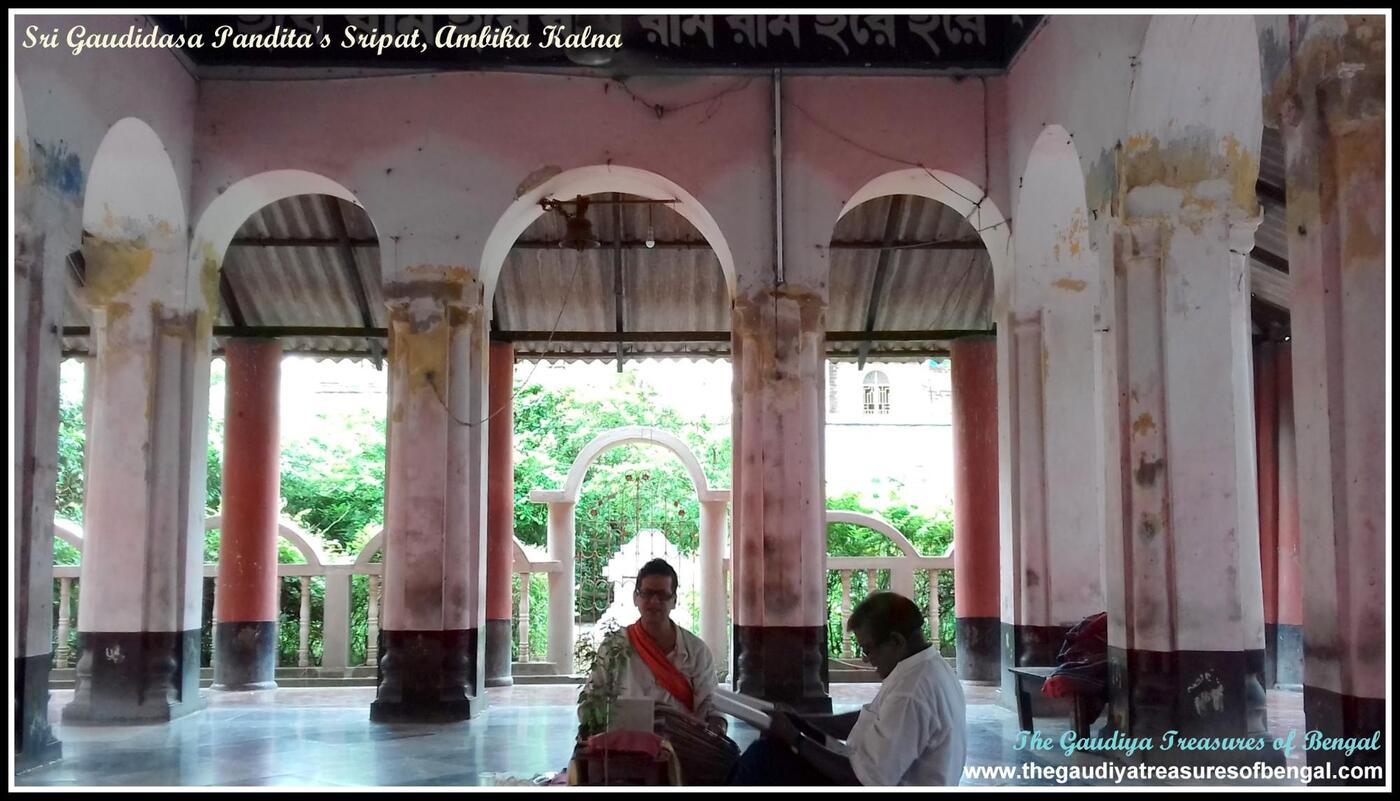
Today Ambika Kalna can be reached by train from Howrah in roughly three and a half hours, or by road from Mayapur in about ninety minutes. Devotees who make the trip find a working temple, not a museum. The Gaura-Nitai Deities are still worshiped daily. The tamarind tree under which Mahaprabhu is said to have met Gauridasa Pandit still stands in front of the temple, and lotus footprints preserved beneath it are still shown to visitors. How that ongoing worship depends on Gauridasa Pandit's descendants and on Hridaya Chaitanya's own line of disciples is told on Disappearance and Legacy.
Chapter 4
Connection to Krishnadasa Kaviraja Goswami
What Chaitanya-charitamrita actually says about the two men - and what it does not.
Two facts about Gauridasa Pandit and Krishnadasa Kaviraja Goswami are certain. A third is often assumed, but it does not hold up when the sources are checked closely. This page keeps the three points separate on purpose.
What Krishnadasa Kaviraja Goswami Actually Wrote #
The first certain fact comes from the text itself. In Sri Chaitanya-charitamrita, Adi-lila 11.26-27, Krishnadasa Kaviraja Goswami names Gauridasa Pandit directly. He praises him in the strongest terms he uses for anyone in that chapter's long list of Nityananda Prabhu's associates: "the emblem of the most elevated devotional service in love of Godhead," a devotee who "sacrificed everything for the service of Lord Nityananda, even the fellowship of his own family." This is real and clear evidence from the text. But it was written by Krishnadasa Kaviraja Goswami decades later at Vrindavana, as part of a trusted account of Mahaprabhu's associates. It is not a record of the two men ever meeting.
Nothing in Chaitanya-charitamrita itself, and nothing in any other available source, describes an actual meeting between Krishnadasa Kaviraja Goswami and Gauridasa Pandit. So this connection is best understood as one of writing and devotion, not a personal one. It is one great Vaishnava writer honoring another great Vaishnava. The timeline also makes a personal meeting unlikely. Gauridasa Pandit belonged to the generation that knew Sri Chaitanya Mahaprabhu directly. Krishnadasa Kaviraja Goswami wrote Chaitanya-charitamrita in his own old age at Vrindavana, by most estimates several decades after Mahaprabhu's disappearance. Gauridasa Pandit lived in the time of the Lord Himself and was older than Him. So he had very likely already passed away by the time Krishnadasa Kaviraja Goswami was writing about him.
The Gauridasa of Antya 6.62 #
There is also a smaller point to note here, for the same reason. Chaitanya-charitamrita's Antya-lila 6.62 also names a "Gauridasa" among the devotees seated around Nityananda Prabhu on a raised platform at Panihati. This was at the festival held by Raghunatha Dasa Goswami, and the verse names him together with Dhananjaya, Jagadisha, Parameshvara Dasa, Mahesha, and Hoda Krishnadasa. The verse itself says nothing more about him. But Srila Prabhupada's purport to Antya 6.63, following Bhaktisiddhanta Sarasvati Thakura's Anubhasya, sends the reader to Adi-lila 11.26 for this Gauridasa, and that is the verse on Gauridasa Pandit. So the commentary treats the Gauridasa of Antya 6.62 as Gauridasa Pandit himself, seated among Nityananda Prabhu's close associates in Bengal.
Checking the Premise: Did Their Paths Cross at Ambika Kalna? #
Krishnadasa Kaviraja Goswami's dramatic turn toward Vrindavana came through a dream in which Nityananda Prabhu ordered him to leave Bengal. It would make a neat story if this had happened at Ambika Kalna, in or near Gauridasa Pandit's own house. But it did not. Chaitanya-charitamrita gives Krishnadasa Kaviraja Goswami's own account, and so does the page on his Early Life and the Call to Vrindavana. Both place his family home at Jhamatpur, a village near Naihati in the Katwa region, not at Ambika Kalna. The sankirtana he hosted, his scolding of his brother Shyamadasa, and Nityananda Prabhu's command in his dream all took place there too. It is easy to assume a connection, because both stories involve Nityananda Prabhu and a Bengali Vaishnava household. But a claim like this should be checked before it is repeated. Here, when we check it, it simply does not hold.
The Real Network: Narottama Dasa Thakura's Visit #
In the generation after Gauridasa Pandit, the real and well-recorded link between Ambika Kalna and the wider Gaudiya Vaishnava world is through a different person, Narottama Dasa Thakura. Traditional accounts of his pilgrimage back from Vrindavana describe him stopping for two days at Shantipur and then going on to Ambika Kalna. There he stayed at the house associated with Gauridasa Pandit, before going on to the great festival he organized at Kheturi. By this time Gauridasa Pandit himself had very likely already passed on. So it is more accurate to say that Narottama Dasa Thakura stopped at the house and temple that Gauridasa Pandit had established. Gauridasa Pandit's disciple Hridaya Chaitanya then carried on the service there. Hridaya Chaitanya is recorded as joining Narottama Dasa Thakura's party for the rest of the journey to Kheturi, along with a number of other Vaishnavas from Ambika Kalna.
That detail matters for the same reason as the Krishnadasa Kaviraja Goswami question. Ambika Kalna remained a real destination for later Bengali Vaishnavas because of Gauridasa Pandit's own household, temple, and chief disciple. It was not because of an invented meeting. What became of that household after his disappearance is the subject of Disappearance and Legacy. That page covers Hridaya Chaitanya's line, the descendants named in the Anubhasya, and the temple's place in Gaudiya Vaishnavism today.
Chapter 5
Disappearance and Legacy
An open question about where he passed away, a household of descendants, and a lineage reaching Baladeva Vidyabhushana.
Sources agree on the season of Gauridasa Pandit's disappearance. But they disagree, in small but real ways, on almost everything else about it. We report these differences openly here, instead of smoothing them over.
When and Where #
Bhaktisiddhanta Sarasvati Thakura's Anubhasya, Stephen Knapp's biographical page, and the Gaudiya History site all place Gauridasa Pandit's disappearance on Shukla Ekadashi in the month of Shravana, with no year given by any of them. One other source gives the date as Shukla Dvadasi, the twelfth day of the waxing moon, instead of Ekadashi. That is one day later than Ekadashi. This one-day difference cannot be settled here, so we report both dates instead of quietly choosing one.
The place is an even harder question. Ambika Kalna's own temple tradition, and most available sources, treat Ambika Kalna as the obvious place. It is where he lived and where his Deities are. It is also where his "sripat" (a term Gaudiya Vaishnavas use for a saint's sacred residence) remains, in the words of one source, "extremely well known." But one biographical account states plainly that Gauridasa Pandit spent his final period doing bhajana at Dhira Samira Kunja in Vrindavana. It says that his samadhi tomb stands there today, inside the compound of the Shyama-Raya Temple. So there are two pictures. In one, he lived all his life in Ambika Kalna and never left. In the other, he went to Vrindavana as an elderly devotee for his last years of bhajana. No source explains how both can be true, and we do not try to settle it here. Both traditions are reported, and readers should treat the question of exactly where Gauridasa Pandit passed away as open.
Twenty-Two Descendants, by Name #
What is not in question is the size of the household Gauridasa Pandit left behind. Bhaktisiddhanta Sarasvati Thakura's Anubhasya lists more than twenty of his descendants by name, headed by an eldest son known as Bada Balarama and a youngest named Raghunatha, whose own sons were Mahesha Pandita and Govinda. A daughter, Annapurna, is also named. Among the other names on that same list is a "Hridaya-chaitanya". This is very likely the same devotee remembered elsewhere as Gauridasa Pandit's foremost disciple. He is the one renamed Hridaya Chaitanya after the pastime described on Establishing Deity Worship at Kalna. If so, disciple and blood family were, in this case, close enough to appear on the same family register. That is a small but meaningful sign. It shows how completely Gauridasa Pandit's household and his devotional service to Nityananda Prabhu had become one thing.
A Line That Reaches Baladeva Vidyabhushana #
Hridaya Chaitanya's own line carried Gauridasa Pandit's legacy further than Ambika Kalna itself. His most important disciple was Shyamananda Prabhu, one of the devotees credited with establishing Gaudiya Vaishnavism in Odisha. From Shyamananda Prabhu, the pancharatrika-diksha line runs through Rasikananda Goswami and Nayanananda Goswami to Radha Damodara Goswami. In time it reaches Baladeva Vidyabhushana. He was the scholar whose Govinda-bhashya made the Gaudiya sampradaya's position secure at Jaipur in 1718. Seen this way, one straight line of formal initiation runs from a Bengali householder's demanding love for Nityananda Prabhu at Ambika Kalna to one of the most important defenses of its philosophy that the Gaudiya Vaishnava tradition ever made. That defense came two centuries and several generations later. Narottama Dasa Thakura's own stop at Ambika Kalna, on his way to the Kheturi festival, is covered in more detail on Connection to Krishnadasa Kaviraja Goswami.
Ambika Kalna Today #
The temple at Ambika Kalna remains an active Gaudiya Vaishnava pilgrimage site, still commonly reached by train from Howrah or by road from Mayapur. The original Gaura-Nitai Deities are still worshiped there. But pilgrims today are given only a brief glimpse of them, a "jhalak darshan" lasting a few seconds, not a long darshan. By local tradition, this is because of the pastime in which they once ran off to join a kirtana. The tamarind tree under which tradition says Mahaprabhu and Gauridasa Pandit once met still stands in front of the temple, and lotus footprints preserved beneath it are shown to visitors as a physical trace of that meeting. A handwritten Bhagavad-gita attributed to Mahaprabhu and an oar said to be his gift to Gauridasa Pandit are also still kept at the temple. Whatever remains unresolved about the exact circumstances of his disappearance, the household, the Deities, and the disciples Gauridasa Pandit left behind at Ambika Kalna have carried his name, largely intact, across five centuries.
Closing
Subala of Vrindavana #
Sri Kavi Karnapura's Gaura-ganoddesha-dipika is the traditional key to who Chaitanya Mahaprabhu's associates were in Krishna's own Vraja pastimes. It identifies Gauridasa Pandit as Subala, one of the twelve principal gopa companions of Krishna and Balarama in Vrindavana. The sources do not treat this identity as disputed. Every account of his life that we found gives the same answer. It also fits well with what is recorded of his life. In Krishna-lila, Subala is remembered for a closeness to Krishna that could be playful, urgent, even a little insistent. Later devotees saw exactly that same quality in Gauridasa Pandit's relationship with Nityananda Prabhu at Kalna.
Kavi Karnapura's verse is short and direct:
subalo yaḥ priya-śreṣṭhaḥ sa gaurīdāsa-paṇḍitaḥ
"Lord Krsna's dearest friend Subala appeared in Lord Caitanya's pastimes as Gauridasa Pandita." (Gaura-ganoddesha-dipika 128)
Srila Prabhupada cites it in his purport to Chaitanya-charitamrita Adi 11.26, the verse that praises Gauridasa Pandit's love: "It is stated in the Gaura-gaṇoddeśa-dīpikā (128) that formerly he was Subala, one of the cowherd boyfriends of Kṛṣṇa and Balarāma in Vṛndāvana."
- Sri Chaitanya-charitamrita, Adi-lila 11.26-27, with Bhaktisiddhanta Sarasvati Thakura's Anubhasya commentary
- Sri Chaitanya-charitamrita, Antya-lila 6.62
- Gaudiya History (ISKCON Desire Tree): Gauridasa Pandit
- Gaudiya History (ISKCON Desire Tree): Gauridasa Pandit - Biography
- The Gaudiya Treasures of Bengal: Worshipable Deities of Gaudidasa Pandita, Ambika Kalna
- Stephen Knapp: Gauri Dasa Pandita
- ISVARA.org Vedic Library: Gauridas Pandita
- Ramai Swami: Gauri Das Pandit Disappearance
- ISKCON Bangalore: Sri Gauridasa Pandita
