Every source that records it places Gopala Guru Goswami's disappearance from this world on the ninth day of a fortnight in the month of Kartika. But the sources do not agree on which fortnight it was, dark or bright. No year is recorded anywhere. What happened immediately afterward, and what is still shown to pilgrims at Puri today, makes up the most vivid part of his story.
| Detail | Description |
|---|---|
| Disappearance day | Ninth day of a fortnight (dark or bright - sources differ) in the month of Kartika |
| Disputed identity | The gopi Tungavidya Sakhi - claimed for Gopala Guru Goswami by Gaudiya History, but for Vakreshwara Pandita by a rendering of Dhyanachandra Goswami's own paddhati |
| Post-disappearance pastime | A reported reappearance and sankirtana procession at Puri, and a meeting with Dhyanachandra Goswami at Vamsivat, Vrindavana |
| Deity still seen today | A small deity of Gopala Guru Goswami himself, carved from a neem tree at Siddha Bakul, kept near the entrance of the Sri Radha-Kanta temple |
| Temple today | Sri Radha-Kanta Matha (the Gambhira), Balisahi, Puri - an active pilgrimage site |
A Contested Succession #
It is said that in old age Gopala Guru Goswami grew anxious about who would carry on Sri Radha-Kanta's seva after him. According to temple tradition, this is how he came to give initiation and charge of the Deity to Dhyanachandra Goswami. That handover did not go smoothly. The king of Puri, tradition says, was displeased that so important a temple's succession had been decided without his approval, and sent soldiers to take control of it the moment word reached him that Gopala Guru Goswami had died. Dhyanachandra Goswami, meanwhile, was still on his way to Swargadwar to cremate his guru's body when he heard the news. What followed is the single most striking pastime connected to Gopala Guru Goswami's name. Holding his guru's feet and weeping, Dhyanachandra pleaded for help. It is said that Gopala Guru Goswami then rose from the funeral palanquin, led a sankirtana procession of astonished devotees back to the temple, and took back Sri Radha-Kanta's seva in person. According to this account, he then remained active at the Gambhira through the reigns of three further kings before finally handing the Deity's care back to Dhyanachandra Goswami and leaving his body for good.
Meeting His Disciple in Vrindavana #
A second story, just as striking, follows the year after. A party of devotees traveling from Vraja to Puri for the Ratha-yatra festival told Dhyanachandra Goswami that his guru was doing bhajana near Vamsivat in Vrindavana. This is the very place on the Yamuna's bank where Krishna is remembered to have played His flute for the gopis. Dhyanachandra, astonished, walked the entire distance and found Gopala Guru Goswami exactly there, absorbed in japa. Dhyanachandra protested that his guru had already left his body at Puri. Gopala Guru Goswami answered lightly, according to the account, that he did not yet understand the transcendental nature of Vrindavana Dhama, where such things are possible. He would not return to Puri, he said, but gave Dhyanachandra a final instruction instead: go to Siddha Bakul, where Sri Haridasa Thakura had done his own bhajana, find the old neem tree growing there, and have a deity of himself carved from its wood. That deity, placed before Sri Radha-Kanta whenever bhoga was offered, would let Dhyanachandra continue having his guru's darshan even without his physical presence. A small deity that matches exactly this description is still shown today, seated near the entrance of the Radha-Kanta temple at Puri. But, as with the sankirtana-procession story above, this pastime comes down only through devotional biography. It does not come from Chaitanya-charitamrita or from a dated Prabhupada purport, and it is reported here as tradition, not settled history.
An Unresolved Question: Who Was Tungavidya? #
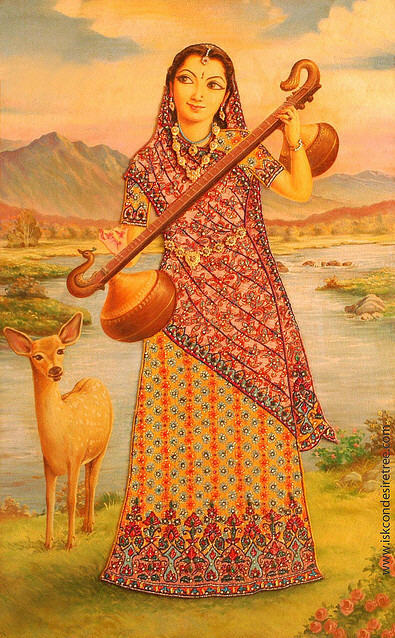
One further claim about Gopala Guru Goswami does not hold up when the sources are checked closely. The disagreement is reported honestly here, without picking a side. Gaudiya History's own biography states that "according to some, Gopal Guru Goswami was the gopi known as Tungavidya Sakhi," one of the eight principal gopi companions of Srimati Radharani in Krishna's Vraja pastimes. But a separate version of Dhyanachandra Goswami's own Dhyana-chandra-paddhati, shared by the Vedic-library site isvara.org, gives a different view. It quotes Dhyanachandra as writing that his own guru's guru, Vakreshwara Pandita, not Gopala Guru Goswami, was "previously very expert in the arts of singing and dancing, the gopi, Tungavidya." These two claims cannot both be right, since Tungavidya Sakhi is one specific gopi and not two. The sources offer no way to decide between them. So we do not quietly choose the more convenient answer. Both traditions are recorded here, and the question is left open.
The Temple Today #
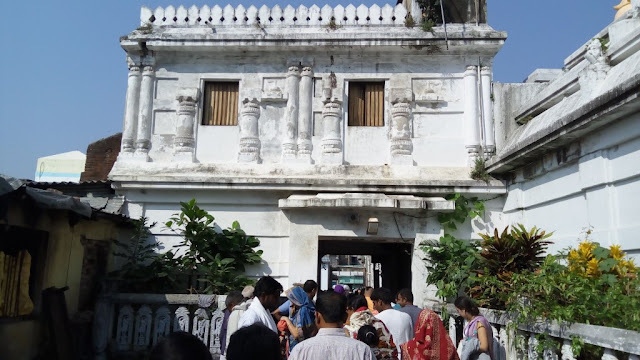
What is not in dispute is that Gopala Guru Goswami's own service left something lasting. The Sri Radha-Kanta Matha is still commonly called the Gambhira, after the small room where Sri Chaitanya Mahaprabhu once lived. It stands today at Balisahi, a short walk from Swargadwar in Puri, and remains an active Gaudiya Vaishnava pilgrimage site. Pilgrims can see the room Mahaprabhu Himself occupied, along with relics said to be His own. They can also see the altar Gopala Guru Goswami expanded. Sri Radha-Kanta is at the center, with Radharani and Lalita on either side, and Gauranga and Nityananda Prabhu as well. A festival is still held there every year on the anniversary of the day Gopala Guru Goswami took charge of the seva. Devotees say that on that day he appears briefly at one side of the seat where Mahaprabhu once sat. As a boy, he was once teased and given a joking title by God Himself. By the end of his own life, he had become one of the people entrusted with keeping God's own house at Puri open. And that house, by every account, is still open.
