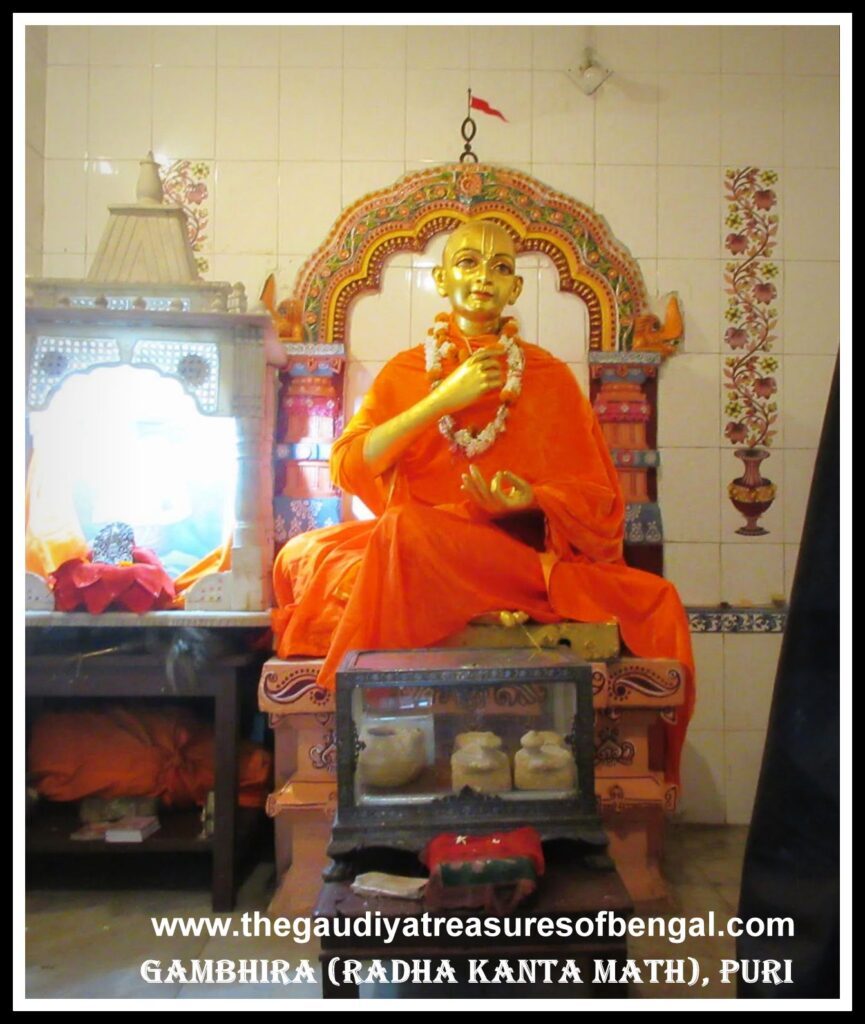
Sri Chaitanya Mahaprabhu's disappearance is traditionally placed in 1534 CE. It ended the best-known part of Gopala Guru Goswami's life, but not his story. Later Gaudiya biographers go on to describe how the young man grew spiritually. He became a formal disciple, studied seriously, and in time was placed in charge of a Deity's worship.
| Detail | Description |
|---|---|
| Diksha guru | Sri Vakreshwara Pandita, "the fifth branch" of Sri Chaitanya Mahaprabhu's own tree |
| Taught rasa-tattva by | Svarupa Damodara Goswami and Raghunatha Dasa Goswami |
| Deity received | Sri Radha-Kanta, at the Gambhira, Kashi Mishra's former house, Puri |
| Additional Deities installed | Sri Radha, Lalita, Nityananda Prabhu, Sri Gauranga |
| Years in documented charge | 1538-1548 CE (temple thoroughly renovated in this period) |
| Foremost disciple | Sri Dhyanachandra Goswami |
| Written work | Sri Gaura-Govindarcana-Smarana-Paddhati (twenty-six chapters) |
A Disciple of Vakreshwara Pandita #
Gopala Guru Goswami's formal spiritual master was Sri Vakreshwara Pandita, one of Sri Chaitanya Mahaprabhu's own most extraordinary associates. Chaitanya-charitamrita calls him "the fifth branch" of Sri Chaitanya Mahaprabhu's own tree of devotees. It says he could dance in unbroken ecstasy for seventy-two continuous hours. Srila Prabhupada's purport adds, quoting the Gaura-ganoddesha-dipika, that Vakreshwara Pandita was considered an incarnation of Aniruddha, one of the four original expansions of Vishnu. The purport also records that Mahaprabhu Himself personally sang while Vakreshwara danced. In this same purport, on the very next verse listing Vakreshwara Pandita's Oriya disciples, Srila Prabhupada names Gopala Guru Goswami directly: "Among these disciples are Sri Gopalaguru and his disciple Sri Dhyanacandra Gosvami." So the guru-disciple line from Vakreshwara Pandita through Gopala Guru Goswami to Dhyanachandra Goswami stands on solid written ground, not only on later retellings of their lives. Vakreshwara Pandita also has his own page on this site. This single line of purport is enough to call Gopala Guru Goswami's diksha a recorded fact, not a devotional guess.
Alongside that formal discipleship, tradition says Gopala Guru Goswami studied the deeper theology of rasa directly under Svarupa Damodara Goswami and Raghunatha Dasa Goswami. Rasa is the science of the different relationships and mellows of loving exchange between a devotee and Krishna. These teachers were two of Mahaprabhu's own closest associates and among the most learned in rasa. Whatever else is uncertain about his life, this detail explains why sources consistently call him an expert in rasika principles, and why his own later writing takes up exactly this subject.
Taking Charge of Sri Radha-Kanta #
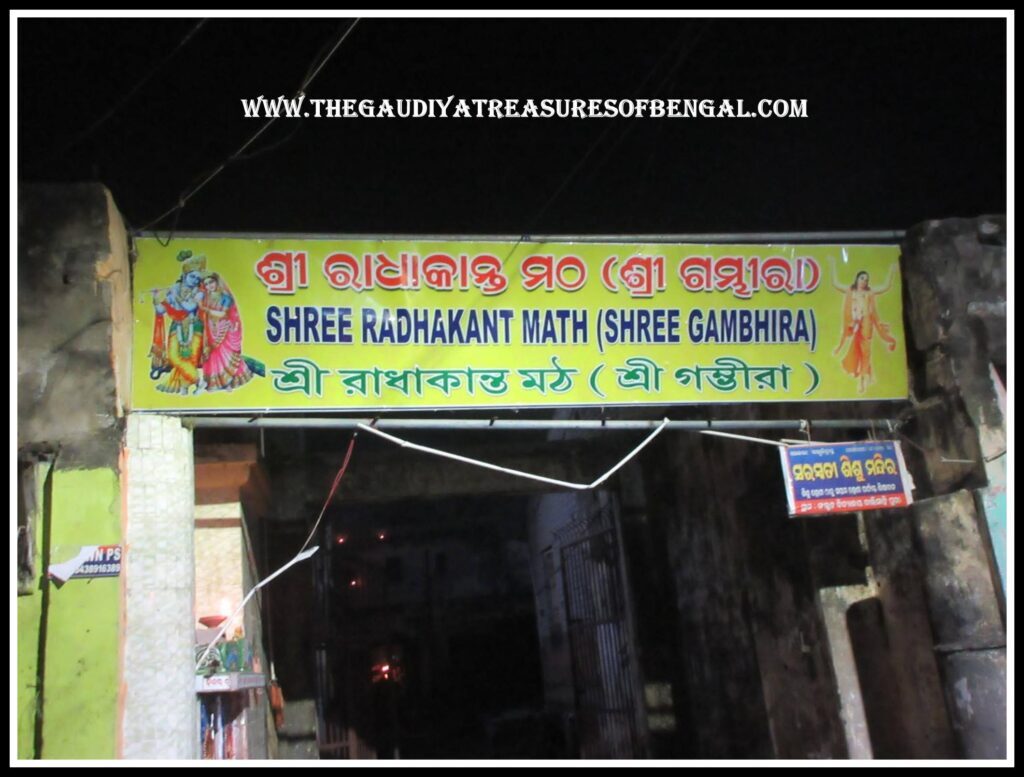
When Vakreshwara Pandita himself passed from this world, the seva of his worshipable Deity, Sri Radha-Kanta, passed to Gopala Guru Goswami. This was at the same house in Puri, by then called the Gambhira, where Sri Chaitanya Mahaprabhu had lived out the last years of His own manifest pastimes. Temple tradition at Puri holds that Gopala Guru Goswami was formally installed as mahant, or head of the temple, on the twelfth day of the bright fortnight of the month of Magha. That date is still marked there every year. The same tradition holds that he was in charge of the seva during at least the years 1538 to 1548 CE, and that the old structure was thoroughly rebuilt in this period. Under his direction four more Deities joined Sri Radha-Kanta on the altar. Sri Radha and Lalita were placed on either side, and forms of Nityananda Prabhu and Sri Gauranga were added as well. In this way, the private worship of a single Deity became something closer to the fuller Gaudiya altar still seen there today.
The Radha-Kanta Deity's own earlier history is remembered a little differently by different tellers. One account has it captured during King Purushottama Deva's military campaign in the south and quietly passed down through Kashi Mishra's own family, who served as royal priests. Another has it installed for a time inside the Jagannatha temple itself, moved out to Kashi Mishra's house only after Lord Jagannatha complained, in a dream to King Prataparudra, that Radha-Kanta was eating the choicest offerings meant for Him. Both versions agree on the outcome. Long before Gopala Guru Goswami's own lifetime, the Deity was already settled at Kashi Mishra's house, along with the small room called the Gambhira. So he inherited an established seva, not a new one, and he made it larger.
Teaching Sri Dhyanachandra Goswami #
Gopala Guru Goswami's most important act as a teacher was training Sri Dhyanachandra Goswami. Dhyanachandra Goswami is remembered today as one of the most important later writers on internal, meditative Gaudiya Vaishnava worship. According to temple tradition, Gopala Guru Goswami found him, or was led to him, in old age through a dream. In the dream Krishna promised that the very next person he met the following morning would be the one to continue Sri Radha-Kanta's seva. That person turned out to be Dhyanachandra Goswami himself, waiting at his doorstep. Gopala Guru Goswami gave him mantra initiation and trained him in the same rasa-tattva he himself had received. Both guru and disciple went on to compose their own versions of a text called Sri Gaura-Govindarcana-Smarana-Paddhati. It is a manual for how a devotee should worship and meditate on the forms of Gauranga and Radha-Govinda together. By Gopala Guru Goswami's own count, it has twenty-six chapters. Later Gaudiya Vaishnavas combined the guru's and the disciple's versions of this paddhati into a single standard text, and it is still the basis of the worship practice of some Gaudiya lines today. Dhyanachandra Goswami's own name is the more familiar one in the wider tradition. But the paddhati's roots, and his own initiation, go back directly to his teacher.
During this same period, at least one other important visitor came to Gopala Guru Goswami's Puri household. The Bhakti-ratnakara records that Narottama Dasa Thakura, on pilgrimage to Jagannatha Puri, visited Kashi Mishra's house and met Gopala Guru Goswami there in person. It is a brief detail, and it is cited here through a secondary version of the Bhakti-ratnakara, not a scholarly edition. Still, it is a real link between Gopala Guru Goswami's Puri temple and the wider circle of Bengali Gaudiya Vaishnavism in the generation after Mahaprabhu. What became of that temple, and of Gopala Guru Goswami himself, after his own long years of service there, is the subject of Legacy.
