Sri Gopala Guru Goswami
The Boy Mahaprabhu Named Guru, Later Keeper of Sri Radha-Kanta at Puri
The complete life, on one page: The main biography and every pastime page, in order, in one place
Introduction
Sri Gopala Guru Goswami began life as an ordinary Oriya brahmana boy named Makaradhvaja Pandit. He was born to a father called Murari Pandit in Utkala (Orissa). By the end of his life he was the keeper of one of Puri's most important Deities and the teacher of a major Gaudiya writer. In between comes one of the more unusual stories in Gaudiya Vaishnavism. As a small child in Sri Chaitanya Mahaprabhu's own household at Jagannatha Puri, he was jokingly given the title "guru" by the Lord Himself. This nickname stayed with him for the rest of his life, and the tradition still remembers him by it. He grew up to become a formal disciple of Sri Vakreshwara Pandita, one of Mahaprabhu's most ecstatic dancing associates. Srila Prabhupada's purport to Sri Chaitanya-charitamrita confirms this discipleship. It also confirms the guru-disciple line that follows from it, down to Gopala Guru Goswami's most important student, Sri Dhyanachandra Goswami.
| Detail | Description |
|---|---|
| Birth name | Makaradhvaja Pandit |
| Family | Oriya (Utkala) brahmana; father Murari Pandit |
| Title's origin | Jokingly given by Sri Chaitanya Mahaprabhu Himself, as a boy at Puri |
| Diksha guru | Sri Vakreshwara Pandita |
| Trained in rasa-tattva by | Svarupa Damodara Goswami and Raghunatha Dasa Goswami |
| Seva entrusted | Deity of Sri Radha-Kanta, at the Gambhira, Puri |
| Foremost disciple | Sri Dhyanachandra Goswami |
At a Glance
- As a boy in Sri Chaitanya Mahaprabhu's own company at Puri, he earned the name "Gopala Guru" from the Lord Himself, after a clever question about chanting the holy name.
- He later became a formal disciple of Sri Vakreshwara Pandita and studied rasa-tattva, the theology of devotional relationships with Krishna, under Svarupa Damodara Goswami and Raghunatha Dasa Goswami.
- After Vakreshwara Pandita's disappearance, he took charge of the Deity of Sri Radha-Kanta at the Gambhira - the very house in Puri where Mahaprabhu had lived - and expanded its worship.
- He trained Sri Dhyanachandra Goswami, and together they wrote versions of a paddhati, a manual for meditative worship of Gauranga and Radha-Govinda, still used by some Gaudiya Vaishnavas today.
- Some devotional traditions are connected with his name, including a miraculous return after his own disappearance and a disputed identity in Krishna's Vraja pastimes. The sections below report honestly both what is well recorded and what is still genuinely disputed.
Scriptural evidence for the introduction (1)
কাশীমিশ্র, প্রদ্যুম্নমিশ্র, রায় ভবানন্দ ।
যাঁহার মিলনে প্রভু পাইলা আনন্দ ॥ ১৩১ ॥
kasi-misra, pradyumna-misra, raya bhavananda
yanhara milane prabhu paila ananda
Word for word
kasi-misra: Kasi Misra; pradyumna-misra: Pradyumna Misra; raya bhavananda: Bhavananda Raya; yanhara: of whom; milane: meeting; prabhu: the Lord; paila: got; ananda: great pleasure.
In the list of devotees at Jagannatha Puri [which begins with Paramananda Puri, Svarupa Damodara, Sarvabhauma Bhattacharya and Gopinatha Acharya], Kasi Misra was the fifth, Pradyumna Misra the sixth and Bhavananda Raya the seventh. Lord Chaitanya took great pleasure in meeting with them.
From the purport: Purport excerpt: "Later this house was inherited by Vakresvara Pandita and then by his disciple Gopalaguru Gosvami, who established a Deity of Radhakanta there."
This purport is the single clearest, most independently reliable confirmation that Gopala Guru Goswami inherited Kashi Mishra's house at Puri and its Deity from Vakreshwara Pandita.
Chapter 1
Boyhood Service to Mahaprabhu at Puri
How a small Oriya brahmana boy in Sri Chaitanya Mahaprabhu's own household came to be called guru.
Sri Gopala Guru Goswami's story does not begin with a famous work or a formal appointment. It begins with a small boy, born Makaradhvaja Pandit to an Oriya brahmana named Murari Pandit, who somehow found his way into the daily company of Sri Chaitanya Mahaprabhu at Jagannatha Puri. Later Gaudiya tradition remembers that this happened through the mercy of Govinda. Govinda was the personal attendant who looked after Mahaprabhu's own bodily needs for the last decades of His manifest life. Tradition says it was Govinda who first made a place for the boy to serve the Lord directly and personally. Once there, Makaradhvaja stayed. Mahaprabhu called him, affectionately, "Gopal," and treated him the way an elder treats a favorite child, teasing him, joking with him, and keeping him near.
| Detail | Description |
|---|---|
| Birth name | Makaradhvaja Pandit |
| Family | Oriya (Utkala) brahmana; father Murari Pandit |
| Brought into Mahaprabhu's service by | The mercy of Govinda, Mahaprabhu's personal attendant |
| Nickname given by Mahaprabhu | "Gopal" |
| Title earned | "Guru," given directly by Sri Chaitanya Mahaprabhu |
| Tester who came from Bengal | Sri Abhirama Thakura, of Nityananda Prabhu's circle |
How a Child Became "Guru" #
Later devotees tell a story about how the boy got his new name. It is Vaishnava humor at its very best, both funny and pointed. One day, the story goes, young Gopal noticed that Mahaprabhu was holding His own tongue between His teeth on His way to answer a call of nature. Puzzled, the boy asked why. Mahaprabhu answered that His tongue simply could not stop chanting the holy name. To continue chanting while attending to bodily business would not be proper, so He held it still instead. Gopal answered back at once: "Prabhu, You are the Supreme Lord, and the whole world follows Your example. What would happen to an ordinary person who left his body at such a moment, not chanting at all?" Mahaprabhu was delighted with the question. "You have spoken correctly," He is said to have replied. "From today you shall be known as guru." News of a small boy earning that title from Sri Chaitanya Mahaprabhu Himself spread quickly among the devotees, and the title stayed with him for the rest of his life. This exchange is found only in later devotional biographies, not in Sri Chaitanya-charitamrita itself. So it should be read as devotional memory, not as an event recorded in scripture. But it is the only account anywhere of how the name "Gopala Guru" actually came to be, and every source repeats some version of it.
A Test From Nityananda Prabhu's Circle #
The new title became known so widely that it reached Nityananda Prabhu's own associate, Sri Abhirama Thakura. He was a powerful devotee, remembered for an unusual gift. His obeisance was said to be so charged with spiritual force that it would crack the head of any Deity that was not genuine. The page on Abhirama Gopala Thakura tells this same story from his side. That page also honestly treats it as devotional tradition, not as a Chaitanya-charitamrita episode, since it has no citation in that text either. According to the account, when Abhirama Thakura heard that a mere boy had been titled guru by the Lord Himself, he decided to see for himself. He traveled to Puri to test the claim. Gopal heard that Abhirama was coming and grew frightened. He ran straight to Mahaprabhu and took shelter in His lap. Mahaprabhu placed His own foot on the boy's head. Tradition describes the mark it left as a tilaka mark shaped like the Lord's own footprint. When Abhirama Thakura arrived and offered his testing obeisance, Gopal was not affected at all. The story says he was protected by the Lord's own potency, which was already invested in him. This is one of the very few places in either devotee's biography where separate retellings show the two of them meeting directly.
What This Boyhood Established #
None of this material has the weight of a Chaitanya-charitamrita citation. It is simply devotional tradition, preserved by later Gaudiya biographers, not material found in Krishnadasa Kaviraja Goswami's own text. But one thing can be said with more confidence, because Srila Prabhupada's own purport to Chaitanya-charitamrita confirms it directly. As a result of this closeness, Gopala Guru Goswami grew up inside Mahaprabhu's own residence at Puri. This was the house of Kashi Mishra, later called the Gambhira. It was there, as an adult, that he would later take on real spiritual responsibility. That part of the story continues on Training and Teaching After Mahaprabhu's Disappearance. It tells of his formal training under two of Mahaprabhu's own closest associates, and of what he built at that same house after Mahaprabhu's disappearance.
Scriptural evidence for this chapter (4)
রাজা কহে, — ঐছে কাশীমিশ্রের ভবন ।
ঠাকুরের নিকট, হয় পরম নির্জন ॥ ২১ ॥
raja kahe, -- aiche kasi-misrera bhavana
thakurera nikata, haya parama nirjana
Word for word
raja kahe: the King replied; aiche: exactly like that; kasi-misrera bhavana: the house of Kasi Misra; thakurera nikata: near Lord Jagannatha; haya: is; parama: very; nirjana: secluded.
The King replied, "Kasi Misra's house is exactly what you require. It is near the temple and is very secluded, calm and quiet."
Cited as the textual origin of Kashi Mishra's house being chosen as Mahaprabhu's Puri residence, the same house where Gopala Guru Goswami grew up and later served.
দর্শন করি’ মহাপ্রভু চলিলা বাহিরে ।
ভট্টাচার্য আনিল তাঁরে কাশীমিশ্র-ঘরে ॥ ৩১ ॥
darsana kari' mahaprabhu calila bahire
bhattacarya anila tanre kasi-misra-ghare
Word for word
darsana kari': seeing Lord Jagannatha; mahaprabhu: Sri Chaitanya Mahaprabhu; calila: departed; bahire: outside; bhattacarya: Sarvabhauma Bhattacharya; anila: brought; tanre: Him; kasi-misra-ghare: to the house of Kasi Misra.
After seeing Lord Jagannatha, Sri Chaitanya Mahaprabhu left the temple. The Bhattacharya then took Him to the house of Kasi Misra.
Records Mahaprabhu's actual arrival at the house where Gopala Guru Goswami would later be raised and would eventually take charge of Deity worship.
কাশীমিশ্র আসি’ পড়িল প্রভুর চরণে ।
গৃহ-সহিত আত্মা তাঁরে কৈল নিবেদনে ॥ ৩২ ॥
kasi-misra asi' padila prabhura carane
grha-sahita atma tanre kaila nivedane
Word for word
kasi-misra: Kasi Misra; asi': coming; padila: fell down; prabhura: of Lord Sri Chaitanya Mahaprabhu; carane: at the lotus feet; grha-sahita: with his house; atma: his personal self; tanre: unto Him; kaila: did; nivedane: submission.
When Sri Chaitanya Mahaprabhu arrived at his house, Kasi Misra immediately fell down at His lotus feet and surrendered himself and all his possessions.
Establishes that Kashi Mishra's house, and everything in it, was surrendered to Mahaprabhu's use - the same house Gopala Guru Goswami would eventually inherit through Vakreshwara Pandita.
"Prabhu, you are the Supreme Lord and everyone follows you. What if someone while relieving themselves left his body, what would be his destination if he were not chanting?" Mahaprabhu became pleased and said, "You have spoken correctly. From today you shall be known as guru."
The sole surviving account of how the boy Makaradhvaja Pandit came to be called Gopala Guru; reported as hagiography, since it has no Chaitanya-charitamrita citation.
Chapter 2
Training and Teaching After Mahaprabhu's Disappearance
From a favorite boy to a disciple of Vakreshwara Pandita, keeper of Sri Radha-Kanta's seva, and guru to Sri Dhyanachandra Goswami.
Sri Chaitanya Mahaprabhu's disappearance is traditionally placed in 1534 CE. It ended the best-known part of Gopala Guru Goswami's life, but not his story. Later Gaudiya biographers go on to describe how the young man grew spiritually. He became a formal disciple, studied seriously, and in time was placed in charge of a Deity's worship.
| Detail | Description |
|---|---|
| Diksha guru | Sri Vakreshwara Pandita, "the fifth branch" of Sri Chaitanya Mahaprabhu's own tree |
| Taught rasa-tattva by | Svarupa Damodara Goswami and Raghunatha Dasa Goswami |
| Deity received | Sri Radha-Kanta, at the Gambhira, Kashi Mishra's former house, Puri |
| Additional Deities installed | Sri Radha, Lalita, Nityananda Prabhu, Sri Gauranga |
| Years in documented charge | 1538-1548 CE (temple thoroughly renovated in this period) |
| Foremost disciple | Sri Dhyanachandra Goswami |
| Written work | Sri Gaura-Govindarcana-Smarana-Paddhati (twenty-six chapters) |
A Disciple of Vakreshwara Pandita #
Gopala Guru Goswami's formal spiritual master was Sri Vakreshwara Pandita, one of Sri Chaitanya Mahaprabhu's own most extraordinary associates. Chaitanya-charitamrita calls him "the fifth branch" of Sri Chaitanya Mahaprabhu's own tree of devotees. It says he could dance in unbroken ecstasy for seventy-two continuous hours. Srila Prabhupada's purport adds, quoting the Gaura-ganoddesha-dipika, that Vakreshwara Pandita was considered an incarnation of Aniruddha, one of the four original expansions of Vishnu. The purport also records that Mahaprabhu Himself personally sang while Vakreshwara danced. In this same purport, on the very next verse listing Vakreshwara Pandita's Oriya disciples, Srila Prabhupada names Gopala Guru Goswami directly: "Among these disciples are Sri Gopalaguru and his disciple Sri Dhyanacandra Gosvami." So the guru-disciple line from Vakreshwara Pandita through Gopala Guru Goswami to Dhyanachandra Goswami stands on solid written ground, not only on later retellings of their lives. Vakreshwara Pandita also has his own page on this site. This single line of purport is enough to call Gopala Guru Goswami's diksha a recorded fact, not a devotional guess.
Alongside that formal discipleship, tradition says Gopala Guru Goswami studied the deeper theology of rasa directly under Svarupa Damodara Goswami and Raghunatha Dasa Goswami. Rasa is the science of the different relationships and mellows of loving exchange between a devotee and Krishna. These teachers were two of Mahaprabhu's own closest associates and among the most learned in rasa. Whatever else is uncertain about his life, this detail explains why sources consistently call him an expert in rasika principles, and why his own later writing takes up exactly this subject.
Taking Charge of Sri Radha-Kanta #
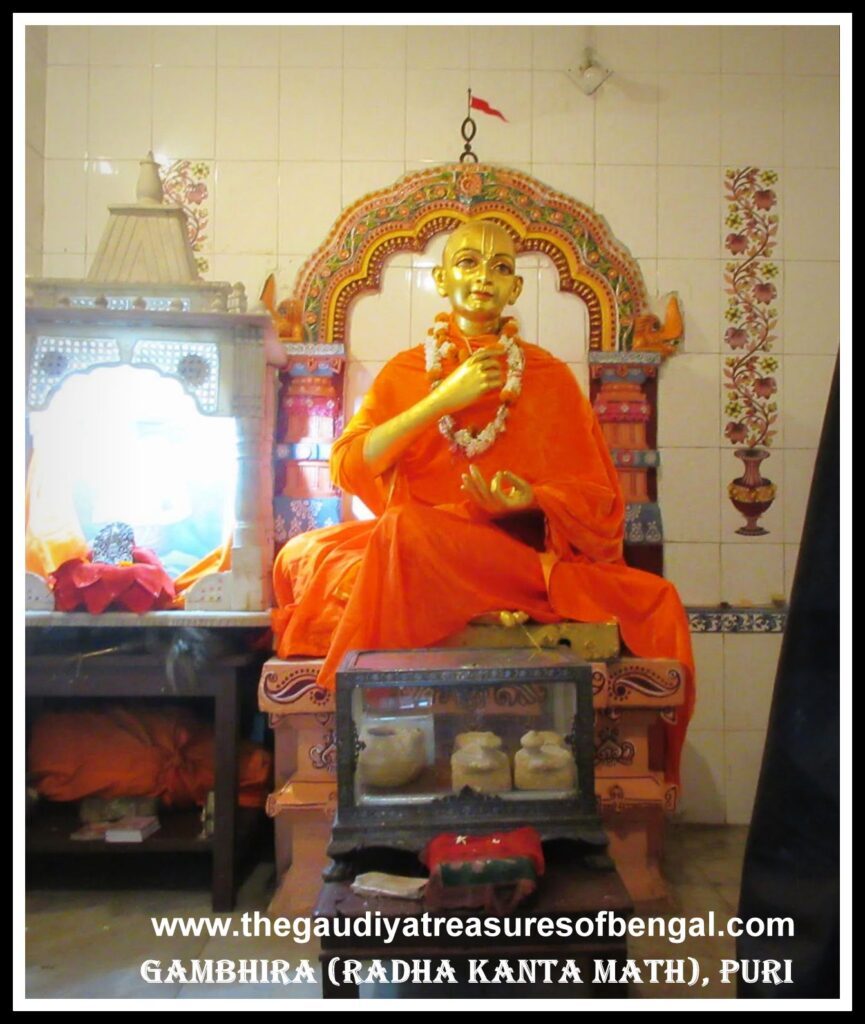
When Vakreshwara Pandita himself passed from this world, the seva of his worshipable Deity, Sri Radha-Kanta, passed to Gopala Guru Goswami. This was at the same house in Puri, by then called the Gambhira, where Sri Chaitanya Mahaprabhu had lived out the last years of His own manifest pastimes. Temple tradition at Puri holds that Gopala Guru Goswami was formally installed as mahant, or head of the temple, on the twelfth day of the bright fortnight of the month of Magha. That date is still marked there every year. The same tradition holds that he was in charge of the seva during at least the years 1538 to 1548 CE, and that the old structure was thoroughly rebuilt in this period. Under his direction four more Deities joined Sri Radha-Kanta on the altar. Sri Radha and Lalita were placed on either side, and forms of Nityananda Prabhu and Sri Gauranga were added as well. In this way, the private worship of a single Deity became something closer to the fuller Gaudiya altar still seen there today.
The Radha-Kanta Deity's own earlier history is remembered a little differently by different tellers. One account has it captured during King Purushottama Deva's military campaign in the south and quietly passed down through Kashi Mishra's own family, who served as royal priests. Another has it installed for a time inside the Jagannatha temple itself, moved out to Kashi Mishra's house only after Lord Jagannatha complained, in a dream to King Prataparudra, that Radha-Kanta was eating the choicest offerings meant for Him. Both versions agree on the outcome. Long before Gopala Guru Goswami's own lifetime, the Deity was already settled at Kashi Mishra's house, along with the small room called the Gambhira. So he inherited an established seva, not a new one, and he made it larger.
Teaching Sri Dhyanachandra Goswami #
Gopala Guru Goswami's most important act as a teacher was training Sri Dhyanachandra Goswami. Dhyanachandra Goswami is remembered today as one of the most important later writers on internal, meditative Gaudiya Vaishnava worship. According to temple tradition, Gopala Guru Goswami found him, or was led to him, in old age through a dream. In the dream Krishna promised that the very next person he met the following morning would be the one to continue Sri Radha-Kanta's seva. That person turned out to be Dhyanachandra Goswami himself, waiting at his doorstep. Gopala Guru Goswami gave him mantra initiation and trained him in the same rasa-tattva he himself had received. Both guru and disciple went on to compose their own versions of a text called Sri Gaura-Govindarcana-Smarana-Paddhati. It is a manual for how a devotee should worship and meditate on the forms of Gauranga and Radha-Govinda together. By Gopala Guru Goswami's own count, it has twenty-six chapters. Later Gaudiya Vaishnavas combined the guru's and the disciple's versions of this paddhati into a single standard text, and it is still the basis of the worship practice of some Gaudiya lines today. Dhyanachandra Goswami's own name is the more familiar one in the wider tradition. But the paddhati's roots, and his own initiation, go back directly to his teacher.
During this same period, at least one other important visitor came to Gopala Guru Goswami's Puri household. The Bhakti-ratnakara records that Narottama Dasa Thakura, on pilgrimage to Jagannatha Puri, visited Kashi Mishra's house and met Gopala Guru Goswami there in person. It is a brief detail, and it is cited here through a secondary version of the Bhakti-ratnakara, not a scholarly edition. Still, it is a real link between Gopala Guru Goswami's Puri temple and the wider circle of Bengali Gaudiya Vaishnavism in the generation after Mahaprabhu. What became of that temple, and of Gopala Guru Goswami himself, after his own long years of service there, is the subject of Legacy.
Scriptural evidence for this chapter (4)
বক্রেশ্বর পণ্ডিত—প্রভুর বড় প্রিয় ভৃত্য ।
এক–ভাবে চব্বিশ প্রহর যাঁর নৃত্য ॥ ১৭ ॥
vakresvara pandita -- prabhura bada priya bhrtya
eka-bhave cabbisa prahara yanra nrtya
Word for word
vakresvara pandita: Vakresvara Pandita; prabhura: of the Lord; bada: very; priya: dear; bhrtya: servant; eka-bhave: continuously in the same ecstasy; cabbisa: twenty-four; prahara: a duration of time comprising three hours; yanra: whose; nrtya: dancing.
Vakresvara Pandita, the fifth branch of the tree, was a very dear servant of Lord Chaitanya's. He could dance with constant ecstasy for seventy-two hours.
From the purport: Purport excerpt: "There are many disciples of Vakresvara Pandita in Orissa... Among these disciples are Sri Gopalaguru and his disciple Sri Dhyanacandra Gosvami."
This is the direct textual basis for calling Gopala Guru Goswami a disciple of Vakreshwara Pandita and Dhyanachandra Goswami his own disciple in turn.
আপনে মহাপ্রভু গায় যাঁর নৃত্যকালে ।
প্রভুর চরণ ধরি’ বক্রেশ্বর বলে ॥ ১৮ ॥
apane mahaprabhu gaya yanra nrtya-kale
prabhura carana dhari' vakresvara bale
Word for word
apane: personally; mahaprabhu: Sri Chaitanya Mahaprabhu; gaya: sang; yanra: whose; nrtya-kale: at the time of dancing; prabhura: of the Lord; carana: lotus feet; dhari': embracing; vakresvara: Vakresvara Pandita; bale: said.
Sri Chaitanya Mahaprabhu personally sang while Vakresvara Pandita danced, and thus Vakresvara Pandita fell at the lotus feet of the Lord and spoke as follows.
Cited here to show the closeness between Mahaprabhu and Vakreshwara Pandita, the guru whose Deity and residence Gopala Guru Goswami would later inherit.
শ্রীবাস-পণ্ডিত ইঁহ, পণ্ডিত-বক্রেশ্বর ।
বিদ্যানিধি-আচার্য, ইঁহ পণ্ডিত-গদাধর ॥ ৮৪ ॥
srivasa-pandita inha, pandita-vakresvara
vidyanidhi-acarya, inha pandita-gadadhara
Word for word
srivasa-pandita: Srivasa Pandita; inha: here; pandita-vakresvara: Vakresvara Pandita; vidyanidhi-acarya: Vidyanidhi Acarya; inha: here; pandita-gadadhara: Gadadhara Pandita.
"Here are Srivasa Pandita, Vakresvara Pandita, Vidyanidhi Acharya and Gadadhara Pandita."
Cited to place Vakreshwara Pandita among the well-known senior Vaishnavas gathered at Puri, the same circle Gopala Guru Goswami grew up around.
Shrila Narottama Dasa Thakura visited the house of Kashi Mishra when he went to Jagannatha Puri. There he met Gopal Guru Goswami.
Cited here via a modern secondary retelling of the Bhakti-ratnakara rather than a scholarly edition of the text itself; it is the one specific, named meeting between Gopala Guru Goswami and another well-documented Gaudiya Vaishnava.
Chapter 3
Legacy
A disputed identity, a miracle after death, and a temple at Puri that still keeps his name at its door.
Every source that records it places Gopala Guru Goswami's disappearance from this world on the ninth day of a fortnight in the month of Kartika. But the sources do not agree on which fortnight it was, dark or bright. No year is recorded anywhere. What happened immediately afterward, and what is still shown to pilgrims at Puri today, makes up the most vivid part of his story.
| Detail | Description |
|---|---|
| Disappearance day | Ninth day of a fortnight (dark or bright - sources differ) in the month of Kartika |
| Disputed identity | The gopi Tungavidya Sakhi - claimed for Gopala Guru Goswami by Gaudiya History, but for Vakreshwara Pandita by a rendering of Dhyanachandra Goswami's own paddhati |
| Post-disappearance pastime | A reported reappearance and sankirtana procession at Puri, and a meeting with Dhyanachandra Goswami at Vamsivat, Vrindavana |
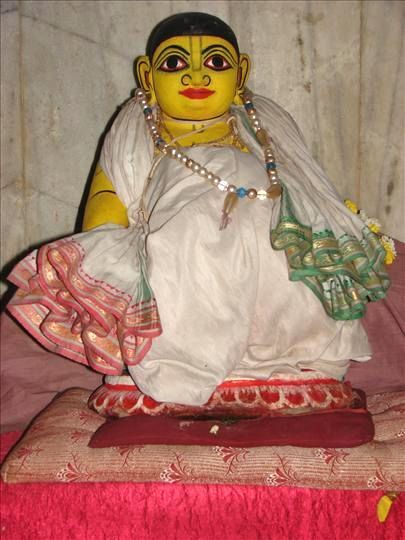
| Deity still seen today | A small deity of Gopala Guru Goswami himself, carved from a neem tree at Siddha Bakul, kept near the entrance of the Sri Radha-Kanta temple |
| Temple today | Sri Radha-Kanta Matha (the Gambhira), Balisahi, Puri - an active pilgrimage site |
A Contested Succession #
It is said that in old age Gopala Guru Goswami grew anxious about who would carry on Sri Radha-Kanta's seva after him. According to temple tradition, this is how he came to give initiation and charge of the Deity to Dhyanachandra Goswami. That handover did not go smoothly. The king of Puri, tradition says, was displeased that so important a temple's succession had been decided without his approval, and sent soldiers to take control of it the moment word reached him that Gopala Guru Goswami had died. Dhyanachandra Goswami, meanwhile, was still on his way to Swargadwar to cremate his guru's body when he heard the news. What followed is the single most striking pastime connected to Gopala Guru Goswami's name. Holding his guru's feet and weeping, Dhyanachandra pleaded for help. It is said that Gopala Guru Goswami then rose from the funeral palanquin, led a sankirtana procession of astonished devotees back to the temple, and took back Sri Radha-Kanta's seva in person. According to this account, he then remained active at the Gambhira through the reigns of three further kings before finally handing the Deity's care back to Dhyanachandra Goswami and leaving his body for good.
Meeting His Disciple in Vrindavana #
A second story, just as striking, follows the year after. A party of devotees traveling from Vraja to Puri for the Ratha-yatra festival told Dhyanachandra Goswami that his guru was doing bhajana near Vamsivat in Vrindavana. This is the very place on the Yamuna's bank where Krishna is remembered to have played His flute for the gopis. Dhyanachandra, astonished, walked the entire distance and found Gopala Guru Goswami exactly there, absorbed in japa. Dhyanachandra protested that his guru had already left his body at Puri. Gopala Guru Goswami answered lightly, according to the account, that he did not yet understand the transcendental nature of Vrindavana Dhama, where such things are possible. He would not return to Puri, he said, but gave Dhyanachandra a final instruction instead: go to Siddha Bakul, where Sri Haridasa Thakura had done his own bhajana, find the old neem tree growing there, and have a deity of himself carved from its wood. That deity, placed before Sri Radha-Kanta whenever bhoga was offered, would let Dhyanachandra continue having his guru's darshan even without his physical presence. A small deity that matches exactly this description is still shown today, seated near the entrance of the Radha-Kanta temple at Puri. But, as with the sankirtana-procession story above, this pastime comes down only through devotional biography. It does not come from Chaitanya-charitamrita or from a dated Prabhupada purport, and it is reported here as tradition, not settled history.
An Unresolved Question: Who Was Tungavidya? #
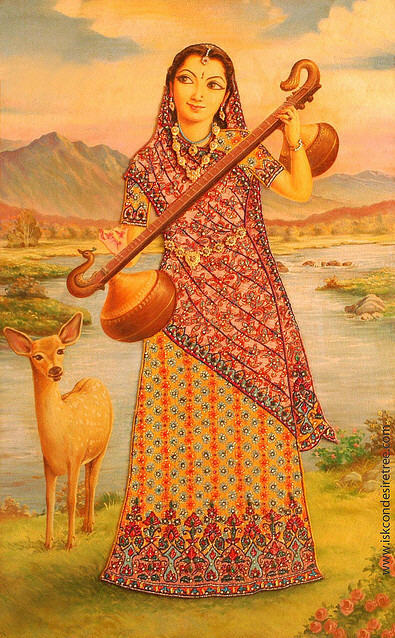
One further claim about Gopala Guru Goswami does not hold up when the sources are checked closely. The disagreement is reported honestly here, without picking a side. Gaudiya History's own biography states that "according to some, Gopal Guru Goswami was the gopi known as Tungavidya Sakhi," one of the eight principal gopi companions of Srimati Radharani in Krishna's Vraja pastimes. But a separate version of Dhyanachandra Goswami's own Dhyana-chandra-paddhati, shared by the Vedic-library site isvara.org, gives a different view. It quotes Dhyanachandra as writing that his own guru's guru, Vakreshwara Pandita, not Gopala Guru Goswami, was "previously very expert in the arts of singing and dancing, the gopi, Tungavidya." These two claims cannot both be right, since Tungavidya Sakhi is one specific gopi and not two. The sources offer no way to decide between them. So we do not quietly choose the more convenient answer. Both traditions are recorded here, and the question is left open.
The Temple Today #
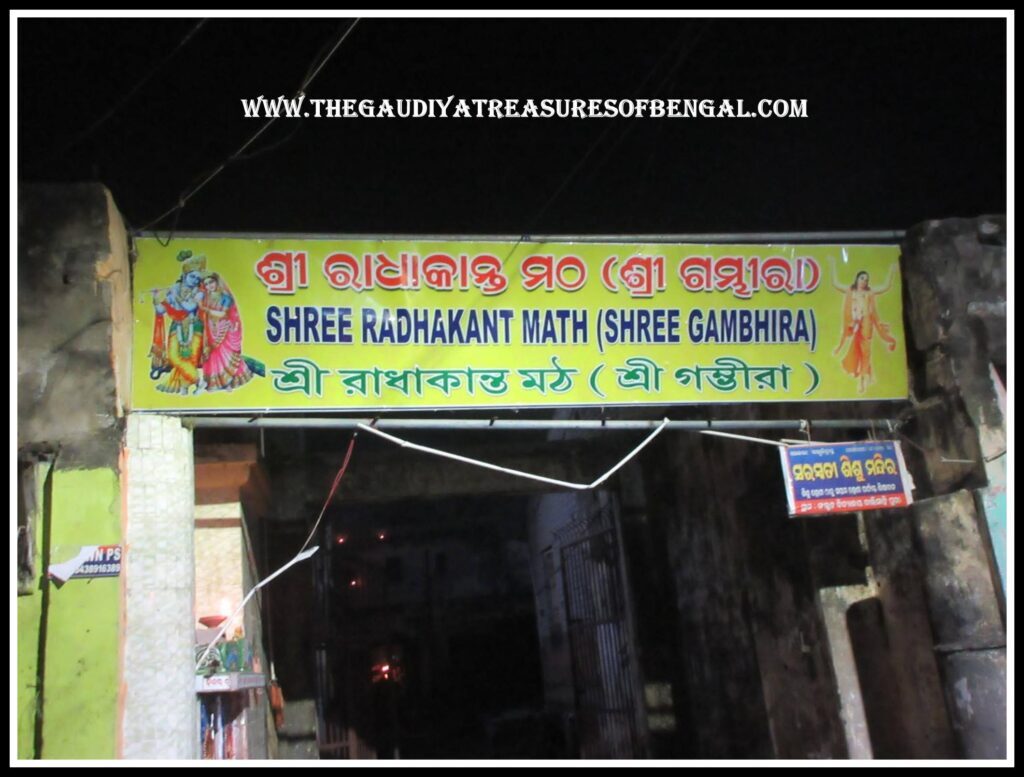
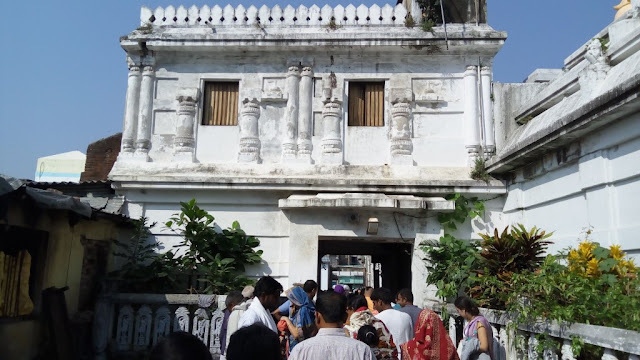
What is not in dispute is that Gopala Guru Goswami's own service left something lasting. The Sri Radha-Kanta Matha is still commonly called the Gambhira, after the small room where Sri Chaitanya Mahaprabhu once lived. It stands today at Balisahi, a short walk from Swargadwar in Puri, and remains an active Gaudiya Vaishnava pilgrimage site. Pilgrims can see the room Mahaprabhu Himself occupied, along with relics said to be His own. They can also see the altar Gopala Guru Goswami expanded. Sri Radha-Kanta is at the center, with Radharani and Lalita on either side, and Gauranga and Nityananda Prabhu as well. A festival is still held there every year on the anniversary of the day Gopala Guru Goswami took charge of the seva. Devotees say that on that day he appears briefly at one side of the seat where Mahaprabhu once sat. As a boy, he was once teased and given a joking title by God Himself. By the end of his own life, he had become one of the people entrusted with keeping God's own house at Puri open. And that house, by every account, is still open.
Scriptural evidence for this chapter (3)
Quoted in the text above:
- on Gopala Guru Goswami's identity Gaudiya History (ISKCON Desire Tree) biography
Further verses:
That person who was previously very expert in the arts of singing and dancing, the gopi Tungavidya, is presently renowned in the world as Vakresvara Pandita.
This rendering of Dhyanachandra Goswami's own paddhati identifies Vakreshwara Pandita, not Gopala Guru Goswami, with the gopi Tungavidya Sakhi - directly contradicting Gaudiya History's claim about Gopala Guru Goswami himself; both are reported here rather than picking one.
"Guru Maharaja, how is it possible? You left your body in Puri!" ... "Don't you understand the transcendental nature of Vrindavan Dham?"
This dialogue, part of the tradition that Gopala Guru Goswami appeared to Dhyanachandra Goswami in Vrindavana after his own disappearance at Puri, is reported here as devotional hagiography rather than a documented historical event.
- Sri Chaitanya-charitamrita, Adi-lila 10.17, with Srila Prabhupada's purport
- Sri Chaitanya-charitamrita, Adi-lila 10.131, with Srila Prabhupada's purport
- Sri Chaitanya-charitamrita, Madhya-lila 10.21-32 (Kashi Mishra's house at Puri)
- Gaudiya History (ISKCON Desire Tree): Gopala Guru Goswami - Biography
- Gaudiya History (ISKCON Desire Tree): Gopala Guru Goswami
- Gaudiya History (ISKCON Desire Tree): Sri Gopala Guru Goswami - Biography
- Stephen Knapp: Gopala Guru Goswami
- ISVARA.org Vedic Library: Vakresvara Pandita (quoting Dhyana-chandra-paddhati)
- The Gaudiya Treasures of Bengal: Gambhira, Jagannath Puri - Residence of Chaitanya Mahaprabhu
- Hindu Temples of India: Radha Kanta Matha, Puri, Odisha
