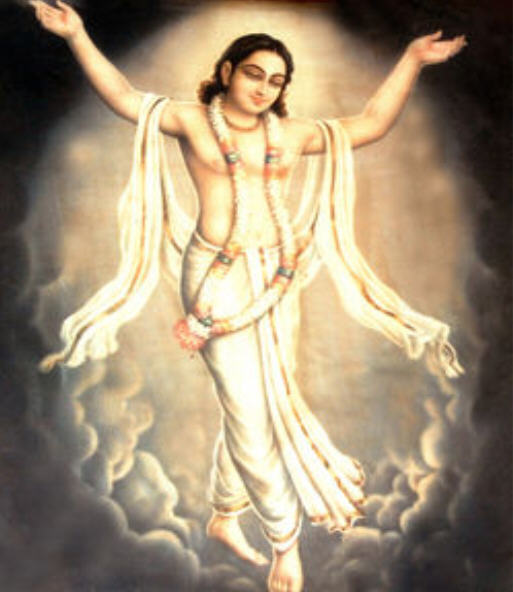
By the time Sri Chaitanya Mahaprabhu had settled into His later years at Jagannatha Puri, the three Ghosh brothers had become a regular part of the yearly Ratha-yatra festival, coming back each year to sing as the Lord's cart moved through the streets. Chaitanya-charitamrita records that Mahaprabhu organized seven separate kirtan parties for the festival. Here the text names Govinda as the leader of one of these parties, and his two brothers sang in it with him.
| Detail | Description |
|---|---|
| Govinda's kirtan party | Leader, with the younger Haridasa, Vishnudasa, and Raghava as responding singers |
| Madhava and Vasudeva | Responding singers in Govinda's party, with Vakreshvara Pandita as its dancer |
| Govinda's identity (Gaura-ganoddesha-dipika 188) | Kalavati, a gopi-singer of Vraja |
| Madhava and Vasudeva's identities | Rasollasa and Gunatunga, gopi-singers of Vraja |
Leading His Own Kirtan Party #
"The Lord formed another group, appointing Govinda Ghosha as leader," Chaitanya-charitamrita says of the Ratha-yatra arrangements. It calls him "pradhana," the chief, of a party that included the junior Haridasa, Vishnudasa, and Raghava as his singers. The very next verse says Madhava and Vasudeva also joined this same party as responding singers, with Vakreshvara Pandita as its dancer. A family gift for kirtan, once described simply as belonging to "the three brothers," was still shared by all three, but now Govinda was the named leader. It is a small detail, easy to miss in a long list of festival arrangements. But it is one of the clearest proofs in scripture that Govinda's own place among Mahaprabhu's associates was more than just "one of the Ghosh brothers."
Kalavati of Vraja #
The Gaura-ganoddesha-dipika is Kavi Karnapura's traditional guide to the Vraja identities of Mahaprabhu's associates. It gives the three brothers three separate identities instead of one shared identity. It identifies Govinda as Kalavati, Madhava as Rasollasa, and Vasudeva as Gunatunga. They are gopis in Krishna's own Vrindavana pastimes who sang the songs composed by Vishakha, one of Radha's closest friends. So this family of Bengali kayastha brothers was given three separate spiritual identities, not one. This matches the same pattern seen throughout Govinda's life. However often the three brothers appear together in the records, tradition and scripture were both careful to keep each one's own identity separate.
Where He Rests: Agradwipa #
No source gives the year of Govinda Ghosh's death or his age at the time. Instead, there is a specific and well-supported tradition, not a guess. He is said to have asked in his final days to be buried instead of cremated, near a place called Dolaprangana at Agradwipa. The Gopinatha Deity he served is said to still hold kusha grass and mark his death anniversary every year, in keeping with Krishna's own promise to him. Bhaktisiddhanta Sarasvati Thakura's own Anubhasya commentary confirms that this shraddha ceremony is still performed at Agradwipa today. For a tradition of this kind, that is about as strong a confirmation as one can normally expect.
A few short reference notes found online instead say his samadhi is in the 64 Samadhis Area near Radha-kunda in Vrindavana. The very same line, word for word, is also used for his brother Vasudeva Ghosh and for the unrelated Lochana Dasa Thakura. This suggests it is a general note used for several devotees, not a specific tradition about Govinda Ghosh himself. The tradition rooted at Agradwipa is specific and is confirmed by a yearly ritual. So it is the far more believable account of where he rests.
A Family Remembered Together and Apart #
There is no question about the lasting place the Ghosh brothers hold in Gaudiya Vaishnava memory. Srila Prabhupada himself read through the verses naming all three brothers in a 1973 lecture on Chaitanya-charitamrita's tenth and eleventh chapters. He translated them for his own students in the same words later printed in the book's purports. It is a small sign that even this brief mention of the three singers remained important in his teaching about the early history of the sankirtana movement. Govinda Ghosh's own record includes his songs of grief at Gauranga's departure, his decision to stay behind when his brothers returned to Bengal, the Gopinatha Deity he established, and the kirtan party he led at the Ratha-yatra. It shows a devotee who lived mostly in his brothers' company, yet whose life left a mark all its own. His brothers' fuller stories are told at Vasudeva Ghosh and Madhava Ghosh.
