Srila Govinda Ghosh
Kirtan Leader Among the Ghosh Brothers, Founder of Sri Gopinatha at Agradwipa
The complete life, on one page: The main biography and every pastime page, in order, in one place
Introduction
Govinda Ghosh was one of three brothers, Govinda, Madhava, and Vasudeva. Their kirtan is remembered in Sri Chaitanya-charitamrita as so sweet that Sri Chaitanya Mahaprabhu and Nityananda Prabhu would dance whenever the three brothers sang. Most sources speak of the three Ghosh brothers together, as one story. But scripture and tradition also remember things that belong to Govinda alone: his own songs, his choice to stay at Jagannatha Puri when his brothers went back to Bengal, his own Deity of Sri Gopinatha at Agradwipa, and his own kirtan party at the yearly Ratha-yatra festival. Both threads matter: what the three brothers did as one, and what Govinda alone is remembered for.
| Detail | Description |
|---|---|
| Family | Uttara-Radhiya Kayastha family of Bengal, with brothers Madhava and Vasudeva |
| Home / shripat | Agradwipa, on the Ganga near Katwa, Bardhaman district |
| Also known as | Ghosha Thakura, Ghosa Thakura |
| Deity established | Sri Gopinatha, Agradwipa |
| Role at Ratha-yatra | Leader of his own kirtan party, in which his brothers Madhava and Vasudeva sang as responding singers |
| Identity | Kalavati, a gopi of Vraja who sang the songs composed by Vishakha (Gaura-ganoddesha-dipika 188; Chaitanya-charitamrita Adi 10.115 purport) |
Scriptural evidence for the introduction (2)
govinda, madhava, vasudeva-tina bhai
yan-sabara kirtane nace caitanya-nitai
Word for word
govinda-Govinda; madhava-Madhava; vasudeva-Vasudeva; tina bhai-three brothers; yan-sabara-all of whom; kirtane-in the performance of sankirtana; nace-dance; caitanya-nitai-Lord Caitanya and Nityananda Prabhu.
The three brothers Govinda, Madhava and Vasudeva were the eighty-second, eighty-third and eighty-fourth branches of the tree. Lord Caitanya and Nityananda used to dance in their kirtana performances.
From the purport: Purport excerpt: "Govinda established the Gopinatha temple in Agradvipa, where he resided... According to the Gaura-ganoddesa-dipika (188), the three brothers were formerly Kalavati, Rasollasa and Gunatunga."
The foundational verse naming all three Ghosh brothers together and recording, in Srila Prabhupada's own purport, that Govinda specifically established the Gopinatha Deity at Agradwipa.
कलावती रसोल्लासा गुणतुङ्गा व्रजे स्थिता ।
श्री विशाखा कृतं गीतं गायन्ति स्माद्य ता मताः ।
गोविन्द माधवानन्दवासुदेवा यथाक्रमम् ॥१८८॥
kalāvatī rasollāsā guṇatuṅgā vraje sthitā
śrī viśākhā kṛtaṁ gītaṁ gāyanti smādya tā matāḥ
govinda mādhavānanda-vāsudevā yathākramam
The vraja-gopis Kalavati-devi, Rasollasa-devi, and Gunatunga-devi, who sang the songs composed by Visakha-devi, later appeared as Govinda, Madhavananda, and Vasudeva respectively.
From the purport: According to the Gaura-gaṇoddeśa-dīpikā (188), the three brothers were formerly Kalāvatī, Rasollāsā and Guṇatuṅgā, who recited the songs composed by Śrī Viśākhā-gopī. (Srila Prabhupada, Chaitanya-charitamrita Adi 10.115 purport)
Kavi Karnapura's verse naming the three Ghosh brothers, in order, as the Vraja gopis Kalavati, Rasollasa and Gunatunga; Govinda, named first, is Kalavati. Sanskrit: diacritic edition of the Gaura-ganoddesha-dipika; English translation as published at bvmlu.org.
Chapter 1
Birth and the Ghosh Brothers of Navadvipa
A kayastha family of three singing brothers, and the one song that is Govinda's alone.
No source gives a year for Govinda Ghosh's birth. What we do know is that he was born into an Uttara-Radhiya kayastha family of Bengal, along with two brothers, Madhava and Vasudeva, and that all three grew up to be singers whose voices are now remembered in scripture itself. Bhaktisiddhanta Sarasvati Thakura, in his own commentary on Chaitanya-charitamrita, notes that a fair still held at Agradwipa, near Katwa, carries the name "Ghosha Thakura" to this day, a title later tradition gave to Govinda alone. Another reference work, the Vishvakosha, places his home more precisely at Kashipur Vishnutala near Agradwipa, and adds that some believe the family's roots go back to Vasinavatala, where kayastha families with the Ghosh surname still live. None of this can be checked directly against Chaitanya-charitamrita, so it is told here as regional tradition, not settled fact.
| Detail | Description |
|---|---|
| Family | Uttara-Radhiya kayastha; brothers Madhava and Vasudeva |
| Govinda's shripat | Agradwipa, on the Ganga near Katwa, Bardhaman district (the river has shifted over the centuries, so it has stood on both banks at different times) |
| Madhava's shripat | Dainhat |
| Vasudeva's shripat | Tamluk |
| Branch numbers in the Chaitanya tree | 82nd (Govinda), 83rd (Madhava), 84th (Vasudeva) |
A Kayastha Family Famous for Sweet Voices #
Srila Prabhupada's purport to Krishnadasa Kaviraja Goswami's Chaitanya-charitamrita, Adi-lila 10.115, says plainly that all three brothers were born in a kayastha family. It also says that Madhava had no equal as a singer, and that people called him "the singer of Vrindavana." Scripture counts the three brothers among the many branches of what it calls the tree of Sri Chaitanya Mahaprabhu's associates: Govinda is the eighty-second branch, Madhava the eighty-third, and Vasudeva the eighty-fourth. These brothers were gifted singers, not brahmana scholars, yet scripture honors them in this way. This shows that Sri Chaitanya Mahaprabhu and Nityananda Prabhu valued kirtan itself as a path to Krishna, not just as something added on to more formal worship.
Singing in Navadvipa's Courtyards #
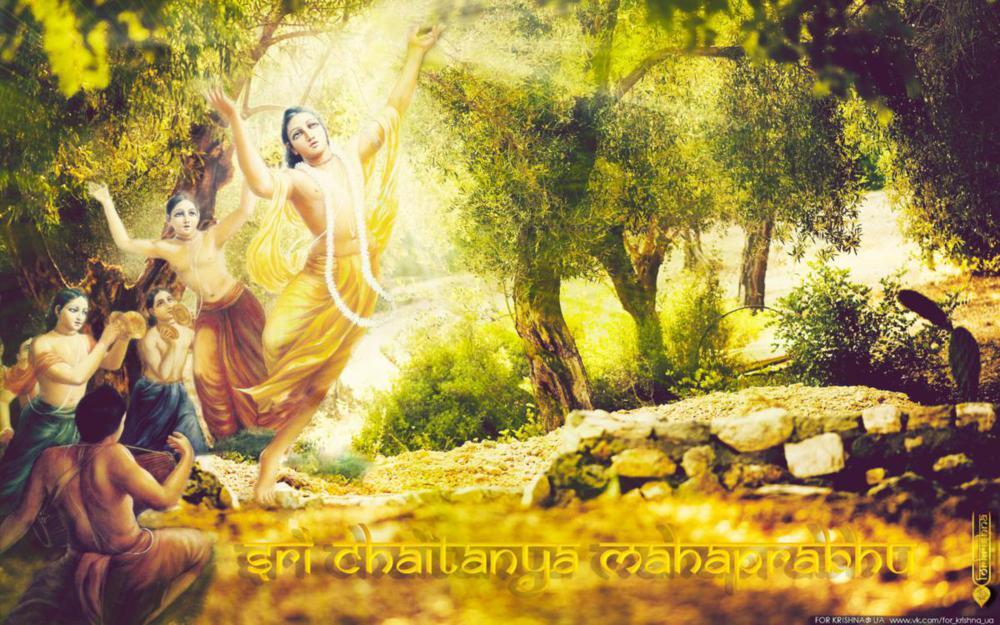
Tradition places the Ghosh brothers' kirtan at some of the most remembered gatherings of Mahaprabhu's Navadvipa years. There is the courtyard of Srivasa Thakura, where the young Lord's earliest sankirtana parties are said to have gathered. There is the nagara-sankirtana procession that marched through the streets to the house of the local Kazi, after he tried to stop congregational chanting. And there is the house of Raghava Pandit, a householder devotee known for his hospitality to Vaishnavas passing through Bengal. Chaitanya-charitamrita does not name the brothers individually in each of these scenes. What it says directly, and repeats in more than one place, is the simple fact that whenever the three of them sang kirtan, Chaitanya and Nitai would dance. That one sentence, repeated in Adi-lila and again in Madhya-lila, is really the scriptural heart of everything remembered about the three brothers together.
The Song Govinda Carried to Mukunda #
One story attached to Govinda's name belongs to him alone, not to all three brothers together. Bengali Vaishnava song collections give him padas that describe, in his own voice, the moment he learned that Gauranga had decided to take sannyasa and leave Navadvipa. In the retelling built around these songs, Govinda saw Mahaprabhu sitting with His head bowed, tears on His face, and could not bring himself to ask what was wrong. When he finally asked and heard the answer, he ran without another word to tell Mukunda Datta, one of the Lord's closest boyhood friends. What survives from that moment are two songs of grief, begging the people of Navadvipa to stop Gauranga from leaving, ending with Govinda's own line that if the Lord truly goes, life itself will not be worth living.
We should be honest about what is scripture here and what is not. No verse in Chaitanya-charitamrita or Chaitanya-bhagavata tells this story of Govinda running to Mukunda. It comes from later retelling, not from either book directly. The songs themselves stand on firmer ground. The Vaishnava Song Book lists three padas credited to "Govinda Ghosha" on its own. One of them is titled, in translation, "Gora Went to the Eastern Land, His Own Associates Fell Into Distress," and the Song Book describes it as "a rare note of separation in this genre, likely describing Chaitanya's departure from Navadvipa and the grief it left among His companions." The song collection is a separate record from the story, and it confirms that Govinda really did write a surviving song on exactly this theme. The other two songs in the same list are on different subjects. One describes Radha's beauty being tested like gold on a touchstone. The other describes a ceremonial scene in which Gauranga bathes and takes His seat on a divine throne. So Govinda's own songs were not limited to this one mood of grief.
Serving Mahaprabhu and the Gopinatha Deity of Agradwipa tells what became of Govinda after Mahaprabhu left Navadvipa. It tells of his own decision to stay with the Lord instead of returning to Bengal with his brothers, and of the Deity he went on to establish.
Scriptural evidence for this chapter (2)
govinda, madhava ghosa, ei vasu-ghosa
tina bhaira kirtane prabhu payena santosa
Word for word
govinda-Govinda Ghosa; madhava ghosa-Madhava Ghosa; ei vasu-ghosa-this Vasudeva Ghosa; tina bhaira-of the three brothers; kirtane-in the sankirtana; prabhu-the Lord; payena santosa-gets very much pleasure.
"Here also are Govinda Ghosa, Madhava Ghosa and Vasudeva Ghosa. They are three brothers, and their sankirtana, congregational chanting, pleases the Lord very much."
From the purport: Purport excerpt: "Govinda Ghosa belonged to the kayastha dynasty of the Uttara-radhiya section, and he was known as Ghosa Thakura. Even to the present day there is a place named Agradvipa, near Katwa, where a fair takes place and is named after Ghosa Thakura."
Confirms the brothers' kayastha lineage and identifies Govinda by his popular title, Ghosa Thakura, tied to the Agradwipa fair that still bears his name.
Chaitanya Mahaprabhu and Nityananda Prabhu danced to the kirtan of the three brothers, Govinda, Madhava and Vasudeva.
Cited via a secondary compilation only, since Chaitanya-bhagavata has no independent online corpus against which the reference could be checked directly.
Chapter 2
Serving Mahaprabhu and the Gopinatha Deity of Agradwipa
Why Govinda alone stayed behind - and the Deity that grew out of a stone found in the Ganga.
When Sri Chaitanya Mahaprabhu sent Nityananda Prabhu back to Bengal to preach, Chaitanya-charitamrita names three devotees who went with Him: Ramadasa, Madhava, and Vasudeva Ghosh. Govinda did not go. "Govinda Ghosha, however, remained with Sri Chaitanya Mahaprabhu at Jagannatha Puri and thus felt great satisfaction," writes Krishnadasa Kaviraja Goswami. It is a short, plain sentence, but it is the clearest scriptural evidence that Govinda's own path, for at least part of his life, stayed close to the Lord's in a way his brothers' did not.
| Detail | Description |
|---|---|
| Textual anchor | Sri Chaitanya-charitamrita, Adi-lila 10.117-118 |
| Brothers who returned to Bengal | Madhava and Vasudeva, with Ramadasa, under Nityananda Prabhu |
| Deity established | Sri Gopinatha, Agradwipa |
| Traditional occasion | Govinda directed to stay behind and install the Deity |
A Habit Corrected, and a Command to Stay #
Achyutacharana Chaudhuri, in Shrihattera Itivrtta, records a traditional story about this. Govinda was traveling with Mahaprabhu's party, and one day, after a meal, he quickly fetched a haritaki fruit for the Lord. Mahaprabhu noticed that Govinda had actually kept a small stock of the fruit, instead of gathering it fresh each time. He gently corrected the habit. Then He told Govinda that since he had not learned to stop saving things for later, he should stay behind and take charge of installing a Deity. Whatever the exact words were, the outcome matches what we know from scripture. Govinda did stay behind instead of returning with his brothers, and he did go on to install a Deity that is still worshiped today. (Accounts differ on where he stayed behind instead of going on to Vrindavana: some say in Bengal, others say near Puri.)
One important point must be made clear here. Chaitanya-charitamrita also mentions a different "Govinda," a personal servant of Sri Chaitanya Mahaprabhu who had earlier been a disciple of Ishvara Puri. The Gaura-ganoddesha-dipika identifies this other Govinda as Bhangura, one of Krishna's own attendants in Vraja. This Govinda traveled with the Lord all the time. Elsewhere, the purports of Chaitanya-charitamrita say that he had the very same habit of storing up haritaki, and that Mahaprabhu corrected him in almost the same words. Some popular retellings mix these two men up as if they were one person. They are not the same person. The personal servant Govinda is identified as Bhangura. Govinda Ghosh is identified separately as Kalavati. Their roles in the Lord's life were also completely different. One was an attendant who traveled with the Lord all the time. The other was a householder singer from Agradwipa who came to Puri mainly for the yearly festival. This page follows what is said specifically about Govinda Ghosh, not the details recorded under the other Govinda's name.
A Stone From the Ganga #
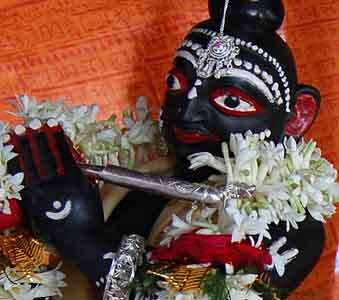
Tradition tells that, not long after being told to stay behind, Govinda was bathing in the Ganga when something struck his back. It felt like a piece of wood, though it was unusually heavy. That night, he is said to have had a dream telling him to keep it safe and give it to Mahaprabhu when the Lord arrived. When Govinda went back for it, he found it was actually a krishna-shila, a sacred stone. The next morning, tradition says, Mahaprabhu came to his house and told him a sculptor would arrive the following day to carve a Deity from the stone. That Deity became Sri Gopinatha, installed at Agradwipa on the Ganga near Katwa. (The river has changed its course over the centuries, so Agradwipa has stood at times on its east bank and at times on its west bank.) This part of the story does match what Chaitanya-charitamrita's own purport briefly states: "Govinda established the Gopinatha temple in Agradvipa, where he resided." The vivid details of the dream and the stone itself come from later biographies, not from Krishnadasa Kaviraja Goswami's own text, and are told here as temple tradition, not as scripture.
Marriage, Loss, and a Promise #
The same tradition goes on to tell of a hard chapter for his family. Govinda married, on the Lord's own later instruction, and served the Gopinatha Deity together with his wife. A son was born, but the wife and the son both died. The loss was so heavy that Govinda is said to have stopped his daily service to the Deity out of grief. Krishna Himself, tradition says, appeared to him in a dream and asked whether a father who has lost one son should let his remaining "son," the Deity he had served as family, go hungry too. Govinda's answer was practical, not sentimental. He said he had hoped a living son would perform his shraddha, the rites owed to the dead, and asked what he would gain by continuing to serve. Krishna is said to have promised to perform that shraddha Himself, forever. The Gopinatha temple at Agradwipa still marks this promise today: the Deity is said to hold kusha grass in His fingers during the yearly rite. This story is moving, but it survives only in temple and biographical tradition, not in Chaitanya-charitamrita or Chaitanya-bhagavata, and should be read that way.
Legacy and Disappearance tells about Govinda's later life, once he began returning each year to Puri for the Ratha-yatra festival. It also shows how, at that festival, he led a kirtan party of his own, with his brothers singing in it.
Scriptural evidence for this chapter (3)
prabhura ajnaya nityananda gaude calila
tanra sange tina-jana prabhu-ajnaya aila
ramadasa, madhava, ara vasudeva ghosa
prabhu-sange rahe govinda paiya santosa
Word for word
prabhura ajnaya-under the order of Lord Caitanya Mahaprabhu; nityananda-Lord Nityananda; gaude calila-went back to Bengal; tina-jana-three men; ramadasa, madhava, ara vasudeva ghosa-Ramadasa, Madhava and Vasudeva Ghosa; prabhu-sange rahe govinda-Govinda remained in the company of the Lord; paiya santosa-feeling great satisfaction.
By the order of Sri Caitanya Mahaprabhu, three devotees accompanied Lord Nityananda Prabhu when He returned to Bengal to preach. These three were Ramadasa, Madhava Ghosa and Vasudeva Ghosa. Govinda Ghosa, however, remained with Sri Caitanya Mahaprabhu at Jagannatha Puri and thus felt great satisfaction.
The clearest scriptural point where Govinda's own path is shown diverging from his brothers': he alone stayed on with Mahaprabhu rather than returning to Bengal.
isvara-purira sisya-brahmacari kasisvara
sri-govinda nama tanra priya anucara
Word for word
isvara-purira sisya-disciple of Isvara Puri; brahmacari kasisvara-Brahmacari Kasisvara; sri-govinda-Sri Govinda; nama-name; tanra priya anucara-his dear follower.
Brahmacari Kasisvara was a disciple of Isvara Puri, and Sri Govinda was another of his dear disciples.
From the purport: Purport excerpt: "Govinda was the personal servant of Sri Caitanya Mahaprabhu. In the Gaura-ganoddesa-dipika (137) it is stated that the servants formerly named Bhrngara and Bhangura in Vrndavana became Kasisvara and Govinda in Caitanya Mahaprabhu's pastimes."
Cited for an important clarification: this personal-servant Govinda (identified as Bhangura) is a distinct individual from Govinda Ghosh (identified separately as Kalavati), though the two are sometimes conflated in popular retellings.
It was said of the meritorious Madhava Ghosh that he was devoted to kirtan and had no equal as a singer on earth, being called a singer from Vrindavana; the three brothers, Govinda, Madhava and Vasudeva, began to sing while Lord Nityananda danced.
Chaitanya-bhagavata has no standalone online corpus to verify this reference against directly; it is cited here via a secondary compilation only, in keeping with the sourcing approach used for that scripture throughout.
Chapter 3
Legacy and Disappearance
His own kirtan party at the Ratha-yatra, a gopi's identity, and two different accounts of where he rests.
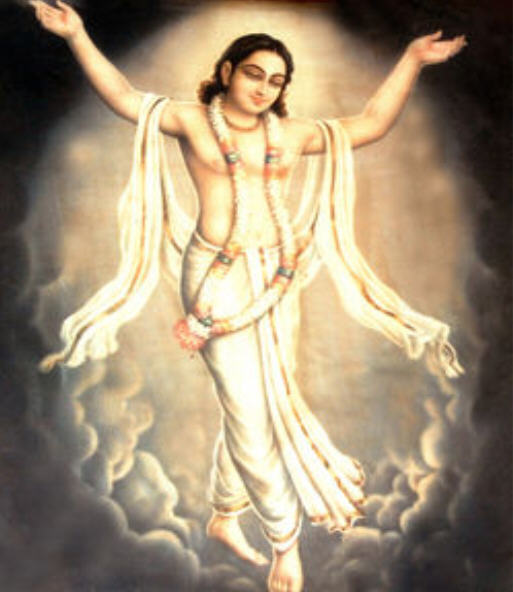
By the time Sri Chaitanya Mahaprabhu had settled into His later years at Jagannatha Puri, the three Ghosh brothers had become a regular part of the yearly Ratha-yatra festival, coming back each year to sing as the Lord's cart moved through the streets. Chaitanya-charitamrita records that Mahaprabhu organized seven separate kirtan parties for the festival. Here the text names Govinda as the leader of one of these parties, and his two brothers sang in it with him.
| Detail | Description |
|---|---|
| Govinda's kirtan party | Leader, with the younger Haridasa, Vishnudasa, and Raghava as responding singers |
| Madhava and Vasudeva | Responding singers in Govinda's party, with Vakreshvara Pandita as its dancer |
| Govinda's identity (Gaura-ganoddesha-dipika 188) | Kalavati, a gopi-singer of Vraja |
| Madhava and Vasudeva's identities | Rasollasa and Gunatunga, gopi-singers of Vraja |
Leading His Own Kirtan Party #
"The Lord formed another group, appointing Govinda Ghosha as leader," Chaitanya-charitamrita says of the Ratha-yatra arrangements. It calls him "pradhana," the chief, of a party that included the junior Haridasa, Vishnudasa, and Raghava as his singers. The very next verse says Madhava and Vasudeva also joined this same party as responding singers, with Vakreshvara Pandita as its dancer. A family gift for kirtan, once described simply as belonging to "the three brothers," was still shared by all three, but now Govinda was the named leader. It is a small detail, easy to miss in a long list of festival arrangements. But it is one of the clearest proofs in scripture that Govinda's own place among Mahaprabhu's associates was more than just "one of the Ghosh brothers."
Kalavati of Vraja #
The Gaura-ganoddesha-dipika is Kavi Karnapura's traditional guide to the Vraja identities of Mahaprabhu's associates. It gives the three brothers three separate identities instead of one shared identity. It identifies Govinda as Kalavati, Madhava as Rasollasa, and Vasudeva as Gunatunga. They are gopis in Krishna's own Vrindavana pastimes who sang the songs composed by Vishakha, one of Radha's closest friends. So this family of Bengali kayastha brothers was given three separate spiritual identities, not one. This matches the same pattern seen throughout Govinda's life. However often the three brothers appear together in the records, tradition and scripture were both careful to keep each one's own identity separate.
Where He Rests: Agradwipa #
No source gives the year of Govinda Ghosh's death or his age at the time. Instead, there is a specific and well-supported tradition, not a guess. He is said to have asked in his final days to be buried instead of cremated, near a place called Dolaprangana at Agradwipa. The Gopinatha Deity he served is said to still hold kusha grass and mark his death anniversary every year, in keeping with Krishna's own promise to him. Bhaktisiddhanta Sarasvati Thakura's own Anubhasya commentary confirms that this shraddha ceremony is still performed at Agradwipa today. For a tradition of this kind, that is about as strong a confirmation as one can normally expect.
A few short reference notes found online instead say his samadhi is in the 64 Samadhis Area near Radha-kunda in Vrindavana. The very same line, word for word, is also used for his brother Vasudeva Ghosh and for the unrelated Lochana Dasa Thakura. This suggests it is a general note used for several devotees, not a specific tradition about Govinda Ghosh himself. The tradition rooted at Agradwipa is specific and is confirmed by a yearly ritual. So it is the far more believable account of where he rests.
A Family Remembered Together and Apart #
There is no question about the lasting place the Ghosh brothers hold in Gaudiya Vaishnava memory. Srila Prabhupada himself read through the verses naming all three brothers in a 1973 lecture on Chaitanya-charitamrita's tenth and eleventh chapters. He translated them for his own students in the same words later printed in the book's purports. It is a small sign that even this brief mention of the three singers remained important in his teaching about the early history of the sankirtana movement. Govinda Ghosh's own record includes his songs of grief at Gauranga's departure, his decision to stay behind when his brothers returned to Bengal, the Gopinatha Deity he established, and the kirtan party he led at the Ratha-yatra. It shows a devotee who lived mostly in his brothers' company, yet whose life left a mark all its own. His brothers' fuller stories are told at Vasudeva Ghosh and Madhava Ghosh.
Scriptural evidence for this chapter (3)
govinda-ghosa-pradhana kaila ara sampradaya
haridasa, visnudasa, raghava, yahan gaya
Word for word
govinda-ghosa-Govinda Ghosa; pradhana kaila-made the chief; ara sampradaya-another group; haridasa, visnudasa, raghava-the younger Haridasa, Visnudasa and Raghava; yahan gaya-where they sing.
The Lord formed another group, appointing Govinda Ghosa as leader. In this group the younger Haridasa, Visnudasa and Raghava were the responding singers.
Records that the Lord made Govinda Ghosh the leader of one of the Ratha-yatra kirtan parties. The very next verse says his brothers joined this same party.
madhava, vasudeva-ghosa,-dui sahodara
nrtya karena tahan pandita-vakresvara
Word for word
madhava, vasudeva-ghosa-Madhava and Vasudeva Ghosa; dui sahodara-two brothers; nrtya karena-dances; tahan-there; pandita-vakresvara-Vakresvara Pandita.
Two brothers named Madhava Ghosa and Vasudeva Ghosa also joined this group as responsive singers. Vakresvara Pandita was the dancer.
Shows Madhava and Vasudeva joining Govinda's own Ratha-yatra party as responding singers, with Vakreshvara Pandita as its dancer. So the three brothers sang together in one party.
kalavati rasollasa gunatunga vraje sthitah
sri-vishakha-kritam gitam gayanti smadya ta matah
govinda-madhavananda-vasudeva yatha-kramam
Govinda, Madhava and Vasudeva were, in their eternal Vraja identities, three gopis named Kalavati, Rasollasa and Gunatunga, who sing the songs composed by Sri Vishakha.
The traditional source for each brother's individual spiritual identity in Krishna's Vraja pastimes; Govinda alone is identified as Kalavati.
Closing
What Remains Honestly Uncertain #
Much of what is told about Govinda Ghosh today comes from later devotional retellings, not directly from Chaitanya-charitamrita or Chaitanya-bhagavata. This includes the vivid dream of a Krishna-shila floating down the Ganga, the deaths of his wife and only son, and Krishna's own promise to perform his shraddha. That does not make these stories false. Gaudiya Vaishnava tradition has always carried such stories alongside its scripture, and the Gopinatha Deity at the center of these stories is real and still worshiped at Agradwipa today. Still, we should keep apart what Krishnadasa Kaviraja Goswami himself wrote and what temple tradition added later. We should not treat both as equally certain.
Songs in the Vaishnava Song Book #
The Vaishnava Song Book carries three songs attributed to Srila Govinda Ghosh. See the full author page here.
- Sri Chaitanya-charitamrita, Adi-lila 10.115, 10.117-118
- Sri Chaitanya-charitamrita, Madhya-lila 11.88, 13.42-43
- Gaudiya History (ISKCON Desire Tree): Sri Govinda Ghosh (short biography)
- Gaudiya History (ISKCON Desire Tree): Govinda Ghosh Biography (full)
- Gaudiya History (ISKCON Desire Tree): Sri Vasudeva Ghosh
- Srila Prabhupada, lecture on Sri Chaitanya-charitamrita, Adi-lila 10th-11th chapters, Los Angeles, December 17, 1973
- This site's Vaishnava Song Book: songs credited to Govinda Ghosha
