When Sri Chaitanya Mahaprabhu sent Nityananda Prabhu back to Bengal to preach, Chaitanya-charitamrita names three devotees who went with Him: Ramadasa, Madhava, and Vasudeva Ghosh. Govinda did not go. "Govinda Ghosha, however, remained with Sri Chaitanya Mahaprabhu at Jagannatha Puri and thus felt great satisfaction," writes Krishnadasa Kaviraja Goswami. It is a short, plain sentence, but it is the clearest scriptural evidence that Govinda's own path, for at least part of his life, stayed close to the Lord's in a way his brothers' did not.
| Detail | Description |
|---|---|
| Textual anchor | Sri Chaitanya-charitamrita, Adi-lila 10.117-118 |
| Brothers who returned to Bengal | Madhava and Vasudeva, with Ramadasa, under Nityananda Prabhu |
| Deity established | Sri Gopinatha, Agradwipa |
| Traditional occasion | Govinda directed to stay behind and install the Deity |
A Habit Corrected, and a Command to Stay #
Achyutacharana Chaudhuri, in Shrihattera Itivrtta, records a traditional story about this. Govinda was traveling with Mahaprabhu's party, and one day, after a meal, he quickly fetched a haritaki fruit for the Lord. Mahaprabhu noticed that Govinda had actually kept a small stock of the fruit, instead of gathering it fresh each time. He gently corrected the habit. Then He told Govinda that since he had not learned to stop saving things for later, he should stay behind and take charge of installing a Deity. Whatever the exact words were, the outcome matches what we know from scripture. Govinda did stay behind instead of returning with his brothers, and he did go on to install a Deity that is still worshiped today. (Accounts differ on where he stayed behind instead of going on to Vrindavana: some say in Bengal, others say near Puri.)
One important point must be made clear here. Chaitanya-charitamrita also mentions a different "Govinda," a personal servant of Sri Chaitanya Mahaprabhu who had earlier been a disciple of Ishvara Puri. The Gaura-ganoddesha-dipika identifies this other Govinda as Bhangura, one of Krishna's own attendants in Vraja. This Govinda traveled with the Lord all the time. Elsewhere, the purports of Chaitanya-charitamrita say that he had the very same habit of storing up haritaki, and that Mahaprabhu corrected him in almost the same words. Some popular retellings mix these two men up as if they were one person. They are not the same person. The personal servant Govinda is identified as Bhangura. Govinda Ghosh is identified separately as Kalavati. Their roles in the Lord's life were also completely different. One was an attendant who traveled with the Lord all the time. The other was a householder singer from Agradwipa who came to Puri mainly for the yearly festival. This page follows what is said specifically about Govinda Ghosh, not the details recorded under the other Govinda's name.
A Stone From the Ganga #
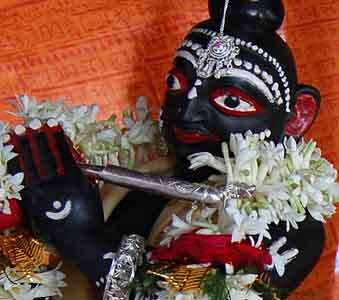
Tradition tells that, not long after being told to stay behind, Govinda was bathing in the Ganga when something struck his back. It felt like a piece of wood, though it was unusually heavy. That night, he is said to have had a dream telling him to keep it safe and give it to Mahaprabhu when the Lord arrived. When Govinda went back for it, he found it was actually a krishna-shila, a sacred stone. The next morning, tradition says, Mahaprabhu came to his house and told him a sculptor would arrive the following day to carve a Deity from the stone. That Deity became Sri Gopinatha, installed at Agradwipa on the Ganga near Katwa. (The river has changed its course over the centuries, so Agradwipa has stood at times on its east bank and at times on its west bank.) This part of the story does match what Chaitanya-charitamrita's own purport briefly states: "Govinda established the Gopinatha temple in Agradvipa, where he resided." The vivid details of the dream and the stone itself come from later biographies, not from Krishnadasa Kaviraja Goswami's own text, and are told here as temple tradition, not as scripture.
Marriage, Loss, and a Promise #
The same tradition goes on to tell of a hard chapter for his family. Govinda married, on the Lord's own later instruction, and served the Gopinatha Deity together with his wife. A son was born, but the wife and the son both died. The loss was so heavy that Govinda is said to have stopped his daily service to the Deity out of grief. Krishna Himself, tradition says, appeared to him in a dream and asked whether a father who has lost one son should let his remaining "son," the Deity he had served as family, go hungry too. Govinda's answer was practical, not sentimental. He said he had hoped a living son would perform his shraddha, the rites owed to the dead, and asked what he would gain by continuing to serve. Krishna is said to have promised to perform that shraddha Himself, forever. The Gopinatha temple at Agradwipa still marks this promise today: the Deity is said to hold kusha grass in His fingers during the yearly rite. This story is moving, but it survives only in temple and biographical tradition, not in Chaitanya-charitamrita or Chaitanya-bhagavata, and should be read that way.
Legacy and Disappearance tells about Govinda's later life, once he began returning each year to Puri for the Ratha-yatra festival. It also shows how, at that festival, he led a kirtan party of his own, with his brothers singing in it.
