Jagannatha Dasa Babaji did not write books or found an institution. What he left behind was a circle of disciples. Through them, he left an unbroken, living connection to everything that followed in modern Gaudiya Vaishnavism.
His Disciples #
Vaishnava biographical sources preserve a list of his principal disciples: Biharidasa Babaji, Bhagavata Dasa Babaji, Gaurahari Dasa Babaji, Ramahari Dasa Babaji, Ramadasa Babaji, Nityananda Dasa Babaji (a resident of Varshana), and Harekrishna Dasa Babaji, a resident of Kadamkhandi. Of these, one name matters more than all the others for the line that produced this tradition. It is Bhagavata Dasa Babaji, whom Jagannatha Dasa Babaji initiated into the babaji order. According to most sources (though not every source agrees), Bhagavata Dasa Babaji in turn gave the same babaji-vesa to Srila Gaura Kishora Dasa Babaji. If this account is correct, Jagannatha Dasa Babaji is the guru's guru, the paramaguru, of the man who would formally initiate Srila Bhaktisiddhanta Sarasvati Thakura. So he is a direct link in the chain that the guru-parampara page traces from Chaitanya Mahaprabhu down to Srila Prabhupada.
An Extraordinary Age #
Vaishnava tradition holds that Jagannatha Dasa Babaji lived to an extraordinary age, though the sources do not agree on the exact figure. One account says that at close to 135 years of age he was still preaching. Though he was almost paralysed by weakness, he still raised his arms in ecstasy during kirtana. Another account gives his age at disappearance as 147. It says this was after he had spent 32 years at the site in Nabadwip where his bhajan kutir and samadhi still stand. Another devotional account gives a third figure, close to the higher of these. It places him at 146 years old on his final journey from Radhakunda to Nabadwip. On that occasion, many Vrajavasis and other Vaishnavas asked him why he was leaving Vraja-dhama at such an age, and he answered them with great humility:
"You can all stay here in Vraja-dhama, because you are all pure Vaishnavas. I am very offensive, and therefore it is better for me to stay at Nabadwip. Sri Sri Gaura-Nitai do not count one's offenses, for They have appeared to liberate all offenders. But here in Vraja-dhama, offenses are counted and their reactions strictly enforced."
The available sources report 135, 146 and 147 years. None of them settles the difference, so it is not settled here either. What the tradition always stresses is not an exact number of years. It is the plain fact that his life was unusually long, and that he kept up his devotional practice without a break to the very end. The people of his own time saw this long life itself as a sign of his spiritual greatness. This was his last journey to Nabadwip-dhama. A few months after he arrived, he entered the Lord's eternal pastimes. It was the first day of the new moon in the month of Phalguna, a fortnight before the anniversary of Lord Chaitanya's own appearance. The year is given only as sometime after 1897, and no exact date survives. To the very end he paid a thousand obeisances daily to his worshipable Deity of Sri Giridhari.
| Detail | Description |
|---|---|
| Birth | Sources disagree: c. 1750 or c. 1800, in the Tangail subdivision of Mayamanasimha district, Bengal |
| Guru lineage | Baladeva Vidyabhushana → Uddhava Dasa Babaji → Madhusudana Dasa Babaji → Jagannatha Dasa Babaji |
| Title | Vaishnava Sarvabhauma ("emperor among the Vaishnavas") |
| Principal disciple in this line | Bhagavata Dasa Babaji, said by most sources to be the guru of Gaura Kishora Dasa Babaji |
| Key pastime | Confirmed the site of Sri Chaitanya Mahaprabhu's birth at Mayapur, 1893 |
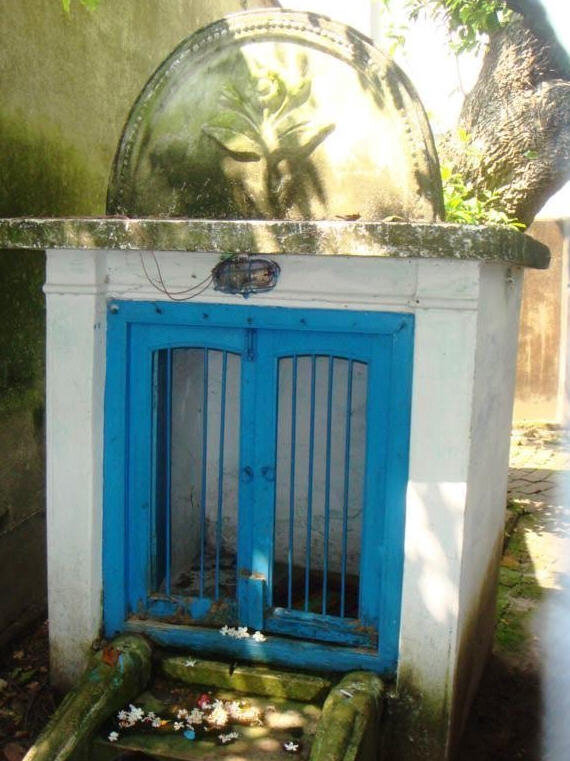
| Final years | Nabadwip, on the bank of the Ganges; samadhi shrine still stands |
| Disappearance | Sometime after 1897, on the new moon of Phalguna, a fortnight before Gaura Purnima; reported age at disappearance ranges from 135 to 147 across sources |
Legacy #
This much can be said with confidence. He was a wandering renunciant who lived on alms. He wrote nothing, built nothing and did not look for followers. Yet in his own lifetime the most learned Vaishnava of the age recognised him as the topmost general among Gaudiya Vaishnavas. Bhaktivinoda Thakura himself is remembered as always calling him by this same title, Vaishnava Sarvabhauma. Jagannatha Dasa Babaji was carried in a basket to a forgotten, tulasi-covered mound on the bank of the Ganges. By being present there in person, he turned a scholar's argument from books into a place people could actually visit. Every pilgrim who has since stood at Yogapitha in Mayapur, and every disciple in the line running from Srila Prabhupada back through Srila Bhaktisiddhanta Sarasvati Thakura, owes something to that single act of confirmation.
