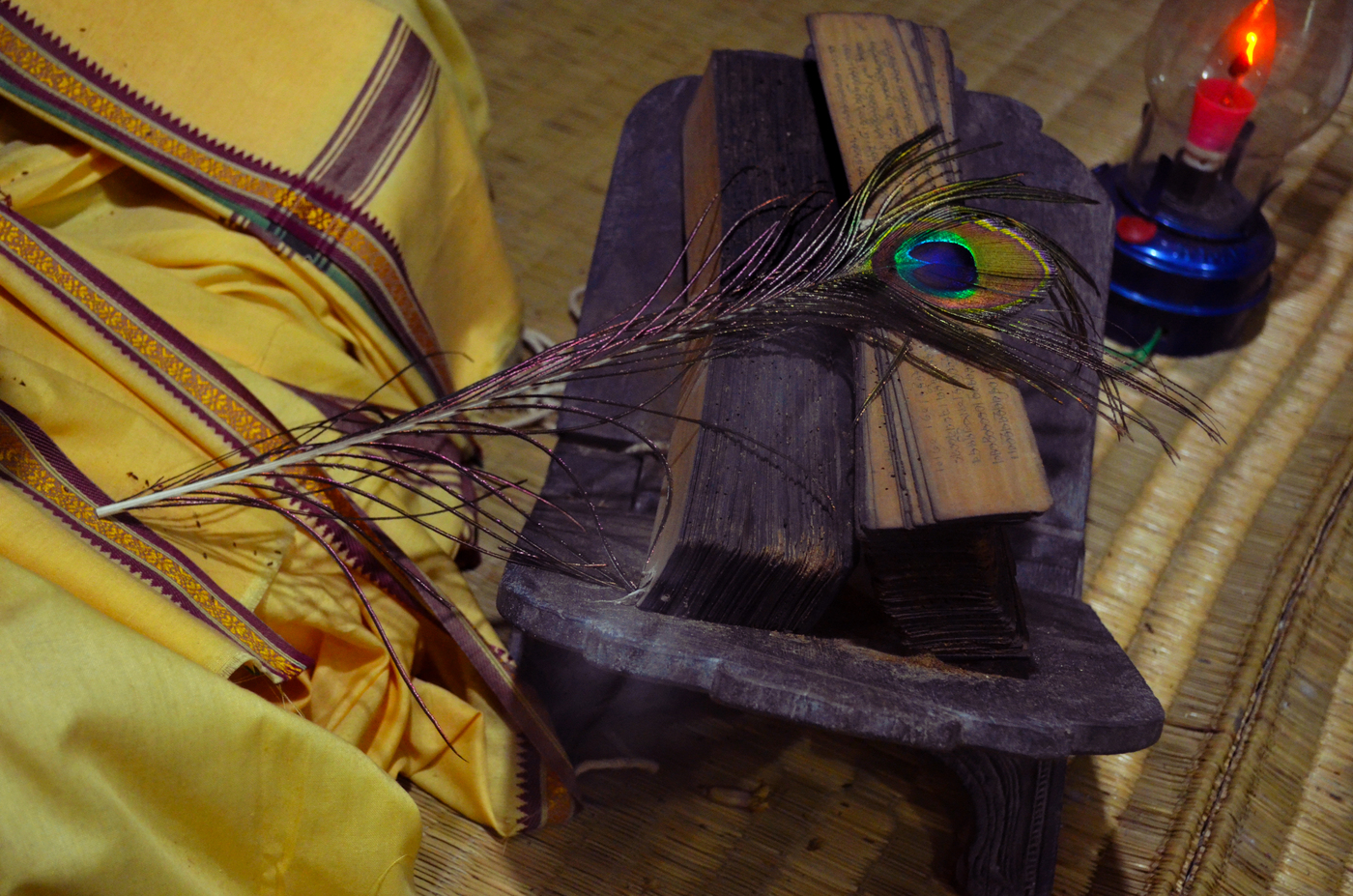
Jayadeva is famous for one book, the Gita Govinda. It is made up of twelve short cantos of Sanskrit verse. It took a story that was already ancient, Krishna's love for the gopis of Vrindavana, and gave it a form that nobody had quite given it before.
| Detail | Description |
|---|---|
| Language | Sanskrit |
| Structure | 12 cantos (sarga), divided into 24 songs (prabandha) |
| Verse form | Ashtapadis, songs of eight couplets each, set to a named raga and tala |
| Subject | Krishna's loving pastimes with the gopis, His separation from Radha, and Their reunion |
| Earliest known commentary | Bhavavibhavini-tika, by Udayanacharya, Odisha, c. 1190 |
| Ritual use | Sung nightly before the Deities at the Jagannatha temple, Puri, since Jayadeva's own era |
Where the Writing Happened #
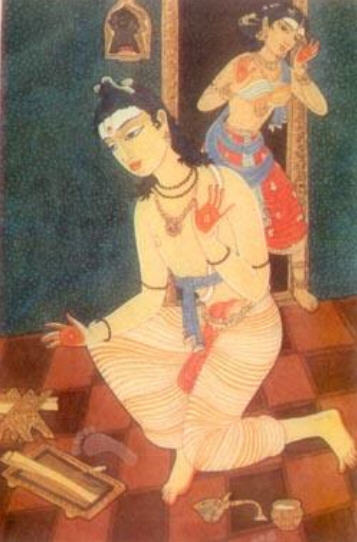
Gaudiya Vaishnava tradition places the poem's composition at Champahati, the small cottage near Nabadwip that Lakshmana Sena built for Jayadeva after he turned down life at the royal palace. There, with Padmavati beside him, tradition says Jayadeva began writing the verses that would become the Gita Govinda. Odisha's tradition places the writing much further south instead, at Jagannatha Puri itself. This fits its claim that Jayadeva's whole life, not just his final years, was spent in that region. The two traditions cannot be fully brought into agreement. But both agree that Jayadeva finished the poem before his life ended, wherever it was written. Both also agree that its home ever since has been the Jagannatha temple. The Odisha State Museum's collection of some two hundred surviving manuscripts shows how deeply the text took root there.
Twelve Cantos of Love and Separation #
The poem's twelve cantos read almost like stage directions for Krishna's changing moods. In the earliest cantos Krishna is full of joy. Partway through, He is separated from Radha and asks Her forgiveness. Then He is bold, and by the poem's end He is joyful and reunited. Within each canto, the ashtapadis carry the main feeling. These are songs of eight couplets each, each set to its own raga and tala. They were composed to be sung and danced, not read in silence. This is part of what makes the Gita Govinda unusual even among great Sanskrit poems. Jayadeva was writing directions for performance as much as literature. Odisha's Jagannatha temple has followed those directions for about eight centuries, through its mahari dancers and Odissi musicians.
Before the twelve cantos even begin, the poem opens with a short set of prayer verses in Krishna's praise. These verses stand apart from the main story. Among them is a Vishnu-stuti verse whose refrain, jaya jayadeva hare, plays on the poet's own name. This temple's own song collection still preserves that verse today, under the title Srita Kamala, alongside two other compositions credited to Jayadeva.
Beneath its beautiful poetry, the poem is really about separation, viraha. Radha's deep pain when Krishna wanders among the other gopis, and the ache that stays even after He returns to Her, fill most of the twelve cantos before any reunion comes. Sri Chaitanya-charitamrita compares this mood directly to the gopis' longing for Krishna just before the rasa dance, as described in Srimad-Bhagavatam. That same ache lies at the heart of Krishna-bhakti itself. Jayadeva's special gift was to give that ache a complete musical and dramatic form of its own. He did this three centuries before Sri Chaitanya Mahaprabhu would make separation in love the emotional center of His own life and teaching.
To Vrindavana and Back #
One further episode, less often told, follows Jayadeva after the poem was written. According to the Bengal-Gaudiya tradition, he later carried his worshipable Deities of Radha and Madhava all the way to Vrindavana and settled near Keshi Ghat. Tradition says that the residents of the dhama were enchanted when they heard him sing his own Gita Govinda in his sweet voice, and that a merchant built a temple there for his Deities. After Vrindavana, the accounts differ again. Some say Jayadeva returned to Kendubilva for his final years. Others say he went on to Jagannatha Puri. There he is remembered for starting the daily recitation of the Gita Govinda before the Deities, a practice still unbroken today. But the episode Gaudiya Vaishnavas remember best of all belongs to the time when he was still writing the poem: the night Krishna Himself is said to have finished a line of the poem in Jayadeva's own hand.
