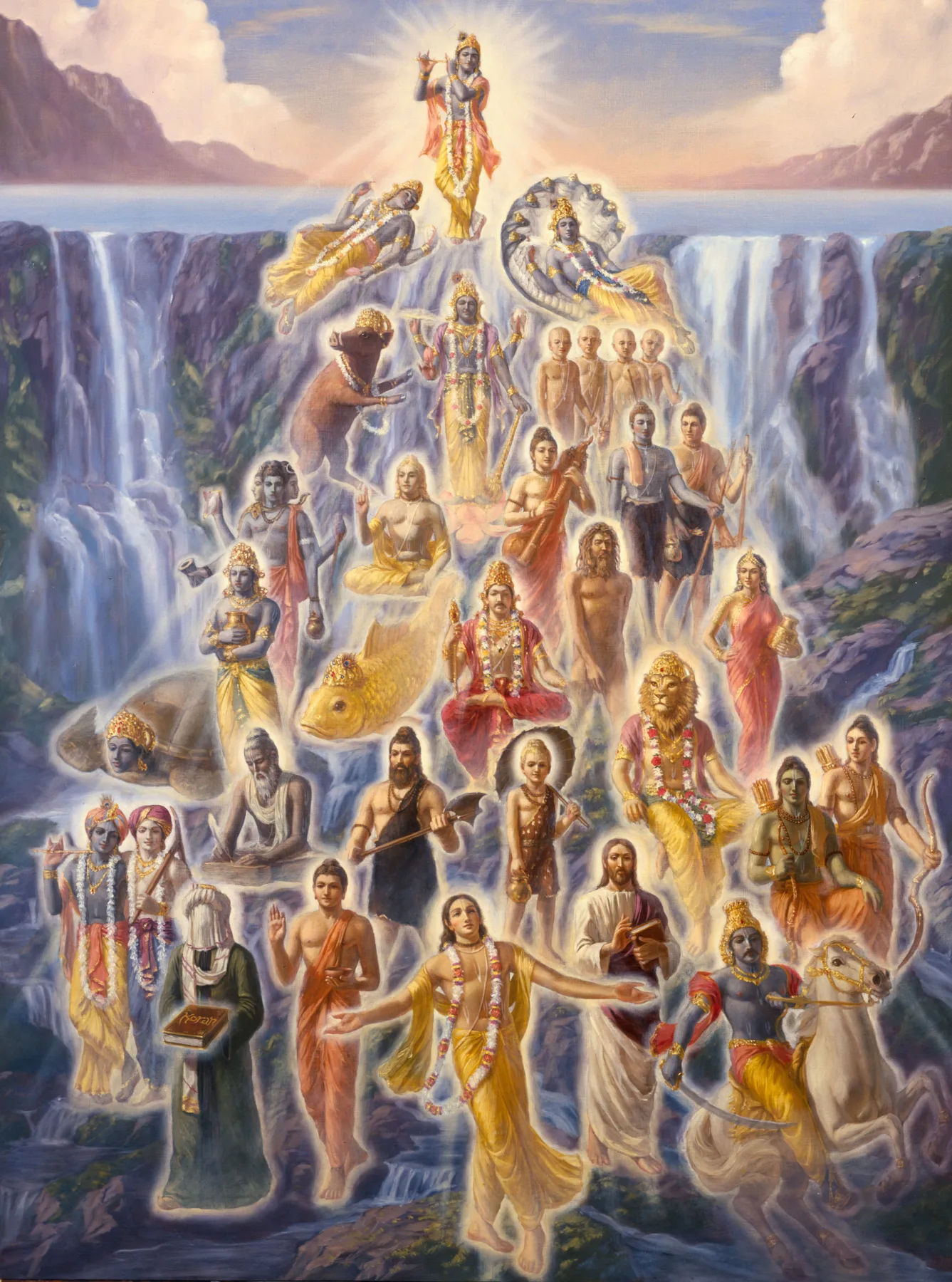
A reader who already knows Brahma-samhita's testimony or Srimad-Bhagavatam's direct statement might reasonably ask a question. Gaudiya Vaishnavism puts Krishna at the center. Does this mean that it rejects the worship of Vishnu and Narayana as practiced throughout the rest of the Vaishnava tradition? It does not. Gaudiya theology has always explained exactly why not, clearly and without avoiding the question. The technical term at the heart of this explanation is vishnu-tattva: the category of Godhead's own direct, personal expansions. This is different from jiva-tattva, the category to which every individual soul belongs, however elevated that soul may be.
Krishna Himself, and His Expansions as Avataras #
Brahma-samhita states the relationship in a single verse. In short, the verse says "His subjective portions as the avataras, viz., Rama, etc., appear from Vaikuntha and His own form Krishna manifests Himself with Vraja in this world, from Goloka," and its full translation reads, "I worship Govinda, the primeval Lord, who manifested Himself personally as Krishna and the different avataras in the world in the forms of Rama, Nrisimha, Vamana, etc., as His subjective portions" (Brahma-samhita 5.39). The distinction is exact. Rama, Nrisimha, Vamana and the other incarnations are described as kala-niyamena, appearing "by the rule of a portion." They are real and fully divine, and they are worthy of full worship. Yet they are portions, not the source itself. The same verse names that source as Krishna, appearing personally, svayam.
| Detail | Description |
|---|---|
| Vishnu-tattva | Godhead's own direct, personal expansions: Vishnu, Narayana, Rama, Nrisimha, and so on |
| Jiva-tattva | The category every individual soul belongs to, including Brahma and Shiva |
| Relationship to Krishna | Vishnu-tattva forms are Krishna's own expansions, equal in divinity, distinct in manifestation |
| Governing analogy (Brahma-samhita 5.46) | One candle's flame lit from another: identical in quality, distinct in location |
| Maha-Vishnu (Brahma-samhita 5.47-48) | The source of unlimited material universes, Himself described as a "portion of a portion" of Govinda |
The Candle and the Causal Ocean #
Brahma-samhita gives its own main example to show how this works without contradiction. "The light of one candle being communicated to other candles, although it burns separately in them, is the same in its quality. I adore the primeval Lord Govinda who exhibits Himself equally in the same mobile manner in His various manifestations" (Brahma-samhita 5.46). Nothing is lost or reduced in the candle that lights another. The second candle's flame is in no way less truly fire. By this account, Vishnu-tattva expansion works the same way. Full divinity is passed on to each expansion without being divided or lost.
The text then applies this same principle on the scale of the whole cosmos. Maha-Vishnu is the form of Godhead who lies in the Causal Ocean, and entire universes come out from Him as He breathes out. Brahma-samhita describes Him very exactly: "I adore the primeval Lord Govinda who assuming His own great subjective form... reposing in the Causal Ocean with the infinity of the world in the pores of His hair, enjoys creative sleep" (Brahma-samhita 5.47). The verses that follow continue: "Brahma and other lords of the mundane worlds, appearing from the pores of hair of Maha-Vishnu, remain alive as long as the duration of one exhalation of the latter. I adore the primeval Lord Govinda of whose subjective personality Maha-Vishnu is the portion of portion" (Brahma-samhita 5.48). Maha-Vishnu is the very form of Godhead who produces unlimited material universes, each with its own Brahma. Yet here He is clearly named a kala-visesha, a specific portion of a portion, of Govinda. This is a very great claim. Entire universes live and die within the span of Maha-Vishnu's breathing. Yet, by Brahma-samhita's own account, even He is still not the source itself.
Brahma's Own Confession Fits the Same Pattern #
This same doctrine explains a verse already examined on The Bhagavatam's Direct Statement: Brahma's confession to Krishna after the Brahma-vimohana-lila. "Lord Narayana is Your expansion, and He is called Narayana because He is the generating source of the primeval water of the universe. He is real, not a product of Your illusory Maya" (Srimad-Bhagavatam 10.14.14). The phrase "not a product of Your illusory Maya" matters as much as the naming of Narayana as Krishna's expansion. Gaudiya theology clearly teaches that vishnu-tattva expansions are not like the false images that material illusion produces. They are not projections, mere appearances or lesser reflections. They are fully real, fully divine persons. They are simply not the original source.
Not a Rejection of Vishnu Worship #
Because of this doctrine, Gaudiya theology does not regard the worship of Vishnu or Narayana, as practiced throughout the wider Vaishnava world, as mistaken or lower in kind. Srila Madhvacharya built an entire tradition centered on Vishnu worship, and it is still thriving today at Udupi. This tradition traces its guru-parampara through his line and does not treat that as a contradiction. Madhvacharya's own page examines this relationship in detail. Gaudiya theology takes nothing away. What it adds is a claim about origin. This claim concerns Krishna, specifically in His two-armed form in Vrindavana. Among the vishnu-tattva forms, He is not just one equal expansion among many. He is the source from which the entire category comes. Every verse examined here describes expansion, never reduction or contradiction. That is how Gaudiya Vaishnavism has always insisted the relationship must be understood.
Why This Doctrine Had to Be Explained, Not Assumed #
Suppose a Krishna-centered theology could not explain Vishnu and Narayana this exactly. Then it would leave a real gap. Either it would imply that most of Vaishnava history worshiped the wrong form of God, or it would contradict its own scriptural sources. Several of those sources, including Srimad-Bhagavatam itself, give enormous attention to Vishnu and Narayana Themselves. The doctrine of vishnu-tattva closes that gap without giving up either truth. Krishna's supremacy stands, and the full divinity of Vishnu and Narayana stands with it. They are related as source and expansion, not as rivals. The same pattern of expansion without loss appears again, in a very different setting, on Sri Chaitanya Mahaprabhu: Krishna Himself. There, Krishna's own personal associates are understood to come with Him whenever He appears, right alongside His plenary forms.
