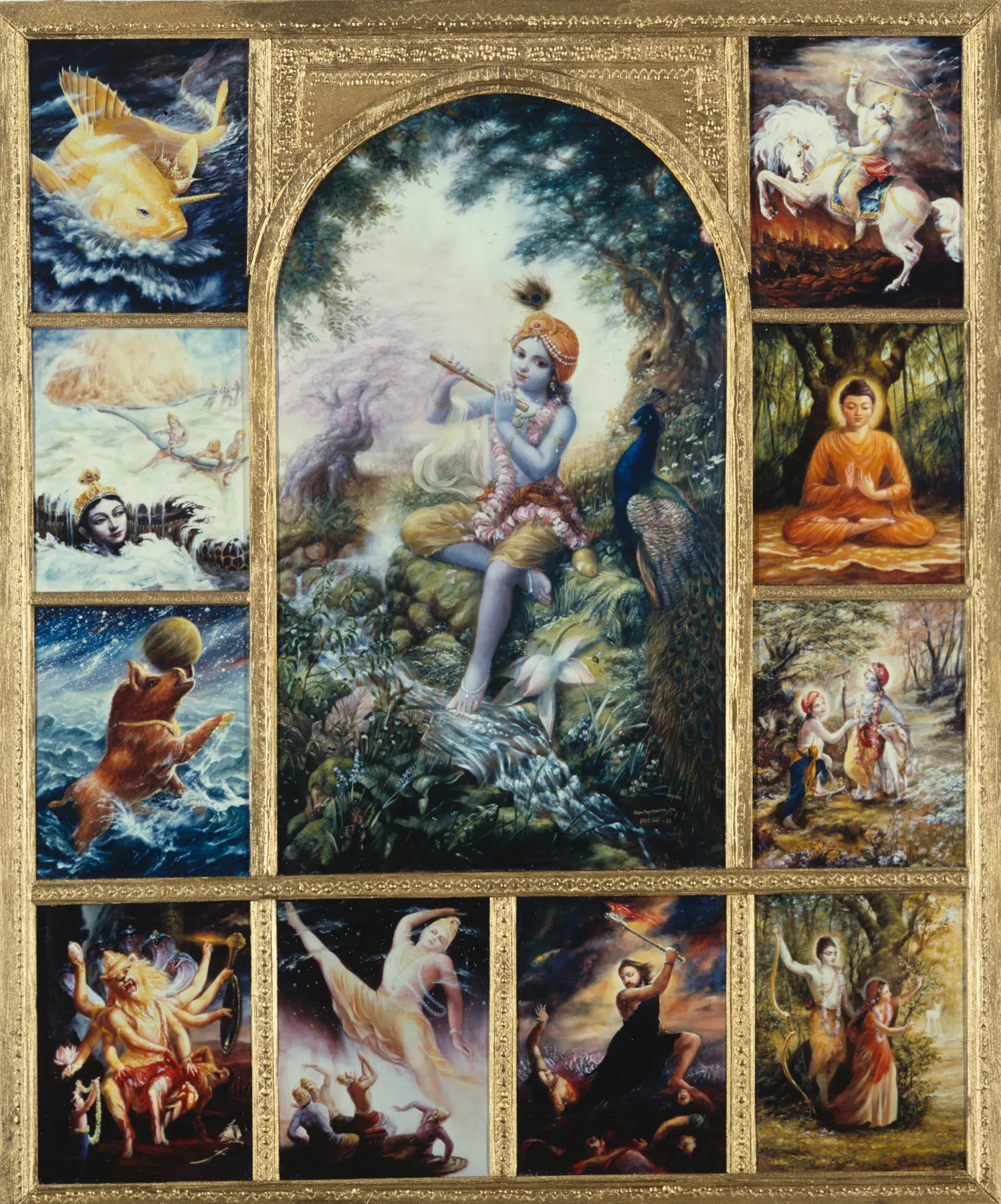
Srimad-Bhagavatam's Third Chapter of the First Canto sets out to answer a question that every serious student of Vedic literature asks sooner or later. How many incarnations of Godhead are there, and how are they related to one another? The chapter answers by listing them. Suta Gosvami names incarnation after incarnation across some twenty-five verses, from the four Kumaras and Varaha to Rama, Vyasadeva and Buddha. The list leads up to one final statement. Ever since, Gaudiya Vaishnavism has treated that statement as the most direct verdict in scripture on Krishna's supreme identity.
The List and Its Conclusion #
The chapter opens by describing how, at the beginning of creation, "the Lord first expanded Himself in the universal form of the purusha incarnation and manifested all the ingredients for the material creation" (Srimad-Bhagavatam 1.3.1). So from its very first verse, the chapter makes clear that the list which follows is a list of the one Godhead's own expansions. It is not a list of separate, competing deities. After naming every incarnation in turn, the chapter reaches its verdict: "All of the above-mentioned incarnations are either plenary portions or portions of the plenary portions of the Lord, but Lord Krishna is the original Personality of Godhead. All of them appear on planets whenever there is a disturbance created by the atheists. The Lord incarnates to protect the theists" (Srimad-Bhagavatam 1.3.28).
| Detail | Description |
|---|---|
| Reference | Srimad-Bhagavatam 1.3.28 |
| Context | The concluding verse of a chapter listing the incarnations of Godhead |
| Central claim | Every incarnation named is a plenary portion or a portion of a portion, except Krishna, who is bhagavan svayam, the Personality of Godhead in person |
| Later systematized by | Jiva Goswami's Krishna-sandarbha, the fourth of the Six Sandarbhas |
The distinction the verse makes is exact. It is not just poetry. Many names come before Krishna on the list. They include forms as great as Rama, and the purusha incarnations who create the material universes and are present throughout them. Every one of these is described with two specific Sanskrit categories: amsha, a plenary portion, and kala, a portion of a portion. Only Krishna is given a completely different, third term, svayam, "personally" or "in person," and He is not a portion of anything. He is the source from which the portions come. Srila Prabhupada's purport gives a simple example to explain this relationship. The example does not make the other incarnations less important. It explains the difference in how much power each one shows: "When in the room small electric bulbs are displayed, it does not mean that the electric powerhouse is limited by the small bulbs. The same powerhouse can supply power to operate large-scale industrial dynamos with greater volts. Similarly, the incarnations of the Lord display limited powers because so much power is needed at that particular time." Vishnu and Narayana are not incarnations in the ordinary sense. They are Krishna's own plenary vishnu-tattva expansions. The page The Vishnu-tattva Expansions explains in full how this same relationship applies to them.
Brahma's Own Confession #
This is not the only place in Srimad-Bhagavatam where the same conclusion appears. Lord Brahma's own page already tells the story of the Brahma-vimohana-lila. Brahma stole away Krishna's cowherd friends and calves to test whether the boy before him was truly God. Krishna answered so completely that Brahma fell at His feet in prayer. Among those prayers, recorded in the Bhagavatam's Tenth Canto, Brahma does more than praise Krishna. He openly confesses who Krishna is: "Are You not the original Narayana, O supreme controller, since You are the Soul of every embodied being and the eternal witness of all created realms? Indeed, Lord Narayana is Your expansion, and He is called Narayana because He is the generating source of the primeval water of the universe. He is real, not a product of Your illusory Maya" (Srimad-Bhagavatam 10.14.14). This verse has a special weight. It comes from Brahma, whom the parampara honors as adi-guru. And he spoke it at the very moment of his own defeat, after he had directly tested Krishna's divinity. It is not a philosopher's argument. It is a confession, drawn out of the one witness in the universe most qualified to make it.
A Verse Prabhupada Returned To Often #
Srila Prabhupada quoted Srimad-Bhagavatam 1.3.28 again and again, across decades of lectures. In one 1969 talk in Los Angeles, he starts from the meaning of Krishna's own name and builds the point from there: "Krishna is all-attractive. That is the perfect name of God, 'Krishna.'... So krishnas tu bhagavan svayam [SB 1.3.28]. According to Vedic literature, Krishna is the Supreme Personality of Godhead, svayam. Svayam means original. Krishna has many extension, incarnation. We are also Krishna's extension. We are, all living entities, we are also Krishna's extension. We are called vibhinnamsha, separated extension." The difference he explains there, between the vishnu-tattva expansions and the vibhinnamsha status of ordinary souls, is taken up directly on The Vishnu-tattva Expansions.
Why the Bhagavatam's Wording Matters #
Gaudiya Vaishnavism's whole case depends on pointing to exact words of scripture that anyone can check. It does not rest on an idea simply handed down. SB 1.3.28 is the clearest example of this kind of evidence. Here the scripture first takes the trouble to list incarnation after incarnation, using the same technical terms throughout. Then it clearly marks one name on that list as different in kind from every other. Srila Jiva Goswami took this single verse, among others, and built a whole book of formal argument on it. That work is examined in full on The Six Goswamis and Krishna-sandarbha.
