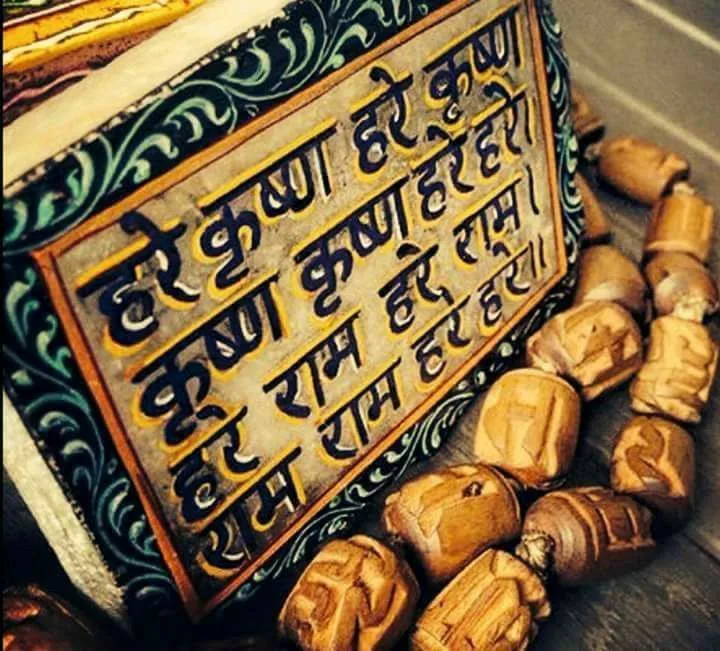
Each of the other proofs gathered on these pages shows, from a different angle, that Krishna is bhagavan svayam, the Supreme Personality of Godhead Himself. He is not a portion or a symbol of God. He is God in person. A question follows naturally from this. Krishna appeared in His own body at particular times and in particular places, in Vrindavana and Dvaraka, many centuries ago. So how can a soul living now, in the Age of Kali, come close to Him, when there is no real hope of meeting Him in person? Gaudiya Vaishnavism's answer is not a compromise or a weaker second choice. Krishna's name is not different from Krishna. The name itself is His incarnation for exactly this age.
Name and Named Are Not Different #
Sri Chaitanya Mahaprabhu states the doctrine directly, in a verse He Himself quotes at Varanasi, while speaking to a Maharashtrian brahmana: "The holy name of Krishna is transcendentally blissful. It bestows all spiritual benedictions, for it is Krishna Himself, the reservoir of all pleasure... This is because the name of Krishna and Krishna Himself are identical" (quoted in Sri Chaitanya-charitamrita, Madhya-lila 17.133). Srila Prabhupada's purport to this verse names the Padma Purana as its source. We must say clearly what can be checked here and what cannot. We could not find this exact verse in any surviving edition of the Padma Purana that was available to compare. Some outside researchers have also questioned where exactly the verse comes from. But two things are fully confirmed, and they matter most for this tradition's own practice. First, Sri Chaitanya Mahaprabhu quoted the verse as authoritative, in exactly this place in Chaitanya-charitamrita. Second, ever since then, Gaudiya Vaishnavism has accepted it as scriptural teaching on nama-nami-abheda, the nondifference of the name and its owner.
| Detail | Description |
|---|---|
| Doctrine | Nama-nami-abheda: the holy name of Krishna is nondifferent from Krishna Himself |
| Key statement | CC Madhya 17.133: "the name of Krishna and Krishna Himself are identical" (traditionally attributed to Padma Purana; exact source unverified) |
| Foundational verse | Siksastaka 1 (CC Antya 20.12): Sri Chaitanya Mahaprabhu's own words on sankirtana |
| Kali-yuga's one virtue | SB 12.3.51: liberation through chanting alone |
| No other means | CC Adi 17.21: "there is no other means, no other means, no other means" |
This teaching does not rest on one disputed verse alone. Srimad-Bhagavatam as Krishna's Own Literary Incarnation already looks at Srila Prabhupada's purport to SB 1.2.17. There the same principle is stated about Krishna's spoken messages in general: "Lord Krishna is present there in the form of transcendental sound." In the same purport, Srila Prabhupada at once quotes Sri Chaitanya Mahaprabhu's Siksastaka to show that the same is true of Krishna's holy name, which "has all the potencies of the Lord." So two separate verses, seen from two different sides, lead to the same teaching. Krishna is fully present in sound, whether that sound is the Bhagavatam's account of His pastimes or simply His name.
How Krishna Appears in This Age #
Sri Chaitanya Mahaprabhu: Krishna Himself already looks at Srimad-Bhagavatam 11.5.32 to show who Mahaprabhu is. It reads the verse as a prophecy that names His golden complexion and His constant companions. Here we return to the same verse for another reason, to see what it says about the age itself, not about the person. The verse links Krishna's own presence in Kali-yuga to one particular practice, and the two cannot be separated: "In the Age of Kali, intelligent persons perform congregational chanting to worship the incarnation of Godhead who constantly sings the names of Krishna... He is Krishna Himself" (Srimad-Bhagavatam 11.5.32). Other parts of scripture say that each earlier age in the Vedic account of time had its own recommended way to approach Krishna. It was meditation in Satya-yuga, elaborate sacrifice in Treta-yuga and opulent temple worship in Dvapara-yuga. This verse names the process for Kali-yuga just as clearly. It is sankirtana, congregational chanting. This worship needs no special renunciation, no fire altar and no wealth. It needs only the willingness to chant and hear.
Chaitanya Mahaprabhu's Own Foundational Statement #
The Siksastaka already tells how these eight verses are the entire written legacy Sri Chaitanya Mahaprabhu left in His own hand. The first of them is not about Himself at all. It is a declaration of victory for congregational chanting itself: "Let there be all victory for the chanting of the holy name of Lord Krishna, which can cleanse the mirror of the heart and stop the miseries of the blazing fire of material existence. That chanting is the waxing moon that spreads the white lotus of good fortune for all living entities. It is the life and soul of all education... it gives a cooling effect to everyone and enables one to taste full nectar at every step" (Sri Chaitanya-charitamrita, Antya-lila 20.12). The founder of this movement chose to begin His only written work in this way. He did not begin with an argument about who He was. He began with praise for the practice He came to give. This tradition sees that choice as a sign of what mattered most to Him.
Why Congregational Chanting, Specifically #
Wherever else Srimad-Bhagavatam describes Kali-yuga, it calls this age an ocean of faults, quarrel and hypocrisy. But it makes one exception: "My dear King, although Kali-yuga is an ocean of faults, there is still one good quality about this age: Simply by chanting the Hare Krishna maha-mantra, one can become free from material bondage and be promoted to the transcendental kingdom" (Srimad-Bhagavatam 12.3.51). While instructing His followers, Sri Chaitanya Mahaprabhu Himself quoted a verse that makes the same point even more strongly: "In this Age of Kali there is no other means, no other means, no other means for self-realization than chanting the holy name, chanting the holy name, chanting the holy name of Lord Hari" (quoted in Sri Chaitanya-charitamrita, Adi-lila 17.21). The threefold repetition in the original is not just for style. Gaudiya commentators read the triple emphasis as ruling out meditation, sacrifice and temple worship, one by one, as the main process for this age. In their place stands the one process that the conditions of this age cannot block.
The name carries Krishna's full potency. It does not merely point toward Him. That is why chanting it does not need the long preparation and qualification that other spiritual processes have demanded in the past. This follows directly from nama-nami-abheda and is not a separate claim. Sankirtana is also congregational by its very nature. It is public and shared, not private and solitary. That is why it offers something the processes of earlier ages could not: an invitation open to everyone who can hear it, whatever their birth, training or situation. Sri Chaitanya Mahaprabhu's own inauguration of this practice, at Srivasa Angan and then in the streets of Nabadwip, put exactly this teaching into action in history. Srila Prabhupada's own mission carried the same congregational chanting to every part of the world that Mahaprabhu's own associates could not reach. It is the tradition's most direct link to what Mahaprabhu began.
The Same Claim, Restated #
Nothing on this page adds a teaching that is unrelated to the rest of the case for who Krishna is. The root of that case is that Krishna is the origin of the guru-parampara and has no guru of His own. This is stated directly on The Source of This Parampara. This account makes the same claim and carries it one step further. Krishna's own words in the Bhagavad-gita, Srimad-Bhagavatam's direct statement and the Six Goswamis' systematic case all establish that Krishna is bhagavan svayam. He is not a portion of Godhead but its source. This account gives the practical conclusion that this tradition has always drawn from that claim. Krishna is truly the Supreme Personality of Godhead, and His name is truly nondifferent from Him. So He has not left the conditioned souls of this age without a direct way to reach Him. He has simply made Himself as near as His own name, chanted with an open heart.
Songs in the Vaishnava Song Book #
The Vaishnava Song Book carries several songs that put these same teachings directly into devotional verse. Ceto Darpana Marjanam is Chaitanya Mahaprabhu's own Siksastaka verse 1, quoted above. Nama Tattva sets to song Srimad-Bhagavatam 12.3.51. This is the verse cited earlier to show why chanting is the recommended process of this age. Jaya Jaya Hari Nama Cid Anandamrta Dhama states plainly that the Holy Name is not a symbol pointing to Krishna but is directly identical with Him. Ohe Hari Nama Taba Mahima Apara addresses the name as Krishna Himself. Harinama Tuwa Anek Swarupa and Krsna Nama Dhare Koto Bal both explore the name's own transcendental potency and forms. Biswe Udita Nama Tapana pictures the Holy Name rising over the world like a sun in this age of Kali. Hari Hari Biphale Janama and Gaite Gaite Nama Ki Dasa Hoilo both describe the treasure of congregational chanting that has descended for the fallen souls of this age. The Hare Krishna Maha-mantra itself, of course, is the direct practice described throughout this account.
