Lord Sri Krishna
Svayam Bhagavan: the Supreme Personality of Godhead, Source of All Avataras
The complete life, on one page: The main biography and every pastime page, in order, in one place
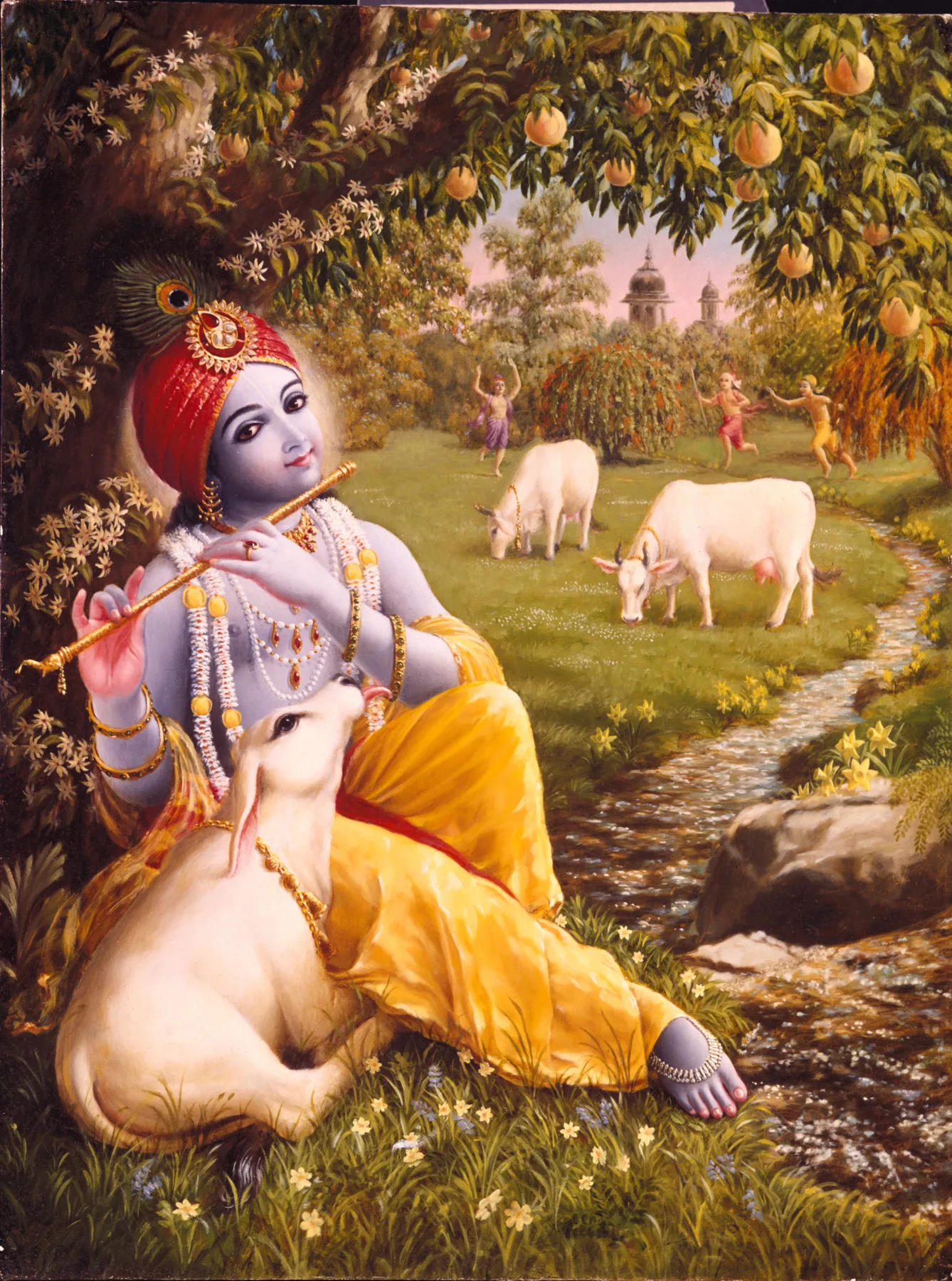
Introduction
The guru-parampara includes many acharyas: Lord Brahma at the very head of the parampara, then Narada Muni, Vyasadeva, Madhvacharya, and on through Sri Chaitanya Mahaprabhu and the Six Goswamis of Vrindavana to Srila Prabhupada. Every one of them carries knowledge that begins with a single person: Krishna. Gaudiya Vaishnavism does not treat Krishna as one conception of God among several, or as one avatara among the many forms Vedic literature describes. It holds Him to be Svayam Bhagavan, God Himself, in His own original, complete, personal form. Vishnu, Narayana and every other divine expansion and incarnation proceed from Him. This is not a devotional preference stated without evidence. This tradition has always insisted that the claim must be shown from scripture, not just declared. The sections below set out that evidence directly, one point at a time, following the tradition's own way of arguing.
This account is not a life story told in order of events. Krishna's own earthly pastimes in Vrindavana and Dvaraka, and the events of the Bhagavad-gita at Kurukshetra, are told in Srimad-Bhagavatam's Tenth Canto and in the Mahabharata. They are far too vast for any single account to hold. Instead, what follows is the case from scripture and philosophy for who Krishna is. It begins with Brahma's own hymn of praise and Krishna's own words about Himself in the Bhagavad-gita. Then come Srimad-Bhagavatam's direct statement, the Vedic and Upanishadic evidence, and the Six Goswamis' careful, step-by-step proof. Next is the teaching that Vishnu and Narayana are Krishna's own expansions, not His rivals. Then comes the identity of Sri Chaitanya Mahaprabhu, and, finally, the parampara's own place in the chain of knowledge that begins here.
| Detail | Description |
|---|---|
| Also known as | Govinda, Gopala, Vasudeva, Shyamasundara, Hari, Madana-mohana, Jagadisha, Purushottama, Vrajendra-nandana |
| Position in Vaishnava theology | Svayam Bhagavan, the Supreme Personality of Godhead Himself, the source of all avataras and expansions, not one avatara among them |
| Position in the guru-parampara | The origin point of the entire chain: He has no guru; He imparted knowledge directly into the heart of Lord Brahma at the dawn of creation |
| Key scriptural proof | Srimad-Bhagavatam 1.3.28: "Krishna is the original Personality of Godhead Himself" |
| Foundational hymn | Sri Brahma-samhita, Chapter Five, traditionally Brahma's own prayer of praise to Krishna |
| Central philosophical text | Srila Jiva Goswami's Krishna-sandarbha, the fourth of his six Sandarbhas |
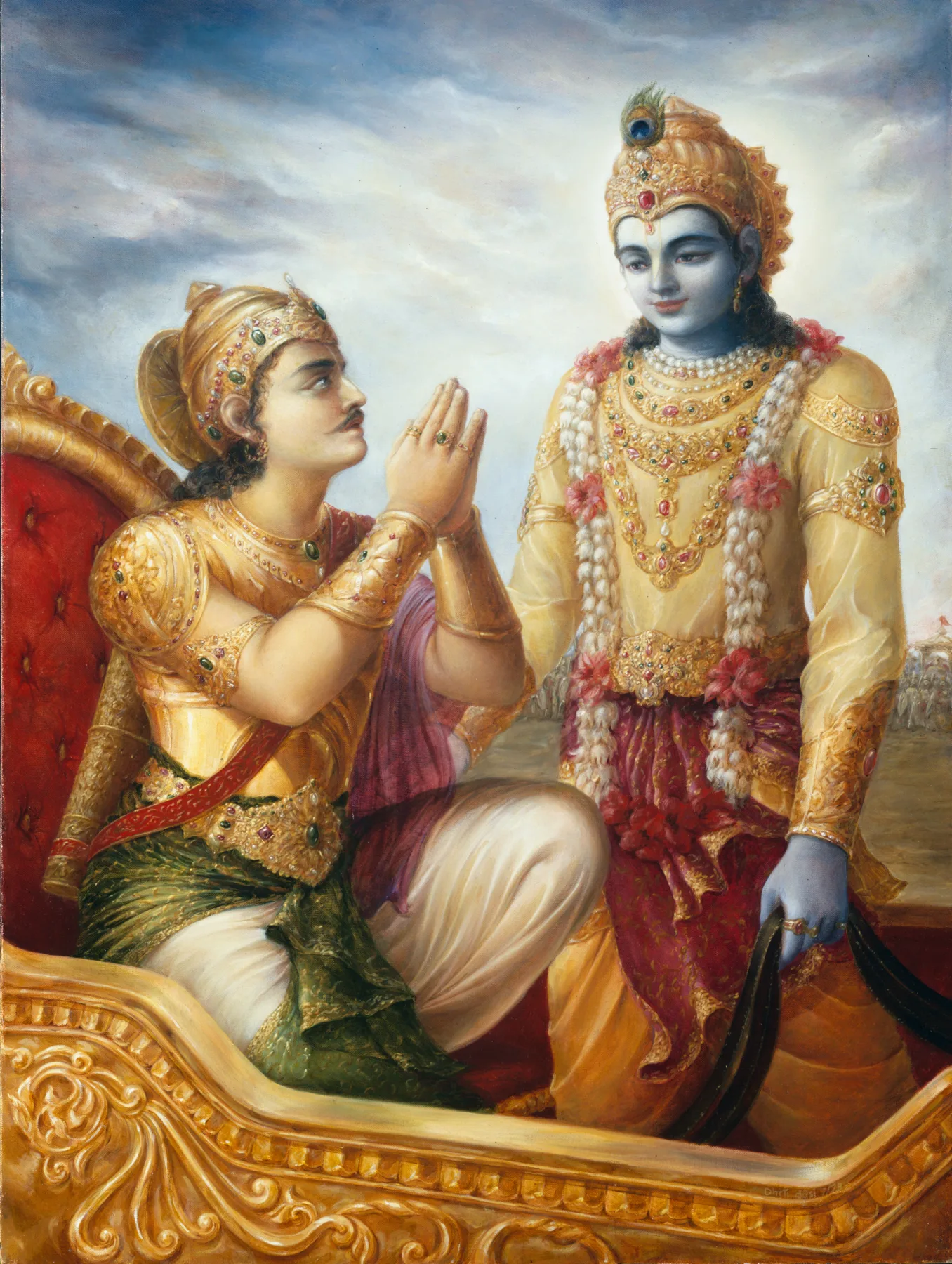
Scriptural evidence for the introduction (2)
īśvaraḥ paramaḥ kṛṣṇaḥ
sac-cid-ānanda-vigrahaḥ
anādir ādir govindaḥ
sarva-kāraṇa-kāraṇam
Word for word
īśvaraḥ: the controller; paramaḥ: supreme; kṛṣṇaḥ: Lord Krishna; sat-cit-ānanda-vigrahaḥ: whose form is eternal existence, absolute knowledge and absolute bliss; anādiḥ: without beginning; ādiḥ: the origin; govindaḥ: Lord Govinda; sarva-kāraṇa-kāraṇam: the cause of all causes.
Krishna who is known as Govinda is the Supreme Godhead. He has an eternal, blissful, spiritual body. He is the origin of all. He has no other origin, and He is the prime cause of all causes.
The single most quoted verse in Gaudiya Vaishnava literature on Krishna's supreme position, Brahma's own testimony, opening his own hymn of praise. One of the two most load-bearing citations on this entire page.
ete cāṁśa-kalāḥ puṁsaḥ
kṛṣṇas tu bhagavān svayam
indrāri-vyākulaṁ lokaṁ
mṛḍayanti yuge yuge
Word for word
ete: all these; ca: and; aṁśa: plenary portions; kalāḥ: portions of the plenary portions; puṁsaḥ: of the Supreme; kṛṣṇaḥ: Lord Krishna; tu: but; bhagavān: the Personality of Godhead; svayam: in person; indra-ari: the enemies of Indra; vyākulam: disturbed; lokam: all the planets; mṛḍayanti: gives protection; yuge yuge: in different ages.
All of the above-mentioned incarnations are either plenary portions or portions of the plenary portions of the Lord, but Lord Sri Krishna is the original Personality of Godhead. All of them appear on planets whenever there is a disturbance created by the atheists. The Lord incarnates to protect the theists.
The Bhagavatam's own direct verdict at the close of its chapter listing the incarnations of Godhead. The second of the two most load-bearing citations here.
Chapter 1
Brahma-samhita's Testimony
The opening verse of Brahma's own hymn of praise names Krishna, not himself, as the supreme controller with no origin of His own.
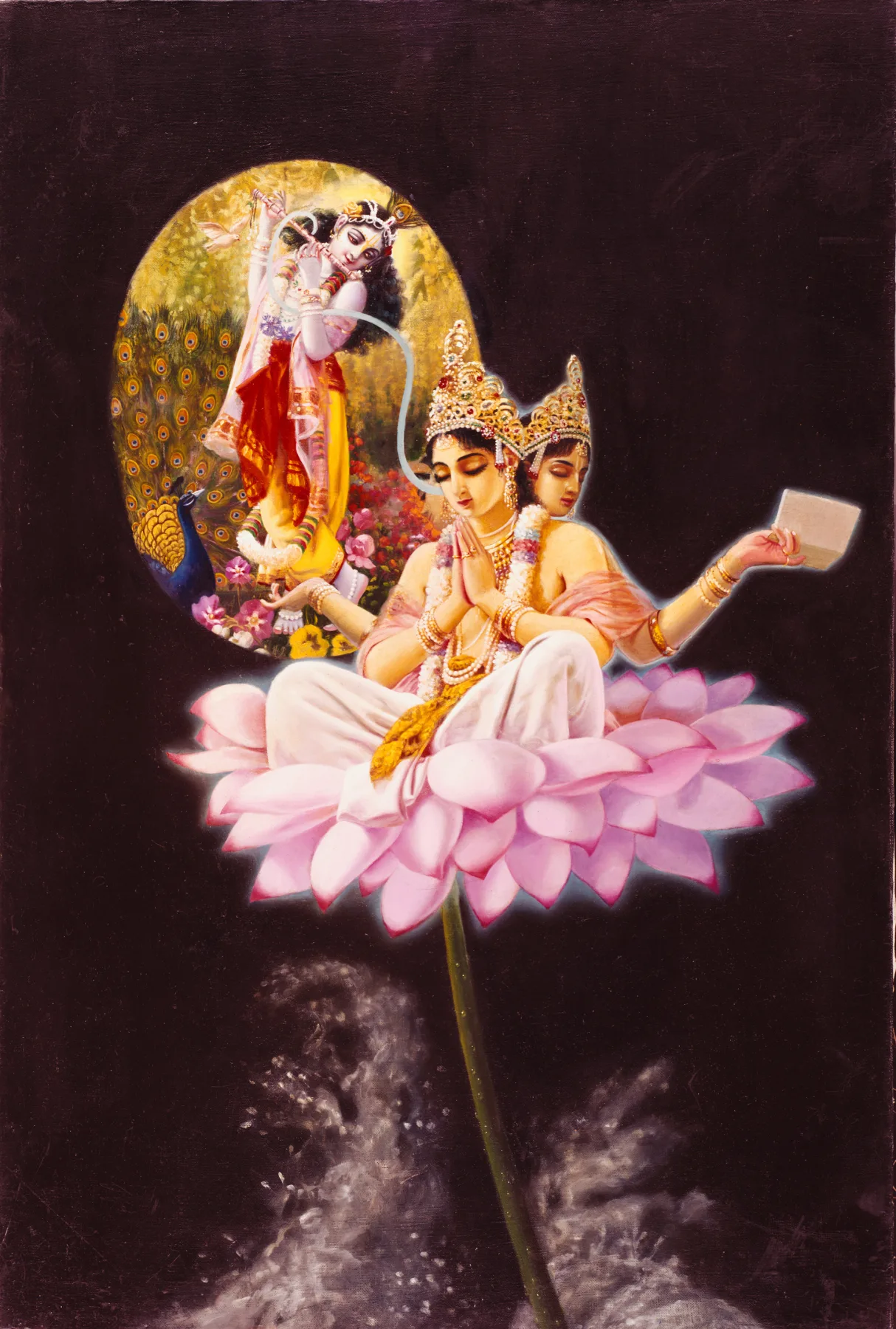
Lord Brahma's own page tells the story of how this text was found. Sri Chaitanya Mahaprabhu was travelling through South India when He discovered a single surviving chapter of an ancient hymn, at the temple of Adi-keshava, and had it copied by hand. The South India Tour also records this discovery. Krishnadasa Kaviraja Goswami said plainly that no other scripture states the final truth about the Absolute Truth as clearly as this one does.
This page does not retell that discovery. It looks instead at what the recovered text actually says. Brahma-samhita is not a hymn about Brahma. It is Brahma's own testimony about Krishna, spoken by the very person the guru-parampara calls its first guru.
The Opening Verse #
Brahma-samhita's fifth chapter opens with the most quoted line in the whole Gaudiya Vaishnava tradition. In full, it says: "Krishna who is known as Govinda is the Supreme Godhead. He has an eternal, blissful, spiritual body. He is the origin of all. He has no other origin, and He is the prime cause of all causes."
This one verse makes five separate claims. Gaudiya teachers have always read them together, as one connected argument, not just a string of praises:
- Krishna is named the Supreme Godhead, the controller of all. No one controls Him.
- His body is sac-cid-ananda: eternal, full of knowledge, and full of bliss. This is not the temporary body every soul in this world carries.
- He is the origin of everything else.
- He has no origin of His own.
- He is the cause of all causes: not one cause among many, but the cause standing behind every other cause there is.
| Detail | Description |
|---|---|
| Reference | Brahma-samhita, Chapter 5, verse 1 |
| Attributed speaker | Lord Brahma, offering his own realization at the dawn of creation |
| Central claim | Krishna (Govinda) is the supreme controller, with no origin of His own, the cause of all causes |
| Recovered by | Sri Chaitanya Mahaprabhu, South India tour, c. 1510 CE |
| First English translation | Bhaktisiddhanta Sarasvati Thakura, 1932, with Jiva Goswami's commentary |
Srila Prabhupada's own purport to this verse states the point plainly. The Absolute is known by many names: the impersonal Brahman effulgence, the localized Paramatma, Vishnu, Ishvara. This verse says all of these are manifestations coming from one single personal source. As Prabhupada puts it, "hence it is evident that Krishna is sole Supreme Godhead."
Think for a moment about who is saying this. By every traditional account, Brahma holds the most powerful post open to any living being in this universe. In his own hymn, he could have claimed some of that glory for himself. Instead, he names someone else as the origin of all origins: a cowherd boy, Krishna, whose pastimes this same tradition also reveres. Bhagavad-gita 7.7 states the same idea in Krishna's own voice. This connection is explored on Krishna's Own Words in the Bhagavad-gita.
Krishna's Own Abode #
The verses that follow describe an actual place, not an abstract idea. Brahma-samhita 5.2 names Krishna's transcendental home Gokula, "a spiritual place of transcendental pastimes," pictured as a thousand-petaled lotus whose center is Krishna's own eternal abode. Verse 29 describes Govinda there, tending cows, surrounded by wish-fulfilling trees, served by hundreds of thousands of gopis with great love and reverence. Verse 37 gives an even more exact picture. There He lives eternally in Goloka together with Radha, "the embodiment of the ecstatic potency," surrounded by Her close associates.
The tradition that preserves these verses does not read them as poetry or metaphor. It takes them as a direct description of a real, eternal, fully personal home. That home is as real as any place on earth. It simply cannot be reached or seen by material senses.
The Light of Brahman #
One more verse deserves close attention, because it reaches all the way back to the Upanishads. Brahma-samhita 5.40 makes a specific claim about the impersonal Brahman effulgence described throughout Vedantic literature. This is the featureless light. Those who read the Vedas in an impersonal way place this light at the very center of everything. This verse says that light is nothing but the glow radiating from Krishna's own transcendental body. It calls that glow "differentiated from the infinity of glories of the mundane universe," yet traces it back, in the end, to a personal source.
This is not a small point. It is Gaudiya Vaishnavism's long-established answer to the oldest objection it faces. That objection says the Absolute Truth described in Vedanta is fundamentally impersonal, and that personal worship is only a lower, temporary stage on the way to something higher. Brahma-samhita says the opposite. The impersonal feature is real, but it comes from something more fundamental, the way sunlight is real but comes from the sun.
The fuller Vedic case for this same claim is given on Vedic and Upanishadic Testimony. The Vishnu-tattva Expansions explains how this same principle applies to Vishnu and Narayana in particular.
A Text Prabhupada Returned to Often #
Srila Prabhupada lectured on this exact verse again and again, across two decades of preaching. A 1968 lecture in Montreal shows him building the same argument from a different angle: that Krishna's eternal form, unlike an ordinary body, never has to be given up. "This form will be changed after few years. As soon as I give up this body, this form is changed... Therefore He hasn't got a form like this to be changed." Quoting the verse directly, he then explained the name Govinda itself: "Govinda means He gives pleasure... So if you serve Krishna in your purified senses, then you really become happy. Therefore His name is Govinda... The cause of all causes. So He is therefore Jagadisha." The full lecture excerpt is recorded in the citations below.
Why This Evidence Stands at the Head of the Case #
Brahma-samhita is not the only proof this tradition offers for Krishna's supremacy. The Bhagavad-gita, Srimad-Bhagavatam, the Upanishads, and the careful, step-by-step arguments of the Six Goswamis are each strong evidence by themselves. But Brahma-samhita has a special place in the order of evidence.
Brahma is the first link in the entire guru-parampara. He received this knowledge directly from Krishna, a story told on Lord Brahma's page. Brahma-samhita is Brahma's own testimony about the very person who taught him. This tradition holds that this is exactly the kind of evidence we should expect to find at the root of any true claim that someone is supreme. An adi-guru as great as Brahma chose to open his own hymn by naming someone else as the cause of all causes. That is not self-praise. It is the testimony of the most qualified witness there could be.
Scriptural evidence for this chapter (5)
Quoted in the text above:
Further verses:
sahasra-patra-kamalaṁ
gokulākhyaṁ mahat padam
tat-karṇikāraṁ tad-dhāma
tad-anantāṁśa-sambhavam
The superexcellent station of Krishna, which is known as Gokula, has thousands of petals and a corolla like that of a lotus sprouted from a part of His infinitary aspect, the whorl of the leaves being the actual abode of Krishna.
Describes Krishna's own transcendental abode, Gokula, immediately after the opening verse names Him supreme.
cintāmaṇi-prakara-sadmasu kalpa-vṛkṣa-
lakṣāvṛteṣu surabhīr abhipālayantam
lakṣmī-sahasra-śata-sambhrama-sevyamānaṁ
govindam ādi-puruṣaṁ tam ahaṁ bhajāmi
I worship Govinda, the primeval Lord, the first progenitor who is tending the cows, yielding all desire, in abodes built with spiritual gems, surrounded by millions of purpose trees, always served with great reverence and affection by hundreds of thousands of lakshmis or gopis.
Describes Govinda personally tending cows in His own abode, served by the gopis, the intimate, pastoral picture Gaudiya Vaishnavas hold to be Krishna's fullest revelation.
ānanda-cinmaya-rasa-pratibhāvitābhis
tābhir ya eva nija-rūpatayā kalābhiḥ
goloka eva nivasaty akhilātma-bhūto
govindam ādi-puruṣaṁ tam ahaṁ bhajāmi
I worship Govinda, the primeval Lord, residing in His own realm, Goloka, with Radha, resembling His own spiritual figure, the embodiment of the ecstatic potency possessed of the sixty-four artistic activities, in the company of Her confidantes (sakhis), embodiments of the extensions of Her bodily form, permeated and vitalized by His ever-blissful spiritual rasa.
Names Krishna's eternal abode Goloka specifically, together with Radha and Her confidential associates.
yasya prabhā prabhavato jagad-aṇḍa-koṭi-
koṭiṣv aśeṣa-vasudhādi vibhūti-bhinnam
tad brahma niṣkalam anantam aśeṣa-bhūtaṁ
govindam ādi-puruṣaṁ tam ahaṁ bhajāmi
I worship Govinda, the primeval Lord, whose effulgence is the source of the nondifferentiated Brahman mentioned in the Upanishads, being differentiated from the infinity of glories of the mundane universe, appears as the indivisible, infinite, limitless truth.
States that the impersonal Brahman effulgence of the Upanishads is itself Krishna's own bodily radiance, Gaudiya Vaishnavism's standing answer to purely impersonalist readings of Vedanta.
Chapter 2
Krishna's Own Words in the Bhagavad-gita
Speaking directly to Arjuna at Kurukshetra, Krishna does not wait for others to declare His position. He states it Himself, again and again, in plain words.
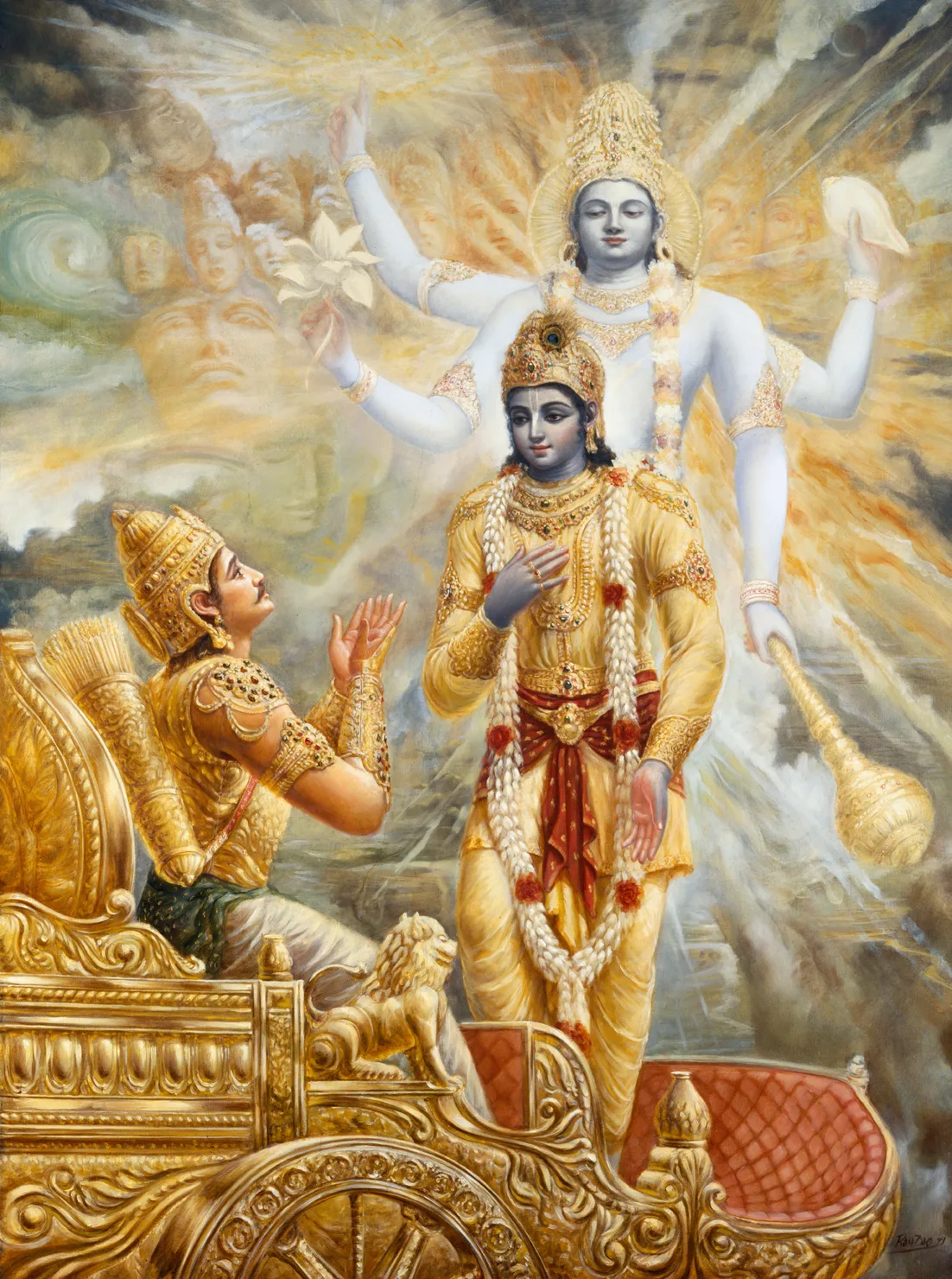
On other pages, the evidence about a person often comes from what someone else says about him. This page is different, because the Bhagavad-gita is not someone else's report about Krishna. It is eighteen chapters of Krishna speaking about Himself, in His own voice, to a friend who has just watched Him drive a chariot onto a battlefield. Gaudiya Vaishnava tradition treats this as decisive. Here we do not depend on how anyone else understood Krishna, because the words come from Krishna Himself. Whatever others conclude about Krishna's position, the Gita records what Krishna Himself claimed His position to be.
"There Is No Truth Superior to Me" #
In the Seventh Chapter, still early in His instruction to Arjuna, Krishna states plainly: "O conqueror of wealth, there is no truth superior to Me. Everything rests upon Me, as pearls are strung on a thread" (Bhagavad-gita 7.7). Srila Prabhupada's purport to this verse argues directly against a different view held by many philosophers. They say that the Absolute Truth is finally impersonal, and that any personal form is only a temporary allowance made for limited human beings. In the same purport, Srila Prabhupada also quotes the Brahma-samhita's own statement and insists "these authorities leave no doubt that the Absolute Truth is the Supreme Person, the cause of all causes." The same claim is examined from Brahma's side on Brahma-samhita's Testimony.
| Detail | Description |
|---|---|
| BG 7.7 | "There is no truth superior to Me": no rival Absolute above Krishna |
| BG 10.8 | "I am the source of all spiritual and material worlds": Krishna as origin of both realms |
| BG 15.18-19 | Krishna names Himself Purushottama, beyond both the perishable and the imperishable |
| BG 18.66 | The Gita's own culminating instruction: surrender directly to Krishna Himself |
| Common thread | Each statement is made by Krishna about Himself, not inferred from His actions |
"I Am the Source of All" #
The Tenth Chapter, traditionally titled Vibhuti-yoga, "The Opulence of the Absolute," contains Krishna's fullest description of Himself as the origin. "I am the source of all spiritual and material worlds," He tells Arjuna. "Everything emanates from Me. The wise who perfectly know this engage in My devotional service and worship Me with all their hearts" (Bhagavad-gita 10.8). Srila Prabhupada's purport shows that this claim is not meant for Arjuna alone: "All Vedic literature agrees that Krishna is the source of Brahma, Shiva and all other demigods." The purport then turns to the Upanishads for support, quoting the Gopala-tapani Upanishad of the Atharva-veda (1.24): "It was Krishna who in the beginning instructed Brahma in Vedic knowledge and who disseminated Vedic knowledge in the past." That one line connects this verse with two other topics in this account. One is the claim that Krishna, not any lesser figure, taught Lord Brahma at the dawn of creation. This is examined in full on The Source of This Parampara. The other is the wider Vedic testimony gathered on Vedic and Upanishadic Testimony.
Purushottama, Beyond Both the Perishable and the Imperishable #
Late in the Gita, the Fifteenth Chapter has a passage on the Purushottama-yoga. It is short, but its philosophy is deep. Here Krishna makes an even more exact claim about which category He belongs to. Vedantic philosophy generally recognizes two broad categories of existence: kshara, the perishable material world, and akshara, the imperishable individual souls. Krishna places Himself in neither category, and above both: "Because I am transcendental, beyond both the fallible and the infallible, and because I am the greatest, I am celebrated both in the world and in the Vedas as that Supreme Person" (Bhagavad-gita 15.18). The next verse says directly what depends on accepting or missing this claim: "Whoever knows Me as the Supreme Personality of Godhead, without doubting, is the knower of everything. He therefore engages himself in full devotional service to Me" (15.19). Srila Prabhupada's purport shows how central this one distinction is to the whole book. "Throughout the whole of Bhagavad-gita, this fact is being stressed at every step," he writes. He says this against those he calls "so many stubborn commentators" who take the Supreme and the individual soul to be finally one and the same.
The Gita's Own Conclusion #
Krishna does not leave His position for the reader to work out by careful reading. Near the very end of the text, He has already explained knowledge of Brahman, the Supersoul, the different social orders, renunciation and a dozen other paths. Then He gives the essence of the whole teaching in a single verse: "Abandon all varieties of religion and just surrender unto Me. I shall deliver you from all sinful reactions. Do not fear" (Bhagavad-gita 18.66). In this instruction Krishna speaks in the first person and asks for surrender to Himself. Nothing in it points to some higher principle beyond Him, as if that surrender should finally be passed on to someone else. Gaudiya Vaishnava tradition reads this as the Gita's own final word on the question of Krishna's supreme identity. The text has taught many other things, about the nature of the soul, the material world, and the paths of knowledge and action. But its author clearly places Himself as the goal to which all of it finally points.
Why This Matters as Independent Evidence #
A reader who has doubts might reasonably ask a question. Why should Krishna's own claims about Himself count as evidence? Could they not simply be a devotional writer's way of speaking? Gaudiya Vaishnava tradition's answer is that the Gita's claims do not stand alone. Other sources confirm them independently: Srimad-Bhagavatam's direct verdict, the Vedic and Upanishadic record, and the careful philosophical case that Jiva Goswami later built from these same sources in his Krishna-sandarbha. But the Bhagavad-gita gives something that none of those later sources can give. It gives the claim in its most direct possible form, because in none of them is Krishna speaking in the first person. It is not what scripture says about Krishna. It is what Krishna says about Himself.
Scriptural evidence for this chapter (5)
Quoted in the text above:
- Bg. 15.18 Bhagavad-gita As It Is (1972 first edition)
- Bg. 18.66 Bhagavad-gita As It Is (1972 first edition)
Further verses:
mattaḥ parataraṁ nānyat
kiñcid asti dhanañ-jaya
mayi sarvam idaṁ protaṁ
sūtre maṇi-gaṇā iva
Word for word
mattaḥ: beyond Me; para-taram: superior; na: not; anyat kiñcit: anything else; asti: there is; dhanañjaya: O conqueror of wealth; mayi: in Me; sarvam: all that be; idam: which we see; protam: is strung; sūtre: on a thread; maṇi-gaṇāḥ: pearls; iva: like.
O conqueror of wealth [Arjuna], there is no Truth superior to Me. Everything rests upon Me, as pearls are strung on a thread.
From the purport: That the Personality of Godhead is the Supreme Absolute Truth is also the affirmation of the Brahma-samhita... These authorities leave no doubt that the Absolute Truth is the Supreme Person, the cause of all causes.
Krishna's own direct claim, in the Bhagavad-gita, that no truth stands above Him.
ahaṁ sarvasya prabhavo
mattaḥ sarvaṁ pravartate
iti matvā bhajante māṁ
budhā bhāva-samanvitāḥ
Word for word
aham: I; sarvasya: of all; prabhavaḥ: the source of generation; mattaḥ: from Me; sarvam: everything; pravartate: emanates; iti: thus; matvā: knowing; bhajante: become devoted; mām: unto Me; budhāḥ: the learned; bhāva-samanvitāḥ: with great attention.
I am the source of all spiritual and material worlds. Everything emanates from Me. The wise who know this perfectly engage in My devotional service and worship Me with all their hearts.
From the purport: All Vedic literature agrees that Krishna is the source of Brahma, Shiva and all other demigods. In the Atharva-veda it is said... 'It was Krishna who in the beginning instructed Brahma in Vedic knowledge and who disseminated Vedic knowledge in the past.'
Krishna names Himself the source of both the spiritual and material worlds; the purport itself reaches into the Atharva-veda for independent Vedic confirmation.
yo mām evam asammūḍho
jānāti puruṣottamam
sa sarva-vid bhajati māṁ
sarva-bhāvena bhārata
Word for word
yaḥ: anyone who; mām: Me; evam: thus; asammūḍhaḥ: without a doubt; jānāti: knows; puruṣa-uttamam: the Supreme Personality of Godhead; saḥ: he; sarva-vit: the knower of everything; bhajati: renders devotional service; mām: unto Me; sarva-bhāvena: in all respects; bhārata: O son of Bharata.
Whoever knows Me as the Supreme Personality of Godhead, without doubting, is to be understood as the knower of everything, and he therefore engages himself in full devotional service, O son of Bharata.
From the purport: Throughout the whole of Bhagavad-gita, this fact is being stressed at every step. And still there are so many stubborn commentators on Bhagavad-gita who consider the Supreme Absolute Truth and the living entities to be one and the same.
States the stakes of accepting Krishna as Purushottama: to know this is, in the Gita's own words, to know everything.
Chapter 3
The Bhagavatam's Direct Statement
At the end of a list of incarnations, Srimad-Bhagavatam stops and names one of them differently from all the rest.
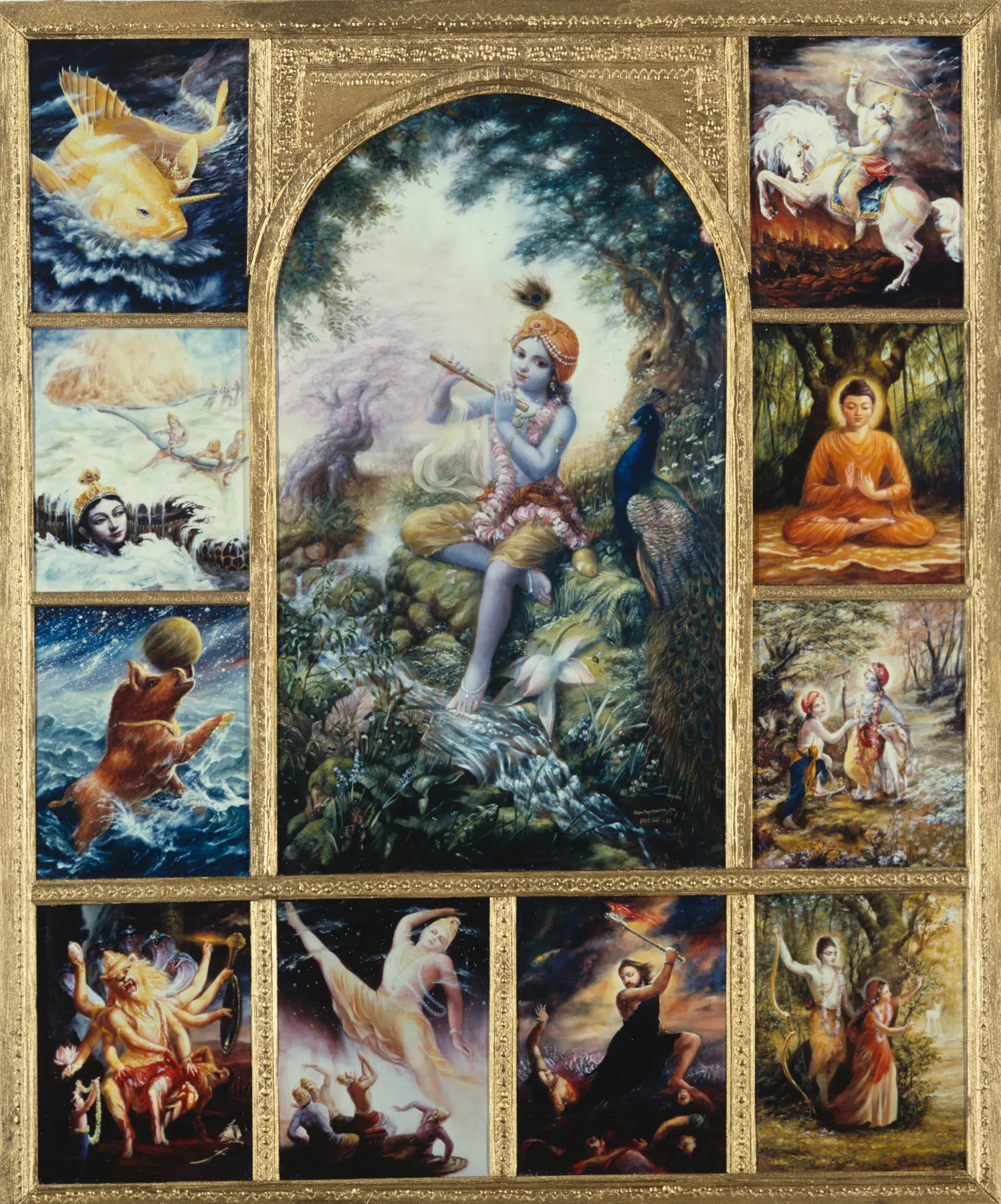
Srimad-Bhagavatam's Third Chapter of the First Canto sets out to answer a question that every serious student of Vedic literature asks sooner or later. How many incarnations of Godhead are there, and how are they related to one another? The chapter answers by listing them. Suta Gosvami names incarnation after incarnation across some twenty-five verses, from the four Kumaras and Varaha to Rama, Vyasadeva and Buddha. The list leads up to one final statement. Ever since, Gaudiya Vaishnavism has treated that statement as the most direct verdict in scripture on Krishna's supreme identity.
The List and Its Conclusion #
The chapter opens by describing how, at the beginning of creation, "the Lord first expanded Himself in the universal form of the purusha incarnation and manifested all the ingredients for the material creation" (Srimad-Bhagavatam 1.3.1). So from its very first verse, the chapter makes clear that the list which follows is a list of the one Godhead's own expansions. It is not a list of separate, competing deities. After naming every incarnation in turn, the chapter reaches its verdict: "All of the above-mentioned incarnations are either plenary portions or portions of the plenary portions of the Lord, but Lord Krishna is the original Personality of Godhead. All of them appear on planets whenever there is a disturbance created by the atheists. The Lord incarnates to protect the theists" (Srimad-Bhagavatam 1.3.28).
| Detail | Description |
|---|---|
| Reference | Srimad-Bhagavatam 1.3.28 |
| Context | The concluding verse of a chapter listing the incarnations of Godhead |
| Central claim | Every incarnation named is a plenary portion or a portion of a portion, except Krishna, who is bhagavan svayam, the Personality of Godhead in person |
| Later systematized by | Jiva Goswami's Krishna-sandarbha, the fourth of the Six Sandarbhas |
The distinction the verse makes is exact. It is not just poetry. Many names come before Krishna on the list. They include forms as great as Rama, and the purusha incarnations who create the material universes and are present throughout them. Every one of these is described with two specific Sanskrit categories: amsha, a plenary portion, and kala, a portion of a portion. Only Krishna is given a completely different, third term, svayam, "personally" or "in person," and He is not a portion of anything. He is the source from which the portions come. Srila Prabhupada's purport gives a simple example to explain this relationship. The example does not make the other incarnations less important. It explains the difference in how much power each one shows: "When in the room small electric bulbs are displayed, it does not mean that the electric powerhouse is limited by the small bulbs. The same powerhouse can supply power to operate large-scale industrial dynamos with greater volts. Similarly, the incarnations of the Lord display limited powers because so much power is needed at that particular time." Vishnu and Narayana are not incarnations in the ordinary sense. They are Krishna's own plenary vishnu-tattva expansions. The page The Vishnu-tattva Expansions explains in full how this same relationship applies to them.
Brahma's Own Confession #
This is not the only place in Srimad-Bhagavatam where the same conclusion appears. Lord Brahma's own page already tells the story of the Brahma-vimohana-lila. Brahma stole away Krishna's cowherd friends and calves to test whether the boy before him was truly God. Krishna answered so completely that Brahma fell at His feet in prayer. Among those prayers, recorded in the Bhagavatam's Tenth Canto, Brahma does more than praise Krishna. He openly confesses who Krishna is: "Are You not the original Narayana, O supreme controller, since You are the Soul of every embodied being and the eternal witness of all created realms? Indeed, Lord Narayana is Your expansion, and He is called Narayana because He is the generating source of the primeval water of the universe. He is real, not a product of Your illusory Maya" (Srimad-Bhagavatam 10.14.14). This verse has a special weight. It comes from Brahma, whom the parampara honors as adi-guru. And he spoke it at the very moment of his own defeat, after he had directly tested Krishna's divinity. It is not a philosopher's argument. It is a confession, drawn out of the one witness in the universe most qualified to make it.
A Verse Prabhupada Returned To Often #
Srila Prabhupada quoted Srimad-Bhagavatam 1.3.28 again and again, across decades of lectures. In one 1969 talk in Los Angeles, he starts from the meaning of Krishna's own name and builds the point from there: "Krishna is all-attractive. That is the perfect name of God, 'Krishna.'... So krishnas tu bhagavan svayam [SB 1.3.28]. According to Vedic literature, Krishna is the Supreme Personality of Godhead, svayam. Svayam means original. Krishna has many extension, incarnation. We are also Krishna's extension. We are, all living entities, we are also Krishna's extension. We are called vibhinnamsha, separated extension." The difference he explains there, between the vishnu-tattva expansions and the vibhinnamsha status of ordinary souls, is taken up directly on The Vishnu-tattva Expansions.
Why the Bhagavatam's Wording Matters #
Gaudiya Vaishnavism's whole case depends on pointing to exact words of scripture that anyone can check. It does not rest on an idea simply handed down. SB 1.3.28 is the clearest example of this kind of evidence. Here the scripture first takes the trouble to list incarnation after incarnation, using the same technical terms throughout. Then it clearly marks one name on that list as different in kind from every other. Srila Jiva Goswami took this single verse, among others, and built a whole book of formal argument on it. That work is examined in full on The Six Goswamis and Krishna-sandarbha.
Scriptural evidence for this chapter (3)
Quoted in the text above:
- SB 1.3.28 Srimad-Bhagavatam
- SB 10.14.14 Srimad-Bhagavatam
Further verses:
sūta uvāca
jagṛhe pauruṣaṁ rūpaṁ
bhagavān mahad-ādibhiḥ
sambhūtaṁ ṣoḍaśa-kalam
ādau loka-sisṛkṣayā
Word for word
sūtaḥ uvāca: Sūta Gosvāmī said; jagṛhe: accepted; pauruṣam: the puruṣa incarnation; rūpam: form; bhagavān: the Personality of Godhead; mahat-ādibhiḥ: with the ingredients of material creation; sambhūtam: thus developed; ṣoḍaśa-kalam: with sixteen primary principles; ādau: at first; loka: planets; sisṛkṣayā: wishing to create.
Sūta said: In the beginning of the creation, the Lord first expanded Himself in the universal form of the purusha incarnation and manifested all the ingredients for the material creation. And thus at first there was the creation of the sixteen principles of material action. This was for the purpose of creating the material universes.
The opening verse of the chapter that lists the incarnations of Godhead and closes with SB 1.3.28, establishes from the outset that the incarnations to follow are the one Godhead's own expansions.
Chapter 4
Vedic and Upanishadic Testimony
Gaudiya acharyas have never rested this claim on the Bhagavatam alone; they trace it into the Upanishads themselves.
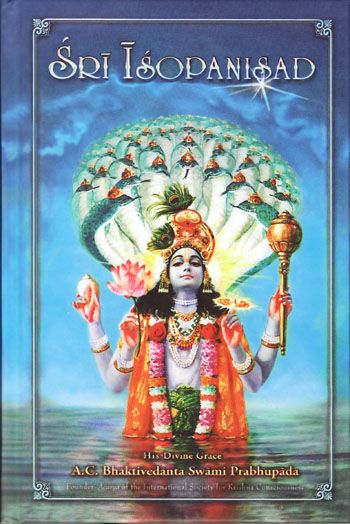
For centuries, philosophers of rival Vedanta schools have often raised an objection to Krishna's supremacy. They say that Srimad-Bhagavatam and the Puranas belong to a later layer of Vedic literature. These books are rich in devotion, they say, but they are not the direct word of shruti, that is, the Vedas and Upanishads themselves. Gaudiya acharyas took this objection seriously. This goes back to Jiva Goswami and, later, to Baladeva Vidyabhushana in his Govinda-bhashya commentary on the Vedanta-sutra. They answered the objection on its own ground. They found Krishna's name and supremacy directly within Upanishadic shruti itself, not just in the Bhagavatam. This page reports what can be checked independently in that case. It is also honest about the limits of what a general reader can check.
The Gopala-tapani Upanishad #
The most direct answer to this objection from the texts themselves is the Gopala-tapani Upanishad. It is a fairly short Upanishad belonging to the Atharva Veda, and it is devoted specifically to Krishna under His name Gopala. Srila Prabhupada quoted and translated several of its verses directly in his purport to Bhagavad-gita 11.54. There he discusses how the Lord can be known only through unalloyed devotion. Its opening verse offers a mantra of obeisance, translated by Srila Prabhupada as: "I offer my respectful obeisances unto Krishna, who has a transcendental form of bliss, eternity and knowledge. I offer my respect to Him, because understanding Him means understanding the Vedas, and He is therefore the supreme spiritual master" (Gopala-tapani Upanishad 1.1).
| Detail | Description |
|---|---|
| Text | Gopala-tapani Upanishad, part of the Atharva Veda |
| 1.1 | Obeisance to Krishna as sac-cid-ananda; understanding Him is understanding the Vedas |
| 1.3 | "Krishna is the Supreme Personality of Godhead" |
| 1.21 | The one, all-pervading, worshipable controller is Krishna, manifest in unlimited forms |
| Verified via | Srila Prabhupada's purport to Bhagavad-gita 11.54, quoting the Upanishad directly |
A few verses later, the Upanishad states its own conclusion more directly than most texts of this kind: "Krishna is the Supreme Personality of Godhead" (Gopala-tapani Upanishad 1.3). And further on: "That one Krishna is the Supreme Personality of Godhead, and He is worshipable... Krishna is one, but He is manifested in unlimited forms and expanded incarnations" (Gopala-tapani Upanishad 1.21). This last line is important. In the language of the Upanishads, it states the same relationship that is examined at length on The Vishnu-tattva Expansions. There is one original person, and He appears in unlimited forms without any contradiction.
Krishna as the Teacher of the Vedas Themselves #
Another verse from the same Upanishad goes back even further, to the very origin of Vedic knowledge. Srila Prabhupada quotes it in his purport to Bhagavad-gita 10.8: "It was Krishna who in the beginning instructed Brahma in Vedic knowledge and who disseminated Vedic knowledge in the past" (Gopala-tapani Upanishad 1.24). This one line completes a connection that this tradition traces throughout its account of the acharyas. Lord Brahma's page records that Krishna placed the catur-shloki directly into Brahma's heart at the dawn of creation. That page cites Srimad-Bhagavatam's own opening verse for the claim. Here an Upanishad, which tradition counts among shruti, states the same fact independently. The Source of This Parampara explains in full what this means for how this parampara is understood.
What This Section Does Not Claim #
To be honest, we must state plainly what this page does not claim. Many more Vedic and Upanishadic citations are passed around in popular Gaudiya literature and in devotional writing online. These are verses said to come from the Chandogya, Katha, Rig Veda and elsewhere, sometimes with exact chapter-and-verse references, sometimes without. This page does not repeat any citation that could not be checked independently, by finding the actual passage in an original source. Some Upanishadic citations are widely repeated, but a general reader finds them difficult or impossible to confirm independently. To do so, one would need special access to scholarly editions of the texts, and scholars themselves debate the manuscript history of those texts. For instance, academic scholars are still genuinely discussing the date of the Gopala-tapani Upanishad and whether it belongs among the accepted scriptures. That is a separate question from whether Gaudiya Vaishnavas sincerely regard it as authoritative shruti, which they do. We do not want to present secondhand citations as checked when they are not. So this page is limited to what has been checked directly: verses Srila Prabhupada himself translated from the Gopala-tapani Upanishad, confirmed against his own published purports.
Why the Vedic Thread Matters Alongside the Others #
None of these lines of proof is meant to stand alone. The Gopala-tapani Upanishad's testimony adds something to Brahma-samhita's account, Krishna's own words in the Gita and Srimad-Bhagavatam's direct statement. It is the kind of source that a rival Vedantist could not reject as only Puranic or as the book of one sect. It is shruti itself. It comes from the very texts that Gaudiya acharyas, from Jiva Goswami onward, pointed to when this objection was raised against them.
Scriptural evidence for this chapter (4)
Quoted in the text above:
- Gopala-tapani Up. 1.1 (quoted in Bg. 11.54 purport) Gopala-tapani Upanishad
- Gopala-tapani Up. 1.21 (quoted in Bg. 11.54 purport) Gopala-tapani Upanishad
- Gopala-tapani Up. 1.24 (quoted in Bg. 10.8 purport, Atharva Veda) Gopala-tapani Upanishad
Further verses:
kṛṣṇo vai paramaṁ daivatam
Word for word
kṛṣṇaḥ: Krishna; vai: indeed; paramam: the supreme; daivatam: Personality of Godhead.
Krishna is the Supreme Personality of Godhead.
A direct, unqualified Upanishadic statement of Krishna's supremacy, quoted by Srila Prabhupada in his purport to Bhagavad-gita 11.54.
Chapter 5
The Six Goswamis and Krishna-sandarbha
This tradition did not answer the question of who Krishna is with devotion alone. It also produced a formal, systematic philosophy.
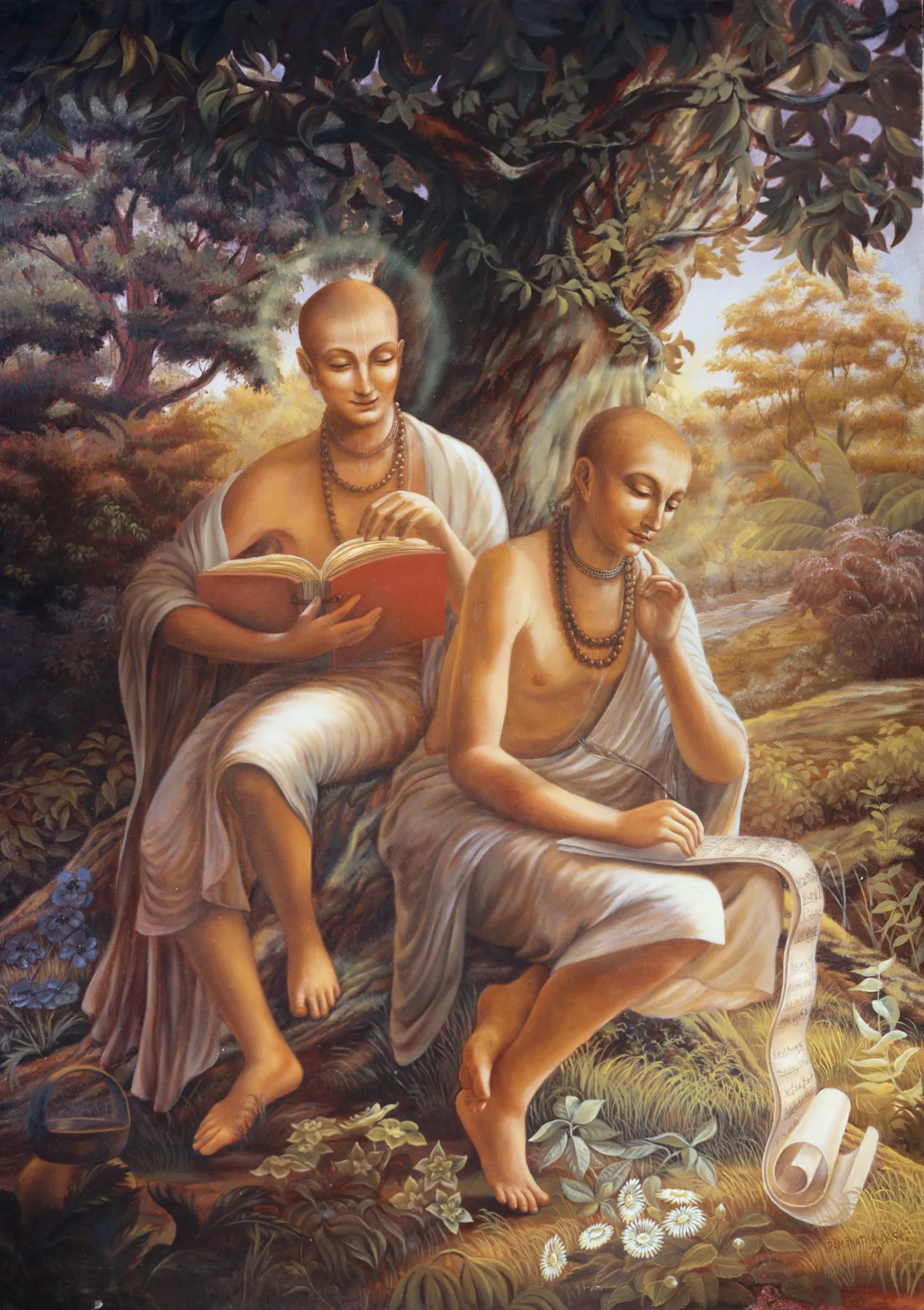
Every proof examined so far on these pages has been a quotation: a verse from Brahma-samhita, from the Gita, from the Bhagavatam, from an Upanishad. Sri Chaitanya Mahaprabhu gave Rupa and Sanatana Goswami a twin mission, teaching Rupa at Prayag and Sanatana at Varanasi. They were to recover the lost places of Krishna's Vrindavana pastimes. They were also to write the theological literature that would give the movement its philosophical foundation. Within a single generation, that second half of the mission produced a large body of formal philosophy. It was built almost entirely from quotations of scripture, not from personal assertion. That is exactly the method these pages follow.
Jiva Goswami's Sat-sandarbha #
Srila Jiva Goswami was the nephew of Rupa and Sanatana and the youngest of the Six Goswamis. He inherited a tradition that already had its devotional practice, its recovered holy places and its first compiled scriptures. What it still lacked was a work that could stand up, argument for argument, against trained Vedantists, Naiyayikas and rival Vaishnava schools. Jiva Goswami's answer was the Sat-sandarbha. It is six works, written one after another and later gathered together as the Bhagavata-sandarbha. Tattva-sandarbha shows which scriptures count as reliable evidence at all. Bhagavat-sandarbha and Paramatma-sandarbha explain the nature of Godhead and His presence as Supersoul. Krishna-sandarbha is the fourth and central volume. Bhakti-sandarbha and Priti-sandarbha move from doctrine into practice and its ultimate goal.
| Detail | Description |
|---|---|
| Full work | Sat-sandarbha (Bhagavata-sandarbha), six parts, by Srila Jiva Goswami |
| Fourth part | Krishna-sandarbha: argues Krishna's supremacy over Narayana from Bhagavatam's own verses |
| Method | Argument built almost entirely from scriptural citation, not independent speculation |
| Grounding verse | Srimad-Bhagavatam 1.2.11: Brahman, Paramatma and Bhagavan as three realizations of one truth |
| Complementary work | Sri Rupa Goswami's Bhakti-rasamrita-sindhu, on why madhurya-rasa is devotion's fullest expression |
What Krishna-sandarbha Actually Argues #
The fourth Sandarbha is devoted to one clearly stated claim. It is that Krishna, and no other form of Godhead, is svayam bhagavan, the original Personality. Vishnu, Narayana and every other divine expansion and incarnation come from Him. Jiva Goswami does not simply assert this. He gathers the Bhagavatam's own verses in support, including Srimad-Bhagavatam 1.3.28 and Brahma's own confession at SB 10.14.14. He explains the eternal nature of Vrindavana and Goloka, and he supports earlier commentators, including Sridhara Svami. He also answers, point by point, the objections that might be raised by a rival Vedantist who holds that Narayana is supreme. Krishnadasa Kaviraja Goswami summed up this achievement directly in Sri Chaitanya-charitamrita: "In Sri Bhagavata-sandarbha, Srila Jiva Gosvami has written conclusively about the ultimate end of devotional service." In this fourth volume, Jiva Goswami applies that conclusive writing specifically to establishing Krishna's own position.
Jiva Goswami's earlier Sandarbhas rely on one basic verse. It should be quoted directly, because the whole argument is built on it. Srimad-Bhagavatam states: "Learned transcendentalists who know the Absolute Truth call this nondual substance Brahman, Paramatma or Bhagavan" (Srimad-Bhagavatam 1.2.11). Srila Prabhupada's purport explains what this means for the case that Jiva Goswami goes on to build. These are not three different truths. They are three depths of realization of the same one truth. The purport describes Bhagavan as "the last word of the Absolute Truth," Paramatma as "the partial representation," and impersonal Brahman as "the glowing effulgence... as the sun rays are to the sun-god." First it must be shown that Bhagavan is the fullest of the three features, not a lower or more limited one. Only then can any argument for Krishna's specific identity as Bhagavan even begin. This is exactly why Jiva Goswami's earlier Sandarbhas prepare this ground before Krishna-sandarbha makes its central claim.
Rupa Goswami and the Question of Why #
Systematic argument answers who Krishna is. But on its own, it does not explain one thing. This tradition worships the loving, playful Krishna of Vrindavana as the fullest revelation of that same Godhead, and not the four-armed, opulent Narayana of Vaikuntha. Why? That question belongs to Srila Rupa Goswami. His Bhakti-rasamrita-sindhu gives Gaudiya Vaishnavism its whole vocabulary for devotional rasa, the different flavors or relationships through which a soul can love God. These are ranked from shanta (neutrality) and dasya (servitorship) through sakhya (friendship) and vatsalya (parental love) to madhurya, conjugal love. This tradition holds madhurya to be the fullest, most complete expression of loving exchange, because it contains within it every quality of the relationships that come before it. At the start of his book, Rupa Goswami defines the goal itself in a single short verse. Unalloyed devotional service must be free from all material desire, unobstructed by fruitive activity or philosophical speculation, and cultivated favorably, for Krishna's own sake (Bhakti-rasamrita-sindhu 1.1.11, quoted in Srila Prabhupada's purport to Bhagavad-gita 11.55).
In this tradition's own account, ranking madhurya highest does not mean that majesty (aishvarya) is false or unworthy of worship. The opulence of Vaikuntha and Narayana is fully real, as examined on The Vishnu-tattva Expansions. The real reason is different. Awe and reverence, however genuine, naturally create some distance between the worshiper and the one who is worshiped. Intimate love does not create that distance. Vrindavana's cowherds, calves and gopis do not know they are addressing the origin of the universe. They know only a beloved companion, son or lover. Rupa Goswami's science of rasa holds that this very forgetfulness of majesty allows the fullest and most natural exchange of love that the Supreme Person can receive.
Two Methods, One Conclusion #
This line of proof differs from all the others examined here in its method, not in its conclusion. Jiva Goswami reaches Krishna's supremacy through formal philosophical argument, verse by verse, addressed to a trained opponent. Rupa Goswami reaches the same destination through the science of devotional feeling and taste, addressed to a practitioner's own heart. Gaudiya Vaishnavism has never treated these as competing approaches. Together they explain what this tradition claims about Krishna. They also explain why it worships Him in the specific and unusual form of Vrindavana's cowherd boy. This tradition holds that, in recent times, that worship was seen in its most complete form in Sri Chaitanya Mahaprabhu Himself.
Scriptural evidence for this chapter (2)
Quoted in the text above:
- SB 1.2.11 Srimad-Bhagavatam
Further verses:
anyābhilāṣitā-śūnyaṁ
jñāna-karmādy-anāvṛtam
ānukūlyena kṛṣṇānu-
śīlanaṁ bhaktir uttamā
Unalloyed devotional service to Krishna must be rendered favorably, free from all desire for material gain, and unobstructed by fruitive activity or philosophical speculation. That is called pure devotional service.
From the purport: In this verse Srila Rupa Gosvami clearly states that if anyone wants to execute unalloyed devotional service, he must be freed from all kinds of material contamination.
Sri Rupa Goswami's foundational definition of pure devotional service, quoted by Srila Prabhupada in his purport to Bhagavad-gita 11.55; the technical basis for the entire science of rasa examined here.
Chapter 6
The Vishnu-tattva Expansions
Krishna's supremacy is not a claim against Vishnu or Narayana. Gaudiya theology explains exactly how They are related, without making either side any less.
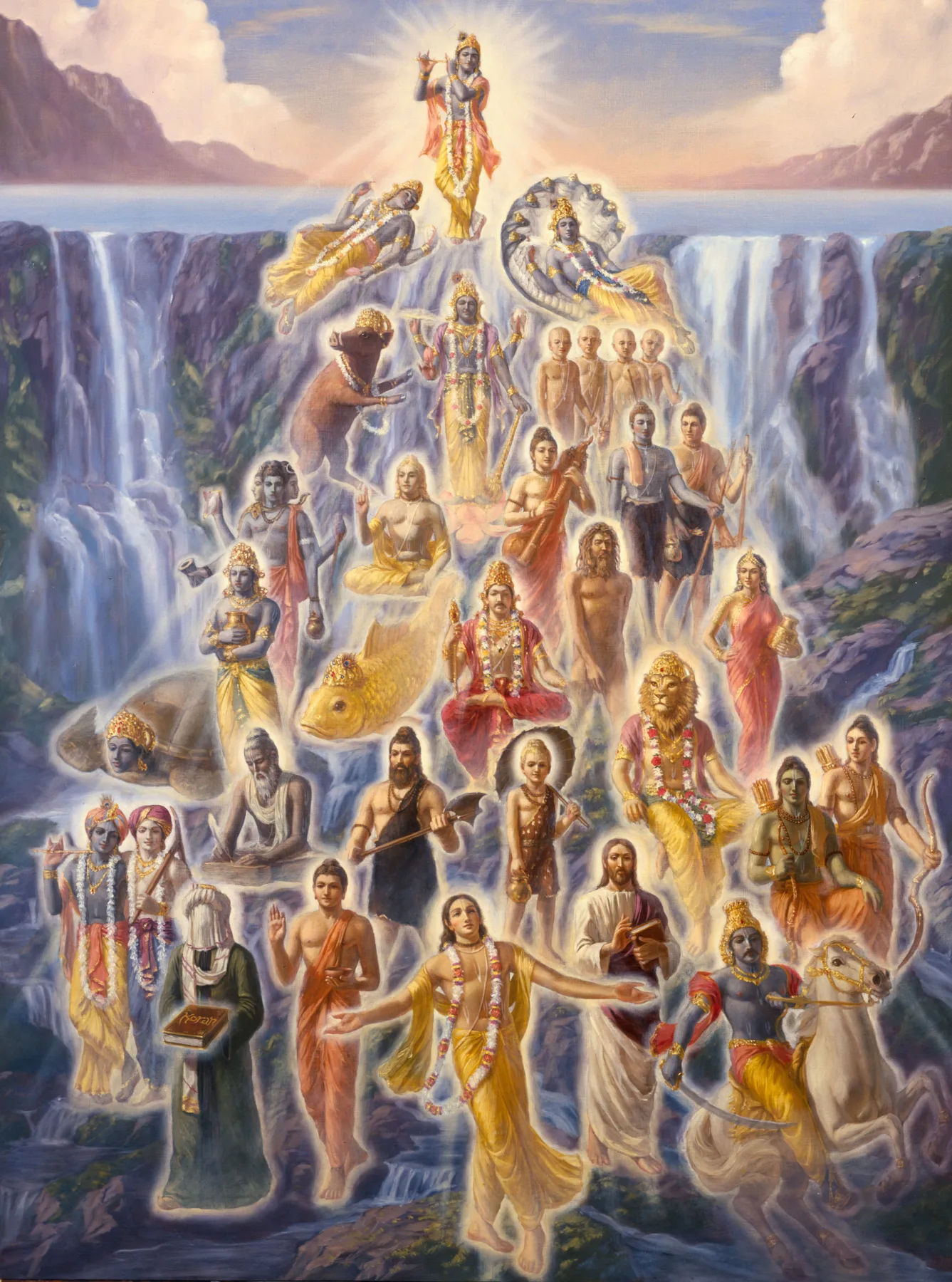
A reader who already knows Brahma-samhita's testimony or Srimad-Bhagavatam's direct statement might reasonably ask a question. Gaudiya Vaishnavism puts Krishna at the center. Does this mean that it rejects the worship of Vishnu and Narayana as practiced throughout the rest of the Vaishnava tradition? It does not. Gaudiya theology has always explained exactly why not, clearly and without avoiding the question. The technical term at the heart of this explanation is vishnu-tattva: the category of Godhead's own direct, personal expansions. This is different from jiva-tattva, the category to which every individual soul belongs, however elevated that soul may be.
Krishna Himself, and His Expansions as Avataras #
Brahma-samhita states the relationship in a single verse. In short, the verse says "His subjective portions as the avataras, viz., Rama, etc., appear from Vaikuntha and His own form Krishna manifests Himself with Vraja in this world, from Goloka," and its full translation reads, "I worship Govinda, the primeval Lord, who manifested Himself personally as Krishna and the different avataras in the world in the forms of Rama, Nrisimha, Vamana, etc., as His subjective portions" (Brahma-samhita 5.39). The distinction is exact. Rama, Nrisimha, Vamana and the other incarnations are described as kala-niyamena, appearing "by the rule of a portion." They are real and fully divine, and they are worthy of full worship. Yet they are portions, not the source itself. The same verse names that source as Krishna, appearing personally, svayam.
| Detail | Description |
|---|---|
| Vishnu-tattva | Godhead's own direct, personal expansions: Vishnu, Narayana, Rama, Nrisimha, and so on |
| Jiva-tattva | The category every individual soul belongs to, including Brahma and Shiva |
| Relationship to Krishna | Vishnu-tattva forms are Krishna's own expansions, equal in divinity, distinct in manifestation |
| Governing analogy (Brahma-samhita 5.46) | One candle's flame lit from another: identical in quality, distinct in location |
| Maha-Vishnu (Brahma-samhita 5.47-48) | The source of unlimited material universes, Himself described as a "portion of a portion" of Govinda |
The Candle and the Causal Ocean #
Brahma-samhita gives its own main example to show how this works without contradiction. "The light of one candle being communicated to other candles, although it burns separately in them, is the same in its quality. I adore the primeval Lord Govinda who exhibits Himself equally in the same mobile manner in His various manifestations" (Brahma-samhita 5.46). Nothing is lost or reduced in the candle that lights another. The second candle's flame is in no way less truly fire. By this account, Vishnu-tattva expansion works the same way. Full divinity is passed on to each expansion without being divided or lost.
The text then applies this same principle on the scale of the whole cosmos. Maha-Vishnu is the form of Godhead who lies in the Causal Ocean, and entire universes come out from Him as He breathes out. Brahma-samhita describes Him very exactly: "I adore the primeval Lord Govinda who assuming His own great subjective form... reposing in the Causal Ocean with the infinity of the world in the pores of His hair, enjoys creative sleep" (Brahma-samhita 5.47). The verses that follow continue: "Brahma and other lords of the mundane worlds, appearing from the pores of hair of Maha-Vishnu, remain alive as long as the duration of one exhalation of the latter. I adore the primeval Lord Govinda of whose subjective personality Maha-Vishnu is the portion of portion" (Brahma-samhita 5.48). Maha-Vishnu is the very form of Godhead who produces unlimited material universes, each with its own Brahma. Yet here He is clearly named a kala-visesha, a specific portion of a portion, of Govinda. This is a very great claim. Entire universes live and die within the span of Maha-Vishnu's breathing. Yet, by Brahma-samhita's own account, even He is still not the source itself.
Brahma's Own Confession Fits the Same Pattern #
This same doctrine explains a verse already examined on The Bhagavatam's Direct Statement: Brahma's confession to Krishna after the Brahma-vimohana-lila. "Lord Narayana is Your expansion, and He is called Narayana because He is the generating source of the primeval water of the universe. He is real, not a product of Your illusory Maya" (Srimad-Bhagavatam 10.14.14). The phrase "not a product of Your illusory Maya" matters as much as the naming of Narayana as Krishna's expansion. Gaudiya theology clearly teaches that vishnu-tattva expansions are not like the false images that material illusion produces. They are not projections, mere appearances or lesser reflections. They are fully real, fully divine persons. They are simply not the original source.
Not a Rejection of Vishnu Worship #
Because of this doctrine, Gaudiya theology does not regard the worship of Vishnu or Narayana, as practiced throughout the wider Vaishnava world, as mistaken or lower in kind. Srila Madhvacharya built an entire tradition centered on Vishnu worship, and it is still thriving today at Udupi. This tradition traces its guru-parampara through his line and does not treat that as a contradiction. Madhvacharya's own page examines this relationship in detail. Gaudiya theology takes nothing away. What it adds is a claim about origin. This claim concerns Krishna, specifically in His two-armed form in Vrindavana. Among the vishnu-tattva forms, He is not just one equal expansion among many. He is the source from which the entire category comes. Every verse examined here describes expansion, never reduction or contradiction. That is how Gaudiya Vaishnavism has always insisted the relationship must be understood.
Why This Doctrine Had to Be Explained, Not Assumed #
Suppose a Krishna-centered theology could not explain Vishnu and Narayana this exactly. Then it would leave a real gap. Either it would imply that most of Vaishnava history worshiped the wrong form of God, or it would contradict its own scriptural sources. Several of those sources, including Srimad-Bhagavatam itself, give enormous attention to Vishnu and Narayana Themselves. The doctrine of vishnu-tattva closes that gap without giving up either truth. Krishna's supremacy stands, and the full divinity of Vishnu and Narayana stands with it. They are related as source and expansion, not as rivals. The same pattern of expansion without loss appears again, in a very different setting, on Sri Chaitanya Mahaprabhu: Krishna Himself. There, Krishna's own personal associates are understood to come with Him whenever He appears, right alongside His plenary forms.
Scriptural evidence for this chapter (4)
Quoted in the text above:
Further verses:
yaḥ kāraṇārṇava-jale bhajati sma yoga-
nidrām ananta-jagad-aṇḍa-sa-roma-kūpaḥ
ādhāra-śaktim avalambya parāṁ sva-mūrtiṁ
govindam ādi-puruṣaṁ tam ahaṁ bhajāmi
I adore the primeval Lord Govinda who, assuming His own great subjective form bearing the name of Shesha, replete with the all-accommodating potency, and reposing in the Causal Ocean with the infinity of the world in the pores of His hair, enjoys creative sleep (yoga-nidra).
Describes Maha-Vishnu (Karanodakashayi Vishnu), the vishnu-tattva form reposing in the Causal Ocean from whom unlimited material universes emanate.
Chapter 7
Sri Chaitanya Mahaprabhu: Krishna Himself
Gaudiya Vaishnavism holds that the same Krishna appeared again in Bengal, in the mood and complexion of His own greatest devotee, Radharani.
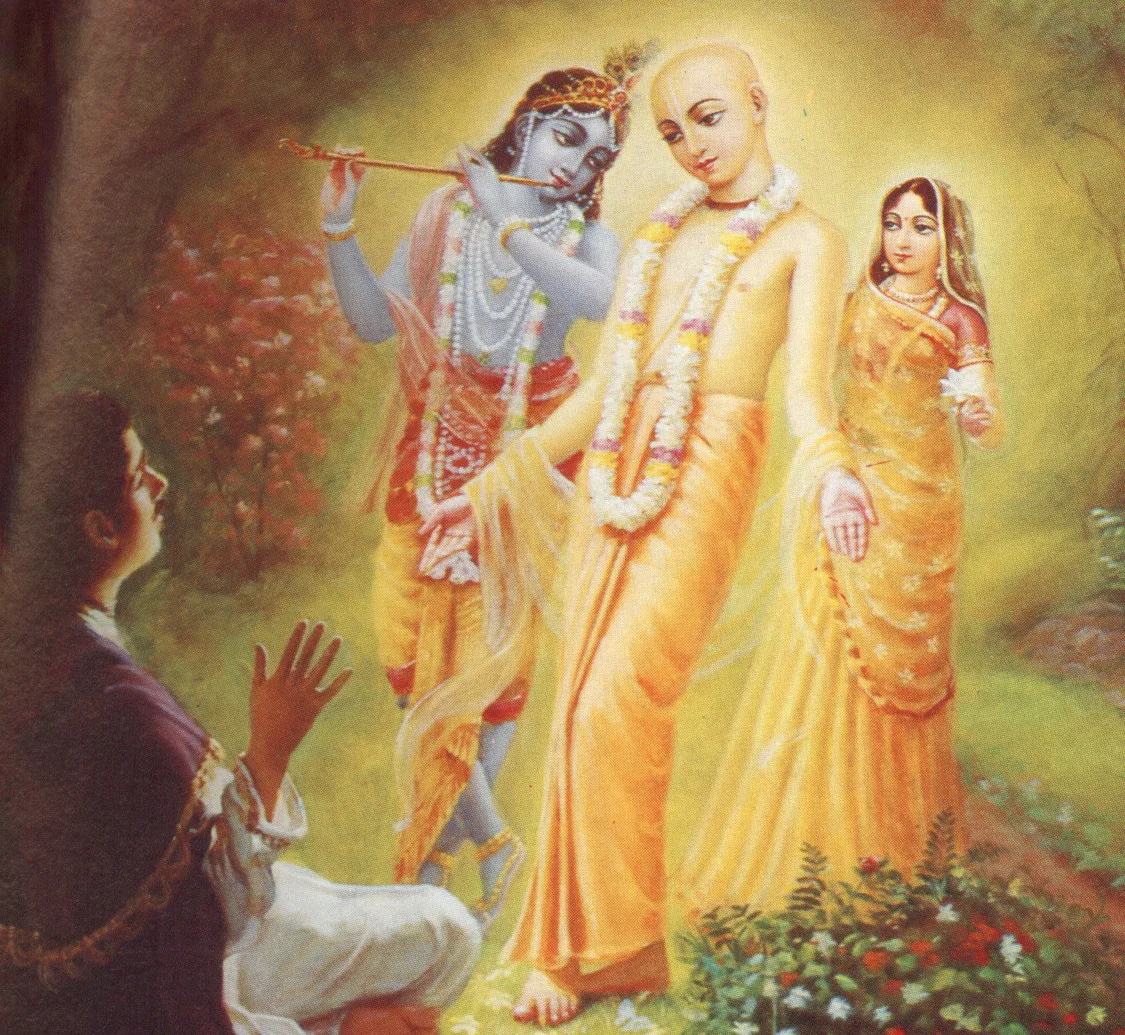
Whatever historical account one reads, Sri Chaitanya Mahaprabhu is the founder of Gaudiya Vaishnavism. He turned congregational chanting into the mass movement that this tradition still carries on. But this tradition does not understand Him through history alone. So this account must state plainly what Gaudiya Vaishnavas actually believe about who He was. They believe that He was not a great devotee of Krishna, and not a saint whom Krishna especially favored, but Krishna Himself. He appeared a second time, in a specific form that He chose on purpose.
The Opening Prayer of Chaitanya-charitamrita #
Krishnadasa Kaviraja Goswami states this claim in the first main verses of his biography of Mahaprabhu. Both verses were checked directly in the original book, not taken from any secondhand quotation. The fourth verse at the opening of the Adi-lila reads, in translation: "May the Supreme Lord who is known as the son of Srimati Sachi-devi be transcendentally situated in the innermost chambers of your heart. Resplendent with the radiance of molten gold, He has appeared in the Age of Kali by His causeless mercy to bestow what no incarnation has ever offered before: the most sublime and radiant mellow of devotional service, the mellow of conjugal love" (Sri Chaitanya-charitamrita, Adi-lila 1.4). The very next verse explains exactly how this came about: "The loving affairs of Sri Radha and Krishna are transcendental manifestations of the Lord's internal pleasure-giving potency. Although Radha and Krishna are one in Their identity, previously They separated Themselves. Now these two transcendental identities have again united, in the form of Sri Krishna Chaitanya. I bow down to Him, who has manifested Himself with the sentiment and complexion of Srimati Radharani although He is Krishna Himself" (Chaitanya-charitamrita, Adi-lila 1.5).
| Detail | Description |
|---|---|
| CC Adi 1.4-5 | Krishnadasa Kaviraja's own opening invocation, identifying Mahaprabhu as Krishna in Radha's mood |
| Prophesied in | Srimad-Bhagavatam 11.5.32: the *krishna-varnam* verse |
| Reason given | To taste, and freely distribute, the sweetness of pure love of God (krishna-prema) |
| Organizing framework | The Panca-tattva: five features of the one appearance |
| Corresponding category | Panca-tattva |
A Verse Prophesying His Own Appearance #
The claim does not rest on Chaitanya-charitamrita alone. Srimad-Bhagavatam itself was composed many centuries before Mahaprabhu's appearance. It contains a verse that Gaudiya Vaishnavas read as a direct prophecy of exactly this event: "In the Age of Kali, intelligent persons perform congregational chanting to worship the incarnation of Godhead who constantly sings the names of Krishna. Although His complexion is not blackish, He is Krishna Himself. He is accompanied by His associates, servants, weapons and confidential companions" (Srimad-Bhagavatam 11.5.32). Every part of that verse fits Mahaprabhu's own recorded life. His complexion was golden, not blackish, while Krishna's own is famously dark. He is worshiped through sankirtana, congregational chanting, rather than temple ritual. And He had constant companions. He did not appear alone. Srila Prabhupada quoted this exact verse as early as December 1966, in one of his first recorded lectures in New York. He explained that "great sages, great philosophers" had confirmed Mahaprabhu's identity from these very symptoms, since Chaitanya Himself "never said that 'I am avatara.'"
Why This Particular Appearance #
Gaudiya theology gives a specific reason why Krishna would appear a second time, in this particular changed form, instead of simply returning as Himself. As the object of Radharani's love, Krishna experiences being loved. But even in that original form, He cannot experience what it is to love Krishna the way Radharani does. He is the one who receives Her devotion, so He cannot taste its full intensity from Her side. Chaitanya-charitamrita's own account, examined above, says that Krishna appeared "with the sentiment and complexion of Srimati Radharani" specifically to taste that experience directly. At the same time, He came to give madhurya-rasa freely to every soul in the Age of Kali. Even His own appearance in Vrindavana had not offered this mellow of devotion so openly. Rupa Goswami's science of rasa is examined on The Six Goswamis and Krishna-sandarbha. It gives the technical terms for exactly what that mellow is and why it ranks as the fullest expression of devotion. In this account, Mahaprabhu's own appearance shows in living form the teaching that Rupa Goswami later set out in systematic form.
The Panca-tattva #
Krishna does not appear alone in this understanding. Chaitanya-charitamrita states directly that "these five tattvas incarnate with Lord Chaitanya Mahaprabhu, and thus the Lord executes His sankirtana movement with great pleasure" (Chaitanya-charitamrita, Adi-lila 7.4). This is the Panca-tattva, five features of the one appearance, all present at the same time. Later verses explain their relationship exactly: "Spiritually there are no differences between these five tattvas, for on the transcendental platform everything is absolute. Yet there are also varieties in the spiritual world, and in order to taste these spiritual varieties one should distinguish between them" (Chaitanya-charitamrita, Adi-lila 7.5). This teaching is the basis for the category used to group the biographical pages here, Panca-tattva. It follows the same logic examined on The Vishnu-tattva Expansions. The five are fully one in essence, and yet they are truly distinct in their features. Neither truth cancels the other.
Not a Separate Claim, But the Same One #
It would be easy to think that this account brings in an entirely new theological subject. It might seem separate from the case for Krishna's supremacy made on the other pages. It is not. Every proof gathered on those pages describes the same single person, and this tradition holds that He appeared again in Nabadwip. Those proofs are Brahma-samhita naming Krishna the cause of all causes, Krishna's own words in the Gita, Srimad-Bhagavatam's direct statement, the Vedic record, the Six Goswamis' systematic case, and the vishnu-tattva doctrine explaining Krishna's expansions. Sri Chaitanya Mahaprabhu's own page tells the historical story of that appearance in full. This page gives only the claim itself, and the specific verses on which Gaudiya Vaishnavism has always said that claim rests.
Scriptural evidence for this chapter (5)
Quoted in the text above:
- CC Adi 1.4 Sri Chaitanya-charitamrita
- CC Adi 1.5 Sri Chaitanya-charitamrita
- SB 11.5.32 Srimad-Bhagavatam
- CC Adi 7.4 Sri Chaitanya-charitamrita
- CC Adi 7.5 Sri Chaitanya-charitamrita
Chapter 8
Srimad-Bhagavatam as Krishna's Own Literary Incarnation
Gaudiya Vaishnavism holds Srimad-Bhagavatam to be not merely a book about Krishna, but Krishna's own incarnation in the form of transcendental sound.
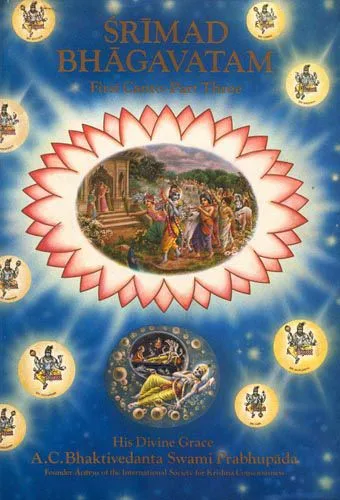
On other pages, Srimad-Bhagavatam serves as a source. The book is opened and its verses are drawn out one by one as evidence for Krishna's supremacy. Here the Bhagavatam itself is the subject. Gaudiya Vaishnava tradition does not regard it merely as a very authoritative book about Krishna. Such a book might be more reliable than other scriptures, but in the end it would still be only a book. The tradition holds Srimad-Bhagavatam to be Krishna's own incarnation. He does not appear here in a body of flesh, as at Vrindavana or Kurukshetra, but in the form of transcendental sound. This is not devotional exaggeration or a poetic figure of speech. It is stated as literal doctrine, in the Bhagavatam's own words, and this page shows exactly where.
The Same Chapter, Twelve Verses Later #
The Bhagavatam's Direct Statement already examines the Third Chapter of the First Canto in detail. That chapter lists incarnation after incarnation. The list builds up to the verdict of Srimad-Bhagavatam 1.3.28, that Krishna alone is bhagavan svayam, the original Personality of Godhead. Every other incarnation named is a portion or a portion of a portion. But the chapter does not end there. Twelve verses later, after finishing its list of the incarnations, it turns to describe the book itself, the same book that has been telling all of this. It states directly what that book is: "This Srimad-Bhagavatam is the literary incarnation of God, and it is compiled by Srila Vyasadeva, the incarnation of God. It is meant for the ultimate good of all people, and it is all-successful, all-blissful and all-perfect" (Srimad-Bhagavatam 1.3.40).
| Detail | Description |
|---|---|
| Reference | Srimad-Bhagavatam 1.3.40 |
| Central claim | Srimad-Bhagavatam is Krishna's own literary incarnation, compiled by Vyasadeva, himself an incarnation |
| Confirming verse | SB 1.3.43: the Bhagavatam arose "just after the departure of Lord Krishna to His own abode" |
| Doctrine | Shabda-avatara: the Supreme Lord's incarnation in the form of transcendental sound |
| Practical implication | Hearing and studying the Bhagavatam from a bona fide source is treated as direct association with Krishna |
Srila Prabhupada's own purport to this verse states plainly what this means: "Srimad-Bhagavatam is the literary incarnation of Lord Sri Krishna and is therefore nondifferent from Him... Srimad-Bhagavatam should be worshiped as respectfully as we worship the Lord." In this tradition's understanding, an incarnation is not a symbol of Krishna, or something that stands in for Him while He is absent. It is Krishna Himself, appearing in a different form for a particular purpose. Here the form is a book. The purpose is the one the verse itself names: the ultimate good of all people in an age when Krishna's own personal, bodily presence in Vrindavana and Dvaraka has ended.
The Bhagavatam's Own Limbs #
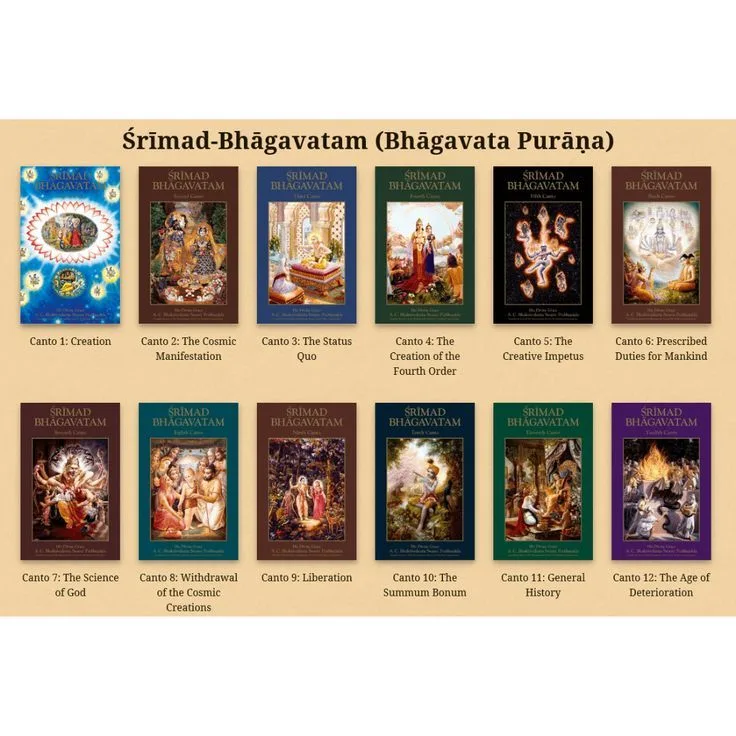
Another verse, quoted from the Padma Purana, makes the same claim in an even more vivid, physical way. It does not say only that the Bhagavatam represents Krishna. It matches the twelve cantos directly with Krishna's own transcendental body, limb by limb:
pādau yadīyau prathama-dvitīyau
tṛtīya-turyau kathitau yad-ūrū
nābhis tathā pañcama eva ṣaṣṭho
bhujāntaraṁ dor-yugalaṁ tathānyau
kaṇṭhas tu rājan navamo yadīyo
mukhāravindaṁ daśamaṁ praphullam
ekādaśo yasya lalāṭa-paṭṭaṁ
śiro 'pi tu dvādaśa eva bhāti
"The First and Second Cantos of the Bhagavatam are Sri Krishna's lotus feet. The Third and Fourth Cantos are His thighs. The Fifth Canto is His navel. The Sixth Canto is His chest. The Seventh and Eighth Cantos are His arms. The Ninth Canto is His throat. The Tenth Canto is His beautiful lotus face. The Eleventh Canto is His forehead. The Twelfth Canto is His head."
The same passage closes with a direct prayer to the book itself, addressed as a person:
tam ādi-devaṁ karuṇā-nidhānaṁ
tamāla-varṇaṁ suhitāvatāram
apāra-saṁsāra-samudra-setuṁ
bhajāmahe bhāgavata-svarūpam
"I bow down to that original Lord, the ocean of mercy, whose color is like that of a tamala tree, who appears in this world for the welfare of all. I worship Him as the bridge for crossing the unfathomable ocean of material existence. The Bhagavatam has appeared as His very Self."
This verse is not just poetic decoration. SB 1.3.40 states directly that Srimad-Bhagavatam is Krishna's own literary incarnation. If that is so, this verse simply carries that claim to its natural conclusion. The book has a body, and that body is Krishna's own.
Two Verses That Confirm the Claim #
The chapter's very next verses state clearly when this incarnation appeared. "This Bhagavata Purana is as brilliant as the sun, and it has arisen just after the departure of Lord Krishna to His own abode, accompanied by religion, knowledge, etc. Persons who have lost their vision due to the dense darkness of ignorance in the Age of Kali shall get light from this Purana" (Srimad-Bhagavatam 1.3.43). Srila Prabhupada's purport draws the conclusion as directly as the verse itself: "We must therefore accept Srimad-Bhagavatam as the direct representation of Lord Krishna. One who can see Srimad-Bhagavatam can see also Lord Sri Krishna in person. They are identical." The order of events matters. Krishna returns to His own abode, and at that very time the Bhagavatam "arises." It is not a memorial of someone who has now gone away. It is His own continuing presence in a different form.
Another verse, from the opening chapter of the First Canto, describes what kind of presence this is meant to be. Srimad-Bhagavatam is called "the mature fruit of the desire tree of Vedic literatures," made sweeter still for having "emanated from the lips of Sri Sukadeva Gosvami" (Srimad-Bhagavatam 1.1.3). This fruit did not fall to the ground on its own. It was carried down carefully through an unbroken chain of speakers, from Narada to Vyasadeva to Sukadeva Gosvami to Maharaja Parikshit, and from Parikshit's own assembly down to every disciplic succession since. The picture that the verse itself gives should be taken seriously. What the hearer tastes is not information taken out of a text. It is a fruit received, still whole, from a particular mouth.
Hearing as Direct Contact #
If the Bhagavatam is Krishna's own literary incarnation, then hearing it is not just a preparation for meeting Krishna more directly at some later time. Hearing it already is that meeting. Srimad-Bhagavatam says this about Krishna's own narrations in general: "Sri Krishna, the Personality of Godhead, who is the Paramatma [Supersoul] in everyone's heart and the benefactor of the truthful devotee, cleanses desire for material enjoyment from the heart of the devotee who has developed the urge to hear His messages" (Srimad-Bhagavatam 1.2.17). Srila Prabhupada's purport explains plainly how this works: "Messages of the Personality of Godhead, Sri Krishna, are nondifferent from Him. Whenever, therefore, offenseless hearing and glorification of God are undertaken, it is to be understood that Lord Krishna is present there in the form of transcendental sound, which is as powerful as the Lord personally." In the same purport, he at once quotes Sri Chaitanya Mahaprabhu's Siksastaka to make the same point about Krishna's holy names in particular. It is one doctrine, shabda as avatara, applied to two different forms of sound. It is examined in full on The Holy Name: Krishna's Incarnation for This Age.
What This Means in Practice #
This is why Gaudiya Vaishnava temples, this tradition included, treat Bhagavatam class with a formality closer to Deity worship than to ordinary study. The book is not opened casually. It is handled with respect and heard from, not merely read silently. In his purport to SB 1.3.40, Srila Prabhupada records the standard this tradition sets for how that hearing should happen. He quotes Sri Chaitanya Mahaprabhu's own private secretary: "Srila Svarupa Damodara Gosvami advised all intending visitors who came to see the Lord at Puri to make a study of the Bhagavatam from the person Bhagavatam," meaning a living, self-realized representative of the disciplic succession, not a printed page alone. This is the same principle already familiar from Vyasadeva's own page. In this tradition, scripture is never received apart from the chain of speakers who carry it. The chain itself is part of what makes the encounter real, and not just a passing on of information. The Source of This Parampara traces this same chain back to its actual root.
The page Krishna Himself examines Sri Chaitanya Mahaprabhu Himself at length. Mahaprabhu is recorded as having declared this very status for the text, saying that Srimad-Bhagavatam is "the spotless sound representation of all Vedic knowledge and history." But this page is concerned with the specific scriptural ground for the claim. Mahaprabhu said so. More than that, the Bhagavatam says so about itself. It says so in the same chapter that already gave, on another page, the most important verse about who Krishna is. Srila Prabhupada's own life's work was translating this text and distributing it worldwide. That work rests on accepting the claim just as it is stated. Giving someone the Bhagavatam is not merely giving them information about Krishna. It is giving them Krishna.
Scriptural evidence for this chapter (5)
Quoted in the text above:
- SB 1.3.40 Srimad-Bhagavatam
- SB 1.3.43 Srimad-Bhagavatam
- SB 1.2.17 Srimad-Bhagavatam
- Padma Purana (Bhagavata-mahatmya)
Further verses:
nigama-kalpa-taror galitaṁ phalaṁ
śuka-mukhād amṛta-drava-saṁyutam
pibata bhāgavataṁ rasam ālayaṁ
muhur aho rasikā bhuvi bhāvukāḥ
Word for word
nigama-kalpa-taroḥ: of the Vedic literatures, the desire tree; galitam: fully matured; phalam: fruit; śuka-mukhāt: from the lips of Śrīla Śukadeva Gosvāmī; amṛta: nectar; drava-saṁyutam: softened and made relishable; pibata: do relish it; bhāgavatam: the book dealing in the science of the eternal relation with the Lord; rasam: juice; ālayam: until liberation; muhuḥ: always; rasikāḥ: those full in the knowledge of mellows; bhuvi: on the earth; bhāvukāḥ: expert and thoughtful.
O expert and thoughtful men, relish Srimad-Bhagavatam, the mature fruit of the desire tree of Vedic literatures. It emanated from the lips of Sri Sukadeva Gosvami. Therefore this fruit has become even more tasteful, although its nectarean juice was already relishable for all, including liberated souls.
From the purport: The ripened fruit is not dropped all of a sudden from the highest planet of Krishnaloka. Rather, it has come down carefully through the chain of disciplic succession without change or disturbance.
Describes the Bhagavatam as the ripened fruit of Vedic literature, received only through an unbroken chain of speakers, the same disciplic-succession principle the parampara pages already document.
Chapter 9
The Holy Name: Krishna's Incarnation for This Age
Gaudiya Vaishnavism holds that Krishna's name is not different from Krishna Himself, and that in Kali-yuga His most merciful and accessible incarnation is the chanting of that name.
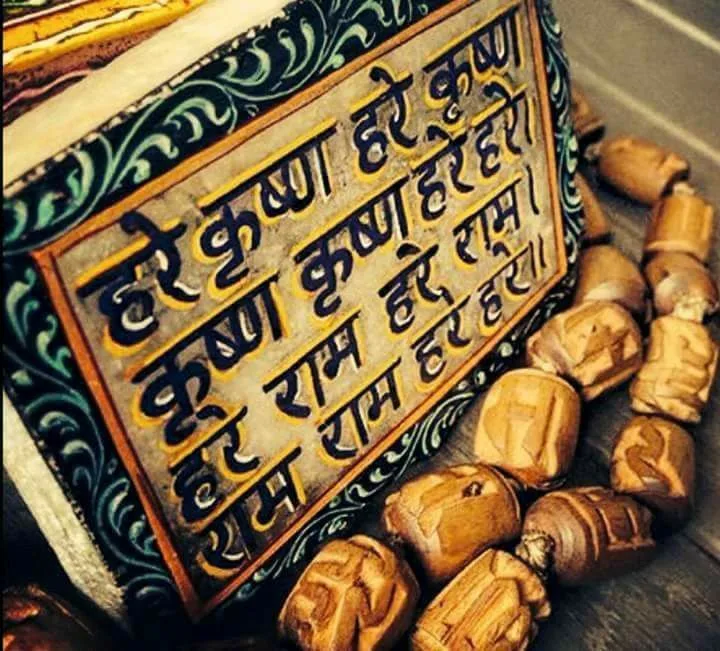
Each of the other proofs gathered on these pages shows, from a different angle, that Krishna is bhagavan svayam, the Supreme Personality of Godhead Himself. He is not a portion or a symbol of God. He is God in person. A question follows naturally from this. Krishna appeared in His own body at particular times and in particular places, in Vrindavana and Dvaraka, many centuries ago. So how can a soul living now, in the Age of Kali, come close to Him, when there is no real hope of meeting Him in person? Gaudiya Vaishnavism's answer is not a compromise or a weaker second choice. Krishna's name is not different from Krishna. The name itself is His incarnation for exactly this age.
Name and Named Are Not Different #
Sri Chaitanya Mahaprabhu states the doctrine directly, in a verse He Himself quotes at Varanasi, while speaking to a Maharashtrian brahmana: "The holy name of Krishna is transcendentally blissful. It bestows all spiritual benedictions, for it is Krishna Himself, the reservoir of all pleasure... This is because the name of Krishna and Krishna Himself are identical" (quoted in Sri Chaitanya-charitamrita, Madhya-lila 17.133). Srila Prabhupada's purport to this verse names the Padma Purana as its source. We must say clearly what can be checked here and what cannot. We could not find this exact verse in any surviving edition of the Padma Purana that was available to compare. Some outside researchers have also questioned where exactly the verse comes from. But two things are fully confirmed, and they matter most for this tradition's own practice. First, Sri Chaitanya Mahaprabhu quoted the verse as authoritative, in exactly this place in Chaitanya-charitamrita. Second, ever since then, Gaudiya Vaishnavism has accepted it as scriptural teaching on nama-nami-abheda, the nondifference of the name and its owner.
| Detail | Description |
|---|---|
| Doctrine | Nama-nami-abheda: the holy name of Krishna is nondifferent from Krishna Himself |
| Key statement | CC Madhya 17.133: "the name of Krishna and Krishna Himself are identical" (traditionally attributed to Padma Purana; exact source unverified) |
| Foundational verse | Siksastaka 1 (CC Antya 20.12): Sri Chaitanya Mahaprabhu's own words on sankirtana |
| Kali-yuga's one virtue | SB 12.3.51: liberation through chanting alone |
| No other means | CC Adi 17.21: "there is no other means, no other means, no other means" |
This teaching does not rest on one disputed verse alone. Srimad-Bhagavatam as Krishna's Own Literary Incarnation already looks at Srila Prabhupada's purport to SB 1.2.17. There the same principle is stated about Krishna's spoken messages in general: "Lord Krishna is present there in the form of transcendental sound." In the same purport, Srila Prabhupada at once quotes Sri Chaitanya Mahaprabhu's Siksastaka to show that the same is true of Krishna's holy name, which "has all the potencies of the Lord." So two separate verses, seen from two different sides, lead to the same teaching. Krishna is fully present in sound, whether that sound is the Bhagavatam's account of His pastimes or simply His name.
How Krishna Appears in This Age #
Sri Chaitanya Mahaprabhu: Krishna Himself already looks at Srimad-Bhagavatam 11.5.32 to show who Mahaprabhu is. It reads the verse as a prophecy that names His golden complexion and His constant companions. Here we return to the same verse for another reason, to see what it says about the age itself, not about the person. The verse links Krishna's own presence in Kali-yuga to one particular practice, and the two cannot be separated: "In the Age of Kali, intelligent persons perform congregational chanting to worship the incarnation of Godhead who constantly sings the names of Krishna... He is Krishna Himself" (Srimad-Bhagavatam 11.5.32). Other parts of scripture say that each earlier age in the Vedic account of time had its own recommended way to approach Krishna. It was meditation in Satya-yuga, elaborate sacrifice in Treta-yuga and opulent temple worship in Dvapara-yuga. This verse names the process for Kali-yuga just as clearly. It is sankirtana, congregational chanting. This worship needs no special renunciation, no fire altar and no wealth. It needs only the willingness to chant and hear.
Chaitanya Mahaprabhu's Own Foundational Statement #
The Siksastaka already tells how these eight verses are the entire written legacy Sri Chaitanya Mahaprabhu left in His own hand. The first of them is not about Himself at all. It is a declaration of victory for congregational chanting itself: "Let there be all victory for the chanting of the holy name of Lord Krishna, which can cleanse the mirror of the heart and stop the miseries of the blazing fire of material existence. That chanting is the waxing moon that spreads the white lotus of good fortune for all living entities. It is the life and soul of all education... it gives a cooling effect to everyone and enables one to taste full nectar at every step" (Sri Chaitanya-charitamrita, Antya-lila 20.12). The founder of this movement chose to begin His only written work in this way. He did not begin with an argument about who He was. He began with praise for the practice He came to give. This tradition sees that choice as a sign of what mattered most to Him.
Why Congregational Chanting, Specifically #
Wherever else Srimad-Bhagavatam describes Kali-yuga, it calls this age an ocean of faults, quarrel and hypocrisy. But it makes one exception: "My dear King, although Kali-yuga is an ocean of faults, there is still one good quality about this age: Simply by chanting the Hare Krishna maha-mantra, one can become free from material bondage and be promoted to the transcendental kingdom" (Srimad-Bhagavatam 12.3.51). While instructing His followers, Sri Chaitanya Mahaprabhu Himself quoted a verse that makes the same point even more strongly: "In this Age of Kali there is no other means, no other means, no other means for self-realization than chanting the holy name, chanting the holy name, chanting the holy name of Lord Hari" (quoted in Sri Chaitanya-charitamrita, Adi-lila 17.21). The threefold repetition in the original is not just for style. Gaudiya commentators read the triple emphasis as ruling out meditation, sacrifice and temple worship, one by one, as the main process for this age. In their place stands the one process that the conditions of this age cannot block.
The name carries Krishna's full potency. It does not merely point toward Him. That is why chanting it does not need the long preparation and qualification that other spiritual processes have demanded in the past. This follows directly from nama-nami-abheda and is not a separate claim. Sankirtana is also congregational by its very nature. It is public and shared, not private and solitary. That is why it offers something the processes of earlier ages could not: an invitation open to everyone who can hear it, whatever their birth, training or situation. Sri Chaitanya Mahaprabhu's own inauguration of this practice, at Srivasa Angan and then in the streets of Nabadwip, put exactly this teaching into action in history. Srila Prabhupada's own mission carried the same congregational chanting to every part of the world that Mahaprabhu's own associates could not reach. It is the tradition's most direct link to what Mahaprabhu began.
The Same Claim, Restated #
Nothing on this page adds a teaching that is unrelated to the rest of the case for who Krishna is. The root of that case is that Krishna is the origin of the guru-parampara and has no guru of His own. This is stated directly on The Source of This Parampara. This account makes the same claim and carries it one step further. Krishna's own words in the Bhagavad-gita, Srimad-Bhagavatam's direct statement and the Six Goswamis' systematic case all establish that Krishna is bhagavan svayam. He is not a portion of Godhead but its source. This account gives the practical conclusion that this tradition has always drawn from that claim. Krishna is truly the Supreme Personality of Godhead, and His name is truly nondifferent from Him. So He has not left the conditioned souls of this age without a direct way to reach Him. He has simply made Himself as near as His own name, chanted with an open heart.
Songs in the Vaishnava Song Book #
The Vaishnava Song Book carries several songs that put these same teachings directly into devotional verse. Ceto Darpana Marjanam is Chaitanya Mahaprabhu's own Siksastaka verse 1, quoted above. Nama Tattva sets to song Srimad-Bhagavatam 12.3.51. This is the verse cited earlier to show why chanting is the recommended process of this age. Jaya Jaya Hari Nama Cid Anandamrta Dhama states plainly that the Holy Name is not a symbol pointing to Krishna but is directly identical with Him. Ohe Hari Nama Taba Mahima Apara addresses the name as Krishna Himself. Harinama Tuwa Anek Swarupa and Krsna Nama Dhare Koto Bal both explore the name's own transcendental potency and forms. Biswe Udita Nama Tapana pictures the Holy Name rising over the world like a sun in this age of Kali. Hari Hari Biphale Janama and Gaite Gaite Nama Ki Dasa Hoilo both describe the treasure of congregational chanting that has descended for the fallen souls of this age. The Hare Krishna Maha-mantra itself, of course, is the direct practice described throughout this account.
Scriptural evidence for this chapter (6)
Quoted in the text above:
- CC Madhya 17.133 Sri Chaitanya-charitamrita
- CC Antya 20.12 (Siksastaka verse 1) Sri Chaitanya-charitamrita
- SB 11.5.32 Srimad-Bhagavatam
- SB 12.3.51 Srimad-Bhagavatam
- CC Adi 17.21 Sri Chaitanya-charitamrita
Further verses:
śṛṇvatāṁ sva-kathāḥ kṛṣṇaḥ
puṇya-śravaṇa-kīrtanaḥ
hṛdy antaḥ stho hy abhadrāṇi
vidhunoti suhṛt satām
Word for word
śṛṇvatām: those who have developed the urge to hear; sva-kathāḥ: His own words; kṛṣṇaḥ: the Personality of Godhead; puṇya-śravaṇa-kīrtanaḥ: virtuous to hear and chant; hṛdi antaḥ sthaḥ: within one's heart; abhadrāṇi: desire to enjoy matter; vidhunoti: cleanses; suhṛt: benefactor; satām: of the truthful.
Sri Krishna, the Personality of Godhead, who is the Paramatma [Supersoul] in everyone's heart and the benefactor of the truthful devotee, cleanses desire for material enjoyment from the heart of the devotee who has developed the urge to hear His messages, which are in themselves virtuous when properly heard and chanted.
From the purport: Sri Chaitanya Mahaprabhu, in His Siksastaka, declares clearly that the holy name of the Lord has all the potencies of the Lord and that He has endowed His innumerable names with the same potency.
Reused here for its nama-nami angle specifically: the same purport that establishes shabda-avatara for Krishna's spoken messages (examined on Srimad-Bhagavatam as Krishna's Own Literary Incarnation) reaches directly for the Siksastaka to extend the identical principle to the holy name.
Chapter 10
The Source of This Parampara
Everything this website says about the guru-parampara it follows goes back to one starting point: Krishna Himself, who has no guru.
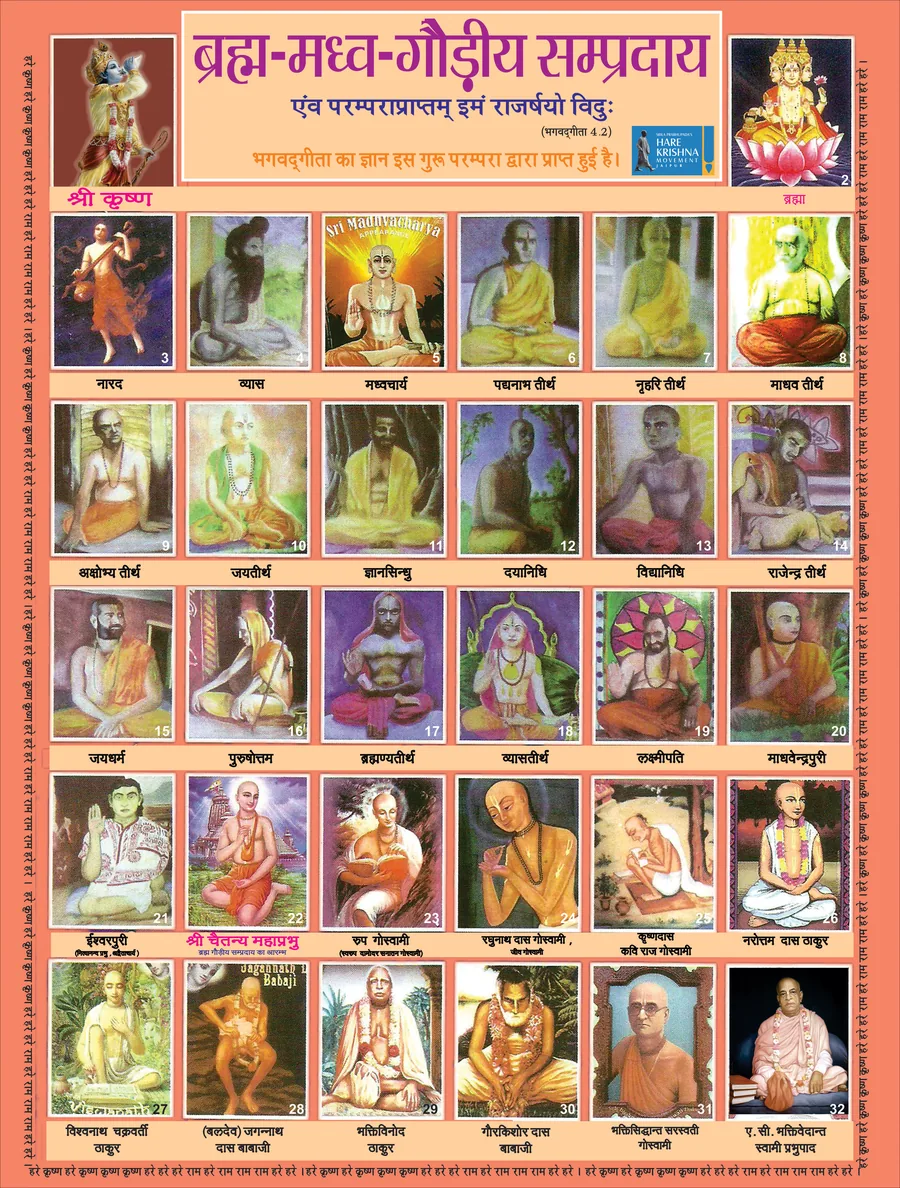
The guru-parampara, taken together, describes an unbroken chain. Lord Brahma received knowledge directly from the Supreme Lord and taught Narada Muni. Narada taught Vyasadeva. The line continued, generations later, through Madhvacharya and the Madhva-sampradaya sannyasis, down to Sri Chaitanya Mahaprabhu, the Six Goswamis, and eventually Srila Prabhupada's own generation. Every other figure in that chain has a named guru. Krishna alone does not. This page explains why. Krishna is not only the first in the chain. He is the only one in it with no guru of His own, because He is the source of everything the whole chain passes on.
No Guru to Name #
Lord Brahma's own page already sets the example here. It names no guru for Brahma, because it is better to leave that place empty than to invent a name. Brahma received the catur-shloki directly from the Lord within his own heart. No human or deva teacher stood between them, and so no guru is recorded for him. Srimad-Bhagavatam's own opening verse is the scriptural basis for this claim. It offers obeisances to "Sri Krishna, son of Vasudeva... the primeval cause of all causes of the creation, sustenance and destruction of the manifested universes... It is He only who first imparted the Vedic knowledge unto the heart of Brahmaji, the original living being" (Srimad-Bhagavatam 1.1.1). The same reasoning now takes us one step further back, to the root. Brahma has no guru because he received knowledge directly from Krishna. So Krishna Himself, who gave that knowledge, is where the question of "who taught the teacher" simply stops. He is not only the first in this chain. Without Him, there is no chain to be first in.
| Detail | Description |
|---|---|
| SB 1.1.1 | Krishna imparts Vedic knowledge directly into Brahma's heart: the Bhagavatam's own opening claim |
| Chain from Krishna | Krishna to Brahma to Narada to Vyasadeva to Madhvacharya to the Madhva-sampradaya to Chaitanya Mahaprabhu |
| Tradition | The Brahma-Madhva-Gaudiya sampradaya |
| Guru of Krishna | Deliberately omitted: Krishna has no guru |
| Next link forward | Lord Brahma |
The Brahma-Madhva-Gaudiya Sampradaya, From Its Own Root #
Srila Prabhupada named this exact chain, link by link, in a 1972 lecture in Bombay on Srimad-Bhagavatam's opening verses. He traced it in a single breath from its beginning: "So Srila Vyasadeva, our first predecessor in the disciplic chain of guru-parampara. There is guru-parampara. There are four Vaishnava sampradayas: one is called Brahma-sampradaya, the other is called Rudra-sampradaya, the other is called Sri-sampradaya, and Nimbarka-sampradaya, or Kumara-sampradaya. So we belong to the Brahma-sampradaya. Brahma's disciple and son also, Narada; his disciple, Vyasadeva; and his disciple is Madhavacharya; and Sri Chaitanya Mahaprabhu belongs to this Madhavacharya-sampradaya. His spiritual master was Ishvara Puri, and Ishvara Puri's spiritual master was Madhavendra Puri. This Madhavendra Puri happened to be in the disciplic succession of Madhavacharya; therefore we, coming down from Sri Chaitanya Mahaprabhu, we are known as Madhva-Gaudiya-sampradaya." Every name in that lecture, from Vyasadeva onward, is treated in detail elsewhere in this account, such as Madhvacharya. The fuller line that comes down through him is traced on the Madhava-sampradaya pages. This page goes one step further back than any of them, to the root that all those pages point to in the end. That root is not Brahma, though he is rightly called adi-guru, "first guru." It is Krishna. In Brahma-samhita's own opening testimony, Brahma himself calls Krishna guru. This is examined in full on Brahma-samhita's Testimony.
The Same Root Confirmed Independently #
This is not a claim resting on a single verse. In Bhagavad-gita 10.8, Krishna Himself states directly that He is the source. Srila Prabhupada's purport to that verse brings in independent support from the Vedas, quoting the Gopala-tapani Upanishad: "It was Krishna who in the beginning instructed Brahma in Vedic knowledge and who disseminated Vedic knowledge in the past" (Gopala-tapani Upanishad 1.24, examined in full on Vedic and Upanishadic Testimony). So three separate sources say the same thing: Srimad-Bhagavatam's opening verse, Brahma-samhita's own testimony, and an Upanishad that belongs to shruti itself. All three agree that Krishna taught Brahma, not the other way round, and not anyone else.
Why Krishna's Account Comes First #
It is best to read about the acharyas roughly in the order in which their teaching comes down to a Gaudiya Vaishnava disciple today. Every other figure in this chain, including Lord Brahma himself, comes somewhere further down that line. Krishna comes first, ahead of Brahma. Other pages say many things about Brahma: his role as adi-guru, his authorship of Brahma-samhita, his own defeat and confession in Vrindavana. All of these depend on an earlier claim that is stated directly here. The knowledge that Brahma received was passed down through Narada, Vyasadeva, Madhvacharya, Chaitanya Mahaprabhu, the Six Goswamis and, eventually, Srila Prabhupada himself. It did not begin with any of them. It began here.
Where the Chain Leads Next #
Now that this page has shown the root of the chain, it looks forward, as the rest of this account already does. Lord Brahma is the very next link. The knowledge Brahma received did not begin with him. It was his only to carry forward, and he was the first living being to receive it. Everything else recorded here, from Narada Muni to Srila Prabhupada's own disciples in the present day, is that same carrying forward of the knowledge. It has been repeated without a break for as long as this tradition has kept any record of itself.
Scriptural evidence for this chapter (1)
oṁ namo bhagavate vāsudevāya
janmādy asya yato 'nvayād itarataś cārtheṣv abhijñaḥ svarāṭ
tene brahma hṛdā ya ādi-kavaye muhyanti yat sūrayaḥ
tejo-vāri-mṛdāṁ yathā vinimayo yatra tri-sargo 'mṛṣā
dhāmnā svena sadā nirasta-kuhakaṁ satyaṁ paraṁ dhīmahi
Word for word
om: O my Lord; namaḥ: offering my obeisances; bhagavate: unto the Personality of Godhead; vāsudevāya: unto Vāsudeva (Lord Sri Krishna); janma-ādi: creation, sustenance and destruction; asya: of the manifested universes; yataḥ: from whom; abhijñaḥ: fully cognizant; sva-rāṭ: fully independent; tene: imparted; brahma: Vedic knowledge; hṛdā: through the heart; ya: who; ādi-kavaye: unto the original created being; muhyanti: are illusioned; yat: about whom; sūrayaḥ: great sages and demigods.
O my Lord, Sri Krishna, son of Vasudeva, O all-pervading Personality of Godhead, I offer my respectful obeisances unto You. I meditate upon Lord Sri Krishna because He is the Absolute Truth and the primeval cause of all causes of the creation, sustenance and destruction of the manifested universes... It is He only who first imparted the Vedic knowledge unto the heart of Brahmaji, the original living being.
Srimad-Bhagavatam's own opening verse, the scriptural root of the entire guru-parampara, naming Krishna as the one who taught Brahma directly, with no guru of His own.
- Brahma-samhita 5.1 and surrounding verses, vedabase.io
- Bhagavad-gita 7.7, 10.8, 15.18-19, 18.66, vedabase.io
- Srimad-Bhagavatam 1.3.28, vedabase.io
- Srimad-Bhagavatam 1.1.1, vedabase.io
- Bhagavad-gita 11.54, purport (quoting Gopala-tapani Upanishad), vedabase.io
- Sri Chaitanya-charitamrita, Adi-lila 1.4-5, vedabase.io
- Srimad-Bhagavatam 11.5.32, vedabase.io
- This website's own biography of Lord Brahma
- This website's own biography of Sri Chaitanya Mahaprabhu
- This website's own biography of Jiva Goswami
