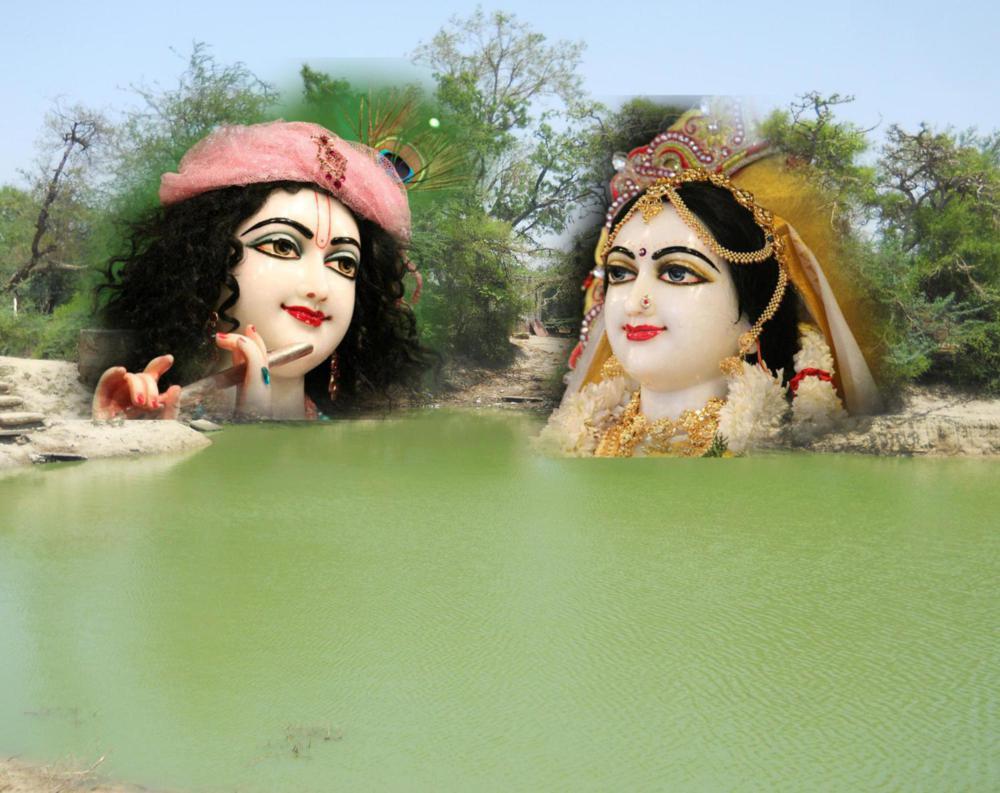
Lokanatha's wandering through the twelve forests of Vraja in time brought him to Khadiravana. From there he went on to Kishori-kunda, a small lake near the village of Umarao (also spelled Umaraa) by the forest of Chatravana. He was so struck by the beauty of the place that he stayed on there to do solitary bhajana. During this stay, a desire he had long held grew strong in him. He wanted to worship Radha and Krishna not only in meditation but in Deity form.
An Unlooked-For Gift #
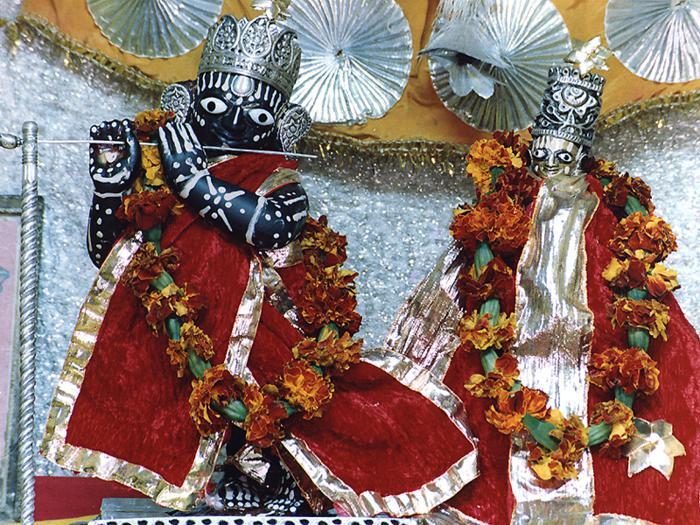
Tradition holds that Krishna, who knows the hearts of his devotees, answered this desire directly. He appeared before Lokanatha in person, presented him with a small Deity, told him its name was Radha-Vinoda, and then vanished. Lokanatha was astonished, and suddenly anxious at having been left alone with the Lord himself in Deity form. It is said that the Deity then reassured him, speaking to him with a smile: "I live here on the banks of Kishori-kunda, in the village of Umarao. I saw your eagerness to serve me, so I came here myself. Now, please, give me something to eat." Moved to tears, Lokanatha cooked at once, offered rice on a fresh banana leaf, made a bed of flowers for the Deity to rest on, and fanned him with leaves. That was the first of what would become a lifetime of personal, hands-on service.
A Cloth Bag for a Temple #
Word spread among the local Vrajavasis and cowherds, who wanted to build Lokanatha a small hut so that he and his new Deity would have a proper home. He refused. Instead, he sewed a simple cloth bag, hung it around his neck, and kept Radha-Vinoda in it at all times. As the sources put it, the Deity became like a jeweled necklace worn constantly against his chest. This was not a temporary arrangement. It remained his practice for the rest of his life, through every season and every forest he walked. It is remembered today as one of the clearest images of *vairagya* (renunciation) in the whole Gaudiya Vaishnava tradition. Lokanatha accepted nothing beyond what the Deity's own service strictly required. He refused even the comforts other devotees were eager to offer him.
From a Bag to a Temple #
The Deity Lokanatha carried through the forests did in time find a settled home. But the home that later pilgrims would see did not come in his own lifetime. Generations later, a pratibhu-murti of Radha-Vinoda was installed on the altar of the Radha-Gokulananda temple in Vrindavana proper. A pratibhu-murti is a replica of a Deity, authorized through proper ritual. Vishvanatha Chakravarti Thakura later rebuilt and expanded this temple. He brought several Deities, including his own Gokulananda, under one roof there (see Disappearance and Legacy for the fuller story of that temple and of what became of the original Deity). For most of those years, though, Radha-Vinoda's only shelter was a length of cloth and the constant, undivided attention of the renunciant who carried him. This life of service went on into Lokanatha's later years, when he took on the one disciple whose story is told in Initiating Narottama Dasa Thakura.
One Forest Among Twelve #
Chatravana, the forest by Kishori-kunda where Radha-Vinoda was revealed, is counted among the dvadasha-vana, the twelve sacred forests traditionally said to make up the wider Vraja-mandala. In this period, the Goswamis of Vrindavana worked patiently together to identify and revive the forgotten holy places scattered through these forests. This was one of their great projects, and it is most closely connected with Sanatana Goswami's own writings on Vraja's geography. Lokanatha's discovery of Radha-Vinoda at Kishori-kunda was part of the same wider work of rediscovery. Still, no source claims he took a formal, organized part in it the way Sanatana did. His contribution was simply to find, and then never leave, one particular corner of it.
