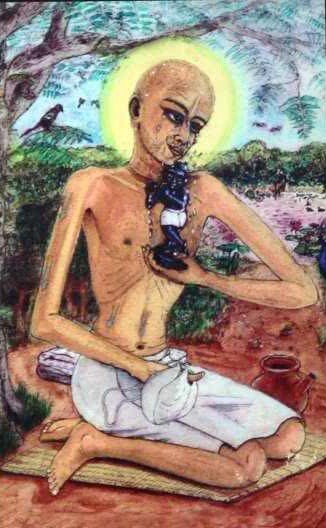
Lokanatha Gosvami did not only give up material comfort. He gave up his own reputation just as fiercely. Several independent accounts agree on the main event. Before he began to write Sri Chaitanya-charitamrita, Krishnadasa Kaviraja Goswami asked permission not only from Lokanatha but also from Raghunatha Bhatta Goswami. Lokanatha gave his blessing, but he clearly forbade Krishnadasa to write anything about him in the book. Krishnadasa was afraid to disobey the order of such a senior Vaishnava, so he obeyed. As a direct result, Lokanatha's name appears in that famous text only in passing. He receives nothing like the long description given to Rupa, Sanatana or the other Goswamis.
The One Verse That Names Him #
The one place where Lokanatha's name does appear in Sri Chaitanya-charitamrita comes almost by accident. It is in a verse about an episode involving Rupa Goswami, not Lokanatha himself. Rupa Goswami grew old and could no longer make the walk to Govardhana to see the Deity of Gopala there. So the Deity came to Mathura instead. At that time the Deity was worshiped at the house of Vitthaleshvara in Mathura. The reason given for moving the Deity there was fear of Muslim iconoclasm (attacks on temple images). But tradition says the real reason was to show mercy to Rupa. The Deity stayed for a month, so that Rupa and other Gaudiya Vaishnavas could have darshan without the difficult journey. Krishnadasa Kaviraja Goswami records that Rupa was accompanied on this occasion by Gopala Bhatta Gosvami, Raghunatha Dasa Goswami, Raghunatha Bhatta Goswami, and Lokanatha Dasa Gosvami. It is the only time Sri Chaitanya-charitamrita names him outright.
Why the Name Is So Rare #
Srila Prabhupada's own purport to this verse spells out exactly why: "Because Lokanatha dasa Gosvami did not want his name mentioned in Caitanya-caritamrta, we do not often see it in this celebrated book." The purport goes on to give the short biographical facts about Lokanatha that are otherwise scattered across many sources: his village, his father's name, his brother, and his founding of a temple in Vrindavana. It gives them because so little else about Lokanatha was included in the book. He himself had asked to be left out of it.
Company Kept in Vrindavana #
Sanatana Goswami's verse in his Hari-bhakti-vilasa names Lokanatha together with Krishnadasa Kaviraja Goswami himself, the very author Lokanatha had forbidden to write about him. It seems the two men were close companions in Vrindavana, not just an author and his unwilling subject. In Sri Chaitanya-charitamrita, Krishnadasa is famous for describing himself as the lowest and most fallen of devotees. Because of this closeness, that habit reads as more than a writer's custom. It is the same spirit of humility that Lokanatha lived by. Krishnadasa shared that spirit, and he was so gifted with words that his own humility became scripture. Yet he made sure that Lokanatha's humility did not.
A Second Witness, Freely Given #
Not every fellow Goswami felt bound by the same restriction. In the mangalacarana verses at the opening of his own Hari-bhakti-vilasa, Sanatana Goswami named Lokanatha without hesitation. He offered obeisances to "Kashishvara Pandit, Lokanatha and Krishnadasa" as devotees especially dear to Govinda in Vrindavana. Later, Narottama Dasa Thakura composed a pranama-mantra in his guru's honor (see Initiating Narottama Dasa Thakura). That single verse and this pranama-mantra are among the very few early records that name Lokanatha openly. Yet he spent his life trying to make sure that later generations of Gaudiya Vaishnavas would know as little about him as possible.
A Teaching Chaitanya Mahaprabhu Himself Gave #
Gaudiya Vaishnava teachers have long pointed to Lokanatha's life as a living example of the instructions on humility that Chaitanya Mahaprabhu himself gave. The most famous of these is the Sikshashtaka verse that urges a devotee to think of himself as lower than the straw in the street. It also urges him to expect no honor for himself, while offering honor freely to others. Lokanatha may or may not have heard that verse directly from Mahaprabhu's own lips. Either way, his life reads almost like that verse put into practice word for word. He refused fame, he refused comfort, and he refused even to let his own name travel. This is part of why later acharyas in this lineage return to his example so often, even though so little else about him survives.
