Srila Lokanatha Gosvami
The Renunciant Guardian of Radha-Vinoda
The complete life, on one page: The main biography and every pastime page, in order, in one place
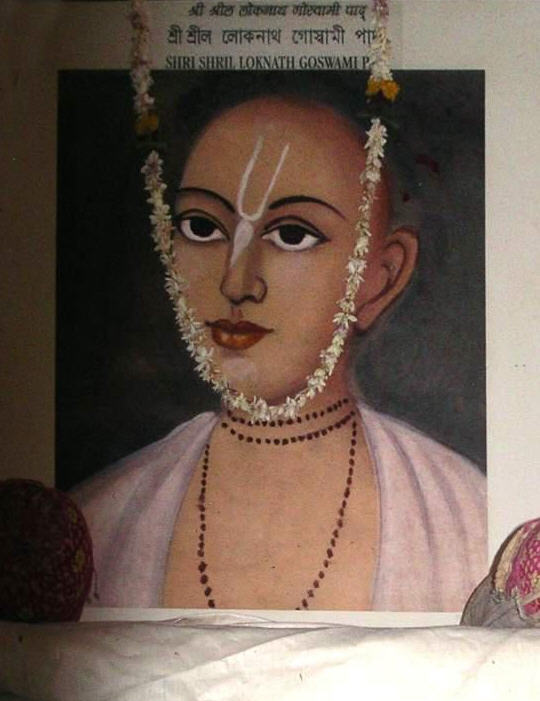
Introduction
śrīmad-rādhā-vinodaika-sevā-sampat-samanvitam
padmanābhātmajaṁ śrīmal-lokanātha-prabhuṁ bhaje
"I worship the lotus feet of Srila Lokanatha Prabhu, the son of Sri Padmanabha. He is a storehouse of singleminded service to the lotus feet of Sri Sri Radha-Vinoda."
Lokanatha Gosvami's own pranama-mantra, composed for him by his disciple, Narottama Dasa Thakura (Bhakti-ratnakara 1.297).
Srila Lokanatha Gosvami is remembered as one of the earliest devotees Sri Chaitanya Mahaprabhu sent toward Vrindavana. He is also remembered as the one who lived most apart from others. He avoided name and fame so completely that he asked Krishnadasa Kaviraja Goswami to leave him out of Sri Chaitanya-charitamrita. He would not accept a house or a temple. Instead he wandered the forests of Vraja, carrying a Deity of Radha-Vinoda in a cloth bag around his neck. For decades he refused every request to accept a disciple. He broke that vow only once, for Narottama Dasa Thakura. This was after Narottama spent nearly a year secretly cleaning the place where Lokanatha relieved himself each night.
| Detail | Description |
|---|---|
| Birth | Year not recorded; native of Talakhadi, Jessore (Yashohara) district, Bengal |
| Parents | Padmanabha (Chakravarti/Bhattacharya) and Sita Devi |
| Sibling | Younger brother Pragalbha Bhattacharya, whose descendants still lived in the family village |
| Identity | Lila-manjari in Krishna-lila (Gaura-ganoddesha-dipika 187) |
| Close companion | Bhugarbha Gosvami, a relative and lifelong friend, initiated by Gadadhara Pandit |
| Only known disciple | Narottama Dasa Thakura |
| Deity worshiped | Radha-Vinoda, discovered at Kishori-kunda in Vraja |
| Disappearance | Ashtami of Shravana or Asharh (accounts differ); place also disputed |
One devotional account gives 1483 CE as the year Lokanatha Gosvami appeared. But it gives this date only in a short summary of dates. The same book's detailed chapter on his life does not repeat it, and no other source confirms it. So the entry "Year not recorded" above is the more careful and better-supported statement (see Birth and Early Life).
Scriptural evidence for the introduction (2)
shrimad-radha-vinodaika-seva-sampat-samanvitam
padmanabhatmajam shrimal-lokanatha-prabhum bhaje
I worship the lotus feet of Lokanatha Prabhu, the son of Padmanabha, a storehouse of single-minded service to the lotus feet of Radha-Vinoda.
Narottama Dasa Thakura's own pranama verse to his guru, naming both Lokanatha Gosvami's father and the Radha-Vinoda Deity that defined his life of service.
भूगर्भ ठक्कुरस्यासीत्पूर्वाख्या प्रेम मञ्जरी ।
लोकनाथाख्य गोस्वामी श्री लीला मञ्जरी पुरा ॥१८७॥
bhūgarbha ṭhakkurasyāsīt pūrvākhyā prema mañjarī |
lokanāthākhya gosvāmī śrī līlā mañjarī purā ||187||
Bhugarbha Thakura was the incarnation of Prema-manjari. Lokanatha Gosvami was the incarnation of Lila-manjari.
Kavi Karnapura gives the Krishna-lila identities of the two lifelong companions, Bhugarbha (Prema-manjari) and Lokanatha (Lila-manjari), in one verse. Sanskrit: diacritic edition of the Gaura-ganoddesha-dipika; English translation as published at bvmlu.org.
Chapter 1
Birth and Early Life
A boy indifferent to family life in a Jessore village grows up to leave everything behind.
Srila Lokanatha Gosvami was born into a family living in Talakhadi (also spelled Talakhari or Talakhori). This village was in the Jessore district of Bengal, then known as Yashohara, in what is now Bangladesh. Before that, the family had lived in a place called Kanchanapada (also given as Kachnapara). No source records the year of his birth, and none of the traditional biographies try to give one. This gap is not unusual. Very little is recorded about the childhoods of even the most important early Gaudiya Vaishnavas. One other devotional account does give 1483 CE as the year Lokanatha Gosvami appeared. But it gives this date only in a short table of dates. That same account's detailed story of his life never repeats the date, and no other source confirms it. So we note it only as one less certain date, not as a settled fact.
| Detail | Description |
|---|---|
| Birthplace | Talakhadi, Jessore (Yashohara) district, Bengal |
| Earlier family home | Kanchanapada (Kachnapara) |
| Father | Padmanabha (given as Padmanabha Chakravarti or Padmanabha Bhattacharya) |
| Mother | Sita Devi |
| Younger brother | Pragalbha Bhattacharya |
| Close relative and companion | Bhugarbha Gosvami |
A Household He Could Not Settle Into #
Lokanatha's father, Padmanabha, is remembered as a devoted follower of Advaita Acharya. Lokanatha grew up in this household with his mother Sita Devi and his younger brother Pragalbha. The traditional accounts say that from his earliest years he showed no real interest in the ordinary business of family life. In whatever way this lack of interest showed itself, in the end it led to one firm and permanent decision. He would leave home and seek out Sri Chaitanya Mahaprabhu.
Traditional dating places his leaving home around Shaka 1431, which is roughly 1509-1510 CE. If this is accurate, Lokanatha arrived at Chaitanya Mahaprabhu's side at Nabadwipa only days before the Lord accepted the renounced order of sannyasa. That event is reliably dated to 1510 CE. The closeness of these two events in time is one of the firmer clues we have for dating Lokanatha's life. But it depends on a single line of tradition, and no independent source confirms it.
Pragalbha and the Family Left Behind #
Unlike Lokanatha, his younger brother Pragalbha Bhattacharya stayed in Talakhadi. Later Vaishnava pilgrims recorded that Pragalbha's descendants were still living in the village generations afterward. Almost nothing else about the family survives. But later writers thought this small, concrete detail was worth keeping. One of them was Srila Prabhupada, in a purport that touches on Lokanatha. The purport even gives travel directions to the village from the nearest railway station. This shows that even a few generations ago, Talakhadi was still a place Vaishnavas might actually visit.
Bhugarbha, a Companion for Life #
The relationship from this period that shaped the rest of Lokanatha's life was his bond with Bhugarbha Gosvami. Different sources describe Bhugarbha either as a paternal uncle or as a more distant relative close to Lokanatha in age. Whatever their exact family tie, the two seem to have been inseparable from an early age. Later Bhugarbha chose to leave everything and go with Lokanatha on the long overland journey toward Vrindavana. He would not let Lokanatha travel that road alone (see Arrival in Vrindavana). Bhugarbha went on to take initiation from Gadadhara Pandit. He is also remembered as one of the devotees who settled in Vraja. But in all the surviving accounts of both men, their closeness stands out as clearly as anything recorded about either man's life before Vrindavana. The Bhakti-ratnakara describes their friendship as being of one spirit in two bodies.
Bhugarbha himself later accepted disciples. Among them were Sri Chaitanya Dasa, who served as pujari to the Deity of Govinda Dev, and also Mukundananda Cakravarti and Premi Krishna Dasa. This places Bhugarbha's disciples alongside the other branches that come down from Gadadhara Pandit. The Bhakti-ratnakara also names Sri Bhagavata Dasa, a godbrother of Bhugarbha under Gadadhara Pandit, as another close friend of the two companions. It also records that Bhugarbha and Bhagavata Dasa both went on to settle in Vrindavana, as two branches of Gadadhara Pandit's line.
Finding Talakhadi Today #
Srila Prabhupada's own purport touching on Lokanatha's origins even gives directions for reaching the village. From the Yashohara station on what was once the E.B.R. Railroad, a traveler goes by bus to Sonakhali and on to Khejura. From there he goes on foot (or, in the rainy season, by boat) to Talakhadi itself. This is a small detail, almost a side remark, in a purport that is mainly about other things. But it is one of the very few places where any of Lokanatha's biographers gives an exact route, one that can be checked, to a place connected with his life before Vrindavana. It also shows how much of what we can say about his early years depends on a few short, secondhand mentions, not on a full life story.
Chapter 2
Arrival in Vrindavana
Sent by Mahaprabhu toward Vrindavana, Lokanatha chases him across India before settling into a lifetime of solitary bhajana.
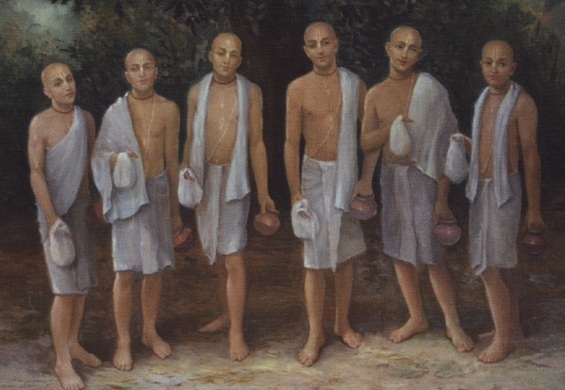
When Lokanatha reached Nabadwipa and took darshan of Sri Chaitanya Mahaprabhu, the Lord embraced him warmly and told him to go and live in Vrindavana without delay. Lokanatha understood, from something in the Lord's manner, that Mahaprabhu himself intended to accept sannyasa within days. He wept at the thought of the Lord's beautiful hair being shaved, and of the grief this would cause the devotees of Nabadwipa. Mahaprabhu consoled him and promised that they would be reunited in Vrindavana. Lokanatha's lifelong companion, Bhugarbha Gosvami, could not bear to see him go alone, so Bhugarbha went with him. Together they set out on the long walk toward Vraja. They passed through Rajmahal, Tajpur, Purnia and Lucknow before finally arriving.
A Chase Across Half of India #
What followed was not the settled life of bhajana that Lokanatha might have expected. He was still burning with separation from Mahaprabhu. He heard that the Lord had taken sannyasa and had then gone from Jagannatha Puri to South India on pilgrimage, and he set out for South India at once. But when he arrived, he learned that Mahaprabhu had already left for Vrindavana. Lokanatha turned back toward Vraja at once. But by the time he reached it, Mahaprabhu had left again, this time for Prayaga. Lokanatha was heartbroken at having missed the Lord a second time, and he decided to leave for Prayaga the very next morning. That night, Mahaprabhu appeared to him in a dream. Mahaprabhu told him plainly to stop running from place to place and to remain in Vrindavana to do his bhajana. By one account, Mahaprabhu also said that he had not broken his promise. He had already come to Vrindavana himself, in another form, so that Lokanatha would always stay connected with him there. From then on Lokanatha stayed in Vraja for good. For some time, almost no one knew he was there.
A Circle of Goswamis Takes Shape #
In time, Lokanatha's life alone came to an end. Rupa Goswami, Sanatana Goswami, Gopala Bhatta Goswami and others of Mahaprabhu's dearest followers came one by one to settle in Vraja as well, joining Lokanatha and his companion Bhugarbha. Sources describe this reunion as one of pure affection (devotees of one mind and one heart). They also note that Lokanatha was regarded as the eldest in this circle, even though later tradition did not include him in the formal group of the Six Goswamis of Vrindavana. He was also regarded as fully absorbed in prema, even by the standards of that great company. In the opening verses (mangalacarana) of his own Hari-bhakti-vilasa, Sanatana Goswami honored Lokanatha by naming him directly. He named him, alongside Kashishvara Pandit and Krishnadasa Kaviraja Goswami, as one of the devotees especially dear to Govinda in Vrindavana. This is one of the rare times Lokanatha's name appears in a book where he had no power to stop it (see The Vow of No Fame for why that power mattered so much to him elsewhere).
Notes That Helped Rediscover Vraja #
Lokanatha gave this circle more than his seniority and example. When Rupa and Sanatana Goswami reached Vrindavana, Lokanatha handed over to them his own personal notes on the holy places of Vraja. He had gathered these notes during his years of solitary wandering through its forests and groves. Tradition says those notes helped the two brothers identify and establish many of the actual pastime-sites of Krishna that pilgrims visit to this day. This was a quiet, practical service to the rediscovery of Vraja. It receives far less attention than his life of renunciation. But in its own way, it stands beside Sanatana Goswami's own famous writings on the holy places of the region.
Settling Into Solitude #
Even among these renounced devotees, Lokanatha mostly kept to himself. He is remembered as a *viviktananda* Vaishnava. This means one who finds his joy in solitary worship, not in the company of other devotees, even like-minded ones. The Goswamis of Vrindavana are said to have kept him in their company at all only with great effort. In this way Lokanatha lived in Vraja, absorbed in Radha and Krishna, and largely unknown even to the pilgrims passing through. He spent the years like this until he discovered the Deity that would shape the rest of his life (see The Radha-Vinoda Deity).
Arriving Before the Rest #
Tradition dates Lokanatha's departure from Bengal to Shaka 1431, or roughly 1509-1510 CE. If this dating is accurate, he would have reached Vraja several years before Rupa and Sanatana Goswami were free to join him there. For some years afterward, both men remained busy in the service of the Bengal Sultanate. Only then were they able to give up their posts and travel to Vrindavana themselves. This is part of why several sources describe Lokanatha as already the senior figure among the renounced Gaudiya Vaishnavas of Vraja by the time the others arrived. He was not senior in initiation or in scholarship. In those, Rupa, Sanatana and later Jiva Goswami had no equal. He was senior simply in how long he had already been living the solitary life that all of them were coming to Vrindavana to live.
Scriptural evidence for this chapter (1)
vrindavana-priyan vande shri-govinda-padashritan
shrimat-kashishvaram lokanatham shri-krishnadasakam
I offer my obeisances unto Kashishvara Pandit, Lokanatha and Krishnadasa, who are very dear to Vrindavana and who have taken shelter at the lotus feet of Govinda.
Sanatana Goswami's own opening tribute in the Hari-bhakti-vilasa names Lokanatha Gosvami alongside Kashishvara Pandit and Krishnadasa Kaviraja Goswami as especially dear to Govinda in Vrindavana, one of the very few places his name appears in a text he did not personally restrict.
Chapter 3
The Radha-Vinoda Deity
At Kishori-kunda, Krishna himself is said to have given Lokanatha a Deity — and a cloth bag became its only temple.
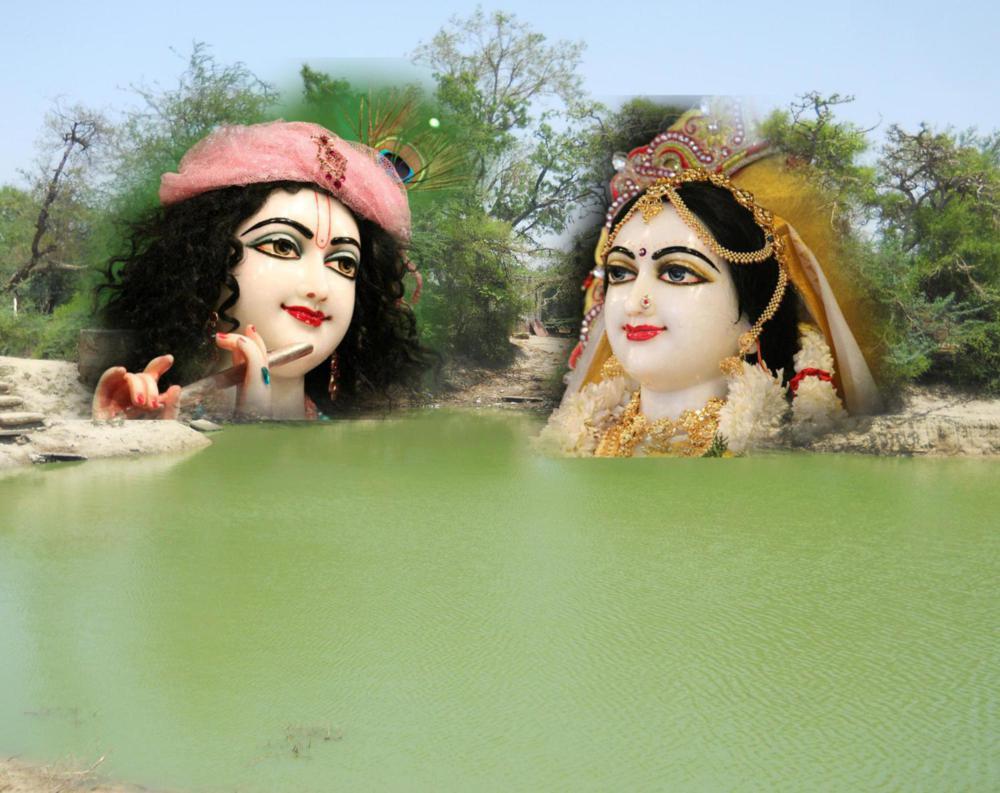
Lokanatha's wandering through the twelve forests of Vraja in time brought him to Khadiravana. From there he went on to Kishori-kunda, a small lake near the village of Umarao (also spelled Umaraa) by the forest of Chatravana. He was so struck by the beauty of the place that he stayed on there to do solitary bhajana. During this stay, a desire he had long held grew strong in him. He wanted to worship Radha and Krishna not only in meditation but in Deity form.
An Unlooked-For Gift #
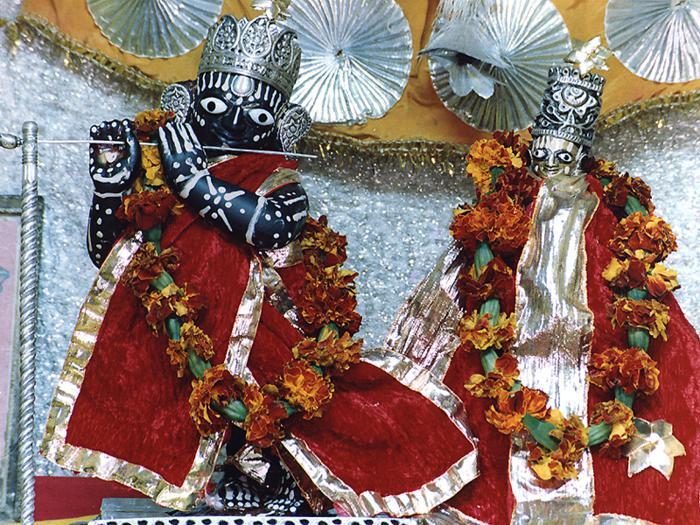
Tradition holds that Krishna, who knows the hearts of his devotees, answered this desire directly. He appeared before Lokanatha in person, presented him with a small Deity, told him its name was Radha-Vinoda, and then vanished. Lokanatha was astonished, and suddenly anxious at having been left alone with the Lord himself in Deity form. It is said that the Deity then reassured him, speaking to him with a smile: "I live here on the banks of Kishori-kunda, in the village of Umarao. I saw your eagerness to serve me, so I came here myself. Now, please, give me something to eat." Moved to tears, Lokanatha cooked at once, offered rice on a fresh banana leaf, made a bed of flowers for the Deity to rest on, and fanned him with leaves. That was the first of what would become a lifetime of personal, hands-on service.
A Cloth Bag for a Temple #
Word spread among the local Vrajavasis and cowherds, who wanted to build Lokanatha a small hut so that he and his new Deity would have a proper home. He refused. Instead, he sewed a simple cloth bag, hung it around his neck, and kept Radha-Vinoda in it at all times. As the sources put it, the Deity became like a jeweled necklace worn constantly against his chest. This was not a temporary arrangement. It remained his practice for the rest of his life, through every season and every forest he walked. It is remembered today as one of the clearest images of *vairagya* (renunciation) in the whole Gaudiya Vaishnava tradition. Lokanatha accepted nothing beyond what the Deity's own service strictly required. He refused even the comforts other devotees were eager to offer him.
From a Bag to a Temple #
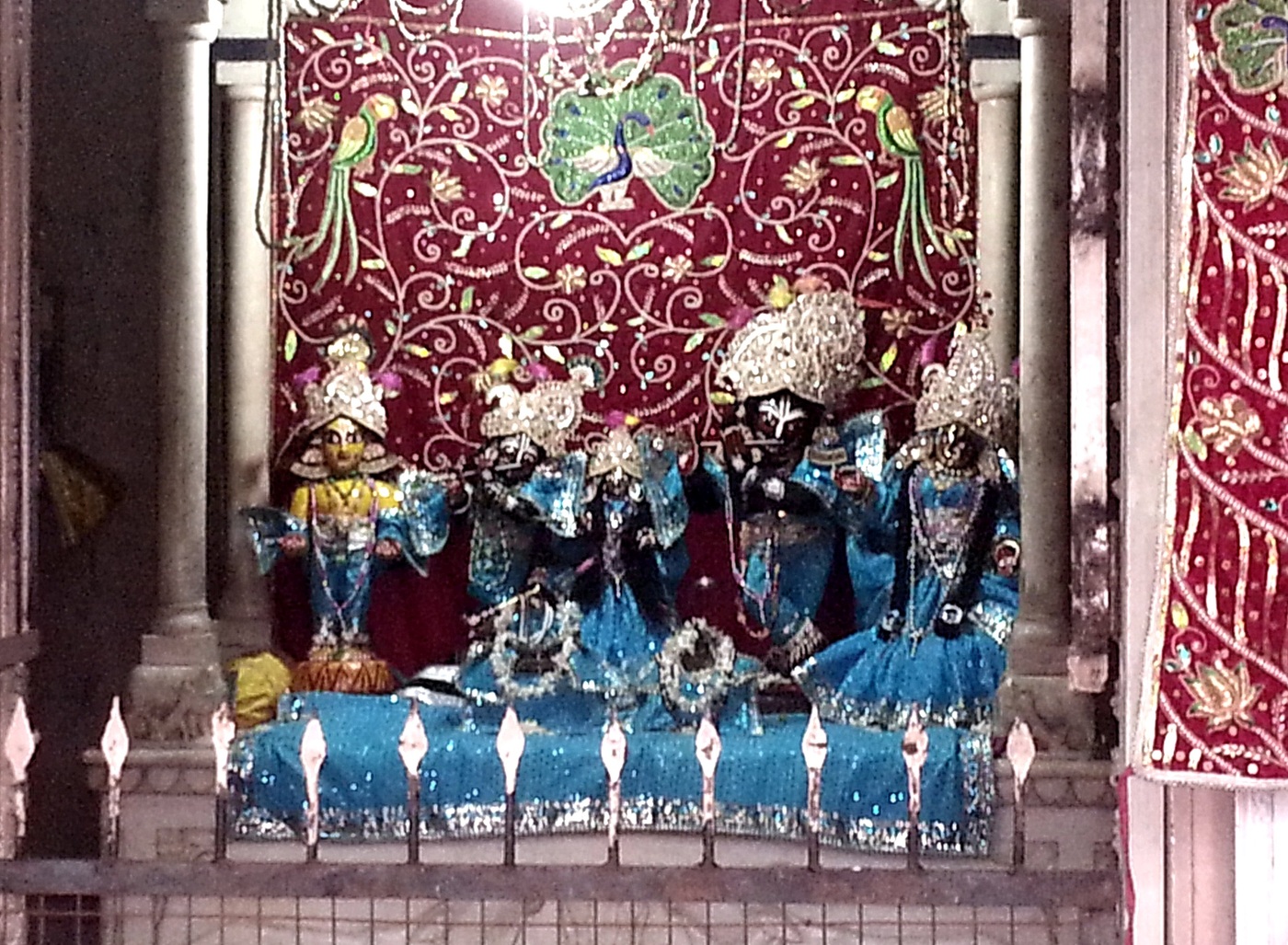
The Deity Lokanatha carried through the forests did in time find a settled home. But the home that later pilgrims would see did not come in his own lifetime. Generations later, a pratibhu-murti of Radha-Vinoda was installed on the altar of the Radha-Gokulananda temple in Vrindavana proper. A pratibhu-murti is a replica of a Deity, authorized through proper ritual. Vishvanatha Chakravarti Thakura later rebuilt and expanded this temple. He brought several Deities, including his own Gokulananda, under one roof there (see Disappearance and Legacy for the fuller story of that temple and of what became of the original Deity). For most of those years, though, Radha-Vinoda's only shelter was a length of cloth and the constant, undivided attention of the renunciant who carried him. This life of service went on into Lokanatha's later years, when he took on the one disciple whose story is told in Initiating Narottama Dasa Thakura.
One Forest Among Twelve #
Chatravana, the forest by Kishori-kunda where Radha-Vinoda was revealed, is counted among the dvadasha-vana, the twelve sacred forests traditionally said to make up the wider Vraja-mandala. In this period, the Goswamis of Vrindavana worked patiently together to identify and revive the forgotten holy places scattered through these forests. This was one of their great projects, and it is most closely connected with Sanatana Goswami's own writings on Vraja's geography. Lokanatha's discovery of Radha-Vinoda at Kishori-kunda was part of the same wider work of rediscovery. Still, no source claims he took a formal, organized part in it the way Sanatana did. His contribution was simply to find, and then never leave, one particular corner of it.
Chapter 4
The Vow of No Fame
He disliked recognition so much that his own name was nearly left out of Sri Chaitanya-charitamrita itself.
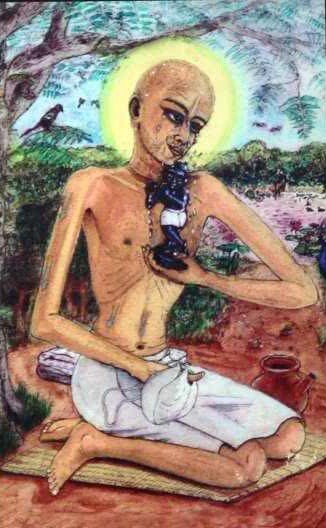
Lokanatha Gosvami did not only give up material comfort. He gave up his own reputation just as fiercely. Several independent accounts agree on the main event. Before he began to write Sri Chaitanya-charitamrita, Krishnadasa Kaviraja Goswami asked permission not only from Lokanatha but also from Raghunatha Bhatta Goswami. Lokanatha gave his blessing, but he clearly forbade Krishnadasa to write anything about him in the book. Krishnadasa was afraid to disobey the order of such a senior Vaishnava, so he obeyed. As a direct result, Lokanatha's name appears in that famous text only in passing. He receives nothing like the long description given to Rupa, Sanatana or the other Goswamis.
The One Verse That Names Him #
The one place where Lokanatha's name does appear in Sri Chaitanya-charitamrita comes almost by accident. It is in a verse about an episode involving Rupa Goswami, not Lokanatha himself. Rupa Goswami grew old and could no longer make the walk to Govardhana to see the Deity of Gopala there. So the Deity came to Mathura instead. At that time the Deity was worshiped at the house of Vitthaleshvara in Mathura. The reason given for moving the Deity there was fear of Muslim iconoclasm (attacks on temple images). But tradition says the real reason was to show mercy to Rupa. The Deity stayed for a month, so that Rupa and other Gaudiya Vaishnavas could have darshan without the difficult journey. Krishnadasa Kaviraja Goswami records that Rupa was accompanied on this occasion by Gopala Bhatta Gosvami, Raghunatha Dasa Goswami, Raghunatha Bhatta Goswami, and Lokanatha Dasa Gosvami. It is the only time Sri Chaitanya-charitamrita names him outright.
Why the Name Is So Rare #
Srila Prabhupada's own purport to this verse spells out exactly why: "Because Lokanatha dasa Gosvami did not want his name mentioned in Caitanya-caritamrta, we do not often see it in this celebrated book." The purport goes on to give the short biographical facts about Lokanatha that are otherwise scattered across many sources: his village, his father's name, his brother, and his founding of a temple in Vrindavana. It gives them because so little else about Lokanatha was included in the book. He himself had asked to be left out of it.
Company Kept in Vrindavana #
Sanatana Goswami's verse in his Hari-bhakti-vilasa names Lokanatha together with Krishnadasa Kaviraja Goswami himself, the very author Lokanatha had forbidden to write about him. It seems the two men were close companions in Vrindavana, not just an author and his unwilling subject. In Sri Chaitanya-charitamrita, Krishnadasa is famous for describing himself as the lowest and most fallen of devotees. Because of this closeness, that habit reads as more than a writer's custom. It is the same spirit of humility that Lokanatha lived by. Krishnadasa shared that spirit, and he was so gifted with words that his own humility became scripture. Yet he made sure that Lokanatha's humility did not.
A Second Witness, Freely Given #
Not every fellow Goswami felt bound by the same restriction. In the mangalacarana verses at the opening of his own Hari-bhakti-vilasa, Sanatana Goswami named Lokanatha without hesitation. He offered obeisances to "Kashishvara Pandit, Lokanatha and Krishnadasa" as devotees especially dear to Govinda in Vrindavana. Later, Narottama Dasa Thakura composed a pranama-mantra in his guru's honor (see Initiating Narottama Dasa Thakura). That single verse and this pranama-mantra are among the very few early records that name Lokanatha openly. Yet he spent his life trying to make sure that later generations of Gaudiya Vaishnavas would know as little about him as possible.
A Teaching Chaitanya Mahaprabhu Himself Gave #
Gaudiya Vaishnava teachers have long pointed to Lokanatha's life as a living example of the instructions on humility that Chaitanya Mahaprabhu himself gave. The most famous of these is the Sikshashtaka verse that urges a devotee to think of himself as lower than the straw in the street. It also urges him to expect no honor for himself, while offering honor freely to others. Lokanatha may or may not have heard that verse directly from Mahaprabhu's own lips. Either way, his life reads almost like that verse put into practice word for word. He refused fame, he refused comfort, and he refused even to let his own name travel. This is part of why later acharyas in this lineage return to his example so often, even though so little else about him survives.
Scriptural evidence for this chapter (2)
sange gopala-bhatta, dasa-raghunatha
raghunatha-bhatta-gosani, ara lokanatha
Word for word
sange: with Rupa Gosvami; gopala-bhatta: Gopala Bhatta; dasa-raghunatha: Raghunatha dasa Gosvami; raghunatha-bhatta-gosani: Raghunatha Bhatta Gosvami; ara: and; lokanatha: Lokanatha dasa Gosvami.
When Rupa Gosvami stayed at Mathura, he was accompanied by Gopala Bhatta Gosvami, Raghunatha dasa Gosvami, Raghunatha Bhatta Gosvami and Lokanatha dasa Gosvami.
From the purport: Purport excerpt: "Because Lokanatha dasa Gosvami did not want his name mentioned in Caitanya-caritamrta, we do not often see it in this celebrated book."
The single verse in which Krishnadasa Kaviraja Goswami names Lokanatha Gosvami directly; Srila Prabhupada's purport explains why such mentions are otherwise almost entirely absent from the text.
trnad api sunicena
taror iva sahisnuna
amanina manadena
kirtaniyah sada harih
Word for word
trnat api: than downtrodden grass; sunicena: being lower; taroh: than a tree; iva: like; sahisnuna: with tolerance; amanina: without being puffed up by false pride; manadena: giving respect to all; kirtaniyah: to be chanted; sada: always; harih: the holy name of the Lord.
One who thinks himself lower than the grass, who is more tolerant than a tree, and who does not expect personal honor but is always prepared to give all respect to others can very easily always chant the holy name of the Lord.
Chaitanya Mahaprabhu's own teaching on humility, which later Gaudiya Vaishnavas have long pointed to as the ideal Lokanatha Gosvami's life of self-effacement so closely embodied.
Chapter 5
Initiating Narottama Dasa Thakura
A year of hidden service breaks a lifelong vow, and Lokanatha accepts the only disciple he would ever have.
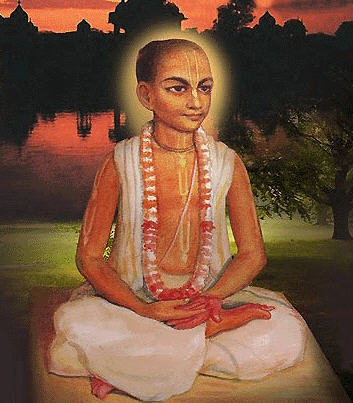
By the time Narottama Dasa Thakura reached Vrindavana, Lokanatha Gosvami had already lived out most of the events described elsewhere: the long chase after Chaitanya Mahaprabhu, the settled years of solitary bhajana, the discovery of Radha-Vinoda at Kishori-kunda. By this time he had also lost many of the devotees he had grown old with. Rupa and Sanatana Goswami had already ended their earthly pastimes, and Lokanatha grieved their passing deeply. Narottama arrived in these later years of Lokanatha's life. He was the son of Raja Krishnananda Datta of Gopalpura, in what is now Rajshahi district, Bangladesh.
Narottama Dasa Thakura's discipleship under Lokanatha Gosvami tells this story in detail from Narottama's side. It also covers Jiva Goswami's role in sending Narottama to Lokanatha instead of initiating him himself. The account that follows here tells the same events as they are remembered from Lokanatha's side.
Two Vows in Collision #
Lokanatha had, by this stage of his life, settled firmly into a vow never to accept a disciple at all, consistent with everything else about how he had lived since receiving Radha-Vinoda. Narottama, for his part, made an equally firm vow of his own: he would take initiation from Lokanatha Gosvami, and from no one else. The two vows could not both be honored, and for some time neither man showed any sign of budging. Narottama asked repeatedly; Lokanatha refused just as consistently.
A Year of Service No One Was Meant to See #
Instead of asking again, Narottama changed his approach. Each night, in secret, he went to the place in the forest where Lokanatha relieved himself and cleaned it thoroughly. By some accounts, he even prepared fine sifted earth and water, so that his future guru would have something clean to wash with afterward. He did this for close to a year without being discovered. At last Lokanatha noticed that someone was mysteriously keeping the place clean, and he wanted to know who it was. One night he hid nearby and waited, chanting japa, until he saw the person at work. It was Narottama, the son of a raja. He was doing the lowest and most unpleasant work imaginable, only in the hope of winning Lokanatha's mercy. Lokanatha was astonished, and asked him directly what he thought he was doing. Narottama fell at his feet in tears and said, in effect, that his life would be worthless without Lokanatha's mercy.
A Guru's Resolve Softens #
That plain, humble answer did what a year of open requests could not. Lokanatha was moved by Narottama's humility, which was plain to see, and by how much he had endured to prove it. His firm decision broke, and at last he agreed to initiate him. The ceremony took place, by every account, on the full-moon day (purnima) of the month of Shravana. Narottama became Lokanatha's one and only disciple. No source claims he ever initiated anyone else. In that same initiation Lokanatha gave Narottama the confidential Radha-Krishna mantra along with the Gayatri-mantra. He went further still. He told his new disciple that Narottama's own eternal identity in Krishna's pastimes was Champak Manjari. Gurus do not usually share such a secret so early in a disciple's spiritual life.
A Guru Sends His Disciple Home #
Lokanatha himself had spent his life almost totally withdrawn from the world. Even so, he saw in Narottama something rarer than his own solitary nature. Narottama was a cultured, capable young man with a real gift for dealing with people, not only for solitary bhajana. Before sending him on his way, Lokanatha gave Narottama one more instruction. He was to keep taking shelter of Jiva Goswami for further guidance. Jiva Goswami also gave his own instruction to the wider group of preachers who were leaving. Together with that instruction, Lokanatha's blessing sent Narottama back toward Bengal. There Narottama carried the Goswamis' teaching to a part of India that Lokanatha himself would never see again. This work reached its high point in the Kheturi festival, which helped unite Gaudiya Vaishnavism a generation after Mahaprabhu's disappearance.
A Buried Blessing on the Padmavati #
One further detail links this episode back to Narottama's own childhood, well before the two men ever met. Years earlier, Nityananda Prabhu was on his way to Puri at Mahaprabhu's order. It is said that he wept in ecstasy at a spot on the banks of the Padmavati river near Kheturi, a place later remembered as Prematila. He is said to have "buried" there the love he felt, for Narottama's future benefit. Years afterward, Narottama happened to bathe at that same spot. Suddenly he was overcome with divine love. It was strong enough to cut every tie to his father's kingdom, and it first set him on the road to Vrindavana. Read together with Lokanatha's own life, the story suggests how the tradition sees Narottama's initiation. In the eyes of the tradition, more than one acharya was preparing the way for it. This began long before Narottama cleaned the ground in Lokanatha's service for even a single night.
Scriptural evidence for this chapter (1)
ha ha prabhu lokanatha, rakha padadvandve
kripadrishthye chaha yadi haiya anande
O Lord Lokanatha! If you are pleased with me, please keep me at the shelter of your lotus feet, and cast your merciful glance upon me.
The opening of Narottama Dasa Thakura's own prayer to Lokanatha Gosvami in his Prarthana, composed after his initiation and still recited by disciples of this lineage.
Chapter 6
Disappearance and Legacy
Sources genuinely disagree on where and when Lokanatha Gosvami left this world — but not on what he left behind.
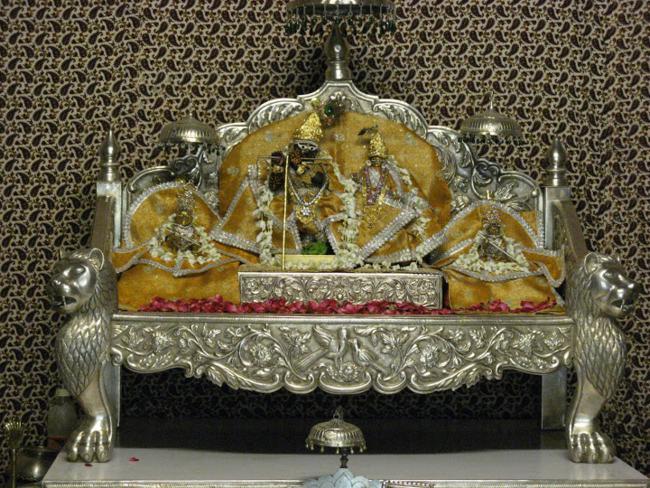
Lokanatha Gosvami lived to a great age, still absorbed in his solitary worship of Radha-Vinoda. The accounts of his final days do not agree with one another on several important points. The sources really do disagree on the month, the lunar fortnight, and even the specific place of his disappearance.
Conflicting Traditions #
One widely repeated account places his final bhajana and disappearance at Khadiravana, near a village called Khoyra Gram, beside a lake called Yugala-kunda. It gives the date as Krishnastami (the eighth day of the dark fortnight) in the month of Shravana. A closely related version agrees on Khadiravana and Yugala-kunda but gives the eighth day of the bright fortnight of Shravana instead. A third account, drawn from Srila Bhakti Ballabh Tirtha Maharaj's "Sri Chaitanya: His Life and Associates," gives a specific year, Shaka 1510, which corresponds to 1588-89 CE. But it places the date in the month of Asharh, not Shravana, again on the eighth day of the dark fortnight. A separate devotional account, independent of that book, supports this third tradition, the one that gives a year. It too places Lokanatha Gosvami's disappearance in the month of Asharh, on the eighth day of the dark fortnight. It gives no year of its own. But its month and fortnight match exactly those of Srila Bhakti Ballabh Tirtha Maharaj's Shaka 1510 date. No source explains all of these differences, and we do not invent an answer here.
| Detail | Description |
|---|---|
| Disappearance site (one tradition) | Khadiravana, near Khoyra Gram, beside Yugala-kunda |
| Disappearance date (bright-fortnight tradition) | Ashtami, bright fortnight of Shravana |
| Disappearance date (dark-fortnight tradition) | Krishnastami, month of Shravana |
| Disappearance date (dated tradition, corroborated by a second source) | Ashtami, dark fortnight of Asharh, Shaka 1510 (1588-89 CE) |
| Memorial (puspa) samadhi | Courtyard of the Radha-Gokulananda temple, Vrindavana |
One Samadhi, Two Places #
At least part of this apparent contradiction can be explained by a distinction that Gaudiya Vaishnava tradition makes. It separates a devotee's actual place of departure from a memorial, or *puspa-samadhi* (literally a "flower samadhi"). Such a memorial is often set up afterward at a place of special importance in the devotee's life and worship. Several sources describe Lokanatha's puspa-samadhi as standing in a small courtyard beside the Radha-Gokulananda temple in Vrindavana proper. Narottama's own samadhi was later placed in that very courtyard, close to that of his guru, as Narottama Dasa Thakura's disappearance and legacy already describes. Vishvanatha Chakravarti Thakura is also buried in that same small courtyard, alongside the enshrined Deities of Vijaya-Govinda, worshiped there by Baladeva Vidyabhusana.
What Became of Radha-Vinoda #
According to tradition, the original Radha-Vinoda Deity that Lokanatha carried through the forests of Vraja for most of his life is now worshiped in Jaipur, Rajasthan. It is said to have been moved there at some point, to protect it during a time of danger to Vrindavana under Mughal rule. At one time only a single source reported this detail, but now another source confirms it independently. The same devotional account that confirms the Asharh disappearance tradition above also says simply that Lokanatha's Radha-Vinodji receives service in Jaipur today. This matches the tradition recorded here. A pratibhu-murti remains on the altar of the Radha-Gokulananda temple in Vrindavana to this day. A pratibhu-murti is a replica authorized through proper ritual, and worship offered to it has the same value as worship offered to the original. This is the temple that Vishvanatha Chakravarti Thakura later rebuilt on the site where Lokanatha himself had once done his bhajana. The same temple, tradition holds, also came to house a Govardhana-shila that Mahaprabhu himself had kept for three years, pressing it to his heart, before he gave it to Raghunatha Dasa Goswami. This is a further sign of how fully the memories and sacred objects of Vrindavana's early renunciants came to be gathered into this one small temple area.
A Separate Summary Chronology #
A different, less detailed table of dates, found elsewhere in the same devotional account cited above, gives Lokanatha Gosvami's life a third set of dates. It gives 1483 CE for his appearance, 1509 CE for his arrival in Vrindavana together with Bhugarbha Gosvami, and 1585 CE for his disappearance. The 1509 arrival date broadly agrees with the traditional date given earlier (Shaka 1431, or roughly 1509-1510 CE, for his departure from Bengal). But the 1585 disappearance year is a few years earlier than the Shaka 1510 (1588-89 CE) tradition confirmed above. And the 1483 birth year is not repeated anywhere else, not even in that same devotional account's own detailed telling of Lokanatha's life. So these figures are noted here only as a separate, less detailed list of dates. They do not settle the questions about his dates already described above.
A Legacy Measured in One Disciple #
So far as any surviving record shows, Lokanatha Gosvami accepted exactly one disciple in his entire life. That fact alone makes his legacy unusual among the acharyas of this tradition. He did not leave a lineage of many direct students. Instead, his influence on Gaudiya Vaishnavism runs almost entirely through Narottama Dasa Thakura. Narottama's preaching in Bengal, his songs, and his role in organizing the Kheturi festival went on to shape the movement for generations. In time, this lineage came down through Bhaktivinoda Thakura, Bhaktisiddhanta Sarasvati Thakura and Srila Prabhupada into the ISKCON temples. There Narottama's songs, and indirectly Lokanatha's own example of renunciation, are still carried forward today. It is a striking legacy for a man who wished, above all, to be left as unrecorded as possible. Every account of his life shows this wish again and again.
Closing
Family and a Lifelong Companion #
Lokanatha's father, Padmanabha, was a devoted follower of Advaita Acharya. His mother was Sita Devi. His only younger brother, Pragalbha Bhattacharya, stayed behind in Talakhadi, where Pragalbha's descendants were still living generations later. But Lokanatha's closest lifelong companion was not his brother. It was Bhugarbha Gosvami, a relative (his paternal uncle, by one account). Bhugarbha went with him on the long walk to Vrindavana. The two remained so close that the Bhakti-ratnakara says they "only had different bodies; in spirit they were one." Bhugarbha had taken initiation from Gadadhara Pandit. Gaura-ganoddesha-dipika identifies his eternal identity in Krishna's pastimes as Prema-manjari. In the same way, it identifies Lokanatha's own identity there as Lila-manjari. Most sources give this name, though at least one gives it slightly differently.
Kavi Karnapura names both friends together in one verse of the Gaura-ganoddesha-dipika:
bhūgarbha ṭhakkurasyāsīt pūrvākhyā prema mañjarī
lokanāthākhya gosvāmī śrī līlā mañjarī purā
"Bhugarbha Thakura was the incarnation of Prema-manjari. Lokanatha Gosvami was the incarnation of Lila-manjari." (Gaura-ganoddesha-dipika 187)
- Sri Caitanya-caritamrta, Madhya-lila 18.49, purport
- Lokanatha Dasa Goswami - Biography - Gaudiya History
- Lokanatha Goswami - Gaudiya History
- Sri Lokanatha Goswami - Shyam Das Baba
- Sri Lokanatha Goswami - A Life of Humble and Dedicated Service - ISKCON Bangalore
- Srila Lokanath Gosvami - Disappearance - ISKCON Desire Tree
- Sri Lokanatha Goswami - Vaisnava Calendar Reminder Services
