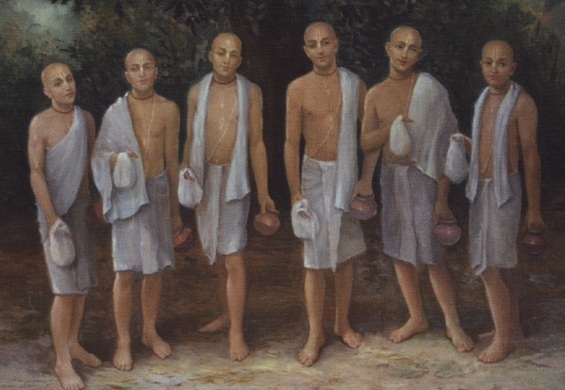
When Lokanatha reached Nabadwipa and took darshan of Sri Chaitanya Mahaprabhu, the Lord embraced him warmly and told him to go and live in Vrindavana without delay. Lokanatha understood, from something in the Lord's manner, that Mahaprabhu himself intended to accept sannyasa within days. He wept at the thought of the Lord's beautiful hair being shaved, and of the grief this would cause the devotees of Nabadwipa. Mahaprabhu consoled him and promised that they would be reunited in Vrindavana. Lokanatha's lifelong companion, Bhugarbha Gosvami, could not bear to see him go alone, so Bhugarbha went with him. Together they set out on the long walk toward Vraja. They passed through Rajmahal, Tajpur, Purnia and Lucknow before finally arriving.
A Chase Across Half of India #
What followed was not the settled life of bhajana that Lokanatha might have expected. He was still burning with separation from Mahaprabhu. He heard that the Lord had taken sannyasa and had then gone from Jagannatha Puri to South India on pilgrimage, and he set out for South India at once. But when he arrived, he learned that Mahaprabhu had already left for Vrindavana. Lokanatha turned back toward Vraja at once. But by the time he reached it, Mahaprabhu had left again, this time for Prayaga. Lokanatha was heartbroken at having missed the Lord a second time, and he decided to leave for Prayaga the very next morning. That night, Mahaprabhu appeared to him in a dream. Mahaprabhu told him plainly to stop running from place to place and to remain in Vrindavana to do his bhajana. By one account, Mahaprabhu also said that he had not broken his promise. He had already come to Vrindavana himself, in another form, so that Lokanatha would always stay connected with him there. From then on Lokanatha stayed in Vraja for good. For some time, almost no one knew he was there.
A Circle of Goswamis Takes Shape #
In time, Lokanatha's life alone came to an end. Rupa Goswami, Sanatana Goswami, Gopala Bhatta Goswami and others of Mahaprabhu's dearest followers came one by one to settle in Vraja as well, joining Lokanatha and his companion Bhugarbha. Sources describe this reunion as one of pure affection (devotees of one mind and one heart). They also note that Lokanatha was regarded as the eldest in this circle, even though later tradition did not include him in the formal group of the Six Goswamis of Vrindavana. He was also regarded as fully absorbed in prema, even by the standards of that great company. In the opening verses (mangalacarana) of his own Hari-bhakti-vilasa, Sanatana Goswami honored Lokanatha by naming him directly. He named him, alongside Kashishvara Pandit and Krishnadasa Kaviraja Goswami, as one of the devotees especially dear to Govinda in Vrindavana. This is one of the rare times Lokanatha's name appears in a book where he had no power to stop it (see The Vow of No Fame for why that power mattered so much to him elsewhere).
Notes That Helped Rediscover Vraja #
Lokanatha gave this circle more than his seniority and example. When Rupa and Sanatana Goswami reached Vrindavana, Lokanatha handed over to them his own personal notes on the holy places of Vraja. He had gathered these notes during his years of solitary wandering through its forests and groves. Tradition says those notes helped the two brothers identify and establish many of the actual pastime-sites of Krishna that pilgrims visit to this day. This was a quiet, practical service to the rediscovery of Vraja. It receives far less attention than his life of renunciation. But in its own way, it stands beside Sanatana Goswami's own famous writings on the holy places of the region.
Settling Into Solitude #
Even among these renounced devotees, Lokanatha mostly kept to himself. He is remembered as a *viviktananda* Vaishnava. This means one who finds his joy in solitary worship, not in the company of other devotees, even like-minded ones. The Goswamis of Vrindavana are said to have kept him in their company at all only with great effort. In this way Lokanatha lived in Vraja, absorbed in Radha and Krishna, and largely unknown even to the pilgrims passing through. He spent the years like this until he discovered the Deity that would shape the rest of his life (see The Radha-Vinoda Deity).
Arriving Before the Rest #
Tradition dates Lokanatha's departure from Bengal to Shaka 1431, or roughly 1509-1510 CE. If this dating is accurate, he would have reached Vraja several years before Rupa and Sanatana Goswami were free to join him there. For some years afterward, both men remained busy in the service of the Bengal Sultanate. Only then were they able to give up their posts and travel to Vrindavana themselves. This is part of why several sources describe Lokanatha as already the senior figure among the renounced Gaudiya Vaishnavas of Vraja by the time the others arrived. He was not senior in initiation or in scholarship. In those, Rupa, Sanatana and later Jiva Goswami had no equal. He was senior simply in how long he had already been living the solitary life that all of them were coming to Vrindavana to live.
