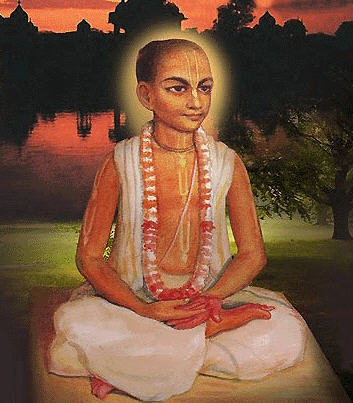
By the time Narottama Dasa Thakura reached Vrindavana, Lokanatha Gosvami had already lived out most of the events described elsewhere: the long chase after Chaitanya Mahaprabhu, the settled years of solitary bhajana, the discovery of Radha-Vinoda at Kishori-kunda. By this time he had also lost many of the devotees he had grown old with. Rupa and Sanatana Goswami had already ended their earthly pastimes, and Lokanatha grieved their passing deeply. Narottama arrived in these later years of Lokanatha's life. He was the son of Raja Krishnananda Datta of Gopalpura, in what is now Rajshahi district, Bangladesh.
Narottama Dasa Thakura's discipleship under Lokanatha Gosvami tells this story in detail from Narottama's side. It also covers Jiva Goswami's role in sending Narottama to Lokanatha instead of initiating him himself. The account that follows here tells the same events as they are remembered from Lokanatha's side.
Two Vows in Collision #
Lokanatha had, by this stage of his life, settled firmly into a vow never to accept a disciple at all, consistent with everything else about how he had lived since receiving Radha-Vinoda. Narottama, for his part, made an equally firm vow of his own: he would take initiation from Lokanatha Gosvami, and from no one else. The two vows could not both be honored, and for some time neither man showed any sign of budging. Narottama asked repeatedly; Lokanatha refused just as consistently.
A Year of Service No One Was Meant to See #
Instead of asking again, Narottama changed his approach. Each night, in secret, he went to the place in the forest where Lokanatha relieved himself and cleaned it thoroughly. By some accounts, he even prepared fine sifted earth and water, so that his future guru would have something clean to wash with afterward. He did this for close to a year without being discovered. At last Lokanatha noticed that someone was mysteriously keeping the place clean, and he wanted to know who it was. One night he hid nearby and waited, chanting japa, until he saw the person at work. It was Narottama, the son of a raja. He was doing the lowest and most unpleasant work imaginable, only in the hope of winning Lokanatha's mercy. Lokanatha was astonished, and asked him directly what he thought he was doing. Narottama fell at his feet in tears and said, in effect, that his life would be worthless without Lokanatha's mercy.
A Guru's Resolve Softens #
That plain, humble answer did what a year of open requests could not. Lokanatha was moved by Narottama's humility, which was plain to see, and by how much he had endured to prove it. His firm decision broke, and at last he agreed to initiate him. The ceremony took place, by every account, on the full-moon day (purnima) of the month of Shravana. Narottama became Lokanatha's one and only disciple. No source claims he ever initiated anyone else. In that same initiation Lokanatha gave Narottama the confidential Radha-Krishna mantra along with the Gayatri-mantra. He went further still. He told his new disciple that Narottama's own eternal identity in Krishna's pastimes was Champak Manjari. Gurus do not usually share such a secret so early in a disciple's spiritual life.
A Guru Sends His Disciple Home #
Lokanatha himself had spent his life almost totally withdrawn from the world. Even so, he saw in Narottama something rarer than his own solitary nature. Narottama was a cultured, capable young man with a real gift for dealing with people, not only for solitary bhajana. Before sending him on his way, Lokanatha gave Narottama one more instruction. He was to keep taking shelter of Jiva Goswami for further guidance. Jiva Goswami also gave his own instruction to the wider group of preachers who were leaving. Together with that instruction, Lokanatha's blessing sent Narottama back toward Bengal. There Narottama carried the Goswamis' teaching to a part of India that Lokanatha himself would never see again. This work reached its high point in the Kheturi festival, which helped unite Gaudiya Vaishnavism a generation after Mahaprabhu's disappearance.
A Buried Blessing on the Padmavati #
One further detail links this episode back to Narottama's own childhood, well before the two men ever met. Years earlier, Nityananda Prabhu was on his way to Puri at Mahaprabhu's order. It is said that he wept in ecstasy at a spot on the banks of the Padmavati river near Kheturi, a place later remembered as Prematila. He is said to have "buried" there the love he felt, for Narottama's future benefit. Years afterward, Narottama happened to bathe at that same spot. Suddenly he was overcome with divine love. It was strong enough to cut every tie to his father's kingdom, and it first set him on the road to Vrindavana. Read together with Lokanatha's own life, the story suggests how the tradition sees Narottama's initiation. In the eyes of the tradition, more than one acharya was preparing the way for it. This began long before Narottama cleaned the ground in Lokanatha's service for even a single night.
