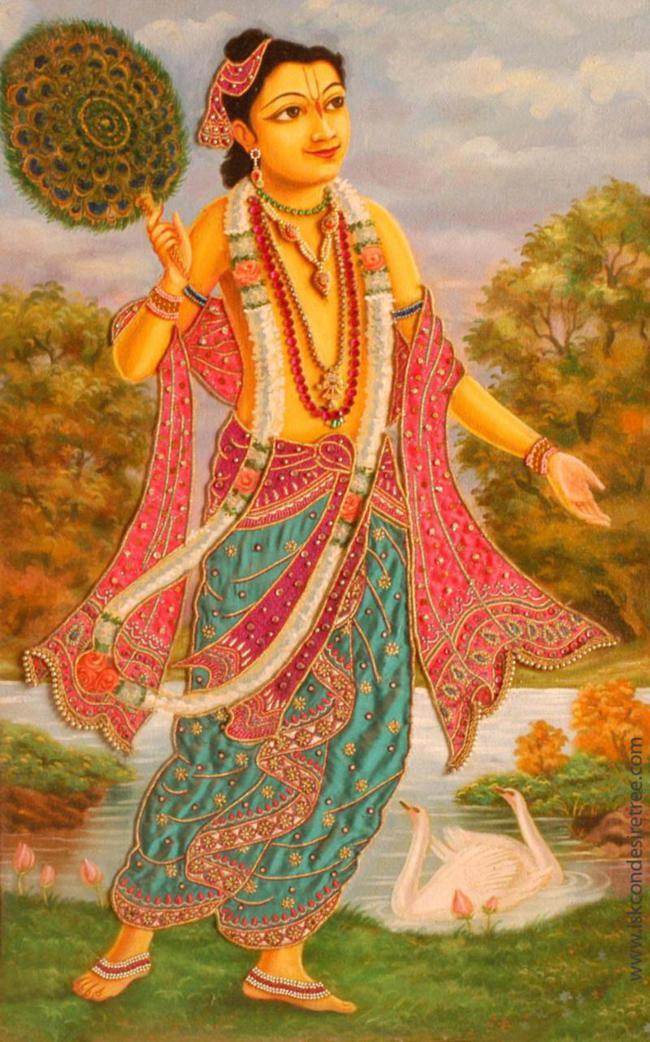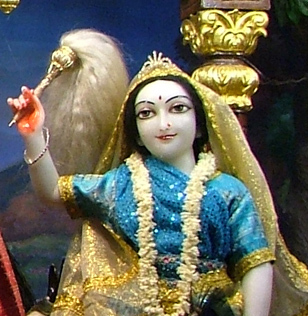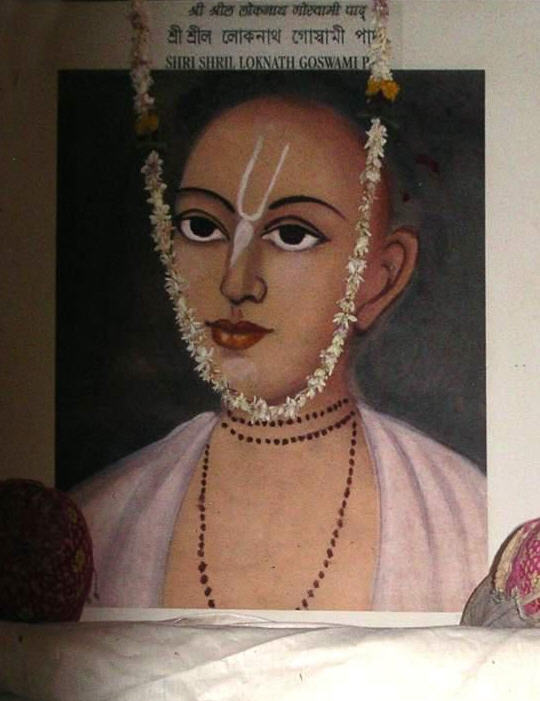
Shikhi Mahiti
The Likhanadhikari Counted Among Mahaprabhu's Three Confidential Devotees
Also known as Sikhi Mahiti, Sikhi Mahati, Shikhi Mahati, Ragalekha
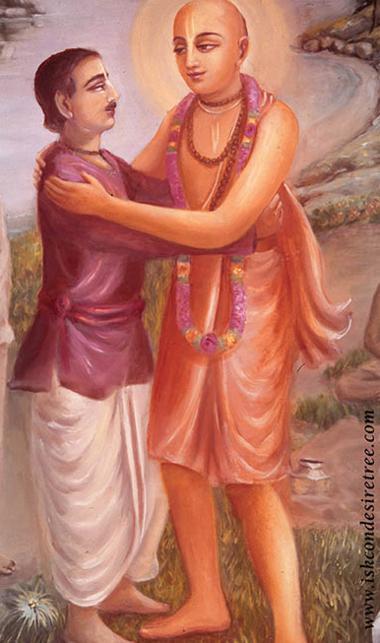
“I am still seeing the same dream. Do you think I have become deranged? And the most wonderful thing is that as soon as I came near Chaitanya Mahaprabhu, He embraced me with His long arms.”
Shikhi Mahiti's own words to his brother and sister after waking from his dream of Lord Chaitanya entering the Jagannatha Deity, as preserved in a purport to Sri Chaitanya-charitamrita, Adi-lila 10.135-136
Shikhi Mahiti held a real administrative post inside the Jagannatha temple at Puri. This sets him apart from almost every other devotee in Sri Chaitanya Mahaprabhu's Puri circle. The tradition records their devotion in detail, but it rarely names their worldly work at all. Sarvabhauma Bhattacharya introduced him to Mahaprabhu in two words: likhanadhikari, the official in charge of writing. He was the eldest of three siblings, all serving that same temple. Sri Chaitanya-charitamrita gives his rank very exactly. He was not just one of the many devotees Mahaprabhu accepted at Puri. He was one of the three men the text names as His most confidential associates in the entire world. His sister, Srimati Madhavi Devi, was the "half" that completed that number to three and a half. His younger brother, Murari Mahiti, belonged to the same household of unbroken service. Both siblings have their own documented lives, and Shikhi Mahiti is named in each account. This page gathers what the sources say about him in particular.
| Detail | Description |
|---|---|
| Family | Eldest of three siblings; sister Srimati Madhavi Devi, brother Murari Mahiti |
| Temple post | Likhanadhikari, "in charge of writing," at the Jagannatha temple, Puri - keeper of the Madala Panji chronicle |
| Region | Jagannatha Puri, Odisha - the title Mahiti marks an Odia temple-service family |
| Rank among devotees | One of the "three" among Mahaprabhu's three-and-a-half most confidential associates, with Svarupa Damodara Goswami and Ramananda Raya (Antya-lila 2.105-106) |
| Identity | Ragalekha, a maidservant of Srimati Radharani (Gaura-ganoddesha-dipika 189; Chaitanya-charitamrita Adi 10.135-136 purport) |
| Born / Disappeared | Not recorded |
| Principal source | Sri Chaitanya-charitamrita, Adi-lila Chapter Ten, Madhya-lila Chapters One, Ten and Sixteen, and Antya-lila Chapter Two |
The Likhanadhikari of Jagannatha Puri #
"Mahiti" is not a family surname in the ordinary sense. It is an Odia title for temple administration, like Mahapatra or Pattanayaka, carried by families who hold hereditary service posts at the Jagannatha temple. Chaitanya-charitamrita is specific about what the title meant for Shikhi Mahiti himself. Sarvabhauma Bhattacharya brought Puri's devotees before Mahaprabhu one by one at the home of Kashi Mishra. He introduced Shikhi Mahiti as the man "in charge of writing". Srila Prabhupada's purport explains this post more fully as deula-karana-pada-prapta karmacari. This was a temple officer employed especially to keep the Madala Panji, the Jagannatha temple's own running record of events and its calendar. Chaitanya-charitamrita records the worldly work of very few of Mahaprabhu's Puri devotees, and this is one of them. It places Shikhi Mahiti at the centre of the running of one of India's largest temples, not at its edges. The fuller scene of that introduction is told in full on The Likhanadhikari of Jagannatha Puri. That page also tells what it meant that his own younger brother was named immediately after him.
One of the Three #
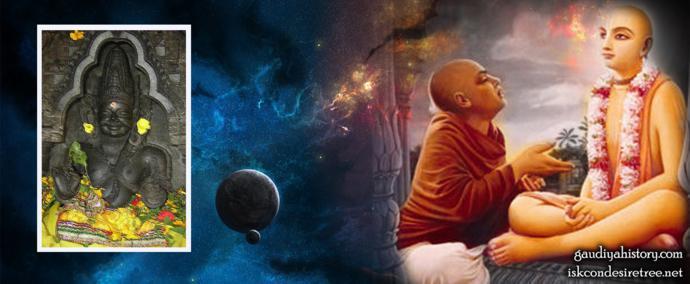
Chaitanya-charitamrita's Antya-lila states the ranking plainly, without any condition. In the entire world, only three and a half people were Mahaprabhu's truly confidential devotees during His last eighteen years at Puri. The three were Svarupa Damodara Goswami, Ramananda Raya and Shikhi Mahiti. The remaining half was Shikhi Mahiti's own sister, Madhavi Devi. Srila Prabhupada's purport explains why she was counted as a half and not a whole person. It was only because the social customs of the time did not allow her the same free access to the Lord that His male associates had. Shikhi Mahiti was named as one of only three men in the entire world, alongside two of the most celebrated personalities in the whole Gaudiya tradition. This is about as high a mark of trust as Chaitanya-charitamrita records for anyone. Fewer readers notice how often Srila Prabhupada himself returned to this exact number, decades later and thousands of miles from Puri, when he wanted to explain who Mahaprabhu's closest associates really were. That later history runs from a 1976 letter written in Mayapur to two talks given in Bhubaneswar in January 1977. It is told in full on Named Among the Three and a Half.
A Dream That Proved True #
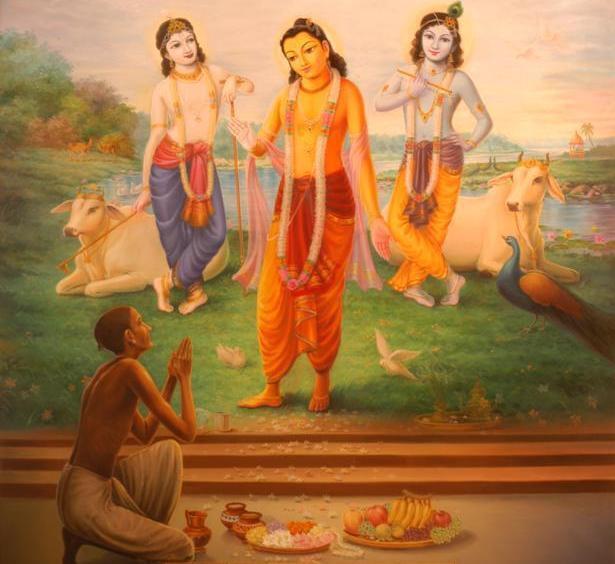
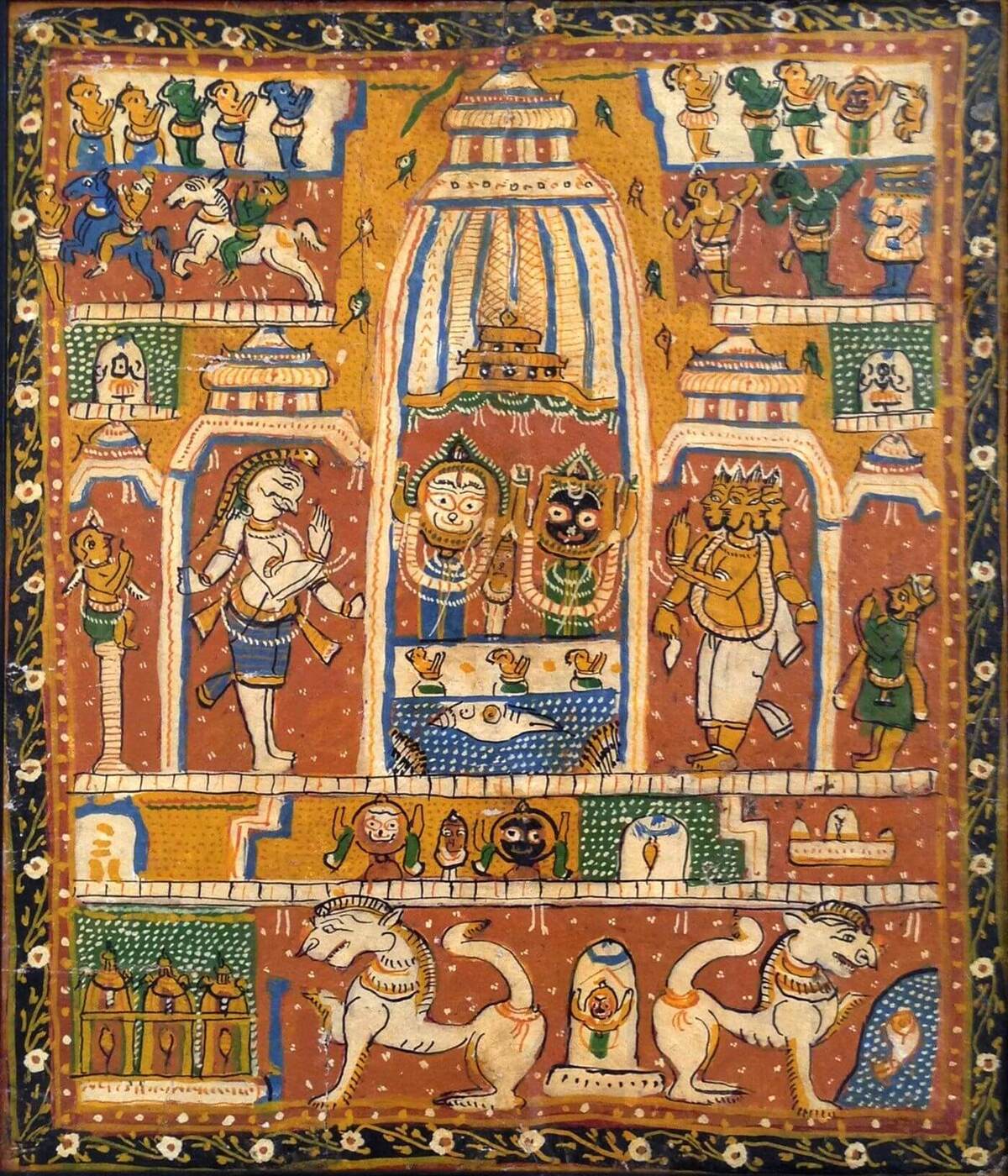
There is only one moment where Shikhi Mahiti is shown doing something, and not simply named. It comes in Srila Prabhupada's purport to Chaitanya-charitamrita (Adi 10.135-136), which retells it from the Oriya book Caitanya-carita-mahakavya. One night he fell asleep in the middle of his own mental service to the Lord. He dreamed that Mahaprabhu was entering the body of the Jagannatha Deity and coming back out of it again and again. He woke his brother and sister in tears, unsure whether he had lost his mind: "I am still seeing the same dream. Do you think I have become deranged?" The three went together to the temple. There they found Mahaprabhu exactly as the dream had shown Him, absorbed in looking at Jagannatha in the Jagamohana hall. The Lord embraced Shikhi Mahiti at once, calling him "the elder brother of Murari." The same account is the source for Shikhi Mahiti's identity in Krishna's own pastimes. The Gaura-ganoddesha-dipika (189) names him as Ragalekha, a former assistant of Srimati Radharani, and names Madhavi Devi as another such assistant, Kalakeli. The dream, the run to the temple and the embrace are narrated in full on Madhavi Devi's own page, exactly as Chaitanya-charitamrita's purport preserves them. They are told there because she is present throughout, as the sister who helped wake him.
Kavi Karnapura's verse names brother and sister together:
rāgalekhā-kalākelyau rādhā-dāsyau purā sthite
te jñeye śikhi-māhātī tat-svasā mādhavī-kramāt
"Srimati Radharani's maidservants, Rangalekha-devi and Kalakeli-devi, appeared as Sikhi-mahiti and his sister, Madhavi-devi respectively." (Gaura-ganoddesha-dipika 189)
Srila Prabhupada gives the same identity in his purport to Chaitanya-charitamrita Adi 10.135-136: "In the Gaura-gaṇoddeśa-dīpikā (189) it is said that Śikhi Māhiti was formerly an assistant of Śrīmatī Rādhārāṇī named Rāgalekhā. His sister Mādhavī was also an assistant of Śrīmatī Rādhārāṇī and was named Kalākelī."
A Household United in Service #
Chaitanya-charitamrita almost never separates Shikhi Mahiti from his brother and sister. The three are named together everywhere the text lists the devotees who constantly surrounded Mahaprabhu at Puri. They are described as devotees "who could not forget Him for a moment of their lives." That closeness touched even one of the harder episodes in the Lord's later years. A young man of the renounced order named Junior Haridasa was once sent, in a respected householder's name, to beg fine rice from "the sister of Shikhi Mahiti" for the Lord's meal. This ordinary act of charity became the occasion for Mahaprabhu to uphold a strict standard, with no exceptions, for the renounced order. It ended Junior Haridasa's place at His side for the rest of his life. Shikhi Mahiti himself plays no active part in that story. It belongs to Madhavi Devi, and it is told in full on The Rice Alms and Junior Haridasa. But Srila Prabhupada came back to the episode often, even decades later in a 1976 lecture in Honolulu. Because of this, his sister's name and Shikhi Mahiti's own family became permanently attached to it in the tradition's memory.
What the Record Does Not Say #
No surviving source gives a birth year, a disappearance year, or a native place for Shikhi Mahiti beyond his family's standing service at Jagannatha Puri. Srila Prabhupada's purport to Chaitanya-charitamrita, Madhya-lila 16.281, states plainly that Shikhi Mahiti never visited Vrindavana-dhama in this life. It says the same of Pundarika Vidyanidhi, Haridasa Thakura, Shivananda Sena, Ramananda Raya, Gadadhara Pandit and his own sister Madhavi Devi. The same chapter is about Mahaprabhu's own attempt to travel to Vrindavana. In it, Shikhi Mahiti is named among the devotees who met the Lord at Puri when He came back, together with Kashi Mishra, Ramananda Raya and Sarvabhauma Bhattacharya (Madhya-lila 16.254). The two passages agree: Shikhi Mahiti's place of service was Puri, and he did not go to Vrindavana. Likewise, nothing in Chaitanya-charitamrita records how long Shikhi Mahiti held his post as likhanadhikari, what became of that post after him, or how or when his own service at Puri ended. So what remains is not a full life story. It is an exact and unusual picture of his place. He was a working temple official, holding a real administrative post inside one of India's largest temples. And Sri Chaitanya Mahaprabhu Himself counted him as one of only three people in the entire world close enough to call truly His own.
Scriptural evidence
Quoted in the text above:
- Verse 189 Gaura-ganoddesha-dipika
Further verses:
prataparudra raja, ara odhra krsnananda
paramananda mahapatra, odhra sivananda
bhagavan acarya, brahmanandakhya bharati
sri-sikhi mahiti, ara murari mahiti
King Prataparudra of Orissa, the Oriya devotees Krsnananda and Sivananda, and Paramananda Mahapatra, Bhagavan Acarya, Brahmananda Bharati, Sri Sikhi Mahiti and Murari Mahiti constantly associated with Caitanya Mahaprabhu while He resided in Jagannatha Puri.
From the purport: In the Gaura-gaṇoddeśa-dīpikā (189) it is said that Śikhi Māhiti was formerly an assistant of Śrīmatī Rādhārāṇī named Rāgalekhā. His sister Mādhavī was also an assistant of Śrīmatī Rādhārāṇī and was named Kalākelī. Śikhi Māhiti, Mādhavī and their brother Murāri Māhiti were all unalloyed devotees of Śrī Caitanya Mahāprabhu who could not forget Him for a moment of their lives.
The formal listing that places Shikhi Mahiti, by name and with the honorific Sri, among the devotees who constantly surrounded Mahaprabhu at Puri, alongside his own younger brother Murari Mahiti.
damodara-svarupa-milane parama ananda
sikhi-mahiti-milana, raya bhavananda
Then there was a meeting with Svarupa Damodara, bringing great pleasure, and a meeting with Shikhi Mahiti and with Bhavananda Raya, the father of Ramananda Raya.
A joyful listing, from Chaitanya-charitamrita's own summary of the Lord's later pastimes, that names a reunion with Shikhi Mahiti in the same breath as the reunion with Svarupa Damodara Goswami.
tabu vrndavana yaha' loka sikhaite
seita karibe, tomara yei laya citte
"Although wherever You stay is Vrindavana, You will still go to Vrindavana just to instruct people. Otherwise, You will do whatever You think best."
From the purport: Purport excerpt: "Sri Pundarika Vidyanidhi, Sri Haridasa Thakura, Srivasa Pandita, Sivananda Sena, Sri Ramananda Raya, Sri Sikhi Mahiti, Sri Madhavidevi and Sri Gadadhara Pandita Gosvami never visited Vrindavana-dhama."
The source for the tradition, already recorded on the Madhavi Devi and Pundarika Vidyanidhi pages, that Shikhi Mahiti himself never made the journey to Vrindavana-dhama.
kasi-misra, ramananda, pradyumna, sarvabhauma
vaninatha, sikhi-adi yata bhakta-gana
Kasi Misra, Ramananda Raya, Pradyumna, Sarvabhauma Bhattacharya, Vaninatha Raya, Sikhi Mahiti and all the other devotees [gathered together].
Cited here for the honest tension it leaves unresolved: this verse, from the very chapter describing Mahaprabhu's own attempt to travel to Vrindavana, still lists Shikhi Mahiti among the devotees gathered at Puri, even though other verses state he never made that journey himself.
What Srila Prabhupada said
His personal associate you know, Chota Haridasa, Junior Haridasa. He was very nice singer, so he was singing in the assembly of Caitanya Mahaprabhu. And one day he went to beg some rice from Sikhi Mahiti's sister, and there was a young woman, and he lustfully saw there... Caitanya Mahaprabhu is so strict that He rejected him from His associates.
- Sri Chaitanya-charitamrita, Adi-lila 10.135-137 (vedabase.io)
- Sri Chaitanya-charitamrita, Madhya-lila 1.130 (vedabase.io)
- Sri Chaitanya-charitamrita, Madhya-lila 10.42-44 (vedabase.io)
- Sri Chaitanya-charitamrita, Madhya-lila 16.254 and 16.281 (vedabase.io)
- Sri Chaitanya-charitamrita, Antya-lila 2.104-106 (vedabase.io)
- Srimad-Bhagavatam, Canto 1, Introduction (vedabase.io)
- Letter to Sri Ajita Kumar Chatterjee, 12 February 1976 (vedabase.io)
- Arrival address, Bhubaneswar, 19 January 1977 (vedabase.io)
- Evening Lecture, Bhubaneswar, 23 January 1977 (vedabase.io)
- Srimad-Bhagavatam 6.1.23 lecture, Honolulu, 23 May 1976 (vedabase.io)
- Shikhi Mahiti Biography, Gaudiya History (ISKCON Desire Tree)
- Shikhi Mahiti, Gaudiya History (ISKCON Desire Tree)
- Madhavi Devi (nandgramdham.org)
- Murari Mahiti (nandgramdham.org)
Frequently asked
When was Shikhi Mahiti born?
Shikhi Mahiti appeared Not recorded in Not recorded; his family was established at Jagannatha Puri, Odisha.
When and where did Shikhi Mahiti disappear?
Shikhi Mahiti disappeared Not recorded at Not recorded.
What are the main pastimes of Shikhi Mahiti?
The pastimes covered here include: The Likhanadhikari of Jagannatha Puri, Named Among the Three and a Half.