Gaudiya Vaishnavas would come to see Sri Nityananda Prabhu as Krishna's own elder brother Balarama. Long before the world knew Him as Nityananda Prabhu, He had already spent years as a wandering avadhuta, visiting one holy place after another with no fixed home. Tradition holds that His travels eventually brought Him to Vrindavana itself, where He heard the news that would end His wandering: Krishna had already appeared in this age, as Gaurahari, the son of Sachi, in Navadvipa-Mayapur. Nityananda Prabhu hurried back toward Bengal at once.
A Dream the Night Before #
What happened next is preserved chiefly in Srila Vrindavana Dasa Thakura's Sri Chaitanya-bhagavata, and it begins, fittingly, with a dream. The night before Nityananda Prabhu's arrival, Sri Chaitanya Mahaprabhu dreamed of a majestic stranger arriving by chariot at His door: a figure in a blue dhoti and turban, a kamandalu in one hand, His gait swaying with a strange ecstasy, asking after the house of "Nimai Pandita." When Mahaprabhu asked who He was, the stranger only laughed and said the two of them would meet the next day.
On waking, Mahaprabhu told the assembled devotees that Nityananda Prabhu had in fact arrived in Navadvipa. He sent Srivasa Thakura and Haridasa Thakura out to find Him. However, Nityananda Prabhu did not announce Himself. Instead He had gone into hiding in the house of Nandana Acharya. He was still dressed as an avadhuta and was chanting the holy names. Later tellings say that His body was radiant enough to outshine millions of moons. By some accounts, this was not the very first time. The tradition remembers that Nityananda Prabhu stayed at Nandana Acharya's house whenever He was in Navadvipa. So the household was already used to sheltering Him quietly, even before this particular dream and search took place. Srivasa and Haridasa searched the homes of Vaishnavas, sannyasis, householders, and even nonbelievers across the whole town, by some accounts for nine hours. They found no trace of Him. It seems that Nandana Acharya's own door was simply never suspected.
Found at Last #
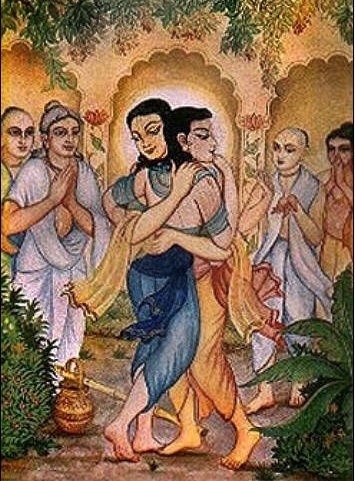
When the two returned empty-handed, Mahaprabhu, smiling in His own omniscience, understood exactly where His brother was hiding and led the devotees Himself, directly, to Nandana Acharya's house. There He found Nityananda Prabhu and clutched Him to His chest, glorifying Him before the whole assembly, while the devotees stood astonished at a beauty they could only compare to a million rising suns.
To reveal Nityananda Prabhu's true identity to everyone present, Mahaprabhu had Srivasa Thakura sing a verse from the Srimad-Bhagavatam. The verse describes Krishna entering the forest of Vrindavana, with a peacock feather in His hair and a garland of forest flowers at His neck. He fills the holes of His flute with the nectar of His own lips as the cowherd boys sing His glories (Srimad-Bhagavatam 10.21.5). As soon as Nityananda Prabhu heard it, He cried out "Ha Krishna!" and collapsed. The eight ecstatic symptoms of transcendental love, known in bhakti literature as the ashta-sattvika-bhava, appeared on His body one after another. Mahaprabhu, taking His brother into His arms, could not stop glorifying Him to the devotees gathered around them in Nandana Acharya's own courtyard.
A House Long Remembered #
For Nandana Acharya himself, the sources agree on very little beyond one plain fact: he felt his life fulfilled simply by having sheltered Nityananda Prabhu under his own roof and having had the chance to serve Him, however briefly, before the world at large knew who He was. Narahari Chakravarti Thakura's later chronicle Bhakti-ratnakara records that Nandana Acharya's house was still being pointed out to the next generation of pilgrims, among them Shrinivasa Acharya, as the very place where the two brothers had first stood face to face.
The site itself is remembered to this day. Centuries later, Srila Bhakti Saranga Goswami Maharaja, founder of the Gaudiya Sangha, built a temple on the spot in Ishodyan, Mayapur, housing Deities of Sri Chaitanya Mahaprabhu and Nityananda Prabhu together. Known locally as Nandan Acharya Bhaban, it remains a stop on the Navadvipa-Mayapur pilgrim circuit. It was a modest brahmana's house, still remembered as the place where two brothers, whom the tradition calls inseparable, first stood face to face. The rest of what Nandana Acharya's house witnessed is told on Advaita Acharya's Test and the Lord's Own Hiding. This includes Advaita Acharya's own test of the Lord, and Mahaprabhu's own retreat there in a moment of despair.
