Padmanabha Tirtha
First Pontiff After Madhvacharya
The complete life, on one page: The main biography and every pastime page, in order, in one place
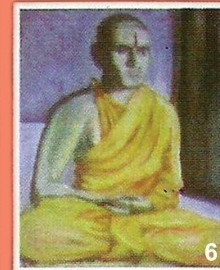
Introduction
Padmanabha Tirtha comes right after Madhvacharya in the Gaudiya Vaishnava guru-parampara. He also comes right after Madhva in the documented history of the Dvaita Vedanta school itself, and that second fact makes him unusual among the names in this parampara list. Some other links in this chain can be traced only through Gaudiya sources. But Padmanabha Tirtha's place as Madhva's own disciple and first successor is confirmed by the Dvaita tradition's own texts too. It is also confirmed by more than half a century of independent study of those texts by scholars, most of all B. N. K. Sharma's standard history of the school. He was already a serious scholar before he ever met Madhva. He soon became one of Madhva's most trusted early disciples. Tradition remembers him as the first person to hold the seat Madhva left behind when he departed from this world.
| Detail | Description |
|---|---|
| Purva-ashrama name | Shobhana Bhatta |
| Guru | Madhvacharya |
| Native of | Uttara-Karnataka, near the Godavari (disputed; see below) |
| Became a disciple | c. 1265 CE, on the banks of the Godavari, probably near Puntamba or Paithan |
| Position | Traditionally the first to head the pitha after Madhvacharya; first pontiff counted by the Uttaradi Matha |
| Chief works | About 15 works, including the Sattarkadipavali, Nyayaratnavali and Sannyayaratnavali, and commentaries on the Gita-bhashya and the ten Prakaranas |
| Disappeared | 1324 CE, at Nava Brindavana near Hampi |
Scriptural evidence for the introduction (1)
vyāsāl labdha-kṛṣṇa-dīkṣo mādhvācāryo mahāyaśāḥ
tasya śiṣyo'bhavat padmanābhācāryo mahāśayaḥ
tasya śiṣyo naraharis tac-chiṣyo mādhava-dvijaḥ
akṣobhyas tasya śiṣyo'bhūt tac-chiṣyo jayatīrthakaḥ
"Madhvacharya took initiation in the Krishna mantra from Vyasa. Madhva's disciple was Padmanabhacharya, an illustrious person, whose disciple was Narahari, who was followed by Madhava, the twice-born. Madhava's disciple was Akshobhya, who was followed by Jayatirtha."
The earliest known textual source for the specific Gaudiya guru-parampara chain naming Padmanabhacharya directly as Madhva's own disciple and Narahari's own guru; quoted here via Gaudiya scholar Jagadananda Das's comparative study, since no independent English translation of the full Sanskrit text is posted online. Compare the Dvaita-tradition reading of the same four names as parallel disciples rather than a chain, discussed on One Guru, or Four Disciples?
Chapter 1
Meeting Madhvacharya on the Godavari
A celebrated logician who lost a debate on the banks of a river, and became one of Madhvacharya's most trusted disciples.
By the time Madhvacharya met the scholar who would become Padmanabha Tirtha, he had already made one long journey to North India and back. He had met Vyasadeva at Badarikashrama and completed his commentary on the Bhagavad-gita along the way. According to B. N. K. Sharma's account, as Madhvacharya continued his journey home toward Udupi, his party came to the banks of the Godavari river. A well-known scholar of the region named Shobhana Bhatta was living there.
| Detail | Description |
|---|---|
| Pre-sannyasa name | Shobhana Bhatta |
| Reputation | A distinguished scholar and skilled logician, master of many branches of learning |
| Likely location | Puntamba or Paithan, on the Godavari |
| Occasion | Madhvacharya's return journey from his first North Indian tour |
| Approximate date | c. 1265 CE |
| Outcome | Defeated in philosophical debate; accepted sannyasa as Padmanabha Tirtha |
A Contest of Learning #
Shobhana Bhatta was not an easy opponent. Madhvacharya's own earliest biography, the Sanskrit poem Madhva-vijaya, describes him as an accomplished master of many branches of learning. Later writers in the Gaudiya tradition remember the meeting in very vivid terms, though clearly with some exaggeration. Many generations afterward, the Gaudiya acharya Baladeva Vidyabhushana wrote a commentary on Jiva Gosvami's Tattvasandarbha. It describes a scholar "proficient in fourteen branches of learning" who was "silenced by Madhva in fourteen seconds." This detail is important because it comes from a Gaudiya text, not a Dvaita one. It shows that the story of this meeting was told on both sides, even after the two traditions later became separate. In Sharma's own, more careful reading of the Madhva-vijaya, Shobhana Bhatta simply tries "conclusions with Madhva" and is "worsted by him in disputation."
Where, Exactly? #
The Madhva-vijaya itself does not name the meeting place. Many earlier writers assumed it was Rajahmundry. The poem describes Shobhana Bhatta as coming "from the region of the Godavari," so they reasoned that he must have been a native of the Andhra country further downriver. Sharma disputes that reading. He points out that other records show Kannada-speaking settlements along the upper Godavari well into the thirteenth century. So he argues that the meeting more probably took place further upstream, at Puntamba or Paithan. In that period these places were in the Kannada-speaking border region. Today they are in Maharashtra's Ahmednagar district. Sharma's more careful view is the more likely one. No single site can be confirmed with certainty.
A Second Conversion, Same Journey #
Shobhana Bhatta's conversion was not the only one that stretch of the journey produced. Srila Prabhupada's own purport to Sri Chaitanya-charitamrita, Madhya 9.245, describes this same leg of the return journey:
There he met with two learned scholars named Sobhana Bhatta and Svami Sastri. Later these scholars became known in the disciplic succession of Madhvacarya as Padmanabha Tirtha and Narahari Tirtha.
The second scholar, called Svami Sastri before his conversion, became Narahari Tirtha. Dvaita tradition places his own discipleship at almost exactly the same time. His earliest dated inscription, from 1264 CE, already gives him the ascetic title "Sripada." So his conversion must have taken place before that date. Narahari Tirtha's later work in Kalinga is told more fully on his own page, Narahari Tirtha. Other records confirm that story.
Having accepted initiation, Shobhana Bhatta took the name Padmanabha Tirtha. In the words of the Madhva-vijaya's own praise for him, he quickly became one of Madhvacharya's most trusted early disciples. That status would soon make him the natural choice to lead the community Madhva left behind.
Scriptural evidence for this chapter (1)
From the purport: Purport excerpt: "There he met with two learned scholars named Sobhana Bhatta and Svami Sastri. Later these scholars became known in the disciplic succession of Madhvacarya as Padmanabha Tirtha and Narahari Tirtha."
Srila Prabhupada's own purport to Chaitanya-charitamrita records this meeting on the return leg of Madhvacharya's North Indian tour; this is the Gaudiya tradition's own account of the same event Dvaita-tradition sources describe as a debate on the banks of the Godavari.
Chapter 2
Commentaries That Shaped Early Dvaita
Nearly fifteen works that first explained Madhvacharya's brief and difficult Sanskrit, and a tribute from the later commentator whose works became more famous than his.
Later students often found Madhvacharya's style truly difficult. He wrote in a dense, compressed way, and he gave little of the step-by-step explanation that makes a philosophical text easy to follow. Padmanabha Tirtha was the first serious disciple to take up the work of explaining it. By B. N. K. Sharma's count, he left behind nearly fifteen works that did exactly that.
| Detail | Description |
|---|---|
| Total works ascribed | Nearly 15 |
| On the Brahma-sutra-bhashya | Sattarkadipavali (covering the opening sections only) |
| On the Anuvyakhyana | Sannyayaratnavali |
| On the Vishnu-tattva-vinirnaya | Nyayaratnavali |
| On the Gita-bhashya | Gitabhashya-Bhavadipika |
| On the ten Prakaranas | Commentaries on all ten, though manuscripts of three are lost |
| Later status | Superseded within a generation by Jayatirtha's own commentaries |
The First to Explain Nearly Everything #
Trivikrama Panditacharya was the other well-known early commentator on Madhva's works. What sets Padmanabha Tirtha apart from him is simply that he covered far more. Trivikrama wrote a commentary only on the Brahma-sutra-bhashya. Padmanabha Tirtha commented on Madhva's Dasha-prakaranas (the ten shorter philosophical tracts), the Brahma-sutra-bhashya, the Anuvyakhyana and the Gita-bhashya. By Sharma's account, he is the earliest known commentator on all of them. In a broad sense, Sharma calls him the Tikakara, "the commentator," of the whole system. He was the person who first made most of Madhva's major works easy for later students to approach. Sharma describes his style as clear and to the point, without long side discussions. He rarely turned to long arguments against opposing views, which later commentators, Jayatirtha above all, would become known for.
A Tribute From His Greatest Successor #
Jayatirtha wrote a generation after Padmanabha Tirtha. In time he produced commentaries so thorough and so widely studied that they replaced nearly all the earlier ones. That included Padmanabha Tirtha's own commentaries, along with those of Trivikrama and Narahari Tirtha. Yet Jayatirtha did not simply set aside the work of the teacher before him. In his own Nyaya-sudha, he honours Padmanabha Tirtha formally and by name. He praises him as the pioneer whose commentaries protected Madhva's works for later generations, so that they were not lost because of "serious difficulties." He also gives him the title of honour Tikakara for this service. This is rare in the history of any school of thought. The writer whose work later outshone nearly everyone else's still stopped to thank, formally, the teacher whose work he had built on.
Read Today Mostly by Specialists #
Padmanabha Tirtha's own commentaries were very important in the history of the school, but today they are read mainly by Dvaita specialists. Sharma says plainly that the earlier commentaries of Trivikrama, Narahari Tirtha and Padmanabha Tirtha alike "have been completely superseded" by Jayatirtha's own writing, and "are no longer studied" except for their historical interest. Several of Padmanabha Tirtha's fifteen works survive only in manuscript form and have never been published. His importance comes less from being read now and more from having made possible everything written after him.
Chapter 3
One Guru, or Four Disciples?
The Gaudiya parampara reads Padmanabha, Narahari, Madhava and Akshobhya Tirtha as one chain of teacher and disciple. Dvaita tradition itself reads them differently — and even the dates disagree by a century.
Behind the simple line "Madhvacharya, then Padmanabha Tirtha, then Narahari Tirtha" in the Gaudiya guru-parampara, there are two separate, real uncertainties. Neither one is a reason to doubt that Padmanabha Tirtha was a real historical person and Madhva's own disciple. For a name from so long ago, that much is unusually well confirmed. But how the line continued after him is truly disputed. These questions are like the ones already discussed on Madhvacharya's page, and discussed in full on Life in the Madhva Sampradaya.
A Chain, or Four Parallel Disciples? #
The Gaudiya parampara list is recorded in Kavi Karnapura's Gaura-ganoddesha-dipika (1576) and repeated by Baladeva Vidyabhushana's Prameya-ratnavali a generation or two later. It describes an unbroken line:
Madhvacharya took initiation in the Krishna mantra from Vyasa. Madhva's disciple was Padmanabhacharya, an illustrious person, whose disciple was Narahari, who was followed by Madhava, the twice-born. Madhava's disciple was Akshobhya, who was followed by Jayatirtha.
A third, independent Gaudiya-tradition source, Harirama Vyasa's Nava-ratnam, gives essentially the same sequence:
Sri Krishna, the Supreme Lord, Brahma, Narada, Badarayana [Vyasa], Sri Madhva, Padmanabha, Nrihari and Madhava, Akshobhya and Jayatirtha, Jnanasindhu, Dayanidhi...
Dvaita tradition itself agrees on the names and their rough order, but it tells a different story about how these teachers were related. Jagadananda Das is a researcher who compared the records of both traditions. He puts it plainly: "In the Madhvaite tradition, Padmanabha, Nrihari, Madhava and Akshobhya are all considered to be direct disciples of Madhva, rather than being links of a historic chain." B. N. K. Sharma's own scholarly history reaches the same conclusion from the Dvaita side. He warns against the whole picture of the four "occupying" a single pitha and "handing over charge" one after another to the next. He says this picture "is a popular assumption for which there is no conclusive evidence." This neat picture was not clearly recorded until well after the three main mathas of the tradition were established, around the middle of the fifteenth century. That was more than a hundred years after Padmanabha Tirtha's own death. Even the Madhva-vijaya itself, the earliest biography of any of them, names only Padmanabha Tirtha (and, elsewhere, Akshobhya Tirtha) directly. Narahari Tirtha and Madhava Tirtha are not named there at all. But Narahari Tirtha's own dated inscriptions confirm separately that he was Madhva's direct disciple.
A Century's Difference in the Dates #
A second, related dispute is about dates, not relationships. Most Mutt lists of teachers use a traditional Sakabda-era system of dates. This includes the version given in Srila Prabhupada's own purport to Chaitanya-charitamrita, Madhya 9.245. This system gives Madhvacharya's birth as Saka 1040 and the year Padmanabha Tirtha succeeded him as Saka 1120, roughly 1119 and 1199 CE:
(14) Padmanabha, 1120; Narahari, 1127; Madhava, 1136; and Aksobhya 1159; (15) Jaya Tirtha, 1167... (For approximate Christian era dates, add seventy-eight years.)
Sharma's research treats these older dates as out of date. Narahari Tirtha himself left dated inscriptions, which were discovered and published only in the twentieth century. They place him firmly in the kingdom of Kalinga between 1264 and 1293 CE. Working backward from that firm evidence, Sharma places Madhvacharya's own life in 1238-1317 CE. He dates Padmanabha Tirtha's headship of the pitha to roughly 1317/1318 to 1324 CE. That is a full century later than the traditional Sakabda-based dates still found in most popular and devotional retellings. Madhvacharya's page uses this same 1238-1317 CE dating for exactly this reason.
None of this changes the main fact. Padmanabha Tirtha was Madhva's own disciple, and the first to lead the community after him. Real Dvaita-tradition sources confirm this independently, which is not true of several other names further down this same parampara list. But it does raise doubts about a neater picture that came later. In that picture, a single, unbroken chain of initiation runs in a straight line from Madhva through Padmanabha Tirtha to Narahari Tirtha and beyond. That picture may be a real simplification, made some time long after the events. The early history behind it may have been messier and less like a straight line.
Scriptural evidence for this chapter (2)
Quoted in the text above:
- opening verses (Harirama Vyasa) Nava-ratnam
Further verses:
From the purport: Purport excerpt: "(14) Padmanabha, 1120; Narahari, 1127; Madhava, 1136; and Aksobhya 1159; (15) Jaya Tirtha, 1167... (For approximate Christian era dates, add seventy-eight years.)"
This Sakabda-era dating (giving Padmanabha Tirtha's own succession as roughly 1199 CE) is the traditional Mutt-list chronology; B. N. K. Sharma's epigraphically-supported academic redating moves the same events about a century later, to 1317/1318-1324 CE, as discussed here.
Closing
A Scholar Named Shobhana Bhatta #
Before he took sannyasa, Padmanabha Tirtha was called Shobhana Bhatta. Every source agrees that he was already an important figure. Madhvacharya's own earliest biography, the Sanskrit poem Madhva-vijaya, describes him as a master of many branches of learning and a skilled logician. There is real disagreement about where exactly he came from. Several early writers assumed he was a Telugu brahmana from the Andhra country. They read this from a line in the Madhva-vijaya that places him "in the region of the Godavari." B. N. K. Sharma disagreed. He pointed to other early Dvaita-tradition texts that call Shobhana Bhatta a teacher "of the good folk of Karnataka." He also pointed out that separate records show Kannada-speaking settlements along the upper Godavari well into the thirteenth century. For these reasons, Sharma held that Shobhana Bhatta more likely belonged to Uttara-Karnataka, the northern edge of the Kannada-speaking region, and not to Andhra itself. The available sources cannot settle either claim beyond doubt. Since the sources themselves do not agree, both views are given here.
Beaten in Debate, Won Over to Dvaita #
Shobhana Bhatta and Madhvacharya met somewhere on the banks of the Godavari, most likely near Puntamba or Paithan. This happened while Madhvacharya was returning to Udupi from his first journey to North India, probably around 1265 CE. Both sides of the later split between the Gaudiya and Dvaita traditions remember what happened next in very similar terms. There was a formal philosophical contest, and Shobhana Bhatta lost it. Sharma reads the Madhva-vijaya as saying he tried "conclusions with Madhva" and was "worsted by him in disputation." He then asked to join the new teaching and was initiated as Padmanabha Tirtha. His was not the only conversion on that journey. Around the same time, Madhva also met a second scholar, Svami Sastri. Svami Sastri became a disciple under the name Narahari Tirtha, and later succeeded Padmanabha Tirtha in turn. His own page is at Narahari Tirtha.
First to Sit on the Pitha #
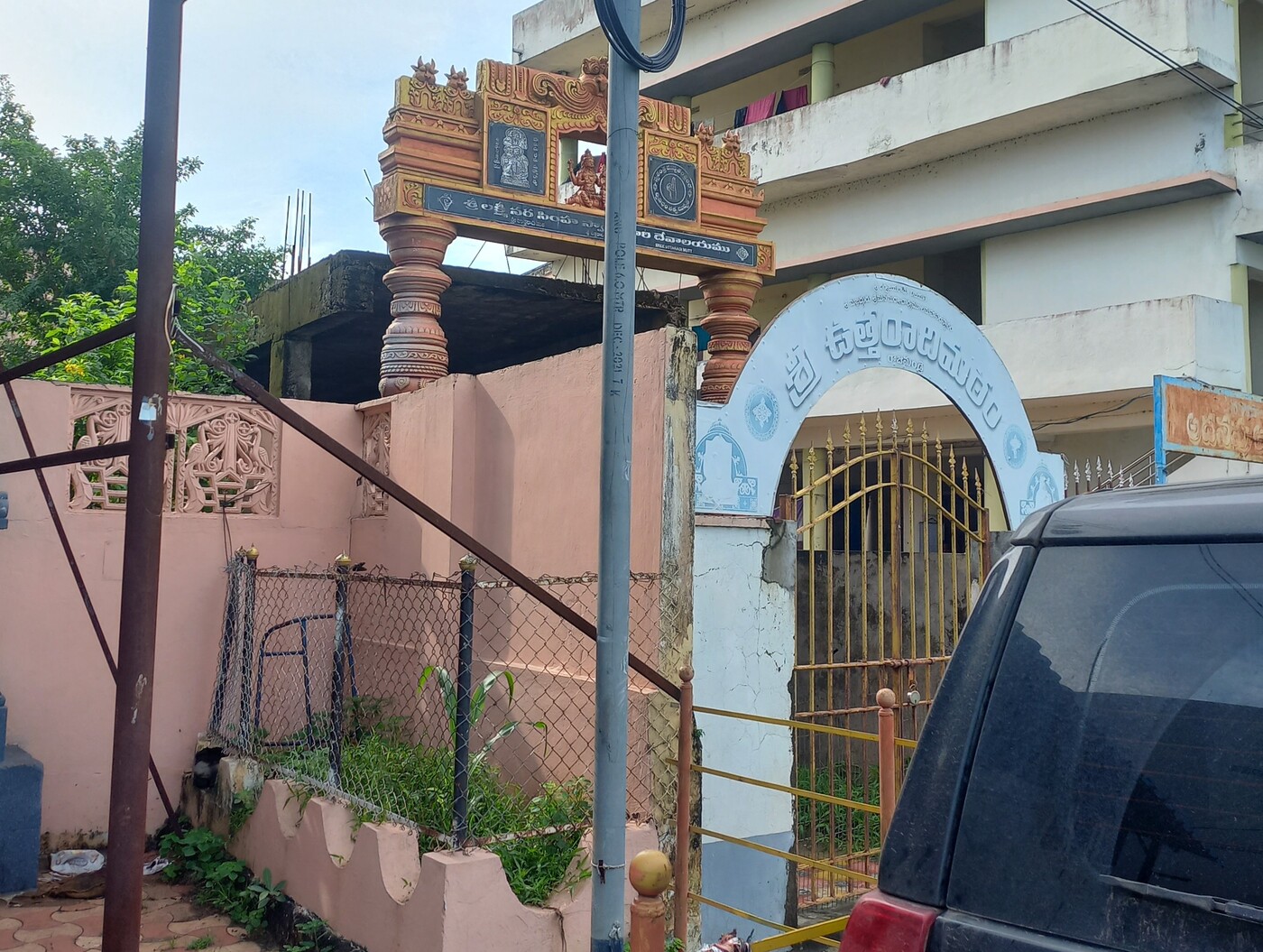
The Madhva-vijaya singles Padmanabha Tirtha out for special praise. Dvaita tradition remembers him as probably the senior-most of Madhva's disciples from outside the Tulu-speaking heartland around Udupi. That status made him the natural choice to lead the community after Madhva's own departure. The Uttaradi Matha counts him today as its first pontiff. Later tradition speaks of four direct disciples who carried Madhva's teaching beyond Udupi: Padmanabha Tirtha, Narahari Tirtha, Madhava Tirtha and Akshobhya Tirtha. Sharma's academic history places Padmanabha Tirtha first among them. But we should seriously ask whether history really followed this neat order of four, instead of assuming that it is settled. This question is examined below.
Entombed at Nava Brindavana #
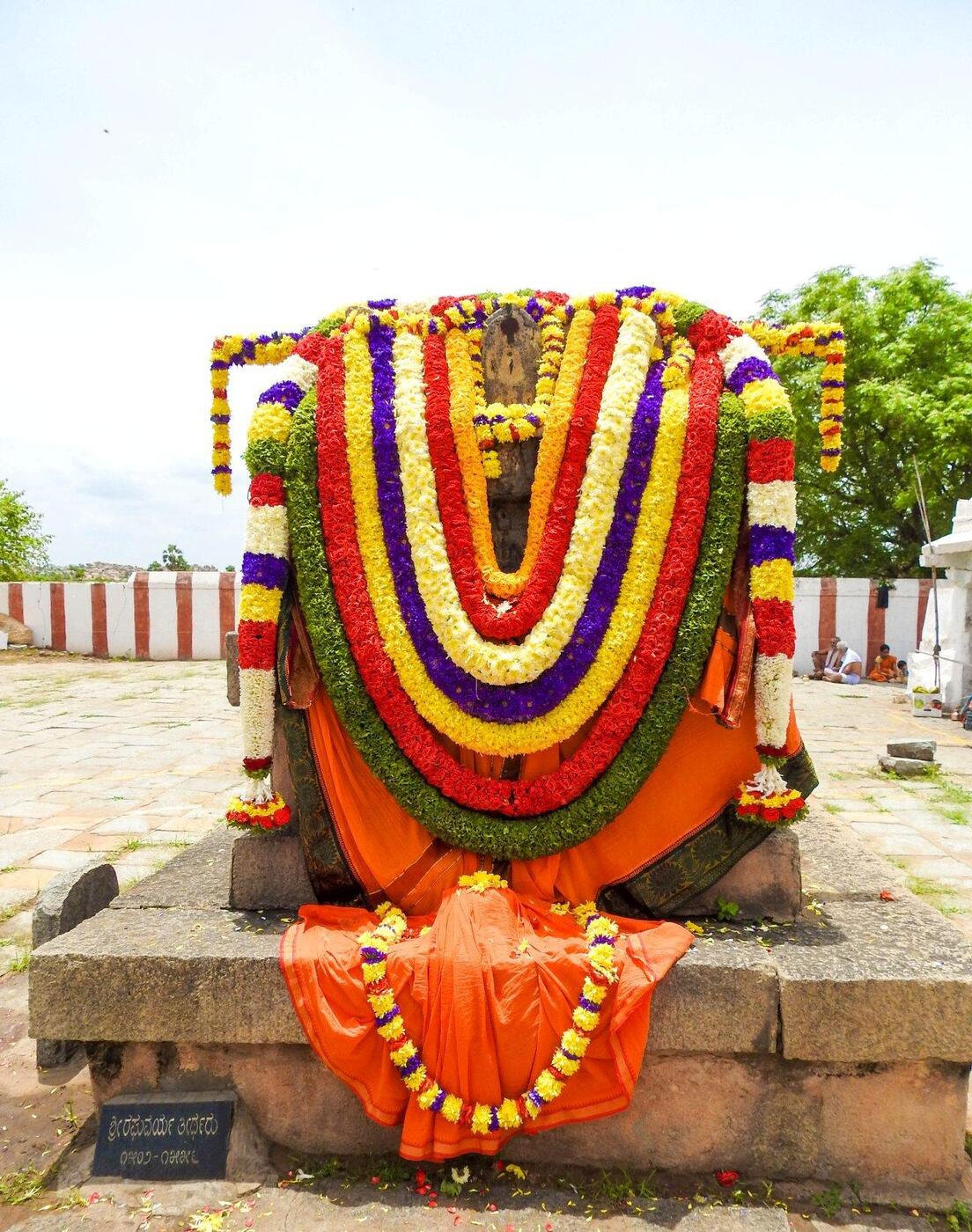
Padmanabha Tirtha is remembered as having headed the community for about seven years before his own passing in 1324 CE. He was laid to rest at Nava Brindavana, an island in the Tungabhadra river near Anegundi, close to Hampi in modern Karnataka. Over the following three centuries, this same site received the tombs of eight more Dvaita-tradition pontiffs, among them the celebrated Vyasa Tirtha. Padmanabha Tirtha's own tomb there is the oldest of the nine. The site remains an active place of pilgrimage today for the Uttaradi Matha, the Vyasaraja Matha and the Raghavendra Matha. All three of these institutions trace their own founding back, in the end, through him to Madhvacharya.
- Sri Padmanabha Tirtha - Sri Uttaradi Math
- Padmanabha Tirtha - Gaudiya History (ISKCON Desire Tree)
- Sri Madhvacarya - Disappearance (reproduces Srila Prabhupada's purport to CC Madhya 9.245) - ISKCON Desire Tree
- B. N. K. Sharma, History of the Dvaita School of Vedanta and Its Literature (1961/1981) - Internet Archive
- Is the Gaudiya Vaishnava sampradaya connected to the Madhva line? by Jagadananda Das
