Gaudiya Vaishnavas honour Prabodhananda Saraswati as much for his writings as for his life. His two best-known works are Sri Radha-rasa-sudha-nidhi and Sri Chaitanya-chandramrita. Five centuries later, they are still read and quoted, and their verses are still used in songs. Srila Prabhupada himself came back to both again and again in his own purports and lectures.
| Detail | Description |
|---|---|
| On Radha's glories | Sri Radha-rasa-sudha-nidhi |
| On Sri Chaitanya Mahaprabhu | Sri Chaitanya-chandramrita |
| On the holy land of Vraja | Sri Vrindavana-mahimamrita |
| Other works | Navadvipa-shataka, Sangita-Madhava, Sri Nityanandastakam, and commentaries on Shruti-stuti and the Gopala-tapani Upanishad |
| Quoted by Srila Prabhupada in | Sri Chaitanya-charitamrita and Srimad-Bhagavatam purports, and numerous recorded lectures |
Sri Radha-rasa-sudha-nidhi #
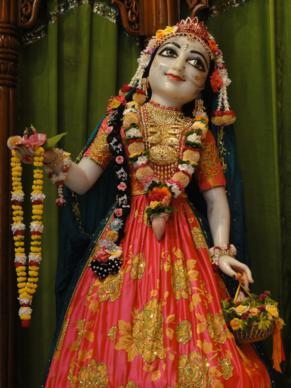
Sri Radha-rasa-sudha-nidhi means "the nectar-ocean of the rasa of Radha." It is a Sanskrit poem devoted entirely to Srimati Radharani's own transcendental beauty, character and moods of love for Krishna. Gaudiya writers describe it as unequalled among Prabodhananda's works for the sheer sweetness of its poetry, and its verses have supplied lyrics still used in devotional song today.
There is one difficulty that we should record honestly. In 1992, J. K. Brzezinski published an academic study in the Bulletin of the School of Oriental and African Studies. It looks at a different claim about the poem's author, found within the separate Radhavallabha sampradaya. That sampradaya was founded by Sri Hita Harivamsa, a younger contemporary of Prabodhananda. This claim credits the same work, at least in part, to Harivamsa, not to Prabodhananda. Gaudiya Vaishnava tradition itself has always been firm on this point. Srila Prabhupada's own purports name Radha-rasa-sudha-nidhi as Prabodhananda's, alongside Sangita-Madhava, Vrindavana-shataka and Navadvipa-shataka. This page follows that view, though not all scholars agree.
There is also a related debate within the Gaudiya tradition itself. Some Gaudiya readers have noticed that Prabodhananda's poetry leans toward the svakiya idea of Radha and Krishna's love, the view that treats them as eternally married. Most Gaudiya Vaishnavas consider the parakiya mood, not the svakiya, to be the highest expression of Vraja-prema. Because of this, a few devotees in the past have read his books with less enthusiasm than they might otherwise deserve. Later Gaudiya commentators, however, have generally set this concern aside as a matter of personal taste, not an error in doctrine. They still count Radha-rasa-sudha-nidhi among the tradition's finest devotional poetry.
Sri Chaitanya-chandramrita #
Sri Chaitanya-chandramrita means "the moonlight-nectar of Lord Chaitanya." It is a long devotional poem in praise of Sri Chaitanya Mahaprabhu, and it is the single work of Prabodhananda's that Srila Prabhupada quoted most often.
Its most famous verse, kaivalyam narakayate, describes how, for a soul touched by Mahaprabhu's mercy, even liberation into impersonal Brahman looks like hell. The heavenly planets look like a flower imagined in an empty sky, and the poison fangs of the senses are pulled out. Srila Prabhupada quoted this verse in his purports to both Sri Chaitanya-charitamrita and Srimad-Bhagavatam, and explained it at length in at least one recorded lecture on the Nectar of Devotion.
A second verse from the same work is dante nidhaya trnakam. In it Prabodhananda speaks of "taking a straw between my teeth and falling at your feet a hundred times," and so it describes the humble, gentle mood he adopted when he approached learned men to speak to them about Krishna. Srila Prabhupada quoted this verse again and again throughout his own preaching career. He gave it as a model for how his own students should approach people with Krishna consciousness, through humility, not argument or force.
In one 1972 lecture on the Nectar of Devotion, Srila Prabhupada worked through the kaivalyam narakayate verse phrase by phrase. He explained that the senses are compared there to serpents whose bite is deadly. But for a devotee touched by Mahaprabhu's mercy, he said, those same serpents' fangs have already been pulled out, protkhata-damstrayate. So for such a soul, engaging the senses fully in Krishna's service holds no danger.
Vrindavana-mahimamrita and the Rest #
Sri Vrindavana-mahimamrita glorifies the holy land of Vrindavana itself, and it is counted among Prabodhananda's other major works. Alongside it are the shorter Navadvipa-shataka in praise of Mahaprabhu's own birthplace, the musical drama Sangita-Madhava, and commentaries on the Shruti-stuti hymn of Srimad-Bhagavatam and on the Gopala-tapani Upanishad. One more of his compositions survives in an unexpected place. The songs section preserves his Sri Nityanandastakam, an eight-verse hymn with a few additional verses added later. It glorifies Nityananda Prabhu as Mahaprabhu's constant companion and the deliverer of the fallen souls of this age. Devotees still sing it today.
