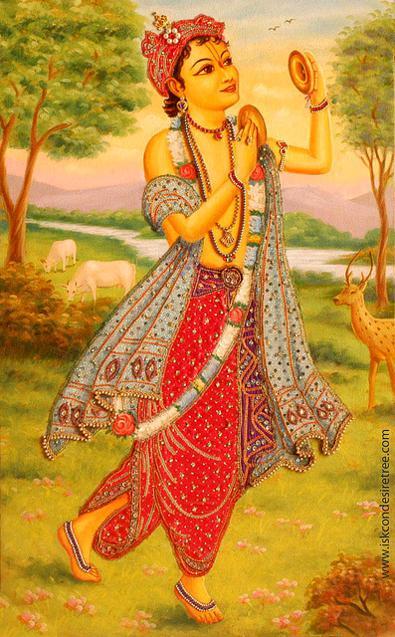
Almost nothing is recorded of Purushottama Dasa Thakura's actual birth. There is no year and no named village. But a good deal is recorded about the family and spiritual identity he was born into. This is unusual for a devotee who stands this far outside the center of Sri Chaitanya Mahaprabhu's own story. He came from a vaidya family, the traditional caste of physicians in Bengal, and Sri Chaitanya-Bhagavata calls both his father and him maha-bhagyavan, "greatly fortunate."
| Detail | Description |
|---|---|
| Father | Sadashiva Kaviraja |
| Grandfather | Kamsari Sen |
| Caste | Vaidya (physician) |
| Region | Nagaradesh, a cluster of five Bengal villages |
| Spiritual identity | Dama, one of the twelve gopalas of Vraja (Gaura-ganoddesha-dipika 131) |
| Rank among Nityananda's associates | Tenth of the gopalas, per Chaitanya-charitamrita |
A Four-Generation Family of Devotees #
Gaudiya tradition remembers Purushottama Dasa Thakura's family as spanning four generations of devotees close to Nityananda Prabhu: his grandfather Kamsari Sen, his father Sadashiva Kaviraja, Purushottama Thakura himself, and his son Kanu Thakura. Srila Bhaktisiddhanta Sarasvati Thakura's Anubhasya commentary, quoted in Srila Prabhupada's purport to Chaitanya-charitamrita, states plainly that "all the family members of Sadashiva Kaviraja were great devotees of Lord Chaitanya Mahaprabhu." The Gaura-ganoddesha-dipika is the traditional key that identifies Chaitanya-era devotees with their eternal roles in Krishna's own pastimes in Vraja. It goes a generation further back still. It names Kamsari Sen as the gopi Ratnavali and Sadashiva Kaviraja as the gopi Chandravali in their earlier, unmanifest identities.
Nagara Purushottama and the Land Called Nagaradesh #
Purushottama Thakura is often called "Nagara Purushottama" in the older sources. The Gaudiya-Vaishnava Abhidhana records two different explanations for the title, without settling on either. Some say Nagara was simply his family surname. Others say it comes from the name of the region where his family lived. Five closely spaced villages there (Beledanga, Berigram, Sukhasagar, Manasapota, and Pal Para) were together known as Nagaradesh. Both explanations are given here because the sources really disagree. Neither one has been quietly chosen over the other.
The Cowherd Boy Dama #
The Gaura-ganoddesha-dipika, verse 131, gives Purushottama Thakura's identity in Krishna's own Vraja pastimes in a short Sanskrit verse: sadasivasuto namna nagarah purusottamah, vaidya-vamsodbhavo namna dama yo vallavo vraje - "Nagara Purushottama, son of Sadashiva, born into a vaidya family, was formerly the cowherd boy named Dama in Vraja." Dama belonged to the twelve gopalas. This was a group of cowherd boys traditionally counted as companions of Krishna's elder brother Balarama, not of Krishna directly. This detail fits neatly with Purushottama Thakura's life. His entire recorded life in this world was given not to Sri Chaitanya Mahaprabhu directly but to Nityananda Prabhu, Balarama's own incarnation. Sri Chaitanya-charitamrita lists him among Nityananda's twenty-four named associates, and in the same passage it calls him specifically "the tenth gopala" (Adi-lila 11.38).
One gaudiyahistory.iskcondesiretree.com page about him gives a different identity. It calls him "Stoka Krishna" instead of Dama, without citing a source for that claim. The Dama identity comes with a directly quoted Gaura-ganoddesha-dipika verse, but the Stoka Krishna claim does not. So Dama is followed here as the better-supported identity. The difference is still noted here openly, not quietly settled.
A Sign of Absorption in Devotion #
The Gaudiya-Vaishnava Abhidhana preserves one striking anecdote from Purushottama Thakura's life. It says that he once swallowed snake poison while in a trance of devotional absorption and suffered no harm at all, to the astonishment of everyone who saw it. In the same passage, the same source notes that "many of Nityananda Prabhu's associates often displayed such miraculous powers." So it presents the event more as one example of a pattern seen among this whole circle of devotees than as a one-time miracle. No further detail about when or where this happened has survived. What followed is recorded much more fully. This was Purushottama Thakura's adult life at the side of Nityananda Prabhu himself, told on the association with Nityananda Prabhu page.
