Srila Purushottama Dasa Thakura
Bengali Devotee Wholly Absorbed in Nityananda Prabhu
The complete life, on one page: The main biography and every pastime page, in order, in one place
Introduction
Srila Purushottama Dasa Thakura was a Bengali devotee of the sixteenth century. He is remembered as one of Nityananda Prabhu's own closest associates. Krishnadasa Kaviraja Goswami names him directly in Sri Chaitanya-charitamrita. Krishnadasa Kaviraja describes Purushottama as having no external awareness of his own body, because his heart was so completely absorbed in Nityananda Prabhu. Very little of his outer life survives. But for a figure this far from the center of the story, what does survive comes from unusually good sources. These are verses from Chaitanya-charitamrita and Chaitanya-Bhagavata, a note from Srila Bhaktisiddhanta Sarasvati Thakura's Anubhasya commentary, and a family line that Gaudiya Vaishnavas still trace across four generations.
One caution is needed at the very start. It is about name ambiguity, which means two different people having almost the same name. A completely different man was also named Purushottama Dasa. He was an Odia poet at the Jagannatha temple in Puri, born around 1550, the son of one Bhagirathi Das, and the author of the poem Kanchi Kaveri. He shares almost the same name, turns up in general search results, and even has his own Wikipedia article. He has no connection to Nityananda Prabhu or the Chaitanya movement's Bengali circle. What follows is about the other man, the vaidya-family devotee whom Chaitanya-charitamrita counts among Nityananda Prabhu's own associates.
| Detail | Description |
|---|---|
| Also known as | Nagara Purushottama, Purushottam Das, Purushottam Thakur |
| Family | Son of Sadashiva Kaviraja; wife named Jahnava; son Kanu Thakura |
| Caste and region | Vaidya (physician) family of Nagaradesh, a cluster of villages in Bengal |
| Birth | Not recorded (probably early sixteenth century) |
| Identity | Dama, a cowherd friend of Krishna and the tenth of the twelve gopalas (Gaura-ganoddesha-dipika 131; Chaitanya-charitamrita Adi 11.38) |
| Listed in | Sri Chaitanya-charitamrita, Adi-lila 11.38-40, among Nityananda Prabhu's own associates |
| Disappearance | Not recorded in the sources |
At a Glance
- Born into a Bengali vaidya family, the son of Sadashiva Kaviraja, in a line that Gaudiya tradition remembers as four generations of devotees close to Nityananda Prabhu's own household.
- Named directly among Nityananda Prabhu's associates in Sri Chaitanya-charitamrita, where Krishnadasa Kaviraja Goswami says he had no external awareness of his own body.
- Identified in the Gaura-ganoddesha-dipika as Dama, one of the twelve gopala cowherd companions who traditionally serve Krishna's brother Balarama in Vraja. This is a fitting eternal identity for a man so fully devoted to Nityananda Prabhu, who is Balarama's own incarnation.
- His son, Kanu Thakura, was taken in by Nityananda Prabhu himself after the boy's mother died, and later carried to Vrindavana by Nityananda's wife Jahnava-devi.
- His disciples and the Deities his family worshiped carried his memory forward for centuries, even as flooding rivers repeatedly forced their shrine to move.
Scriptural evidence for the introduction (2)
sri-sadasiva kaviraja — bada mahasaya, sri-purusottama-dasa — tanhara tanaya
Word for word
sri-sadasiva kaviraja: Sri Sadasiva Kaviraja; bada: great; mahasaya: respectable gentleman; sri-purusottama-dasa: Sri Purushottama dasa; tanhara tanaya: his son
The twenty-third and twenty-fourth prominent devotees of Nityananda Prabhu were Sadashiva Kaviraja and his son Purushottama dasa, who was the tenth gopala.
The verse that first places Purushottama Dasa Thakura on Chaitanya-charitamrita's list of Nityananda Prabhu's named associates.
सदाशिवसुतो नाम्ना नागरः पुरुषोत्तमः ।
वैद्यवंशोद्भवो नाम्ना दामा यो बल्लवो व्रजे ॥१३१॥
sadāśiva-suto nāmnā nāgaraḥ puruṣottamaḥ
vaidya-vaṁśodbhavo nāmnā dāmā yo ballavo vraje
Dama-gopa, who had been Lord Krsna's cowherd friend in Vraja, appeared in Lord Caitanya's pastimes as Nagara Purusottama. Nagara Purusottama was born in a family of phyisicians, and his father's name was Sadasiva.
From the purport: The son of Sadāśiva was Puruṣottama Ṭhākura, and his son was Kānu Ṭhākura. The descendants of Kānu Ṭhākura know him as Nāgara Puruṣottama. He was the cowherd boy named Dāma during kṛṣṇa-līlā. (Srila Prabhupada, Chaitanya-charitamrita Adi 11.40 purport, quoting Srila Bhaktisiddhanta Sarasvati Thakura's Anubhashya)
Kavi Karnapura identifies Nagara Purushottama, the son of Sadashiva of a vaidya family, as Dama, a cowherd friend of Krishna in Vraja. Sanskrit: diacritic edition of the Gaura-ganoddesha-dipika; English translation as published at bvmlu.org.
Chapter 1
Birth and Early Life
A vaidya family, a Vraja identity as the cowherd boy Daman, and the little that is known before adulthood.
Almost nothing is recorded of Purushottama Dasa Thakura's actual birth. There is no year and no named village. But a good deal is recorded about the family and spiritual identity he was born into. This is unusual for a devotee who stands this far outside the center of Sri Chaitanya Mahaprabhu's own story. He came from a vaidya family, the traditional caste of physicians in Bengal, and Sri Chaitanya-Bhagavata calls both his father and him maha-bhagyavan, "greatly fortunate."
| Detail | Description |
|---|---|
| Father | Sadashiva Kaviraja |
| Grandfather | Kamsari Sen |
| Caste | Vaidya (physician) |
| Region | Nagaradesh, a cluster of five Bengal villages |
| Spiritual identity | Dama, one of the twelve gopalas of Vraja (Gaura-ganoddesha-dipika 131) |
| Rank among Nityananda's associates | Tenth of the gopalas, per Chaitanya-charitamrita |
A Four-Generation Family of Devotees #
Gaudiya tradition remembers Purushottama Dasa Thakura's family as spanning four generations of devotees close to Nityananda Prabhu: his grandfather Kamsari Sen, his father Sadashiva Kaviraja, Purushottama Thakura himself, and his son Kanu Thakura. Srila Bhaktisiddhanta Sarasvati Thakura's Anubhasya commentary, quoted in Srila Prabhupada's purport to Chaitanya-charitamrita, states plainly that "all the family members of Sadashiva Kaviraja were great devotees of Lord Chaitanya Mahaprabhu." The Gaura-ganoddesha-dipika is the traditional key that identifies Chaitanya-era devotees with their eternal roles in Krishna's own pastimes in Vraja. It goes a generation further back still. It names Kamsari Sen as the gopi Ratnavali and Sadashiva Kaviraja as the gopi Chandravali in their earlier, unmanifest identities.
Nagara Purushottama and the Land Called Nagaradesh #
Purushottama Thakura is often called "Nagara Purushottama" in the older sources. The Gaudiya-Vaishnava Abhidhana records two different explanations for the title, without settling on either. Some say Nagara was simply his family surname. Others say it comes from the name of the region where his family lived. Five closely spaced villages there (Beledanga, Berigram, Sukhasagar, Manasapota, and Pal Para) were together known as Nagaradesh. Both explanations are given here because the sources really disagree. Neither one has been quietly chosen over the other.
The Cowherd Boy Dama #
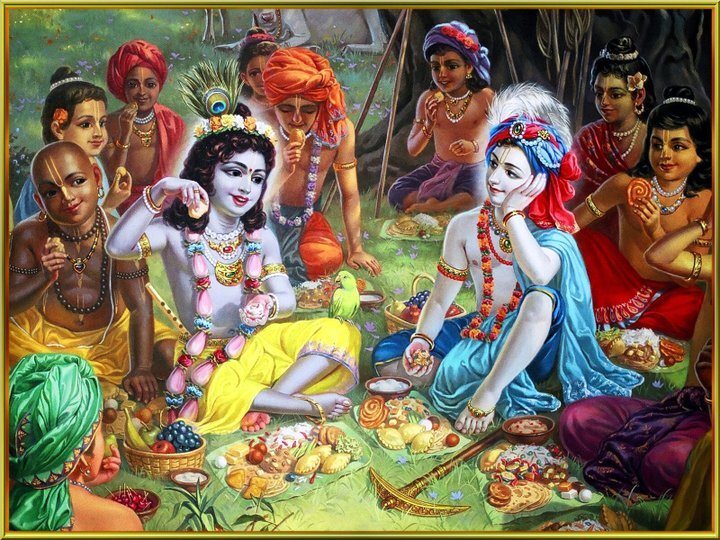
The Gaura-ganoddesha-dipika, verse 131, gives Purushottama Thakura's identity in Krishna's own Vraja pastimes in a short Sanskrit verse: sadasivasuto namna nagarah purusottamah, vaidya-vamsodbhavo namna dama yo vallavo vraje - "Nagara Purushottama, son of Sadashiva, born into a vaidya family, was formerly the cowherd boy named Dama in Vraja." Dama belonged to the twelve gopalas. This was a group of cowherd boys traditionally counted as companions of Krishna's elder brother Balarama, not of Krishna directly. This detail fits neatly with Purushottama Thakura's life. His entire recorded life in this world was given not to Sri Chaitanya Mahaprabhu directly but to Nityananda Prabhu, Balarama's own incarnation. Sri Chaitanya-charitamrita lists him among Nityananda's twenty-four named associates, and in the same passage it calls him specifically "the tenth gopala" (Adi-lila 11.38).
One gaudiyahistory.iskcondesiretree.com page about him gives a different identity. It calls him "Stoka Krishna" instead of Dama, without citing a source for that claim. The Dama identity comes with a directly quoted Gaura-ganoddesha-dipika verse, but the Stoka Krishna claim does not. So Dama is followed here as the better-supported identity. The difference is still noted here openly, not quietly settled.
A Sign of Absorption in Devotion #
The Gaudiya-Vaishnava Abhidhana preserves one striking anecdote from Purushottama Thakura's life. It says that he once swallowed snake poison while in a trance of devotional absorption and suffered no harm at all, to the astonishment of everyone who saw it. In the same passage, the same source notes that "many of Nityananda Prabhu's associates often displayed such miraculous powers." So it presents the event more as one example of a pattern seen among this whole circle of devotees than as a one-time miracle. No further detail about when or where this happened has survived. What followed is recorded much more fully. This was Purushottama Thakura's adult life at the side of Nityananda Prabhu himself, told on the association with Nityananda Prabhu page.
Chapter 2
Association With Nityananda Prabhu
Named among Nityananda Prabhu's own associates in scripture, and the story of a wife, an infant son, and two women named Jahnava.
Other things about Purushottama Dasa Thakura's life remain uncertain. But one thing is stated directly, and more than once, in the movement's own scriptures. His entire adult life was given to the service of Nityananda Prabhu. Sri Chaitanya-charitamrita counts him as the twenty-fourth of Nityananda Prabhu's listed associates. His father, Sadashiva Kaviraja, is the twenty-third. The book also gives Purushottama a description unlike almost any other name on that long list.
| Detail | Description |
|---|---|
| Position among Nityananda's associates | Twenty-fourth listed, immediately after his father |
| Source verses | Chaitanya-charitamrita, Adi-lila 11.38-40; Chaitanya-Bhagavata, Antya 5.741-742 |
| Wife | Jahnava (died shortly after childbirth) |
| Son | Kanu Thakura, taken in by Nityananda Prabhu as an infant |
Merged in Service From Birth #
Chaitanya-charitamrita's description of him is direct: "from birth, Purushottama dasa was merged in the service of the lotus feet of Lord Nityananda Prabhu, and he always engaged in childish play with Lord Krishna" (Adi-lila 11.39). Chaitanya-Bhagavata puts the same idea even more strongly. It says that external consciousness of his own body was never present in him, because Nityananda Prabhu was constantly active within his heart. Vrindavana Dasa Thakura, the author of Chaitanya-Bhagavata, separately names Purushottama Dasa among Nityananda Prabhu's chief associates as well. So the claim rests on two separate scriptural sources that agree with each other, not on just one.
In the plainest sense, this language describes a devotee who had practically no private life apart from Nityananda Prabhu's own service. He was not a scholar. He was not a preacher sent out to found temples, as Abhirama Gopala Thakura was. According to these verses, he was a devotee whose entire visible personality had been absorbed into his Lord's own activity.
A Wife Named Jahnava, and a Son Taken In #
Purushottama Thakura's wife was named Jahnava. She died shortly after giving birth to their son, whom Purushottama Thakura named Kanu. Srila Bhaktisiddhanta Sarasvati Thakura's Anubhasya, quoted in Srila Prabhupada's purport to Chaitanya-charitamrita, records that when the infant was about twelve days old, Nityananda Prabhu himself came and took the boy to his own home at Khadadaha. Nityananda Prabhu gave the infant a name of his own, Shishu Krishnadasa, because the child's devotion was clear even at that age.
Here the sources show a coincidence, though not a contradiction. Purushottama Thakura's own wife was named Jahnava. Separately, Nityananda Prabhu's own wife was named Jahnava-devi, honored in the tradition as Jahnava-mata. The one recorded as taking the boy to Vrindavana five years later is this second Jahnava, Nityananda's wife, not Purushottama's late wife of the same name. There, the Goswamis of Vrindavana saw the child's ecstatic symptoms of devotion and renamed him again, calling him Kanai Thakura. The name Jahnava appears twice because that is exactly what the sources say. It is not an error introduced here.
A Household Woven Into Nityananda's Own Family #
The connection between Purushottama Thakura's household and Nityananda Prabhu's own family did not end with Kanu's upbringing. One of Purushottama Thakura's own disciples, Madhavacharya, later married Nityananda Prabhu's daughter Ganga Devi. This meant that within two generations, a family that had begun as devoted followers of Nityananda Prabhu had also become related to him by marriage. Kanu Thakura himself is recorded as present at the famous Kheturi festival. This was the great gathering organized by Narottama Dasa Thakura. It brought together Jahnava Devi, Virabhadra Gosvami (Nityananda Prabhu's own son), and many of the movement's second-generation leaders. Kanu Thakura's presence there shows how fully Purushottama Thakura's descendants had become part of the wider Gaudiya Vaishnava community by that time.
Srila Bhakti Ballabh Tirtha Maharaj's biographical compilation, Sri Chaitanya: His Life & Associates, quotes Sri Chaitanya-Bhagavata's own description of Purushottama Thakura. This description adds one more image to the same picture: "Sadashiva Kaviraj was very fortunate to have a son like Purushottam Das. Purushottam Das had no external consciousness of his body, for Nityananda Prabhu is constantly acting through him" (Chaitanya-Bhagavata, Antya 5.741-742). Three independent sources all point the same way: Chaitanya-charitamrita, Chaitanya-Bhagavata, and the family's own later history. They show a devotee remembered mainly for how completely his life had come to belong to Nityananda Prabhu, not for anything he did on his own initiative.
The disappearance and legacy page tells what became of this family and its Deities in the generations after Purushottama Thakura's own life. It also tells what is not known about his death.
Scriptural evidence for this chapter (3)
Quoted in the text above:
- Adi 11.39 Sri Chaitanya-charitamrita
- Antya 5.741-742 Sri Chaitanya-Bhagavata
Further verses:
tanra putra — mahasaya sri-kanu thakura, yanra dehe rahe krsna-premamrta-pura
Word for word
tanra putra: his son; mahasaya: a respectable gentleman; sri-kanu thakura: Sri Kanu Thakura; yanra: whose; dehe: in the body; rahe: remained; krsna-prema-amrta-pura: the nectar of devotional service to Krsna
Sri Kanu Thakura, a very respectable gentleman, was the son of Purushottama dasa Thakura. He was such a great devotee that Lord Krishna always lived in his body.
From the purport: Purport excerpt: "It is said that just after the birth of Kanu Thakura, his mother, Jahnava, died."
Introduces Kanu Thakura and, in the fuller purport, the account of Nityananda Prabhu personally taking the infant into his own home at Khadadaha.
Chapter 3
Disappearance and Legacy
No recorded date of death, but a family, a disciple's verse, and a Deity that survived for centuries.
One page on gaudiyahistory.iskcondesiretree.com is titled "Disappearance Day of Shri Purushottama Das Thakura." Yet neither that page nor any other available source gives an actual date, tithi, or place for his disappearance. This gap is reported here openly, not hidden. Purushottama Dasa Thakura's death is simply not recorded in the material available. But much more is recorded about what happened to his family, his disciples, and the Deities he worshiped in the generations afterward. This much detail is unusual for a devotee this far from the center of the story.
| Detail | Description |
|---|---|
| Disappearance date and place | Not recorded in the sources |
| Principal disciples | Madhavacharya, Yadavacharya, Devakinandana Dasa |
| Literary legacy | A verse of homage by his disciple Devakinandana Dasa, in the work Vaishnava-vandana |
| Deity | Pranavallabha (Radha-Krishna), installed by Purushottama Thakura's family |
| Deity's later homes | Beledanga to Sukhasagara to Sahebdanga Berigram to Chandudegrama to Bodhakhana to, by 1950, Jadavpur |
Disciples Who Married Into Nityananda's Own Family #
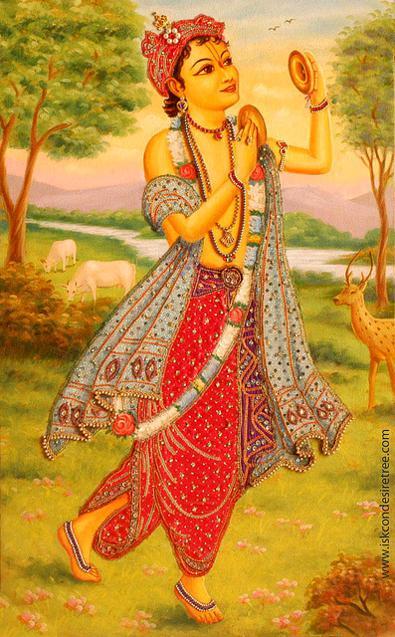
Purushottama Thakura is remembered as having three principal disciples, all born into brahmana families: Madhavacharya, Yadavacharya, and Devakinandana Dasa. Madhavacharya, also called Madhava Chattopadhyaya, came from Jirat in the Hooghly district. He went on to marry Ganga Devi, Nityananda Prabhu's own daughter. This marriage tied Purushottama Thakura's spiritual family directly into Nityananda's household. Devakinandana Dasa, meanwhile, became a writer. He composed Vaishnava-vandana, a work of homage to the Vaishnavas of his own line. One verse from it survives in the biographical record: "I worship Sadashiva Kaviraj with great attentiveness. He was constantly intoxicated with love and had no external consciousness... I bow down to my worshipable Lord, Purushottam Thakur. Who can list his incomparable qualities? He was merciful to those who were devoid of virtue, displaying the natural power of his compassion. When only seven years old, he was so intoxicated with love for Krishna that he danced in a way that enchanted the entire world." It is the closest thing to a first-hand memory of Purushottama Thakura that has survived. It was written about him by his own disciple, not by Purushottama Thakura himself.
A Family Line That Continued for Generations #
Purushottama Thakura's son, Kanu Thakura, grew into a widely respected devotee himself. He eventually established his own shripat, or seat of worship, at Bodhakhana in the Jessore district. By one account, an ankle bell had fallen from his foot while he danced in kirtana in Vrindavana, and he set up his seat at Bodhakhana after that bell was found there. According to Srila Bhaktisiddhanta Sarasvati Thakura's Anubhasya, most of Kanu Thakura's own disciplic descendants eventually settled in the village of Gadabeta, on the river Silavati, in the Midnapore district. Gaudiya Vaishnavas were still able to trace this family and disciplic line in the twentieth century, generations after Purushottama Thakura's own lifetime.
A Deity That Kept Having to Move #
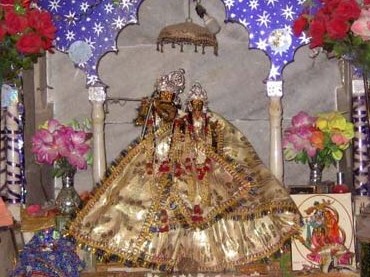
Perhaps the most vivid part of this family's later story is the Deity of Radha-Krishna, known as Pranavallabha, that Purushottama Thakura's family worshiped. It was first installed at Beledanga village. When that temple was destroyed, the Deity was moved to Sukhasagara, between the Chakdaha and Simurali railway stations. Purushottama Thakura himself is said to have sometimes lived there. When the Ganges swallowed that site too, the Deity moved again, to Sahebdanga Berigram. This time it went together with a Deity belonging to Jahnava-devi herself. When that place was also lost, the Deity moved once more, about three or four miles, to the village of Chandudegrama. Kanu Thakura's own line later carried a related Deity, Pranavallabha, to Bodhakhana, where it remained until 1950. That year, the political unrest that followed Partition forced it to be moved to Jadavpur Ghospada, in the Twenty-Four Parganas district. There it went to the house of Gaurahari Goswami, a descendant of Kanu Thakura who was still serving the Deity generations later.
Read together, these details are what remain of a devotee whose own death was never recorded. A family rebuilt a shrine again and again as rivers and history took it away. A disciple's line could still be traced centuries afterward. A Deity was still being worshiped by a direct descendant as recently as 1950. Purushottama Thakura's absorption in the service of Nityananda Prabhu, and the family and Deity worship he left behind, plainly outlasted him by a very long time.
Scriptural evidence for this chapter (1)
Quoted in the text above:
- verse of homage to Sadashiva Kaviraja and Purushottama Thakura Vaishnava-vandana (Devakinandana Dasa)
Closing
Two Men Named Purushottama Dasa #
The name Purushottama Dasa was common enough among Krishna devotees of medieval Bengal and Odisha that more than one prominent figure carries it. Wikipedia's article titled simply "Purushottama Dasa" describes a sixteenth-century Odia poet of the Karana caste. He was born around 1550 in the Puri district. He kept accounts for the Jagannatha temple and wrote "Kanchi Kaveri," a poem about a Gajapati king's marriage and the legend of how the deity stepped in during a battle. That man lived his whole life around Puri and has no recorded tie to Sri Chaitanya Mahaprabhu, Nityananda Prabhu, or the Bengali sankirtana movement at all.
The Purushottama Dasa described here instead comes from gaudiyahistory.iskcondesiretree.com's dedicated biography pages, from Sri Chaitanya-charitamrita, and from Sri Chaitanya-Bhagavata. All of these place him firmly inside Nityananda Prabhu's own circle of associates in Bengal. By checking these sources against each other, instead of relying on any single one, we can reliably tell the two men apart.
What Is Not Known #
No source records Purushottama Dasa Thakura's birth year, birthplace, or the date or place of his disappearance. This is a real gap, and we do not fill it in here with a guess. A date from one generation later is more certain. Bhaktisiddhanta Sarasvati Thakura's Anubhasya places the birth of Purushottama's own son, Kanu Thakura, in the Bengali year 942 (1535 CE). This at least places Purushottama's own adult life in the early-to-mid sixteenth century, the time of Nityananda Prabhu and other associates such as Abhirama Gopala Thakura and Gauridasa Pandit, who lived and preached in the same Bengali circle.
- Purushottama Dasa Thakura (biography) - gaudiyahistory.iskcondesiretree.com
- Purushottama Dasa Thakura - Biography - gaudiyahistory.iskcondesiretree.com
- Purushottama Dasa - Biography - gaudiyahistory.iskcondesiretree.com
- Purushottama Dasa Thakura - Biography (excerpted from Bhakti Ballabh Tirtha Maharaj's Sri Chaitanya: His Life & Associates) - gaudiyahistory.iskcondesiretree.com
- Sri Chaitanya-charitamrita, Adi-lila 11.38-40
