One page on gaudiyahistory.iskcondesiretree.com is titled "Disappearance Day of Shri Purushottama Das Thakura." Yet neither that page nor any other available source gives an actual date, tithi, or place for his disappearance. This gap is reported here openly, not hidden. Purushottama Dasa Thakura's death is simply not recorded in the material available. But much more is recorded about what happened to his family, his disciples, and the Deities he worshiped in the generations afterward. This much detail is unusual for a devotee this far from the center of the story.
| Detail | Description |
|---|---|
| Disappearance date and place | Not recorded in the sources |
| Principal disciples | Madhavacharya, Yadavacharya, Devakinandana Dasa |
| Literary legacy | A verse of homage by his disciple Devakinandana Dasa, in the work Vaishnava-vandana |
| Deity | Pranavallabha (Radha-Krishna), installed by Purushottama Thakura's family |
| Deity's later homes | Beledanga to Sukhasagara to Sahebdanga Berigram to Chandudegrama to Bodhakhana to, by 1950, Jadavpur |
Disciples Who Married Into Nityananda's Own Family #
Purushottama Thakura is remembered as having three principal disciples, all born into brahmana families: Madhavacharya, Yadavacharya, and Devakinandana Dasa. Madhavacharya, also called Madhava Chattopadhyaya, came from Jirat in the Hooghly district. He went on to marry Ganga Devi, Nityananda Prabhu's own daughter. This marriage tied Purushottama Thakura's spiritual family directly into Nityananda's household. Devakinandana Dasa, meanwhile, became a writer. He composed Vaishnava-vandana, a work of homage to the Vaishnavas of his own line. One verse from it survives in the biographical record: "I worship Sadashiva Kaviraj with great attentiveness. He was constantly intoxicated with love and had no external consciousness... I bow down to my worshipable Lord, Purushottam Thakur. Who can list his incomparable qualities? He was merciful to those who were devoid of virtue, displaying the natural power of his compassion. When only seven years old, he was so intoxicated with love for Krishna that he danced in a way that enchanted the entire world." It is the closest thing to a first-hand memory of Purushottama Thakura that has survived. It was written about him by his own disciple, not by Purushottama Thakura himself.
A Family Line That Continued for Generations #
Purushottama Thakura's son, Kanu Thakura, grew into a widely respected devotee himself. He eventually established his own shripat, or seat of worship, at Bodhakhana in the Jessore district. By one account, an ankle bell had fallen from his foot while he danced in kirtana in Vrindavana, and he set up his seat at Bodhakhana after that bell was found there. According to Srila Bhaktisiddhanta Sarasvati Thakura's Anubhasya, most of Kanu Thakura's own disciplic descendants eventually settled in the village of Gadabeta, on the river Silavati, in the Midnapore district. Gaudiya Vaishnavas were still able to trace this family and disciplic line in the twentieth century, generations after Purushottama Thakura's own lifetime.
A Deity That Kept Having to Move #
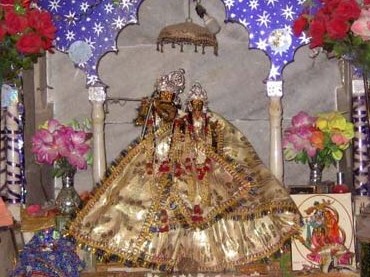
Perhaps the most vivid part of this family's later story is the Deity of Radha-Krishna, known as Pranavallabha, that Purushottama Thakura's family worshiped. It was first installed at Beledanga village. When that temple was destroyed, the Deity was moved to Sukhasagara, between the Chakdaha and Simurali railway stations. Purushottama Thakura himself is said to have sometimes lived there. When the Ganges swallowed that site too, the Deity moved again, to Sahebdanga Berigram. This time it went together with a Deity belonging to Jahnava-devi herself. When that place was also lost, the Deity moved once more, about three or four miles, to the village of Chandudegrama. Kanu Thakura's own line later carried a related Deity, Pranavallabha, to Bodhakhana, where it remained until 1950. That year, the political unrest that followed Partition forced it to be moved to Jadavpur Ghospada, in the Twenty-Four Parganas district. There it went to the house of Gaurahari Goswami, a descendant of Kanu Thakura who was still serving the Deity generations later.
Read together, these details are what remain of a devotee whose own death was never recorded. A family rebuilt a shrine again and again as rivers and history took it away. A disciple's line could still be traced centuries afterward. A Deity was still being worshiped by a direct descendant as recently as 1950. Purushottama Thakura's absorption in the service of Nityananda Prabhu, and the family and Deity worship he left behind, plainly outlasted him by a very long time.
