Srila Ramananda Raya
The Governor Who Became Mahaprabhu's Confidant
The complete life, on one page: The main biography and every pastime page, in order, in one place
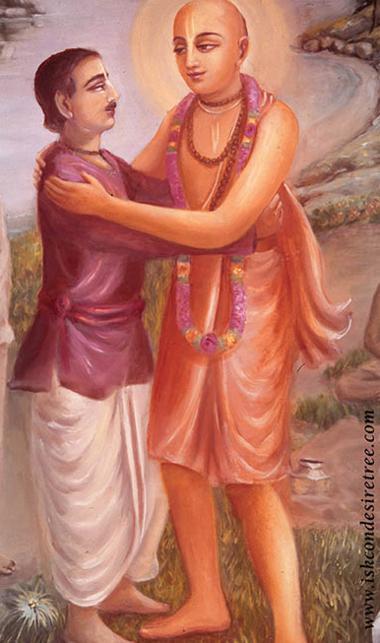
Introduction
Srila Ramananda Raya was one of the most unusual people Sri Chaitanya Mahaprabhu ever drew close to Himself. He was a working provincial governor, not a monk or a scholar-priest by profession. By the caste rules of his own time, he was not even considered fit company for a brahmana, let alone a sannyasi. Yet Sri Chaitanya Mahaprabhu made a special effort to seek him out. He spoke with Ramananda for ten evenings on the bank of the Godavari river, as a student rather than a teacher. Afterward, for the rest of His life in Puri, He kept Ramananda among the two or three people allowed closest to Him in His most private moods. Gaudiya Vaishnavism remembers Ramananda Raya as one of the deepest experts in rasa-shastra, the study of devotional mellows. He had that reputation even before he ever met the Lord. He is also remembered as living proof of Sri Chaitanya Mahaprabhu's own teaching that knowledge of Krishna, not birth, is what qualifies someone to teach it.
| Detail | Description |
|---|---|
| Also known as | Ramananda Ray, Raya Ramananda, Rama Raya |
| Father | Bhavananda Raya, a senior official under the Gajapati kings of Orissa |
| Identity | Cowherd Arjuna and the Pandava Arjuna combined; some say the gopi Lalita (Gaura-ganoddesha-dipika 120-124; Chaitanya-charitamrita Adi 10.134 purport) |
| Social position | Born into the karana (scribal-administrative) community, not a brahmana by birth |
| Government post | Governor of Vidyanagara, on the Godavari, under Maharaja Prataparudra |
| Best known for | The Ramananda Samvada with Sri Chaitanya Mahaprabhu, and decades of confidential service at Puri afterward |
| Literary work | Jagannatha-vallabha-nataka, a Sanskrit drama on Radha and Krishna's pastimes in Vrindavana |
| Constant companion | Svarupa Damodara Goswami, alongside whom he served Mahaprabhu in Puri |
Scriptural evidence for the introduction (2)
प्रियनर्मसखा कश्चिदर्जुनः पाण्डवोऽर्जुनः ।
मिलित्वा समभूद्रामानन्दरायः प्रभोः प्रियः ॥१२०॥
priya-narma-sakhā kaścid arjunaḥ pāṇḍavo’rjunaḥ |
militvā samabhūd rāmānanda-rāyaḥ prabhoḥ priyaḥ ||120||
The cowherd boy Arjuna who was a close friend of the Lord in Vrndavana, and the Pandava Arjuna, both joined to become Ramananda Raya, who was very dear to Lord Caitanya.
From the purport: The Gaura-gaṇoddeśa-dīpikā (120-24) states that Rāmānanda Rāya was formerly Arjuna. He is also considered to have been an incarnation of the gopī Lalitā, although in the opinion of others he was an incarnation of Viśākhādevī. (Srila Prabhupada, Chaitanya-charitamrita Adi 10.134 purport)
Kavi Karnapura records that Krishna's cowherd friend Arjuna and the Pandava Arjuna together appeared as Ramananda Raya. Sanskrit: diacritic edition of the Gaura-ganoddesha-dipika; English translation as published at bvmlu.org.
ललितेत्याहुरेके यत्तदेकेनानुमन्यन्ते ।
भवानन्दं प्रति प्राह गौरो यत्त्वं पृथापतिः ॥१२२॥
गोप्यार्जुनीयया सार्धमेकीभायापि पाण्डवः ।
अर्जुनो यद्रायरामानन्द इत्याहुरुत्तमाः ॥१२३॥
अर्जुनीयाभवत्तूर्णं अर्जुनोऽपि च पाण्डवः ।
इति पाद्मोत्तरखण्डे व्यक्तमेव विराजते ।
तस्मादेतत्त्रयं रामानन्दरायमहाशयः ॥१२४॥
lalitety āhur eke yat tad ekenānumanyante |
bhavānandaṁ prati prāha gauro yat tvaṁ pṛthā-patiḥ ||122||
gopyārjunīyayā sārdham ekībhāyāpi pāṇḍavaḥ |
arjuno yad rāya-rāmānanda ity āhur uttamāḥ ||123||
arjunīyābhavat tūrṇaṁ arjuno’pi ca pāṇḍavaḥ |
iti pādmottara-khaṇḍe vyaktam eva virājate |
tasmād etat trayaṁ rāmānanda-rāya-mahāśayaḥ ||124||
Some say that Ramananda Raya is the incarnation of Lalita-gopi, and others say that because Lord Caitanya directly told Ramananda Raya's father, Bhavananda Raya, that he was the incarnation of Maharaja Pandu, Arjuna's father, therefore Ramananda Raya must be the incarnation of Pandava Arjuna. The most learned devotees say that Ramananda Raya is the incarnation of both the Pandava Arjuna, and a gopi named Arjuniya. This explanation is also supported by the statements of the Padma Purana, Uttara-khanda. From all this we may conclude that Ramananda Raya is the incarnation of Lalita-gopi, Arjuniya-gopi, and Pandava Arjuna.
Kavi Karnapura records the other views: the gopi Lalita, and the gopi Arjuniya joined with the Pandava Arjuna, citing the Padma Purana, Uttara-khanda. Sanskrit: diacritic edition of the Gaura-ganoddesha-dipika; English translation as published at bvmlu.org.
Chapter 1
Birth and Family
The scribal family Ramananda Raya was born into, and why his caste made everything that followed unexpected.
Ramananda Raya was born into a family that had every reason to expect a life of government service for him, not a life of devotion. The tradition remembers his birth partly because the life of devotion he went on to live was so unlikely. His father, Bhavananda Raya, held a senior position in the administration of the Gajapati kings of Orissa and was connected with the area around Alalanatha, also called Brahmagiri, a holy site some distance west of Jagannatha Puri. Sri Chaitanya-charitamrita does not record an exact year for Ramananda Raya's birth. But by the time he met Sri Chaitanya Mahaprabhu on the bank of the Godavari, he was already a mature man of about forty, twice the Lord's own age, with a long career and a settled family life behind him.
A Family of the Karana Community #
Bhavananda Raya's family belonged to Orissa's karana community, a caste of scribes, clerks and administrators who staffed much of the Gajapati kingdom's government. In that era, wider society classed the karanas as shudra, the lowest of the four traditional social orders. They were well below the brahmana priests and scholars. Normally only brahmanas were considered fit to teach scripture or to receive a sannyasi's full respect. This was not a minor detail. It meant that by the ordinary rules of the day, Ramananda Raya had no standing at all to instruct a brahmana-born monk in the deepest truths of devotion. Yet that is exactly what he would later do. Gaudiya Vaishnava writers, drawing on Srila Bhaktisiddhanta Sarasvati Thakura's later commentary, describe the family's position plainly. By birth, they were shudras. But Bhavananda Raya, and especially Ramananda, were devotees whose real spiritual standing had nothing to do with that birth at all.
Five Sons, One Extraordinary Household #
Ramananda Raya was the eldest of five brothers. Sri Chaitanya-charitamrita names the other four as Pattanayaka Gopinatha, Kalanidhi, Sudhanidhi and Nayaka Vaninatha. It also records a striking thing Sri Chaitanya Mahaprabhu later said about the whole family. Embracing Bhavananda Raya, the Lord told him plainly that he had formerly been Maharaja Pandu, the father of the five Pandava brothers of the Mahabharata. He said that Bhavananda's five sons were those same Pandavas, born again. The tradition does not make this kind of statement about ordinary households. It shows how seriously Gaudiya Vaishnavism has always taken this particular family. The tradition sees it as more than background to Ramananda Raya's story. It considered this household spiritually important in itself.
Growing into a Scholar of Rasa #
Nothing in the sources suggests that Ramananda Raya's early life looked unusual from the outside. He grew up to serve the Gajapati state the way his father had. He was trained in the administrative and scholarly skills his community was known for, and in time he was given real responsibility of his own. But somewhere along the way he also became an expert in rasa-shastra, the technical study of the different moods and flavors of devotional love. His knowledge was so deep that Sarvabhauma Bhattacharya specially urged the Lord not to overlook it, when Sri Chaitanya Mahaprabhu eventually came looking for him. All accounts agree that he was a poet and dramatist of genuine skill, and his one surviving Sanskrit work, Jagannatha-vallabha-nataka, is proof that this reputation was not exaggerated. How that reputation reached Sri Chaitanya Mahaprabhu, and what Ramananda Raya's actual government post involved, is told in Governor of Vidyanagara.
Why the Karana Question Matters #
Ramananda Raya's caste could easily be treated as an unimportant historical detail, but Gaudiya Vaishnavism has never treated it that way. Sri Chaitanya Mahaprabhu embraced him, sat and learned from him in private, and eventually called him not just a devotee but a spiritual master in the fullest sense. This became one of the tradition's clearest practical proofs that birth has nothing to do with realization. Srila Prabhupada returned to this point often in his own lectures. He noted plainly that Ramananda Raya belonged to the karana caste of Orissa and, by ordinary social standards, was a shudra householder in government service. He also noted that none of it mattered once Sri Chaitanya Mahaprabhu recognized what Ramananda Raya actually knew. That recognition, and the meeting that made it public, is the subject of The Meeting on the Godavari.
Scriptural evidence for this chapter (2)
রামানন্দ রায়, পট্টনায়ক গোপীনাথ ।
কলানিধি, সুধানিধি, নায়ক বাণীনাথ ॥
rāmānanda rāya, paṭṭanāyaka gopīnātha
kalānidhi, sudhānidhi, nāyaka vāṇīnātha
Word for word
rāmānanda rāya: Rāmānanda Rāya; paṭṭanāyaka gopīnātha: Paṭṭanāyaka Gopīnātha; kalānidhi: Kalānidhi; sudhānidhi: Sudhānidhi; nāyaka vāṇīnātha: Nāyaka Vāṇīnātha.
The five sons of Bhavānanda Rāya were Rāmānanda Rāya, Paṭṭanāyaka Gopīnātha, Kalānidhi, Sudhānidhi and Nāyaka Vāṇīnātha.
Names Ramananda Raya's four brothers, establishing the family described here.
সাক্ষাৎ পাণ্ডু তুমি, তোমার পত্নী কুন্তী ।
পঞ্চপাণ্ডব তোমার পঞ্চপুত্র মহামতি ॥
sākṣāt pāṇḍu tumi, tomāra patnī kuntī
pañca-pāṇḍava tomāra pañca-putra mahā-mati
Word for word
sākṣāt pāṇḍu: directly Mahārāja Pāṇḍu; tumi: you; tomāra: your; patnī: wife; kuntī: like Kuntīdevī; pañca-pāṇḍava: five Pāṇḍavas; tomāra: your; pañca-putra: five sons; mahā-mati: all highly intellectual.
"You are Mahārāja Pāṇḍu himself, and your wife is Kuntīdevī herself. All your highly intellectual sons are representatives of the five Pāṇḍavas."
Sri Chaitanya Mahaprabhu's own words to Bhavananda Raya when the family reunited at Puri, the narrative counterpart to the summary verse in Adi-lila.
Chapter 2
Governor of Vidyanagara
His post under King Prataparudra, and the reputation for rasa-shastra that reached Sri Chaitanya Mahaprabhu before they ever met.
By the time Sri Chaitanya Mahaprabhu's South India tour brought Him near the Godavari river in around 1510, Ramananda Raya was already an important man in the world. He held the post of governor at Vidyanagara. He ran that province of the Gajapati kingdom on behalf of Maharaja Prataparudra. The post gave him genuine authority over revenue, justice and order along a stretch of the empire's territory near the river. Sri Chaitanya-charitamrita simply calls him "a responsible government officer" at Vidyanagara. Srila Prabhupada's purport to that verse notes what Srila Bhaktivinoda Thakura wrote in his Amrita-pravaha-bhashya commentary. Bhaktivinoda Thakura identified this Vidyanagara with a town on the Godavari that was also called Porbandar. This is a different place from the better-known Porbandar in Gujarat, far to the west.
A Governor's Life #
Holding a post like this in the Gajapati kingdom meant more than paperwork. Ramananda Raya was responsible for a province that bordered rival powers to the south. Sri Chaitanya-charitamrita later describes him travelling with the full company of followers that such a position required. There were horses, elephants, soldiers, and a large company of Vedic brahmanas, who went with him even for ordinary religious observances like his visits to bathe in the river. Later, he urged Sri Chaitanya Mahaprabhu to travel on to Puri without him, and his stated reason was exactly this. His own journey to Puri would come with so many horses, elephants and soldiers, "all roaring tumultuously," that it would not be suitable company for the Lord's quiet pilgrimage. It is a small detail, but it shows how grand a life Ramananda Raya was still living, even after his transformation had begun.
A Reputation That Preceded Him #
Sri Chaitanya Mahaprabhu wanted to meet this governor for a reason that had nothing to do with his office. Before the Lord ever set out for South India, Sarvabhauma Bhattacharya spoke to Him about Ramananda Raya. Sarvabhauma was the great scholar of Puri who had recently become Mahaprabhu's own follower. He told the Lord plainly that there was a government officer on the Godavari whose understanding of the moods of Radha and Krishna's love had no equal among the devotees Sarvabhauma knew. Sarvabhauma urged the Lord not to let Ramananda Raya's worldly position keep Him away: "Please do not neglect him, thinking he belongs to a shudra family engaged in materialistic activities... No other devotee can compare with him in knowledge of the divine sentiments." Sri Chaitanya Mahaprabhu took the recommendation so seriously that He later said He had gone to that stretch of river for no other purpose than to meet him.
Poet, Dramatist and Scholar of Rasa #
Ramananda Raya was known as a rasika, one who deeply knows and relishes devotional mellows. This reputation rested on real accomplishment, not rumor. He was a Sanskrit poet and dramatist. He wrote Jagannatha-vallabha-nataka, a play on Radha and Krishna's pastimes in Vrindavana, which later became one of the works performed and sung at the Jagannatha temple itself. All accounts agree that he was also a trained musician and a man deeply read in the literature of rasa. This branch of Vaishnava theology, still called rasa-shastra, describes and explains the different flavors of loving relationship a devotee can have with Krishna. This was Ramananda Raya's real field of expertise long before he had any reason to expect a young sannyasi to test it directly, in person. That test came on the bank of a river he had come to visit for entirely ordinary religious reasons.
The Man Sri Chaitanya Mahaprabhu Went to Find #
Sri Chaitanya Mahaprabhu sought this meeting out very deliberately. He did not simply meet Ramananda Raya by chance in the course of His South Indian travels. He went to the Godavari specifically because Sarvabhauma had told Him to, and He sat waiting at the riverbank for Ramananda Raya's party to arrive. Afterward He even spoke of the meeting as the whole purpose of that part of His journey. From the outside, a governor with soldiers, elephants and a household of brahmana priests in his service was about the most unlikely partner imaginable for a sannyasi's most private theological conversation. What happened when the two of them actually met is told in The Meeting on the Godavari.
Scriptural evidence for this chapter (2)
'রামানন্দ রায়' আছে গোদাবরী-তীরে ।
অধিকারী হয়েন তেঁহো বিদ্যানগরে ॥
'rāmānanda rāya' āche godāvarī-tīre
adhikārī hayena teṅho vidyānagare
Word for word
rāmānanda rāya: Rāmānanda Rāya; āche: there is; godāvarī-tīre: on the bank of river Godāvarī; adhikārī: a responsible officer; hayena: is; teṅho: he; vidyānagare: in the town known as Vidyānagara.
"In the town of Vidyānagara, on the bank of the Godāvarī, there is a responsible government officer named Rāmānanda Rāya.
From the purport: Purport excerpt: "Bhaktivinoda Thakura states that Vidyanagara is today known as Porbandar. There is another Porbandar in western India, in the province of Gujarat."
Sarvabhauma Bhattacharya's introduction of Ramananda Raya to Sri Chaitanya Mahaprabhu before the Lord's South India tour; the purport notes an alternate identification of Vidyanagara.
caṇḍīdāsa, vidyāpati, rāyera nāṭaka-gīti,
karṇāmṛta, śrī-gīta-govinda
svarūpa-rāmānanda-sane, mahāprabhu rātri-dine,
gāya, śune — parama ānanda
Word for word
rāyera: of the poet Rāya Rāmānanda; nāṭaka: the Jagannātha-vallabha-nāṭaka; gīti: songs; svarūpa: Svarūpa Dāmodara; rāmānanda-sane: with Rāya Rāmānanda; mahāprabhu: Lord Caitanya Mahāprabhu; rātri-dine: day and night; gāya: sings; śune: hears.
He also passed His time reading the books and singing the songs of Caṇḍīdāsa and Vidyāpati, and listening to quotations from the Jagannātha-vallabha-nāṭaka, Kṛṣṇa-karṇāmṛta and Gīta-govinda. Thus in the association of Svarūpa Dāmodara and Rāya Rāmānanda, Śrī Caitanya Mahāprabhu passed His days and nights chanting and hearing with great pleasure.
Names Ramananda Raya's own drama, the Jagannatha-vallabha-nataka, as material Mahaprabhu had recited to Him, evidence of Ramananda Raya's literary reputation.
Chapter 3
The Meeting on the Godavari
What the famous riverbank conversation meant for Ramananda Raya himself, told from his own side of the story.
Sri Chaitanya Mahaprabhu reached the bank of the Godavari, sat down after His bath, and waited. At last Ramananda Raya's procession came into view. It was a governor's full company of followers, brahmanas and all, arriving to bathe and offer oblations to his forefathers. The Lord recognized him immediately. But He did not go to him, because of the formal restraint expected of a sannyasi. Ramananda Raya saw an unusually radiant young monk sitting quietly by the water. He came over on his own and fell flat on the ground before Him. What happened next is described in full, verse by verse, in the Ramananda Samvada, from Mahaprabhu's own side of the story. This page tells instead what that meeting was like from Ramananda Raya's side, and what it did to him.
An Embrace He Could Not Explain #
When Sri Chaitanya Mahaprabhu asked if he was Ramananda Raya, the governor answered humbly. He called himself a fallen servant from the shudra community, not a man worth this attention. The Lord embraced him all the same. Then something happened to both of them that neither could keep private. There were tears and shaking, and the name of Krishna broke out of them in half-formed sounds, right in front of the brahmana priests who had come down to the river with Ramananda Raya's party. Sri Chaitanya-charitamrita records what those onlookers made of it. They saw a sannyasi glowing like Brahman itself, sobbing in the arms of a man from the lowest of the four social orders. And their own dignified, serious-minded governor was behaving as though he had lost his senses. Ramananda Raya had not expected anything like this from an ordinary riverside meeting with a wandering monk. A stranger's touch had filled him with an emotion he had no words of his own to explain. And it happened in full view of the very people whose respect his position depended on.
A Governor Made a Teacher #
The two arranged to meet again that evening, privately. What followed over the next ten nights reversed the roles Ramananda Raya would have expected. Ordinarily a devotee asks the questions and a spiritual authority answers them. Here, a sannyasi from a respectable brahmana family put question after question to a shudra governor and accepted his answers as authoritative. Sri Chaitanya-charitamrita records that at first Ramananda Raya felt real hesitation. How could he dare to teach a sannyasi anything? Then Mahaprabhu told him plainly that it makes no difference whether a person is a sannyasi or a householder, a brahmana or a shudra. Whoever actually knows the science of Krishna is qualified to teach it. More than any formal declaration, that one exchange is what let Ramananda Raya set his own hesitation aside and speak.
A Transformation, Not a Lecture #
Across those ten evenings, Ramananda Raya was not simply showing off scholarship that he already had ready. Sri Chaitanya-charitamrita's own opening verse to the chapter compares the exchange to a cloud. Mahaprabhu Himself first filled the cloud with rain. The cloud then poured that same water back down, and it was drawn upward again. This is the tradition's own way of saying that Ramananda Raya was not simply reciting knowledge he had stored up beforehand. More than once he stopped and insisted that the words were not really his. He said he was being made to speak, the way an instrument sounds because a musician's hand is on it, not because the instrument decided anything itself. By the final stages of the conversation, Ramananda Raya no longer saw an ordinary sannyasi in front of him at all. He described a dark cowherd boy standing inside a glow of golden light. Then Mahaprabhu let him see the two of them, Radha and Krishna, together in a single form. The sight was so overwhelming that his body could not stay upright.
What Ramananda Raya Understood About Himself #
The conversation closed with something more personal than theology. Mahaprabhu embraced him and told him that no one else had ever seen what he had just seen. He asked him to keep it secret. Then, almost lightly, He said that the two of them were both madmen, and that because of this shared madness they could meet each other as equals. For his whole adult life, Ramananda Raya had lived inside the formal expectations of government service. He had lived with a governor's retinue, with caste boundaries, and with the careful seriousness a governor was supposed to show. Now he was told that he was, in some sense, on the same level as this extraordinary sannyasi. This must have changed everything he understood about his own life. Before the two parted, the Lord gave him a single practical instruction, so that he could act on all of that feeling. He asked him to step down from his post and settle near Him at Jagannatha Puri. What Ramananda Raya did with that instruction is told in Resigning His Post for Puri.
Scriptural evidence for this chapter (2)
গোদাবরীতীর-বনে বৃন্দাবন-ভ্রম ।
রামানন্দ রায় সহ তাহাঞি মিলন ॥
godāvarī-tīra-vane vṛndāvana-bhrama
rāmānanda rāya saha tāhāñi milana
Word for word
godāvarī-tīra: on the bank of the river Godāvarī; vane: in the forest; vṛndāvana-bhrama: mistook as Vṛndāvana; rāmānanda rāya: Rāmānanda Rāya; saha: with; tāhāñi: there; milana: meeting.
Once the Lord mistook the forest on the bank of the river Godāvarī to be Vṛndāvana. In that place He happened to meet Rāmānanda Rāya.
The one-line summary of the Godavari meeting from the chapter-by-chapter overview of Madhya-lila.
prabhu snāna-kṛtya kari' āchena vasiyā
eka-bhṛtya-saṅge rāya mililā āsiyā
Word for word
prabhu: the Lord; snāna-kṛtya: the daily duty of bathing; kari': finishing; āchena: was; vasiyā: sitting; eka-bhṛtya-saṅge: with one servant; rāya: Rāya Rāmānanda; mililā āsiyā: met, coming.
After finishing His evening bath, Śrī Caitanya Mahāprabhu sat down and waited for Rāmānanda Rāya to come. Then Rāmānanda Rāya, accompanied by one servant, came to meet Him.
The private evening meeting that began the ten nights of conversation; cited here only for the fact of the meeting, not the theological dialogue that followed, which is covered on the Ramananda Samvada page.
Chapter 4
Resigning His Post for Puri
How a governor in office formally left government service, and at Puri went first to Sri Chaitanya Mahaprabhu, not to the Jagannatha temple.
Sri Chaitanya Mahaprabhu's instruction on the bank of the Godavari was simple to state but not at all simple to carry out. Ramananda Raya was to leave the governorship behind and settle near the Lord at Jagannatha Puri. But he was not a young man, free to walk away from his life without consequence. He held real office under Maharaja Prataparudra, headed a household, and carried many responsibilities. These could not simply disappear because a sannyasi had asked him to leave them behind. The sources do not describe a dramatic act of defiance. They describe a formal, patient process, in which a governor asked his king to release him from service and in time received that release.
Asking the King's Permission #
Sri Chaitanya-charitamrita records Ramananda Raya's own account of how it happened, given directly to Mahaprabhu once he had reached Puri: "I duly informed Your Lordship's order to the King... By Your grace, the King was pleased to relieve me of these material activities." Srila Prabhupada's purport adds a further detail. Ramananda Raya did not simply vanish from government service. He made a formal request, and the King granted it out of respect for Ramananda Raya's clear devotion. Ramananda Raya retired with a pension, not in disgrace. Nothing about this change was hidden, and neither side was resentful. Whatever Maharaja Prataparudra thought of his governor's sudden turn toward a wandering monk, he chose not to stand in his way.
Travelling to Puri with the King #
When Ramananda Raya finally made the journey to Jagannatha Puri, he did not travel alone or quietly. Sri Chaitanya-charitamrita records that he came in the company of King Prataparudra himself, who had returned to Puri around the same time. It records that the very first thing Ramananda Raya did on arriving was to go and see Sri Chaitanya Mahaprabhu, meeting Him "with great pleasure," before attending to anything else. Because of his rank and the company he was keeping, it would have been quite reasonable for Ramananda Raya to do the usual formal things first. He could have paid his respects at the King's court, visited the Jagannatha temple, and settled his household. He did none of that first. He went straight to the Lord.
Putting the Temple Second #
The text quietly draws attention to this order of events. When Mahaprabhu asked him afterward, "Ramananda, have you seen the lotus-eyed Lord Jagannatha yet?", Ramananda Raya had to admit he had not. He would go now, he said, and see the temple next. Krishnadasa Kaviraja Goswami follows this exchange with a question that he leaves unanswered: "Who can understand the loving devotional service of Raya Ramananda?" It is a small detail in the telling, but it shows something important. Even Jagannatha's own temple, the center of Puri's entire religious life, came second for Ramananda Raya once he had reached the place where Sri Chaitanya Mahaprabhu was.
Meeting Mahaprabhu's Other Associates #
Once settled at Puri, Ramananda Raya did not attach himself to Mahaprabhu alone. Sri Chaitanya-charitamrita records that he went and offered his respects to the four senior spiritual figures already established in the Lord's circle there: Paramananda Puri, Brahmananda Bharati, Svarupa Damodara and Nityananda Prabhu. Then, as was proper, he met all of the other devotees as well. This was not a small courtesy. A former governor arriving with a king's blessing could easily have expected special respect from a gathering of sannyasis and devotees. Instead, Ramananda Raya offered obeisances first. He entered Mahaprabhu's Puri community the way any devotee would, not the way an important official might. This set the pattern for the decades of service that followed. It was service marked by humility, not by the rank he had just given up.
What He Left Behind, and What He Kept #
Ramananda Raya gave up a great deal. He had commanded soldiers, elephants and revenue for an entire province. He traded that for a life spent mostly within a small circle of devotees at Puri. There he sang, recited and served, without any of the authority his old post had carried. But he kept everything that had really mattered to him once he understood who he had met on the Godavari. He kept his learning in rasa-shastra and his gift as a poet and dramatist. And now, for the first time, he could be with the Lord directly, every day. All of his learning had secretly been pointing toward Him. Nothing in the sources suggests he ever looked back on the exchange as a loss. What that service looked like in the years that followed, alongside Svarupa Damodara, is told in Confidential Service in Puri.
Scriptural evidence for this chapter (3)
rāmānanda rāya āilā gajapati-saṅge
prathamei prabhure āsi' mililā bahu-raṅge
Word for word
rāmānanda rāya: Rāmānanda Rāya; āilā: came; gajapati-saṅge: with the King; prathamei: in the first instance; prabhure: unto Lord Caitanya Mahāprabhu; āsi' mililā bahu-raṅge: came and met with great pleasure.
When King Pratāparudra returned to Jagannātha Purī, Rāmānanda Rāya came with him. Rāmānanda Rāya immediately went to meet Śrī Caitanya Mahāprabhu with great pleasure.
Records that seeing Mahaprabhu, not the King's court or the Jagannatha temple, was Ramananda Raya's first act on reaching Puri.
rāya kahe, — tomāra ājñā rājāke kahila
tomāra icchāya rājā mora viṣaya chāḍāila
Word for word
rāya kahe: Rāmānanda Rāya said; tomāra ājñā: Your order; rājāke kahila: I informed the King; tomāra icchāya: by Your grace; rājā: the King; mora viṣaya chāḍāila: gave me relief from my material activities.
Rāmānanda Rāya said, "I duly informed King Pratāparudra of Your order for me to retire from service. By Your grace, the King was pleased to relieve me of these material activities.
From the purport: Purport excerpt: "Rāmānanda Rāya petitioned the King. The King was very pleased to give him relief, and thus Rāmānanda Rāya retired from service and received a pension from the government."
Ramananda Raya's own account of formally resigning his governorship at Mahaprabhu's request.
prabhu ājñā pāñā rāya calilā daraśane
rāyera prema-bhakti-rīti bujhe kon jane
Word for word
prabhu ājñā: the Lord's permission; pāñā: getting; rāya: Rāmānanda Rāya; calilā daraśane: departed to see Lord Jagannātha; rāyera: of Rāmānanda Rāya; prema-bhakti rīti: process of ecstatic devotional love; bujhe kon jane: who can understand.
Having received Śrī Caitanya Mahāprabhu's permission, Rāmānanda Rāya hastily went to the temple of Lord Jagannātha. Who can understand the devotional service of Rāya Rāmānanda?
Krishnadasa Kaviraja Goswami's own comment on Ramananda Raya visiting the Jagannatha temple only after first meeting Mahaprabhu.
Chapter 5
Confidential Service in Puri
His decades as one of Sri Chaitanya Mahaprabhu's three and a half most confidential associates, alongside Svarupa Damodara Goswami.
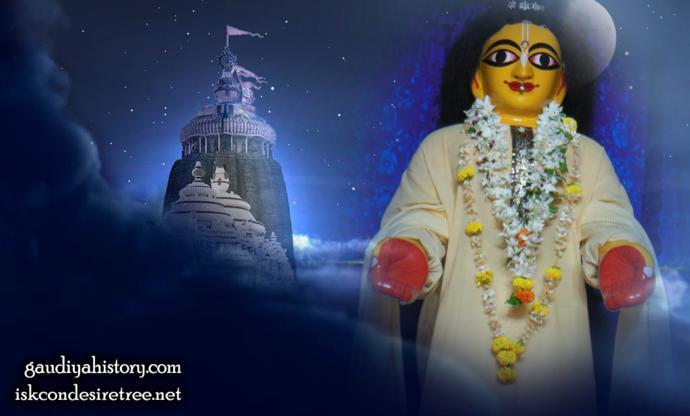
For the rest of Sri Chaitanya Mahaprabhu's manifest life at Jagannatha Puri, Ramananda Raya belonged to a very small circle. Sri Chaitanya-charitamrita gives it an exact, almost startling size. It speaks of three and a half people, in the entire world, whom Mahaprabhu accepted as truly confidential associates of Srimati Radharani Herself. The three were Svarupa Damodara Goswami, Ramananda Raya and Shikhi Mahiti. The half was Shikhi Mahiti's own sister. Everything else recorded about Ramananda Raya's Puri years should be understood with this in mind. He was not just one devoted follower among many. He was one of the small handful of people whom the tradition considers to have stood permanently at the very center of Mahaprabhu's private devotional life.
A Friend Like Subala #
Sri Chaitanya-charitamrita uses a specific comparison to describe what Ramananda Raya actually did for Mahaprabhu day to day. Subala, one of Krishna's cowherd friends in Vrindavana, once helped Krishna Himself through His own moods of separation from Radha. Ramananda Raya gave that same kind of help to Sri Chaitanya Mahaprabhu. Whenever Mahaprabhu's longing for Krishna grew too intense to bear quietly, Ramananda Raya and Svarupa Damodara sang and recited to Him long into the night. They used Ramananda's own compositions, the poetry of Chandidasa and Vidyapati, verses from Bilvamangala Thakura's Krishna-karnamrita and Jayadeva Goswami's Gita Govinda, and lines from his own Jagannatha-vallabha-nataka. Krishnadasa Kaviraja Goswami states outright that at some of these times only Ramananda's words about Krishna and Svarupa Damodara's songs sustained the Lord.
Training the Temple Dancers #
One pastime from these years still troubles readers who come across it for the first time. Ramananda Raya personally trained young devadasis, temple dancers dedicated to Lord Jagannatha's service. He taught them the emotional and rhythmic art of acting out his own dramas, which are full of rasa. In doing so, he bathed, massaged and dressed them with his own hands, every single day. Sri Chaitanya-charitamrita does not soften this or try to explain it away. It simply states that no small-minded person could hope to understand what was in Ramananda Raya's mind while he did it. Mahaprabhu Himself is recorded as saying that even He, a sannyasi under vows, sometimes felt His own mind disturbed by the mere sight of a woman's form. But, He said, Ramananda Raya was greater than He in this respect, for Ramananda remained entirely undisturbed even while touching one directly. The tradition is equally clear about the other side of that statement. This was a special right that belonged to Ramananda Raya alone, granted for reasons particular to his own position. It is not a standard for anyone else to imitate.
Pradyumna Mishra Comes to Hear About Krishna #
Not every glimpse of Ramananda Raya's service in Puri is this dramatic. When the devotee Pradyumna Mishra came to his home hoping to hear about Krishna directly from him, Ramananda Raya's servant first had to explain that his master was busy. He was busy with exactly the kind of daily service just described. When Ramananda Raya came, he received him humbly and asked how he could serve him. But Pradyumna Mishra only said that he had come to see him, and after a while he left. Later, when Sri Chaitanya Mahaprabhu sent him back, Ramananda Raya was filled with joy. He said it was his great fortune that Pradyumna Mishra had come on the Lord's instruction to hear about Krishna, and he spoke about Krishna at length. Krishnadasa Kaviraja Goswami's own comment on the exchange is direct. He says that Ramananda Raya's talks cannot properly be described in ordinary language, because he is not an ordinary man. His very words are absorbed in devotional service. They are spoken as an instrument of the Lord's own will, not as opinions of his own.
A Mine of Devotional Mellows #
Elsewhere, Sri Chaitanya-charitamrita has Mahaprabhu describe Ramananda Raya to another visiting scholar in very clear words. Ramananda Raya, He says, is "the ultimate knower of the transcendental mellows of Krishna's devotional service," the very person who taught Mahaprabhu that Krishna is the Supreme Personality of Godhead. He also says that Ramananda's influence "cannot be described." It was only by Ramananda Raya's mercy, Mahaprabhu says, that He came to understand the unalloyed love of the residents of Vrindavana. Coming from Sri Chaitanya Mahaprabhu Himself, this is about the highest statement of spiritual authority that the tradition records for anyone. Who is Ramananda Raya really, beneath the governor's robes and the years of quiet Puri service? What does the tradition believe lies behind that authority? That is the subject of His Identity in Krishna-Lila.
Scriptural evidence for this chapter (5)
প্রভু লেখা করে যারে — রাধিকার 'গণ' ।
জগতের মধ্যে 'পাত্র' — সাড়ে তিন জন ॥
স্বরূপ গোসাঞি, আর রায় রামানন্দ ।
শিখি-মাহিতি — তিন, তাঁর ভগিনী — অর্ধজন ॥
prabhu lekhā kare yāre — rādhikāra 'gaṇa'
jagatera madhye 'pātra' — sāḍe tina jana
svarūpa gosāñi, āra rāya rāmānanda
śikhi-māhiti — tina, tāṅra bhaginī — ardha-jana
Word for word
prabhu: Śrī Caitanya Mahāprabhu; sāḍe tina jana: three and a half persons; svarūpa gosāñi: Svarūpa Gosvāmī; rāya rāmānanda: Rāmānanda Rāya; śikhi-māhiti: Śikhi Māhiti; tāṅra bhaginī: his sister; ardha-jana: half a person.
Śrī Caitanya Mahāprabhu accepted her as having formerly been an associate of Śrīmatī Rādhārāṇī. In the entire world, three and a half people were His intimate devotees. The three were Svarūpa Dāmodara Gosvāmī, Rāmānanda Rāya and Śikhi Māhiti, and the half a person was Śikhi Māhiti's sister.
States exactly how small Mahaprabhu's circle of fully confidential associates was, and names Ramananda Raya as one of them.
sva-haste karena tāra abhyaṅga-mardana
sva-haste karāna snāna, gātra sammārjana
Word for word
sva-haste: with his own hand; karena: does; tāra: of those two girls; abhyaṅga-mardana: massaging the body with oil; sva-haste karāna snāna: bathes them with his own hand; gātra sammārjana: cleansing the whole body.
With his own hand, Śrī Rāmānanda Rāya massaged their bodies with oil and bathed them with water. Indeed, Rāmānanda Rāya cleansed their entire bodies with his own hand.
The devadasi-training pastime that Sri Chaitanya-charitamrita presents as evidence of Ramananda Raya's unique, non-imitable spiritual position.
রামানন্দ রায়-কথা কহিলে না হয় ।
'মনুষ্য' নহে রায়, কৃষ্ণভক্তিরসময় ॥
rāmānanda rāya-kathā kahile nā haya
'manuṣya' nahe rāya, kṛṣṇa-bhakti-rasa-maya
Word for word
rāmānanda rāya-kathā: the speeches of Rāmānanda Rāya; kahile nā haya: describing is not possible; manuṣya nahe rāya: Rāmānanda Rāya is not an ordinary human being; kṛṣṇa-bhakti-rasa-maya: absorbed in the devotional service of Lord Kṛṣṇa.
"I cannot properly describe the discourses of Rāmānanda Rāya, for he is not an ordinary human being. He is fully absorbed in the devotional service of the Lord.
From the purport: Purport excerpt: "A spiritually advanced person who is authorized to act as the spiritual master speaks as the Supreme Personality of Godhead dictates from within. Thus it is not he that is personally speaking."
Pradyumna Mishra's own conclusion after hearing Ramananda Raya decline to speak on his own authority.
subala yaiche pūrve kṛṣṇa-sukhera sahāya
gaura-sukha-dāna-hetu taiche rāma-rāya
Word for word
subala: Subala, a cowherd boyfriend of Kṛṣṇa; pūrve: previously; kṛṣṇa-sukhera sahāya: helper in giving happiness to Kṛṣṇa; gaura-sukha-dāna-hetu: for giving happiness to Lord Caitanya Mahāprabhu; taiche rāma-rāya: similarly Rāmānanda Rāya.
Previously, when Lord Kṛṣṇa was personally present, Subala, one of His cowherd boyfriends, gave Him happiness when He felt separation from Rādhārāṇī. Similarly, Rāmānanda Rāya helped give happiness to Lord Śrī Caitanya Mahāprabhu.
The direct textual comparison between Ramananda Raya's Puri service and Subala's role in Krishna's own Vraja pastimes.
rāmānanda-rāya kṛṣṇa-rasera 'nidhāna'
teṅha jānāilā — kṛṣṇa — svayaṁ bhagavān
[...]
kahana nā yāya rāmānandera prabhāva
rāya-prasāde jāniluṅ vrajera 'śuddha' bhāva
Word for word
rāmānanda-rāya: Śrīla Rāmānanda Rāya; kṛṣṇa-rasera nidhāna: the mine of the transcendental mellows of Kṛṣṇa's devotional service; jānāilā: has given instruction; svayam bhagavān: the Supreme Personality of Godhead; kahana nā yāya: cannot be described; rāmānandera prabhāva: the influence of Rāmānanda Rāya; rāya-prasāde: by the mercy of Rāmānanda Rāya.
"Śrīla Rāmānanda Rāya is the ultimate knower of the transcendental mellows of Lord Kṛṣṇa's devotional service. He has instructed Me that Lord Kṛṣṇa is the Supreme Personality of Godhead... It is impossible to describe the influence and knowledge of Rāmānanda Rāya, for only by his mercy have I understood the unalloyed love of the residents of Vṛndāvana.
Mahaprabhu's own description of Ramananda Raya's spiritual authority, spoken to Vallabha Bhatta.
Chapter 6
His Identity in Krishna-Lila
What Gaudiya Vaishnava tradition says about who Ramananda Raya is in Krishna's own Vrindavana pastimes, and where the sources disagree.
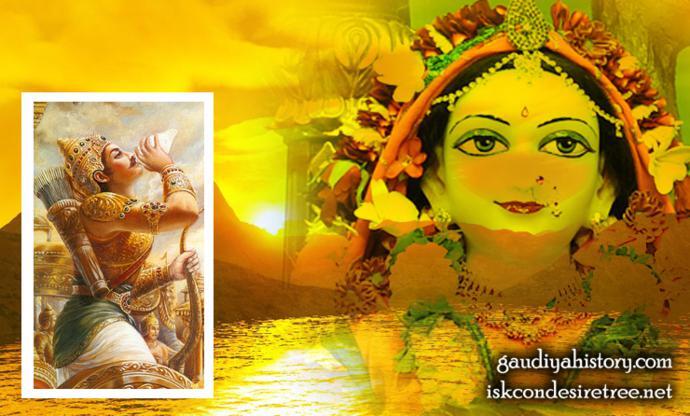
Gaudiya Vaishnavism generally holds that Sri Chaitanya Mahaprabhu's closest associates were not new souls entering His pastimes for the first time. They were eternal companions of Krishna in Vrindavana, appearing again in Bengal and Orissa to take part in Mahaprabhu's own pastimes as Krishna in the mood of Radha. Ramananda Raya is counted among the most important of these associates. But the tradition gives more than one answer about his exact identity. This page sets out what the sources actually say, including where they disagree, without picking a single version and presenting it as settled.
Two Arjunas Made One #
The main source for these identifications is Kavi Karnapura's Gaura-ganoddesha-dipika. This book lists Sri Chaitanya Mahaprabhu's associates and tells who they were in Krishna's own Vrindavana pastimes. Its verses 120 through 124 make an unusual claim about Ramananda Raya. They say that he combines not one but two separate figures named Arjuna. One is a confidential cowherd friend of Krishna in Vrindavana called Arjuna. The other is the more famous Arjuna of the Mahabharata, one of the five Pandava brothers. According to this reading, both of these figures united to become Ramananda Raya. The text supports the Pandava connection by citing a separate passage, said to be from the Padma Purana. This passage describes the Pandava Arjuna as having also once been a gopi named Arjuniya. So this identification is built from two directions at once. That is part of the reason later readers have not always summarized it in the same way.
Lalita or Vishakha #
Besides the Arjuna identification, there is a second, separate question. Which of Radha's closest gopi friends does Ramananda Raya represent? Gaura-ganoddesha-dipika itself notes that some hold he was Lalita-sakhi, while others do not accept this. Srila Bhaktivinoda Thakura, in his own commentary on Sri Chaitanya-charitamrita, took the second view. He wrote about the love that Vishakha had for Radha and Krishna in Vraja, and that Radha and Krishna had for Vishakha. He said that this same love awakened between Sri Chaitanya Mahaprabhu and Ramananda Raya when they met. This points to Vishakha-devi rather than Lalita. Other manuscript sources from Orissa's own devotional literature also favor the Vishakha identification. Among them is a work called Gurbhaktigita, attributed to Achyutananda Dasa. There is no single, universally accepted answer between Lalita and Vishakha. Both readings are current within the tradition, so both are reported here without choosing one.
What Sri Chaitanya Mahaprabhu Said Himself #
Whatever the exact gopi identification may be, the closest thing to a direct statement on the matter comes from Mahaprabhu Himself. Sri Chaitanya-charitamrita records that the Lord embraced Bhavananda Raya and described his five sons. Of the eldest He said: "Ramananda Raya and I are one, although our bodies are different." In his purport to this verse, Srila Prabhupada lays out the Arjuna, Lalita and Vishakha identifications side by side. He does not force a choice between the last two. He also adds the same warning found elsewhere in the tradition. Ramananda Raya's unique closeness to the Lord belongs to him alone, and it was never meant as an example for others to copy. This includes the extraordinary freedom he was given in his service to the temple dancers.
Not a Question of Diksha #
We should be clear about what this identity shows and what it does not show. The primary sources do not describe Ramananda Raya's bond with Sri Chaitanya Mahaprabhu in the language of formal initiation. According to the Bhajana-nirnaya, a record of Gaudiya spiritual lines, Ramananda Raya was already a disciple of Raghavendra Puri before he ever met Sri Chaitanya Mahaprabhu on the Godavari. Through Raghavendra Puri, he was also a grand-disciple of Srila Madhavendra Puri. Afterward, the Lord did not give him a mantra at a formal ceremony. What He gave him was a relationship that the texts describe in far closer terms. They speak of the two being almost one in soul. They speak of a shared "madness" in which the two of them could meet as equals. And they give Ramananda Raya a role as the one who "gave" Mahaprabhu His own deepest realizations of Vrindavana. Even so, on more than one occasion Srila Prabhupada's lectures loosely speak of Ramananda Raya as one of Mahaprabhu's "direct disciples," together with the six Gosvamis. This is a reminder that the tradition does not always draw a hard line between formal initiation and this kind of confidential, eternal service. Because of this uncertainty, and because no initiation ceremony between them is recorded, Sri Chaitanya Mahaprabhu is not treated here as Ramananda Raya's formal diksha-guru.
Scriptural evidence for this chapter (2)
এই পঞ্চ পুত্র তোমার মোর প্রিয়পাত্র ।
রামানন্দ সহ মোর দেহ–ভেদ মাত্র ॥
ei pañca putra tomāra mora priya-pātra
rāmānanda saha mora deha-bheda mātra
Word for word
ei pañca putra: these five sons; tomāra: your; mora priya-pātra: My very dear devotees; rāmānanda saha: with Rāmānanda Rāya; mora deha-bheda mātra: only a bodily difference from Me.
Śrī Caitanya Mahāprabhu told Bhavānanda Rāya, "Your five sons are all My dear devotees. Rāmānanda Rāya and I are one, although our bodies are different."
From the purport: Purport excerpt: "The Gaura-gaṇoddeśa-dīpikā (120-24) states that Rāmānanda Rāya was formerly Arjuna. He is also considered to have been an incarnation of the gopī Lalitā, although in the opinion of others he was an incarnation of Viśākhādevī."
The central citation for Ramananda Raya's identity: Mahaprabhu's own statement of near-identity with him, and Prabhupada's purport laying out the Arjuna, Lalita and Vishakha identifications without forcing a single answer.
priya-narma-sakha kascid arjunah pandavo 'rjunah
militva samabhud ramananda-rayah prabhoh priyah
...lalitety ahur eke yat tad eke nanumanyante...
"There are two Arjunas in Krishna-lila: one is a priya-narma-sakha [confidential friend] in Vraja, the other is one of the Pandavas. These two combined to become Ramananda Raya, the dear associate of Mahaprabhu... Some say he was Lalita; others do not accept this." (Sense-translation, as reported by Gaudiya History.)
The primary genealogical source behind the Arjuna and Lalita/Vishakha identifications; the Sanskrit was accessed only at second hand here, via Gaudiya History's biography page, and is reported accordingly rather than presented as a direct manuscript reading.
Chapter 7
Final Days and Disappearance
His last years at Sri Chaitanya Mahaprabhu's side, and what the sources do not tell us about how his own life ended.
By the tradition's own account, Ramananda Raya's final years are among the hardest to separate from those of Sri Chaitanya Mahaprabhu. As the Lord's later life at Puri deepened into ever more intense states of separation from Krishna, Ramananda Raya and Svarupa Damodara Goswami remained the two people consistently at His side. They stayed with Him day and night, through some of the most difficult passages in the whole of Sri Chaitanya-charitamrita. Sri Chaitanya-charitamrita states this plainly. While Mahaprabhu lived at Nilachala, He was continuously overwhelmed by longing for Krishna. Night and day He tasted, with these same two associates, the verses and songs that gave Him some relief.
Still at the Center, to the End #
Nothing in the sources suggests that Ramananda Raya's role grew smaller as the years went on. If anything, it was the opposite. The sources record him present at some of the gentlest and some of the deepest moments of Mahaprabhu's late Puri life. He was among the devotees before whom the Lord praised Haridasa Thakura's holy character. He was also one of the two whom Mahaprabhu turned to directly when His own ecstasy became almost too much to bear. Once the Lord took Svarupa Damodara and Ramananda Raya by the shoulders and asked them outright, "Tell me what I should do, where should I go, to find Krishna." In one of the tradition's most quoted moments from these years, Sri Chaitanya Mahaprabhu turned to the two of them in open joy. He declared that in this Age of Kali, the congregational chanting of the holy names is the one truly effective means of reaching Krishna. He addressed the statement to Svarupa Damodara and Ramananda Raya by name, as though He were entrusting the announcement to the two people He trusted most to carry it forward.
A Life the Sources Do Not Close #
Here we must admit the limits of what the sources tell us. They tell us about his family, his governorship, his meeting with Mahaprabhu and his decades of service afterward. But no source records exactly when, where or how Ramananda Raya's own life came to an end. Sri Chaitanya-charitamrita is very thorough about his activities during Mahaprabhu's lifetime. Yet it does not narrate his disappearance the way it narrates the departures of some of the Lord's other close associates. Even the devotional literature that exists specifically to preserve dates like this offers two different traditions, not one. Some sources place Ramananda Raya's disappearance day on Jyestha Krishna-panchami, others on Vaishakha Krishna-panchami. The sources themselves do not agree, so both dates are reported here without settling the disagreement.
What Endures #
Despite the uncertainty about his final days, what Ramananda Raya left behind has clearly endured. His Sanskrit drama, Jagannatha-vallabha-nataka, survived him. It continued to be sung and quoted at the Jagannatha temple. This was the same temple that he had once put second, on the day he arrived in Puri, because he went to see Sri Chaitanya Mahaprabhu first. He was a shudra-born government officer. Yet by the Lord's own description, he became someone whose body alone differed from Mahaprabhu's. His example became one of the central proofs Gaudiya Vaishnavism has always pointed to for its claim that devotion, not birth, decides a person's spiritual standing. Srila Prabhupada carried that example into his own preaching centuries later. He named Ramananda Raya again and again in lectures across the world as evidence that a governor and grihastha could stand among the most confidential of Sri Chaitanya Mahaprabhu's associates.
A Legacy Larger Than One Life #
As this page began by saying, Ramananda Raya's story cannot really be separated from Mahaprabhu's own, and the tradition does not appear to have wanted it separated. He is remembered less as an independent historical figure, with his own life story ending in his own clearly marked death. He is remembered more as one half of a relationship, or rather, in his case, as one of the three and a half most confidential associates. The Gaudiya tradition considers this relationship essentially a continuation of Krishna's own eternal pastimes. That is very likely why the exact date of his disappearance was never fixed as firmly in the record as the date of his meeting with Mahaprabhu was. What mattered to the devotees who preserved his story was not when he left. What mattered was how completely his whole adult life, once it began, belonged to Sri Chaitanya Mahaprabhu.
Scriptural evidence for this chapter (2)
এইমত মহাপ্রভু বৈসে নীলাচলে ।
রজনী-দিবসে কৃষ্ণবিরহে বিহ্বলে ॥
স্বরূপ, রামানন্দ, — এই দুইজন-সনে ।
রাত্রি-দিনে রস-গীত-শ্লোক আস্বাদনে ॥
ei-mata mahāprabhu vaise nīlācale
rajanī-divase kṛṣṇa-virahe vihvale
svarūpa, rāmānanda, — ei dui-jana-sane
rātri-dine rasa-gīta-śloka āsvādane
Word for word
mahāprabhu vaise nīlācale: Mahāprabhu resided at Nīlācala; rajanī-divase kṛṣṇa-virahe vihvale: overwhelmed day and night by separation from Kṛṣṇa; svarūpa, rāmānanda: Svarūpa Dāmodara and Rāmānanda Rāya; rātri-dine rasa-gīta-śloka āsvādane: tasting verses and songs of transcendental mellow night and day.
While Śrī Caitanya Mahāprabhu thus resided at Jagannātha Purī, He was continuously overwhelmed, night and day, by separation from Kṛṣṇa. Day and night He tasted transcendental blissful songs and verses with two associates, namely Svarūpa Dāmodara Gosvāmī and Rāmānanda Rāya.
Describes Ramananda Raya's constant presence through Mahaprabhu's most difficult later years at Puri.
হর্ষে প্রভু কহেন, — "শুন স্বরূপ-রামরায় ।
নামসঙ্কীর্তন — কলৌ পরম উপায় ॥
harṣe prabhu kahena, — "śuna svarūpa-rāma-rāya
nāma-saṅkīrtana — kalau parama upāya
Word for word
harṣe: in jubilation; prabhu kahena: the Lord says; śuna svarūpa-rāma-rāya: please hear, Svarupa and Rama Raya; nāma-saṅkīrtana: chanting of the holy name; kalau parama upāya: the supreme means in the Age of Kali.
In great jubilation, Śrī Caitanya Mahāprabhu said, "My dear Svarūpa Dāmodara and Rāmānanda Rāya, know from Me that chanting the holy names is the most feasible means of salvation in this Age of Kali.
Mahaprabhu's declaration on the supremacy of harinama-sankirtana, addressed by name to Svarupa Damodara and Ramananda Raya as the two He trusted to carry it forward.
- Sri Chaitanya-charitamrita, Adi-lila 10.133-134 and purport
- Sri Chaitanya-charitamrita, Madhya-lila 1.104, 7.62, 8 (background), 10.50-53, 11.15-40
- Sri Chaitanya-charitamrita, Antya-lila 2.105-106, 5, 6.9, 7.23-37, 20.3-8
- Gaudiya History: Ramananda Raya - Biography
- Gaudiya History: Ramananda Raya - Biography 2
- Gaudiya History: Ramananda Raya - Biography 3
