Sri Chaitanya-charitamrita sums up the task Sanatana carried with him into Vrindavana in a single verse of praise: "In the course of time, the transcendental news of Krishna's pastimes in Vrindavana was almost lost. To enunciate explicitly those transcendental pastimes, Sri Chaitanya Mahaprabhu empowered Srila Rupa Gosvami and Sanatana Gosvami with the nectar of His mercy to carry out this work in Vrindavana." By the early sixteenth century the exact sites of Krishna's childhood and youth had truly been lost. After centuries of political unrest in the region, they were overgrown or forgotten. The work of finding them fell to Sanatana and Rupa Gosvami, who worked sometimes together and sometimes separately. They walked the land and asked about local memory and tradition. In this way they found again, on the ground, the forests, kunjas and bathing ghats that the Bhagavata Purana and other scriptures described. Devotional accounts say that in this period the two brothers slept no more than an hour and a half a day, under whatever tree or bush was nearest. They spent the rest of their time walking, writing, discussing Krishna's pastimes and chanting His names.
A Test During Ratha-yatra #
Not long after first settling in Vrindavana, Sanatana made one more journey back to Jagannatha Puri to see Sri Chaitanya Mahaprabhu. He walked the whole way alone through the Jharikhanda forest of central India, often fasting and drinking whatever water he found along the way. That water gave him oozing, itching sores. By the time he reached Puri, he had privately decided that a body in this condition was not fit to approach Lord Jagannatha or the Lord's own devotees. He decided that he would end his life by throwing himself under the wheels of Jagannatha's chariot during the coming Ratha-yatra. But Sri Chaitanya Mahaprabhu sought him out at Haridasa Thakura's residence and embraced him by force, in spite of Sanatana's protests. Later Mahaprabhu explained to the assembled devotees that Krishna Himself had arranged this disease only to test how He, Mahaprabhu, would respond to it: "Sanatana Gosvami is one of the associates of Krishna. There could not be any bad odor from his body." At the Lord's touch the sores are said to have vanished completely, and his body took on the color of gold. Sanatana was still troubled in his heart. Later he told Jagadananda Pandita, and then Sri Chaitanya Mahaprabhu Himself, that he wished to give up his body. The Lord's reply became one of the firmest teachings He is recorded to have given anyone: "Your body is My property... Why should you want to destroy another's property?" By the Lord's own order, Sanatana lived one more year at Jagannatha Puri before being sent on to Vrindavana for good.
Begging Wheat for a Bati of Bread #
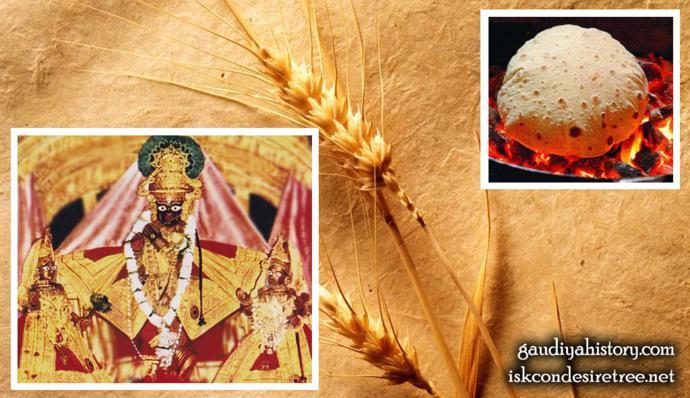
The simple way Sanatana supported himself in these years became a teaching in itself. Accounts describe him begging a small amount of wheat flour from village to village. He would work it into a ball with a little water from the Yamuna and bake it directly in the embers to make a plain, saltless bati bread. This food was so simple that even the poorest villager could offer it without hesitation. He would not eat it himself before first offering it to his worshipable Deity, Madana-mohana. The meaning of this detail is simple and needs no larger claim. A man who had once controlled the wealth of a royal treasury chose, for the last four decades of his life, to eat exactly what he could beg in a single morning and no more.
Discovering the Madana-mohana Deity #
Devotional tradition traces the Madana-mohana Deity's own story back further still, to Sri Advaita Acharya. Advaita Acharya is said to have first found Him under a banyan tree in Vrindavana. On returning to Nabadwipa, he left Him in the keeping of a Mathura brahmana named Choube at nearby Mahavana. Sanatana was then living close by. He noticed an unusually beautiful cowherd boy playing among the local children at Ramana-reti. Sanatana sensed that this was no ordinary child and followed him to a temple. There the boy simply vanished, and only the Deity of Madana-mohana stood inside. A dream that same night confirmed what Sanatana already suspected. Later Sanatana urged Choube's family to take greater care in the Deity's daily worship. Then Madana-mohana is said to have appeared to Sanatana in a dream, complaining that this new formality had spoiled His happiness in that household. Choube, in a dream of his own, was told to hand the Deity over to Sanatana outright. At first Sanatana refused. He protested that a beggar living on alms could not care for a Deity properly. But a further dream persuaded him to accept, and he carried Madana-mohana back to Vrindavana. At first he kept Him in nothing more than the crevice of a tree on top of Dwadashaditya Tila.
In this way Sanatana became responsible for establishing Madana-mohana's worship. The Madana-mohana temple is traditionally remembered as the very first of the great Deity temples founded in Vrindavana by any of the Six Goswamis. Soon after, a wealthy officer in the Mughal army named Krishna Dasa Kapura paid for the building of a proper temple to house Him. In time this building came to be recognized as one of Vrindavana's seven principal temples, and today it is known as the Radha-Madan-Mohan Mandir. In the theology of the Goswamis given in Sri Chaitanya-charitamrita, Sanatana's relationship with this particular Deity has special importance. Commenting on Sri Chaitanya-charitamrita Adi-lila 1.47, Srila Prabhupada writes, "Srila Sanatana Gosvami is the ideal spiritual master, for he delivers one the shelter of the lotus feet of Madana-mohana," and he explains that Madana-mohana represents the sambandha, or foundational relationship with Krishna. Any sincere seeker must first establish this relationship before advancing further. This is why the Gaudiya tradition remembers Sanatana himself specifically as the sambandha-acharya among the Six Goswamis. In the centuries since, political unrest forced the original Deity to be moved from Vrindavana to Karauli in present-day Rajasthan. He is still worshiped there today, while a secondary form continues to be served at the original temple site.
Wealth Poorer Than Love #
One further story preserved in the Bhakti-ratnakara shows how little Sanatana valued the wealth he had once controlled as a minister. A poor brahmana named Jivana Chakravarti had prayed to Lord Shiva for wealth for years. Then he was told in a dream to seek out Sanatana in Vrindavana, because Sanatana possessed a great treasure and would readily share it. When he arrived, he found a thin, plainly dressed renounced man living on alms. The brahmana nearly turned back in disbelief. Then Sanatana remembered a philosopher's touchstone (a stone that turns iron into gold) lying forgotten in a nearby heap of rubbish, and he simply had it brought and given away. The brahmana left overjoyed, but then he grew troubled. If Sanatana could throw away something so valuable without a second thought, he must possess something greater still. The brahmana returned to ask what that could be. Sanatana answered that there was no wealth greater than love for Krishna, and that material riches, touchstones included, only cause greater misery in the end. Moved by this reply, the brahmana begged for that wealth instead, and Sanatana mercifully granted it.
Forty-Three Years Among the Villagers of Vraja #
By the tradition's own count, Sanatana wandered on foot from village to village throughout Vraja-mandala for roughly forty-three years. The Vrajavasis are remembered as having cared for him as their own father. They brought him their quarrels over crops and family matters, along with their spiritual questions. In return they received from him both practical advice and instruction in bhakti. The Bhakti-ratnakara sums up how his godbrothers remembered him in this period: "Renouncing all worldly pleasures, Sanatana Gosvami was humble, detached, always absorbed in study... As an ocean of love and mercy, Sanatana excelled all other devotees in his compassion toward the suffering souls." Even into old age he kept a personal vow to go around Govardhana Hill and offer 1,008 obeisances daily. According to the same tradition, one day Madana-mohana Himself appeared and told him that he was too old for the twenty-four-mile walk and could set the vow aside. Sanatana simply answered, "I will never give up my religious principles," and kept walking. The Deity is said to have honored this determination, not by excusing him, but by a miracle. He pressed His own footprints into a flat Govardhana-shila, so that Sanatana could walk around this stone in place of the hill itself. The stone is still preserved at the Radha-Damodara temple. Sanatana's writing during these same wandering decades is told in Hari-bhakti-vilasa and Other Works. It shows that none of this physical hardship slowed the scholarly work Sri Chaitanya Mahaprabhu had originally asked of him.
