Srila Sanatana Gosvami
Eldest of the Six Goswamis of Vrindavana and the Ideal Spiritual Master
The complete life, on one page: The main biography and every pastime page, in order, in one place
Introduction
yā rūpa-mañjarī-preṣṭhā purāsīd rati-mañjarī
socyate nāma-bhedena lavaṅga-mañjarī budhaiḥ
sādya gaurābhinna-tanuḥ sarvārādhyaḥ sanātanaḥ
tam eva prāviśat kāryān muni-ratnaḥ sanātanaḥ
"Rupa-manjari's closest friend, who was known by the names Rati-manjari and Lavanga-manjari, appeared as Srila Sanatana Gosvami, who was honored by everyone, and who was considered to be like an extension of the transcendental body of Lord Caitanya Mahaprabhu. Sanatana Kumara, the jewel among the sages, entered the body of Sanatana Gosvami ..." (Gaura-ganoddesha-dipika 181-182)
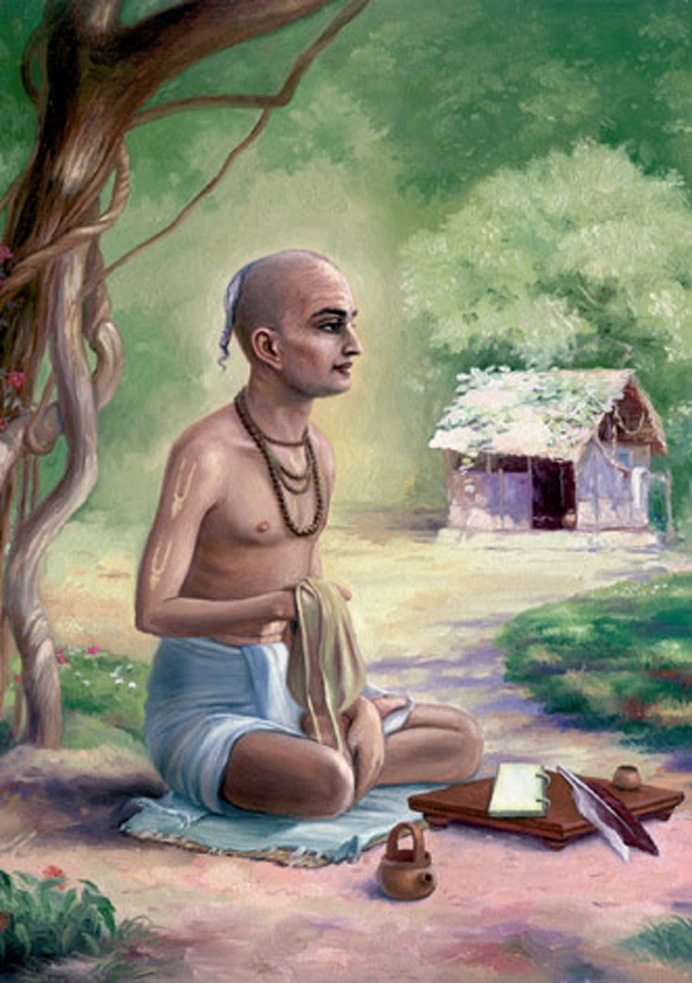
Srila Sanatana Gosvami was the eldest of the Six Goswamis of Vrindavana. According to his own younger brother, he was the one among them accepted as spiritual master. He was born into a family of Karnataka-brahmana lineage that had settled in Bengal for generations. He rose to one of the most senior posts in the court of an independent Muslim sultan, and then gave it up entirely at Sri Chaitanya Mahaprabhu's word. After this came a desperate escape from prison, two months of personal instruction at Varanasi, and roughly four decades of searching, writing and begging in Vrindavana. This life made him, in Srila Prabhupada's own description, "the ideal spiritual master," the Goswami through whom the lost pastime-places of Krishna's Vraja were found again and given to the world.
| Detail | Description |
|---|---|
| Full name | Sanatana Gosvami |
| Born | c. 1488, Bengal (his exact birthplace is disputed among Naihati, Bakla-Chandradvipa/Fateyabad in Jessore, and Ramakeli) |
| Family | Eldest of three brothers: Rupa (scholar and poet) and Anupama/Vallabha (father of Jiva Gosvami) |
| Identity | In Krishna-lila: Rati-manjari or Lavanga-manjari; Sanatana Kumara also entered him (Gaura-ganoddesha-dipika 181-182; Chaitanya-charitamrita Adi 10.84 purport) |
| Court post | Sakara Mallika, a senior ministerial post under Nawab Hussain Shah of Bengal |
| Diksha-guru | Vidyavacaspati (Madhusudana Vidyavacaspati), a brother of Sarvabhauma Bhattacharya |
| Chief works | Hari-bhakti-vilasa, Brihad-bhagavatamrita, Brihad-vaishnava-toshani (Dasama-tippani), Krishna-lila-stava |
| Disappeared | Traditionally dated 1558, beside the Radha-Madana-mohana temple, Vrindavana |
Scriptural evidence for the introduction (3)
Quoted in the text above:
- Verses 181-182 Gaura-ganoddesha-dipika
Further verses:
vande 'nantādbhutaiśvaryaṁ
śrī-caitanya-mahāprabhum
nīco 'pi yat-prasādāt syād
bhakti-śāstra-pravartakaḥ
Word for word
vande: I offer my respectful obeisances; ananta adbhuta aiśvaryam: possessing unlimited, wonderful opulences; śrī-caitanya-mahāprabhum: unto Śrī Caitanya Mahāprabhu; nīcaḥ api: even a person in the lowest status of life; yat-prasādāt: by whose mercy; syāt: may become; bhakti-śāstra-pravartakaḥ: a propounder of the scriptures of devotional service.
Let me offer my respectful obeisances unto Sri Caitanya Mahaprabhu, who has unlimited, wonderful opulences. By His mercy, even a person born as the lowest of men can spread the science of devotional service.
The invocatory verse opening the Chaitanya-charitamrita chapter devoted to Sri Chaitanya Mahaprabhu's instruction of Sanatana Gosvami at Varanasi.
অনুপম–বল্লভ, শ্রীরূপ, সনাতন ।
এই তিন শাখা বৃক্ষের পশ্চিমে সর্বোত্তম ॥
anupama-vallabha, śrī-rūpa, sanātana
ei tina śākhā vṛkṣera paścime sarvottama
On the western side were the forty-third, forty-fourth and forty-fifth branches — Śrī Sanātana, Śrī Rūpa and Anupama. They were the best of all.
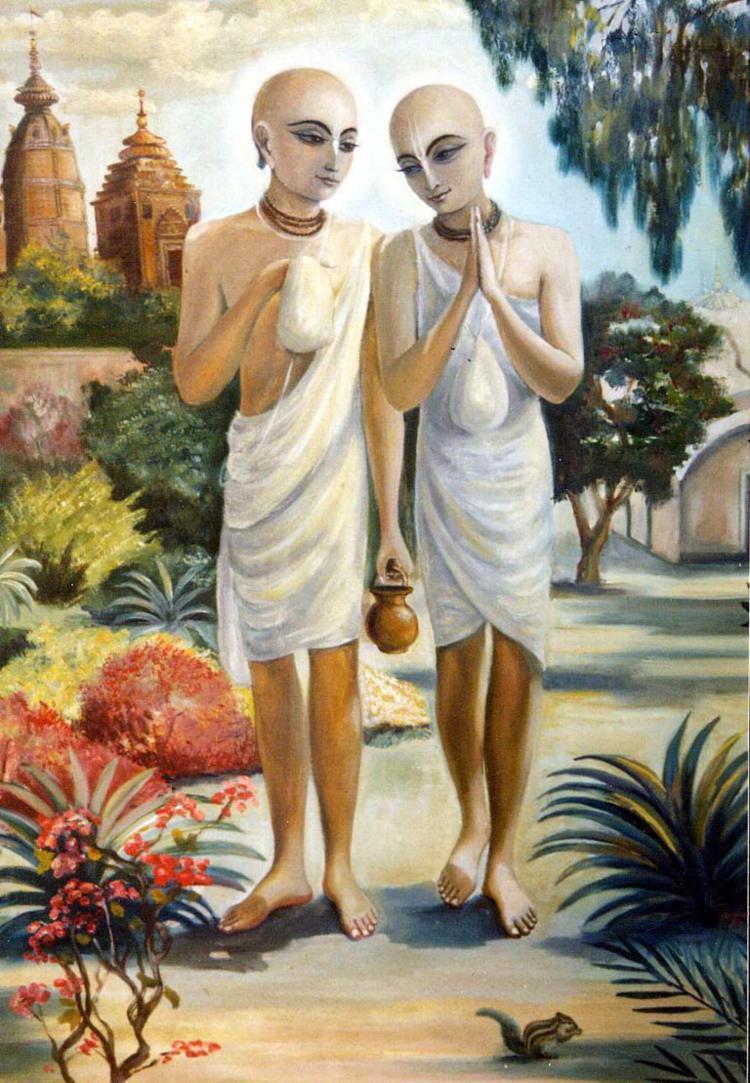
From the purport: Śrī Sanātana Gosvāmī is described in the Gaura-gaṇoddeśa-dīpikā (181). He was formerly known as Rati-mañjarī or sometimes Lavaṅga-mañjarī. (Srila Prabhupada, purport purport)
Krishnadasa Kaviraja Goswami names Sanatana, Rupa and Anupama as the best branches of the Chaitanya tree; the purport gives Sanatana's identity from the Gaura-ganoddesha-dipika. Verse text, translation and purport: Srila Prabhupada, Sri Chaitanya-charitamrita (vedabase.io).
Chapter 1
Birth and Early Life in Bengal
A Karnataka-brahmana family settled in Bengal produced three brothers who would become the tradition's greatest theologians.
According to the genealogy preserved in Narahari Chakravarti's Bhakti-ratnakara, Srila Sanatana Gosvami's family traced its origin to a Karnataka-brahmana family that migrated to eastern India generations before his birth. Various branches of the family are said to have passed through Paulastya-desa, and then through Navahatta (present-day Naihati in West Bengal). Later one ancestor named Kumara, troubled by family difficulties, moved to the village of Bakla-Chandradvipa in East Bengal and built a house at Fateyabad in Jessore. Sanatana, Rupa and Vallabha were born and raised as Kumara's sons. The Bhakti-ratnakara says that the three brothers' learning and early devotion made them "the life of the Vaishnava community." It is not settled which of these ancestral villages was Sanatana's own birthplace. Bhaktivinoda Thakura and the historian Satishchandra Mitra place his birth in Jessore. Other biographers argue for Naihati or Bakla-Chandradvipa. Still others argue for Ramakeli itself, where the family later settled and rose to prominence at the Bengal court. No single account is accepted by all, so an honest retelling has to leave the question open.
What is agreed upon is the household these three brothers grew up in. Their father, remembered variously as Kumaradeva or Mukunda, held office as a secretary under Jalaluddin Fateh Shah, the Sultan of Gauda who ruled in the 1480s. Because of the family's position, all three sons received a serious classical education from childhood. Another part of the family's genealogy names their mother as Revatidevi. It records six children in all, one daughter and five sons, though only Sanatana, Rupa and Vallabha are remembered by name as devotees. This detail does not fully settle the birthplace question above. Sanatana was the eldest, Rupa Gosvami came next, and Vallabha, later given the name Anupama by Sri Chaitanya Mahaprabhu himself, was the youngest. Anupama would later become the father of a fourth great figure of the tradition, Jiva Gosvami, though he did not live to reach Vrindavana himself.
Forests Named for Vraja #
Devotional retellings of Sanatana's boyhood keep returning to one detail. Long before any of the three brothers had reason to think of Krishna's Vrindavana as anything more than a place in scripture, they were already playing Vrindavana games. They gave the forests where they spent their childhood hours the names of Vraja's own twelve forests, among them Talavana, Madhuvana, Kamyavana and Mahavana. They called their favorite bathing ponds Radha-kunda and Shyama-kunda. These are the very names of the two sacred lakes at Govardhana. Sanatana would walk to them and around them almost daily as an old man, decades later. Biographers see this detail as an early, unconscious sign of the bhava that would later flower fully under Sri Chaitanya Mahaprabhu's direct instruction. It is not proof of anything that can be checked historically. But the tradition has remembered it about him so consistently that it is worth recording as part of that memory.
A Dream and a Waking Vision #
One more story attached to Sanatana's youth also comes from within the devotional tradition, not from any record that can be checked historically. It describes a dream in which a very beautiful brahmana boy appeared to him and placed a Srimad-Bhagavatam in his hands. Sanatana woke overjoyed, but was then upset to find neither the boy nor the book anywhere near him. According to the same account, he sat down for his morning worship that same day. Then a boy who looked exactly like the boy in his dream appeared before him in person and offered him a Bhagavatam. The boy told him to study it always, and promised that it would bring him to perfection. The tradition identifies the boy as Krishna Himself. Later in life, in his own composition Krishna-lila-stava, Sanatana would address the Bhagavata directly as "my only company, my only friend, and my guru... my greatest treasure and my personal saviour," and these words are striking enough that later Gaudiya writers have connected them back to this early episode. But the connection itself belongs to devotional legend. It does not come from anything Sanatana wrote directly about his own childhood.
Scholars Under Vidyavacaspati #
As the brothers grew older, their formal education deepened. Sanatana and Rupa both studied Nyaya and Vedanta. Nyaya is the classical Indian system of logic and rhetoric. Their teacher was the well-known logician Vasudeva Sarvabhauma Bhattacharya, the same Sarvabhauma who would later become one of Sri Chaitanya Mahaprabhu's most celebrated converts at Jagannatha Puri. They also studied under Sarvabhauma's brother, Madhusudana Vidyavacaspati, from whom Sanatana received his childhood initiation. Their scholarship became so widely respected that pandits and brahmanas from across India are said to have traveled to study under the two brothers, even while the brothers held government office. Later Gaudiya writers honored them as among the greatest scholars of their generation in Bengal. The brothers had built this reputation well before either of them met Sri Chaitanya Mahaprabhu. That is part of what made their later public renunciation so startling to the people of their time. Their learning could have earned them almost any position, but in the end they chose to walk away from all of it. This choice is told in Service as Minister to Hussain Shah.
Chapter 2
Service as Minister to Hussain Shah
Family duty carried Sanatana into one of the highest offices at the court of Bengal's independent Sultan.
When Sanatana and Rupa's father died, the two eldest brothers lost the free choice that their scholarship alone might otherwise have given them. Alauddin Hussain Shah had risen to become the independent Sultan of Gauda in Bengal after the troubled end of the earlier Habshi dynasty. He drew capable administrators into government service from the learned Hindu families of his territory. The two brothers were already known for their command of Sanskrit learning and, it seems, also of Arabic and Persian. So they were brought into his court. Sanatana was given the post remembered in the tradition as Sakara Mallika, usually translated as a senior ministerial or treasury office. Rupa served as Dabira Khasa, the Sultan's private secretary. Sri Chaitanya-charitamrita itself confirms this pairing directly. In the scene of the brothers' first meeting with Sri Chaitanya Mahaprabhu, the Lord addresses "My dear Dabira Khasa" and "My dear Sakara Mallika" in turn before renaming them Rupa and Sanatana. Srila Prabhupada's purport to the passage states plainly, "Sakara Mallika was the name of Sanatana Gosvami, and Dabira Khasa was the name of Rupa Gosvami." Both are Muslim court titles, not personal names. So later writers sometimes describe Sanatana's duties differently. One calls his post a treasury office, and another calls it a chief minister's office. But according to the original texts, there is no real dispute about which brother held which title.
A Most Brilliant Gem in the Assembly #
Later in Sri Chaitanya-charitamrita, Krishnadasa Kaviraja Gosvami describes the mercy Sri Chaitanya Mahaprabhu showed Sanatana at Varanasi. There he quotes a verse from the poet Kavi-karnapura's Chaitanya-chandrodaya-nataka. It shows how the people of Sanatana's own time saw him at the height of his court career: "Srila Sanatana Gosvami, the elder brother of Srila Rupa Gosvami, was a most important minister in the government of Hussain Shah, the ruler of Bengal, and he was considered a most brilliant gem in that assembly. He possessed all the opulences of a royal position, but he gave up everything just to accept the youthful goddess of renunciation." The same verse compares him, in his years of outward wealth, to "a deep lake covered with moss". On the surface there was courtly duty, but underneath were depths of devotional feeling that none of his fellow ministers could see. Lecturing decades later, Srila Prabhupada put the same point more plainly: "Sanatana Gosvami and Rupa Gosvami... They were ministers. When they were ministers they were not gosvami. But when they become disciples of Lord Caitanya, Sanatana Gosvami and Rupa Gosvami, and was trained by Him, they became gosvami." Elsewhere Srila Prabhupada stressed that the title Gosvami is not hereditary or political. It names one who has mastered the senses, not one who remains their servant. By that meaning, neither brother held the title yet, in spite of all their ministerial rank.
Scholars at Ramakeli #
Even while the two brothers carried out real administrative duties for a Muslim sultan, they kept their household at Ramakeli working as a center of Sanskrit learning. There they taught the shastras they had studied under Vidyavacaspati to pandits who came from across India to sit before them. Devotional retellings say that in this period they were already praised as the crest jewels of Gaudiya Vaishnava scholarship, even before either had formally met Sri Chaitanya Mahaprabhu. They had earned this fame by their learning alone. Later this made their giving up of position all the more remarkable to those who saw it. As Sri Chaitanya Mahaprabhu passed through Gauda toward Vrindavana, He made His way to this household and to these two brothers, who were still living under their Muslim court names. That secret first meeting is told in The Meeting at Ramakeli.
A Minister's Private Devotion #
Even at the height of his ministerial career, Sanatana kept a devotee's private discipline alive beneath his public duties. Another devotional account says that in these same years he compiled the Sadachar Paddhati. This is a short manual of scriptural rules for a householder's gradual advancement in spiritual life. The same account says that he carefully followed its instructions in his own conduct. Every day he gave food to brahmanas, to the destitute and to lepers, and his generosity is remembered as boundless. This detail is easy to overlook beside the drama of his later renunciation. But it shows that when the break with court life came, it was not a sudden change for Sanatana. In every way his circumstances allowed, he had already been living as a devotee, long before Sri Chaitanya Mahaprabhu ever asked anything of him directly.
A Letter, and a Single Verse in Reply #
As their restlessness with court life grew, Rupa and Sanatana are remembered as having written to Sri Chaitanya Mahaprabhu directly, at their own mother's suggestion, to ask what they should do. The first letter got no answer. Another devotional account says that the second got no answer either. When a reply finally came, it gave no direct instruction at all. It was only a single verse of scripture. The verse describes a woman who is attached to a man other than her own husband. She serves her household with steady outward care, just so that no one will suspect where her heart truly longs to be. The brothers understood the Lord's meaning without any further explanation. For the time being they were to keep doing their duties to the Nawab faithfully, while inwardly leaving the outcome entirely to Him. Sanatana, meanwhile, went on reciting Srimad-Bhagavatam with tears of ecstasy for anyone in Gauda-desa who would listen. He waited for the day that the reply had quietly promised.
Two Different Paths Out of Court Service #
The brothers' outward positions were very similar on paper. But once each decided to leave, their paths quickly became very different. Rupa's resignation as Dabira Khasa was accepted without great difficulty, and within a fairly short time he was free to set out after Sri Chaitanya Mahaprabhu. But Hussain Shah firmly refused Sanatana's request to resign. He valued his minister's intelligence too highly to release him easily. This refusal led to the far more dangerous chapter of Imprisonment and Escape. The difference shows that Sanatana's break with worldly position was not, in the end, a matter of simply being given permission. He had to fight for it, at real personal risk, against a ruler who did not want to let him go.
Chapter 3
The Meeting at Ramakeli
A secret night meeting at the brothers' own home in Gauda changed the direction of both their lives.
In 1514, Sri Chaitanya Mahaprabhu passed through Gauda on His way toward Vrindavana, traveling with a large group of followers. Sanatana and Rupa were still serving at the Bengal court under their Muslim titles of Sakara Mallika and Dabira Khasa. They had already heard of Him and secretly longed for His association, but their position made an open approach dangerous. According to Sri Chaitanya-charitamrita, the King himself asked Dabira Khasa, that is Rupa, what he thought of this wandering preacher's growing influence. Rupa answered carefully. He told the Sultan that whatever conviction arose in the Sultan's own mind about who Chaitanya Mahaprabhu was should be trusted as evidence enough. Satisfied, the King himself declared, "I consider Sri Caitanya Mahaprabhu to be the Supreme Personality of Godhead. There is no doubt about it." That conversation settled the matter for both brothers. That same night the two of them decided to go and see the Lord in person, in secret.
In the Dead of Night #
Sri Chaitanya-charitamrita describes what followed in vivid detail: "Thus in the dead of night the two brothers, Dabira Khasa and Sakara Mallika, went to see Sri Caitanya Mahaprabhu incognito. First they met Nityananda Prabhu and Haridasa Thakura," who in turn told the Lord that two men named Rupa and Sanatana, names apparently already known to Him by reputation, had come. The two brothers approached with straw held between their teeth, a traditional sign of deep humility. They had cloths tied around their necks, and they fell before the Lord "like rods." Sri Chaitanya Mahaprabhu was overwhelmed and asked them to rise. But they got up only to fall flat before Him again. They offered a long prayer in which they called themselves more sinful than the notorious brothers Jagai and Madhai, whose deliverance by the Lord was already well known: "We two are millions and millions of times inferior to Jagai and Madhai. We are more degraded, fallen and sinful than they." In reply to this prayer, the Lord addressed each of them by their court names one last time: "My dear Dabira Khasa, you two brothers are My old servants... My dear Sakara Mallika, from this day your names will be changed to Srila Rupa and Srila Sanatana," and told them plainly to give up their humility, "for My heart is breaking to see you so humble."
Turning the Lord Back from Vrindavana #
That same night, or shortly after, Sanatana gave Sri Chaitanya Mahaprabhu a piece of advice that shows the same sharp practical sense he had brought to his years at court. Sanatana learned that the Lord intended to go on to Vrindavana followed by the hundreds and, by some accounts, thousands of devotees then traveling with Him. He pointed out that this was not a fitting way to make a pilgrimage. The company was too large and too visible to move safely or humbly through territory that was, after all, still under Muslim rule. Sri Chaitanya-charitamrita records that the Lord privately considered this advice that same night and accepted it. He went only a short distance further, as far as a place called Kanair Natshala, and then turned back, instead of pressing on toward Vrindavana as He had first planned. This small moment is easy to pass over. But it shows something important about how Sri Chaitanya Mahaprabhu related to Sanatana from their very first conversation. He did not treat Sanatana only as a devotee to be instructed. He also trusted Sanatana's judgment, sharpened by years of real administrative responsibility, and He was willing to act on it.
What the Meeting Set in Motion #
The Ramakeli meeting did not end the brothers' troubles with the Bengal court. Rupa was able to resign his post fairly soon afterward and begin making his way toward the Lord. But Hussain Shah refused outright Sanatana's request to resign, because he was unwilling to lose so capable a minister. So the meeting that began that night at Ramakeli as a secret meeting of the heart was only the start for Sanatana. Before he could actually join the Lord he had just met, he had to travel a much harder and more dangerous road, told in full in Imprisonment and Escape. The names Rupa and Sanatana, given in that single night, are the names by which the tradition has known the two brothers ever since. Their former court titles survive only as a detail of history. They are kept mainly to explain how two Sanskrit scholars were, for a time, called by Muslim titles at all.
Scriptural evidence for this chapter (3)
Quoted in the text above:
- Madhya 1.208 Sri Chaitanya-charitamrita
Further verses:
tāṅrā dui-jana jānāilā prabhura gocare
rūpa, sākara-mallika āilā tomā' dekhibāre
Word for word
tāṅrā: they; dui-jana: two persons; jānāilā: informed; prabhura gocare: in the presence of Lord Caitanya Mahāprabhu; rūpa: Rūpa Gosvāmī; sākara-mallika: and Sanātana Gosvāmī; āilā: have come; tomā' dekhibāre: to see You.
They informed Lord Caitanya Mahaprabhu that two persons, Rupa and Sakara-mallika [Sanatana], had come to see Him.
From the purport: "Sakara Mallika was the name of Sanatana Gosvami, and Dabira Khasa was the name of Rupa Gosvami. They were recognized by these names in the service of the Muslim king."
Srila Prabhupada's purport directly confirms which brother held which Muslim court title, settling a point secondary sources sometimes render inconsistently.
tomāra citte caitanyere kaiche haya jñāna
tomāra citte yei laya, sei ta' pramāṇa
Word for word
tomāra citte: in your mind; caitanyere: of Lord Caitanya Mahāprabhu; kaiche haya jñāna: how there is knowledge; yei laya: whatever takes; sei ta' pramāṇa: that is evidence.
Thus Srila Rupa Gosvami informed the King about his mind as a way of knowing Sri Caitanya Mahaprabhu. He assured the King that whatever occurred in his mind could be considered evidence.
Part of the conversation between the Sultan and Rupa Gosvami (as Dabira Khasa) the same night the two brothers resolved to see Sri Chaitanya Mahaprabhu in secret.
Chapter 4
Imprisonment and Escape
A refused resignation, a jailer's bribe, a night crossing of the Ganges, and a near-fatal encounter on the road to Varanasi.
Hussain Shah did not release Sanatana from his post as easily as he had released Rupa. When Sanatana insisted on resigning, the Sultan refused and personally tried to persuade him to stay. He even went to visit Sanatana and urged him to join an upcoming military campaign against the neighboring kingdom of Odisha. Sanatana stopped attending court and pretended to be ill. The Sultan was suspicious and sent his own physicians to examine him, and they reported back that Sanatana was in perfect health. When Sanatana continued to refuse the King's summons, Hussain Shah had him thrown into prison.
A Letter from Rupa #
While Sanatana was held in prison in Bengal, word reached him that Sri Chaitanya Mahaprabhu had left Jagannatha Puri and set out for Mathura. He also heard that Rupa and Anupama had already decided to meet Him there. This news came in a letter from Rupa, and it pushed Sanatana to act. He went straight to the superintendent of the jail, a Muslim official whom Sri Chaitanya-charitamrita describes bluntly as "a meat-eater," and first appealed to religious principle. Sanatana reminded the jailer of the jailer's own knowledge of the Koran. He also reminded him that anyone who releases a prisoner according to religious principles is himself freed from material bondage by the Lord. When persuasion alone was not enough, Sanatana appealed to plain self-interest and offered him five thousand gold coins. The jailer hesitated, because he was afraid of what the Nawab might do if the truth came out. Sanatana had spent years managing far larger sums as a minister, and he stayed calm. He told the jailer exactly what to say if Hussain Shah returned and asked about his prisoner. The jailer should say that Sanatana had gone to the Ganges, seen the river, simply thrown himself in with his shackles still on, and drowned. Still the jailer was not fully satisfied, and he held out until Sanatana stacked seven thousand gold coins before him. That night, the jailer cut Sanatana's shackles and let him cross the Ganges into the dark.
A Robber Who Chose Not to Rob #
Sanatana could not travel the main roads as a fugitive. So he made his way on foot, day and night, through difficult hill country toward a place called Patada. His only companion was a servant named Ishana, who carried what remained of their money: eight gold coins. At Patada, a landlord took them in. A palmist staying with him had guessed by his art that the strangers carried gold. On the palmist's advice, the landlord began plotting to murder Sanatana and his servant that same night and take the coins. Sanatana sensed something wrong in the landlord's excessive hospitality. Sri Chaitanya-charitamrita remarks, with quiet humour, that these were the instincts of a former royal minister who understood diplomacy. Sanatana quietly asked Ishana how much money remained. Then he walked up to the landlord and offered him seven of the eight coins outright, asking only for safe passage across the hill tract. The landlord's answer is one of the most striking small speeches in the whole narrative: "On this very night I would have killed you and taken your coins. It is very good that you have voluntarily offered them to me. I am now relieved from such a sinful activity... I shall not accept these coins, but I shall get you across that hilly tract of land simply to perform a pious activity." Sanatana insisted that he take the coins anyway. He reasoned that if this man did not take them, someone else along the road certainly would. At last the landlord agreed, and he sent four of his own men to guide them safely through the forest overnight.
Across the Ganges to Varanasi #
Beyond the hills, Sanatana sent Ishana back and went on alone, "covered with a torn quilt," carrying only a waterpot. At last he reached Hajipura. There, by good fortune, he met his own brother-in-law Srikanta. Srikanta was a government official who was then buying horses for the Mughal emperor, with a large sum of money in his charge. Srikanta urged him to rest and dress respectably for a few days. But Sanatana would not stay even a moment, so Srikanta instead gave him a woolen blanket and helped him cross the Ganges one final time. After several more days of travel, Sanatana arrived at Varanasi. He went to the door of Chandrasekhara, a householder devotee with whom Sri Chaitanya Mahaprabhu was then staying. This led to their reunion and to the extraordinary two months of personal instruction told in The Instruction at Varanasi.
Scriptural evidence for this chapter (3)
Quoted in the text above:
- Madhya 20.30 Sri Chaitanya-charitamrita
Further verses:
lobha ha-ila yavanera mudrā dekhiyā
rātre gaṅgā-pāra kaila dāḍukā kāṭiyā
Word for word
lobha ha-ila: there was attraction for the money; yavanera: of the meat-eater; mudrā dekhiyā: seeing the golden coins; rātre: at night; gaṅgā-pāra kaila: he got him across the Ganges; dāḍukā kāṭiyā: breaking the shackles.
When the meat-eater saw the coins, he was attracted to them. He then agreed, and that night he cut Sanatana's shackles and let him cross the Ganges.
The moment the bribed jailer releases Sanatana Gosvami from prison, after seven thousand gold coins finally overcame the man's fear of Hussain Shah.
yatna kari' teṅho eka bhoṭa-kambala dila
gaṅgā pāra kari' dila — gosāñi calila
Word for word
yatna kari': with great care; teṅho: he (Srikanta); eka bhoṭa-kambala dila: gave one woolen blanket; gaṅgā pāra kari' dila: got him across the river Ganges; gosāñi calila: Sanatana Gosvami departed.
With great care, Srikanta gave him a woolen blanket and helped him cross the Ganges. Thus Sanatana Gosvami departed again.
Sanatana Gosvami's brother-in-law Srikanta helping him on the final leg of his journey toward Varanasi.
Chapter 5
The Instruction at Varanasi
Over roughly two months, Sri Chaitanya Mahaprabhu gave Sanatana the fullest and most orderly explanation of Gaudiya theology that the records show Him giving anyone.
Sanatana reached Varanasi and quietly took his place at the door of Chandrasekhara's house. Sri Chaitanya Mahaprabhu recognized him at once. He told His host, "There is a devotee at your door. Please call him in," even though at first Chandrasekhara saw nothing but a Muslim beggar waiting outside. Once Sanatana was inside, the Lord went to him immediately and embraced him, and both men wept, "shoulder to shoulder," in a display of feeling that astonished Chandrasekhara. Then the Lord began cleansing Sanatana's travel-worn body with His own hands. Sanatana protested that the Lord should not touch him. Sri Chaitanya Mahaprabhu's answer became one of the most quoted lines in the entire Chaitanya-charitamrita: "I am touching you just to purify Myself, because by the force of your devotional service you can purify the whole universe." When the Lord asked how he had escaped, Sanatana told the whole story of the jailer, the crossing and the road to Varanasi from beginning to end. In turn he learned that Rupa and Anupama had already gone on ahead to Vrindavana.
The Blanket and the Torn Quilt #
Before any formal teaching began, Sri Chaitanya Mahaprabhu quietly tested Sanatana and worked on his remaining attachment. Sanatana had arrived wearing a single valuable woolen blanket, the one gift from his brother-in-law Srikanta. In every other way he lived a life of strict begging. He went door to door for alms instead of accepting full meals, even when a wealthy brahmana offered them. But the Lord kept glancing again and again at this one costly possession. Sanatana understood the unspoken point. He went to bathe in the Ganges, found a poor Bengali beggar drying a ragged quilt, and asked to trade his fine blanket for it outright. The beggar was astonished and asked why a gentleman would want to make such a clearly unequal trade. Sanatana insisted that he meant it seriously, and the exchange was made. When Sanatana returned wearing the torn quilt, the Lord asked what had become of the blanket and heard the story. He was clearly satisfied. He remarked that Krishna had already delivered Sanatana from the deepest hell of material existence, and would allow no trace of attachment to remain: "After vanquishing a disease, a good physician does not allow any of the disease to remain." Later generations of Gaudiya Vaishnavas have most often pointed to this small, homely scene, not to any grand miracle, when they explain why Sanatana Gosvami is remembered as the model of a Vaishnava's relationship to possessions.
Sambandha, Abhidheya, Prayojana #
With Sanatana's last attachment gone, Sri Chaitanya Mahaprabhu began the teaching for which this meeting is chiefly remembered. He told Sanatana plainly that the Vedic literature deals with three subjects, "sambandha, abhidheya, prayojana". These are the living entity's eternal relationship with God, the regulated practice by which that relationship is revived, and the ultimate goal that this practice leads to, love of God. At the foundation of it all was one often-repeated statement of the soul's true identity: "jivera 'svarupa' haya - krsnera 'nitya-dasa' / krsnera 'tatastha-sakti', 'bhedabheda-prakasa'": "It is the living entity's constitutional position to be an eternal servant of Krishna, because he is the marginal energy of Krishna and a manifestation simultaneously one with and different from the Lord." Starting from this one point, the Lord gave a long explanation, which Sri Chaitanya-charitamrita records in Madhya-lila chapters 20 through 24. He described Krishna's personal opulence, His various energies, and the nature of the soul's forgetfulness and bondage in material life. He also told a memorable parable of a poor man who does not know that his own father left him a buried treasure. Through it He showed exactly why the soul needs revealed scripture and a bona fide guide to recover what is already, in truth, his own.
A Minister's Mind, Freely Given #
Krishnadasa Kaviraja Gosvami pauses partway through this teaching to note something about the manner of Sanatana's questioning, not just its content: "rāja-mantrī sanātana — buddhye bṛhaspati / prabhura kṛpāte puche asaṅkoca-mati": "Sanatana Gosvami had been a minister under Nawab Hussain Shah, and he was undoubtedly as intelligent as Brihaspati, the chief priest of the heavenly kingdom. Due to the Lord's unlimited mercy, Sanatana Gosvami questioned Him without hesitation." In a 1966 lecture on this same exchange, Srila Prabhupada made the same point in plainer language. Sanatana's years as "a politician... a minister" had made him sharp and unafraid to ask exactly the question that needed asking. Now that same trained intelligence was turned toward Krishna instead of the work of government. It let him take in, in two months, a range of teaching that his own later students would need a lifetime to understand fully. Before sending him on, the Lord also gave Sanatana an outline for the book he had been asked to write on the rules of Vaishnava conduct. This was the beginning of what would become the Hari-bhakti-vilasa. Then Sanatana finally set out for Mathura and Vrindavana, the place that would be his home for the rest of his life. This part of his story is told in Arrival in Vrindavana and Madana-mohana.
Scriptural evidence for this chapter (5)
Quoted in the text above:
- Madhya 20.108-109 Sri Chaitanya-charitamrita
- Madhya 20.350 Sri Chaitanya-charitamrita
Further verses:
prabhu kahe, — "tomā sparśi ātma pavitrite
bhakti-bale pāra tumi brahmāṇḍa śodhite
Word for word
prabhu kahe: Lord Caitanya Mahāprabhu replied; tomā sparśi: I touch you; ātma pavitrite: to purify Myself; bhakti-bale: by the strength of your devotional service; pāra tumi brahmāṇḍa śodhite: you are able to purify the universe.
The Lord replied, "I am touching you just to purify Myself, because by the force of your devotional service you can purify the whole universe."
Sri Chaitanya Mahaprabhu's answer when Sanatana Gosvami protested at being touched by the Lord upon their reunion at Varanasi.
eta bali' kāṅthā la-ila, bhoṭa tāṅre diyā
gosāñira ṭhāṅi āilā kāṅthā gale diyā
Word for word
eta bali': saying this; kāṅthā la-ila: he took the quilt; bhoṭa tāṅre diyā: giving him the blanket; gosāñira ṭhāṅi āilā: he returned to Caitanya Mahāprabhu; kāṅthā gale diyā: with the quilt on his shoulder.
Saying this, Sanatana Gosvami exchanged the blanket for the quilt. He then returned to Sri Caitanya Mahaprabhu with the quilt on his shoulder.
Sanatana Gosvami trading away his one remaining valuable possession, a woolen blanket, for a poor mendicant's torn quilt, at Sri Chaitanya Mahaprabhu's unspoken prompting.
veda-śāstra kahe — 'sambandha', 'abhidheya,' 'prayojana'
'kṛṣṇa' — prāpya sambandha, 'bhakti' — prāptyera sādhana
Word for word
veda-śāstra kahe: the Vedic literature instructs; sambandha: the conditioned soul's relationship with the Lord; abhidheya: the regulated activities for reviving that relationship; prayojana: the ultimate goal of life; kṛṣṇa prāpya sambandha: Kṛṣṇa is the relationship to be awakened; bhakti prāptyera sādhana: devotional service is the means of attaining Him.
The Vedic literatures give information about the living entity's eternal relationship with Krishna, which is called sambandha. The living entity's understanding of this relationship and his acting accordingly is called abhidheya. Returning home, back to Godhead, is the ultimate goal of life and is called prayojana.
The formal definition of the sambandha-abhidheya-prayojana framework that structures the entire body of instruction Sri Chaitanya Mahaprabhu gave Sanatana Gosvami at Varanasi.
Chapter 6
Arrival in Vrindavana and Madana-mohana
Sanatana settled into forty years of searching, begging and austerity, and established the first of Vrindavana's great Deity temples.
Sri Chaitanya-charitamrita sums up the task Sanatana carried with him into Vrindavana in a single verse of praise: "In the course of time, the transcendental news of Krishna's pastimes in Vrindavana was almost lost. To enunciate explicitly those transcendental pastimes, Sri Chaitanya Mahaprabhu empowered Srila Rupa Gosvami and Sanatana Gosvami with the nectar of His mercy to carry out this work in Vrindavana." By the early sixteenth century the exact sites of Krishna's childhood and youth had truly been lost. After centuries of political unrest in the region, they were overgrown or forgotten. The work of finding them fell to Sanatana and Rupa Gosvami, who worked sometimes together and sometimes separately. They walked the land and asked about local memory and tradition. In this way they found again, on the ground, the forests, kunjas and bathing ghats that the Bhagavata Purana and other scriptures described. Devotional accounts say that in this period the two brothers slept no more than an hour and a half a day, under whatever tree or bush was nearest. They spent the rest of their time walking, writing, discussing Krishna's pastimes and chanting His names.
A Test During Ratha-yatra #
Not long after first settling in Vrindavana, Sanatana made one more journey back to Jagannatha Puri to see Sri Chaitanya Mahaprabhu. He walked the whole way alone through the Jharikhanda forest of central India, often fasting and drinking whatever water he found along the way. That water gave him oozing, itching sores. By the time he reached Puri, he had privately decided that a body in this condition was not fit to approach Lord Jagannatha or the Lord's own devotees. He decided that he would end his life by throwing himself under the wheels of Jagannatha's chariot during the coming Ratha-yatra. But Sri Chaitanya Mahaprabhu sought him out at Haridasa Thakura's residence and embraced him by force, in spite of Sanatana's protests. Later Mahaprabhu explained to the assembled devotees that Krishna Himself had arranged this disease only to test how He, Mahaprabhu, would respond to it: "Sanatana Gosvami is one of the associates of Krishna. There could not be any bad odor from his body." At the Lord's touch the sores are said to have vanished completely, and his body took on the color of gold. Sanatana was still troubled in his heart. Later he told Jagadananda Pandita, and then Sri Chaitanya Mahaprabhu Himself, that he wished to give up his body. The Lord's reply became one of the firmest teachings He is recorded to have given anyone: "Your body is My property... Why should you want to destroy another's property?" By the Lord's own order, Sanatana lived one more year at Jagannatha Puri before being sent on to Vrindavana for good.
Begging Wheat for a Bati of Bread #
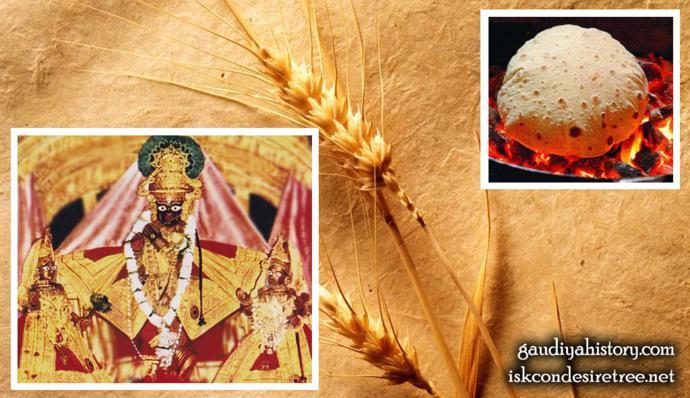
The simple way Sanatana supported himself in these years became a teaching in itself. Accounts describe him begging a small amount of wheat flour from village to village. He would work it into a ball with a little water from the Yamuna and bake it directly in the embers to make a plain, saltless bati bread. This food was so simple that even the poorest villager could offer it without hesitation. He would not eat it himself before first offering it to his worshipable Deity, Madana-mohana. The meaning of this detail is simple and needs no larger claim. A man who had once controlled the wealth of a royal treasury chose, for the last four decades of his life, to eat exactly what he could beg in a single morning and no more.
Discovering the Madana-mohana Deity #
Devotional tradition traces the Madana-mohana Deity's own story back further still, to Sri Advaita Acharya. Advaita Acharya is said to have first found Him under a banyan tree in Vrindavana. On returning to Nabadwipa, he left Him in the keeping of a Mathura brahmana named Choube at nearby Mahavana. Sanatana was then living close by. He noticed an unusually beautiful cowherd boy playing among the local children at Ramana-reti. Sanatana sensed that this was no ordinary child and followed him to a temple. There the boy simply vanished, and only the Deity of Madana-mohana stood inside. A dream that same night confirmed what Sanatana already suspected. Later Sanatana urged Choube's family to take greater care in the Deity's daily worship. Then Madana-mohana is said to have appeared to Sanatana in a dream, complaining that this new formality had spoiled His happiness in that household. Choube, in a dream of his own, was told to hand the Deity over to Sanatana outright. At first Sanatana refused. He protested that a beggar living on alms could not care for a Deity properly. But a further dream persuaded him to accept, and he carried Madana-mohana back to Vrindavana. At first he kept Him in nothing more than the crevice of a tree on top of Dwadashaditya Tila.
In this way Sanatana became responsible for establishing Madana-mohana's worship. The Madana-mohana temple is traditionally remembered as the very first of the great Deity temples founded in Vrindavana by any of the Six Goswamis. Soon after, a wealthy officer in the Mughal army named Krishna Dasa Kapura paid for the building of a proper temple to house Him. In time this building came to be recognized as one of Vrindavana's seven principal temples, and today it is known as the Radha-Madan-Mohan Mandir. In the theology of the Goswamis given in Sri Chaitanya-charitamrita, Sanatana's relationship with this particular Deity has special importance. Commenting on Sri Chaitanya-charitamrita Adi-lila 1.47, Srila Prabhupada writes, "Srila Sanatana Gosvami is the ideal spiritual master, for he delivers one the shelter of the lotus feet of Madana-mohana," and he explains that Madana-mohana represents the sambandha, or foundational relationship with Krishna. Any sincere seeker must first establish this relationship before advancing further. This is why the Gaudiya tradition remembers Sanatana himself specifically as the sambandha-acharya among the Six Goswamis. In the centuries since, political unrest forced the original Deity to be moved from Vrindavana to Karauli in present-day Rajasthan. He is still worshiped there today, while a secondary form continues to be served at the original temple site.
Wealth Poorer Than Love #
One further story preserved in the Bhakti-ratnakara shows how little Sanatana valued the wealth he had once controlled as a minister. A poor brahmana named Jivana Chakravarti had prayed to Lord Shiva for wealth for years. Then he was told in a dream to seek out Sanatana in Vrindavana, because Sanatana possessed a great treasure and would readily share it. When he arrived, he found a thin, plainly dressed renounced man living on alms. The brahmana nearly turned back in disbelief. Then Sanatana remembered a philosopher's touchstone (a stone that turns iron into gold) lying forgotten in a nearby heap of rubbish, and he simply had it brought and given away. The brahmana left overjoyed, but then he grew troubled. If Sanatana could throw away something so valuable without a second thought, he must possess something greater still. The brahmana returned to ask what that could be. Sanatana answered that there was no wealth greater than love for Krishna, and that material riches, touchstones included, only cause greater misery in the end. Moved by this reply, the brahmana begged for that wealth instead, and Sanatana mercifully granted it.
Forty-Three Years Among the Villagers of Vraja #
By the tradition's own count, Sanatana wandered on foot from village to village throughout Vraja-mandala for roughly forty-three years. The Vrajavasis are remembered as having cared for him as their own father. They brought him their quarrels over crops and family matters, along with their spiritual questions. In return they received from him both practical advice and instruction in bhakti. The Bhakti-ratnakara sums up how his godbrothers remembered him in this period: "Renouncing all worldly pleasures, Sanatana Gosvami was humble, detached, always absorbed in study... As an ocean of love and mercy, Sanatana excelled all other devotees in his compassion toward the suffering souls." Even into old age he kept a personal vow to go around Govardhana Hill and offer 1,008 obeisances daily. According to the same tradition, one day Madana-mohana Himself appeared and told him that he was too old for the twenty-four-mile walk and could set the vow aside. Sanatana simply answered, "I will never give up my religious principles," and kept walking. The Deity is said to have honored this determination, not by excusing him, but by a miracle. He pressed His own footprints into a flat Govardhana-shila, so that Sanatana could walk around this stone in place of the hill itself. The stone is still preserved at the Radha-Damodara temple. Sanatana's writing during these same wandering decades is told in Hari-bhakti-vilasa and Other Works. It shows that none of this physical hardship slowed the scholarly work Sri Chaitanya Mahaprabhu had originally asked of him.
Scriptural evidence for this chapter (1)
śikṣā-guruke ta' jāni kṛṣṇera svarūpa
antaryāmī, bhakta-śreṣṭha, — ei dui rūpa
Word for word
śikṣā-guruke: the instructing spiritual master; ta' jāni: indeed I know; kṛṣṇera sva-rūpa: to be the direct representative of Kṛṣṇa; antaryāmī: the indwelling Supersoul; bhakta-śreṣṭha: the best devotee; ei dui rūpa: these two forms.
One should know the instructing spiritual master to be the Personality of Krishna. Lord Krishna manifests Himself as the Supersoul and as the greatest devotee of the Lord.
From the purport: "Srila Sanatana Gosvami is the ideal spiritual master, for he delivers one the shelter of the lotus feet of Madana-mohana."
The theological basis, in Srila Prabhupada's own purport, for regarding Sanatana Gosvami as the Gaudiya tradition's sambandha-acharya through his discovery and establishment of the Madana-mohana Deity.
Chapter 7
Hari-bhakti-vilasa and Other Works
Four Sanskrit works gave the young Gaudiya tradition its code of conduct, its ranking of devotees, and its commentary on the Bhagavatam's tenth canto.
Sri Chaitanya-charitamrita names Sanatana Gosvami as the author of four major works, and each of them met a different need:
- Hari-bhakti-vilasa
- Brihad-bhagavatamrita
- Dasama-tippani
- Dasama-carita
Sri Chaitanya Mahaprabhu had asked him to help build the small Gaudiya Vaishnava community, which was still taking shape.
Hari-bhakti-vilasa: A Code of Vaishnava Conduct #
Among Sanatana's four instructions from Sri Chaitanya Mahaprabhu was a direct order to "compile a book establishing the proper behavior for devotees of Krishna in order to create the foundations of a Vaishnava society." At Varanasi, Sanatana asked for guidance on how to begin, and the Lord gave him a detailed outline: "Because you asked Me for a synopsis, please hear these few indications. In the beginning describe how one must take shelter of a bona fide spiritual master," and the outline went on from there. It covered initiation, morning duties, and Deity worship with five, sixteen or fifty prescribed ingredients. It also covered how to behave when approaching a temple, the observance of Ekadashi and festival days such as Janmashtami and Rama-navami, and the general conduct expected of a Vaishnava toward guru, scripture and fellow devotees alike. Sanatana carried out this work together with Gopala Bhatta Gosvami. The Hari-bhakti-vilasa that came from it became, and still is, the basic handbook of worship and conduct for the entire Gaudiya Vaishnava community. Later teachers such as Raghunatha Bhatta Gosvami, and generations after them, have taken the details of daily sadhana from it. Sanatana also wrote his own commentary on the work, to guide later readers through its detailed rules of worship.
Brihad-bhagavatamrita: A Journey Through the Hierarchy of Devotion #
The Hari-bhakti-vilasa deals with practice. The Brihad-bhagavatamrita deals with doctrine, and it is told in the form of a story. It is roughly 2,500 verses long and divided into two parts. The work follows a Brahmana character named Gopa-kumara on a journey. First he travels through the various planetary systems and forms of liberation found within the material and spiritual worlds. Then he enters the eternal realm of Krishna Himself. Through this story Sanatana sets out, in careful order, the ranking of Krishna's devotees: who is more advanced than whom, and why, and what qualities mark each stage of advancement in bhakti. Sanatana also wrote his own commentary on the work, called the Dig-darshini ("Compass," or "Pointer of Direction"). Without it, many of the book's more tightly packed theological arguments are difficult for a modern reader to follow.
Brihad-vaishnava-toshani: Opening the Tenth Canto #
Sanatana's third major work, also known as the Dasama-tippani, is a long commentary on the Tenth Canto of Srimad-Bhagavatam. This canto describes Krishna's own birth, childhood and youthful pastimes in Vrindavana. So for the Gaudiya tradition it is theologically the single most important part of the entire Bhagavata Purana. Later commentators, including Srila Jiva Gosvami, built directly on Sanatana's explanations here. The work is one of the tradition's earliest full efforts to bring out the devotional meaning of Krishna's pastimes, centred on rasa, and not to read the same verses only as a story or as philosophy.
Krishna-lila-stava: Praise in Verse #
Sanatana's fourth recorded work, Krishna-lila-stava, is a devotional poem of 432 verses. It retells Krishna's pastimes as told in the Bhagavata Purana, from the opening of the Tenth Canto to the killing of Kamsa. In this way it is a companion in poetry to the same part of scripture that his prose commentary, the Brihad-vaishnava-toshani, explains. In this same work Sanatana speaks to the Bhagavata itself directly. Later Gaudiya writers have quoted these lines because they show his personal relationship with the scripture he spent so much of his life explaining: "O holy Bhagavata, you are my only company, my only friend, and my guru. You are my greatest treasure and my personal saviour. You are the emblem of my highest fortune and the very form of ecstasy. I offer my obeisances unto you."
A Legacy Carried Forward #
Within a single generation of Sri Chaitanya Mahaprabhu's own life, these four works gave the Gaudiya Vaishnava community two things. They gave it a working code of conduct, and serious Sanskrit theology to stand beside it. These were exactly the two things Sri Chaitanya Mahaprabhu had specifically instructed Sanatana to produce. Sanatana and Rupa first gathered and organized writings like these, and their nephew Jiva Gosvami carried the work onward. On the strength of this material, Krishnadasa Kaviraja Gosvami was later able to compose Sri Chaitanya-charitamrita itself. For its account of these same events, he drew again and again on the Goswamis' own writings and on Raghunatha Dasa Gosvami's personal memories of them. So the circle of debt is complete. The Lord instructed Sanatana. Sanatana wrote down the tradition's law and doctrine. Then a later Goswami used those same writings to record Sanatana's own life for those who came after. This is part of what the tradition means when it calls Sanatana's decades in Vrindavana foundational.
Scriptural evidence for this chapter (1)
Some of the books compiled by Srila Sanatana Gosvami were the Hari-bhakti-vilasa, Brihad-bhagavatamrita, Dasama-tippani and Dasama-carita.
Krishnadasa Kaviraja Gosvami's own summary listing of Sanatana Gosvami's four major Sanskrit works, in the introductory chapter of Sri Chaitanya-charitamrita.
Chapter 8
Final Days and Disappearance
Sanatana's last years were spent in bhajana at Govardhana; his disappearance left Rupa, Jiva and the Vrindavana community to carry his work forward.
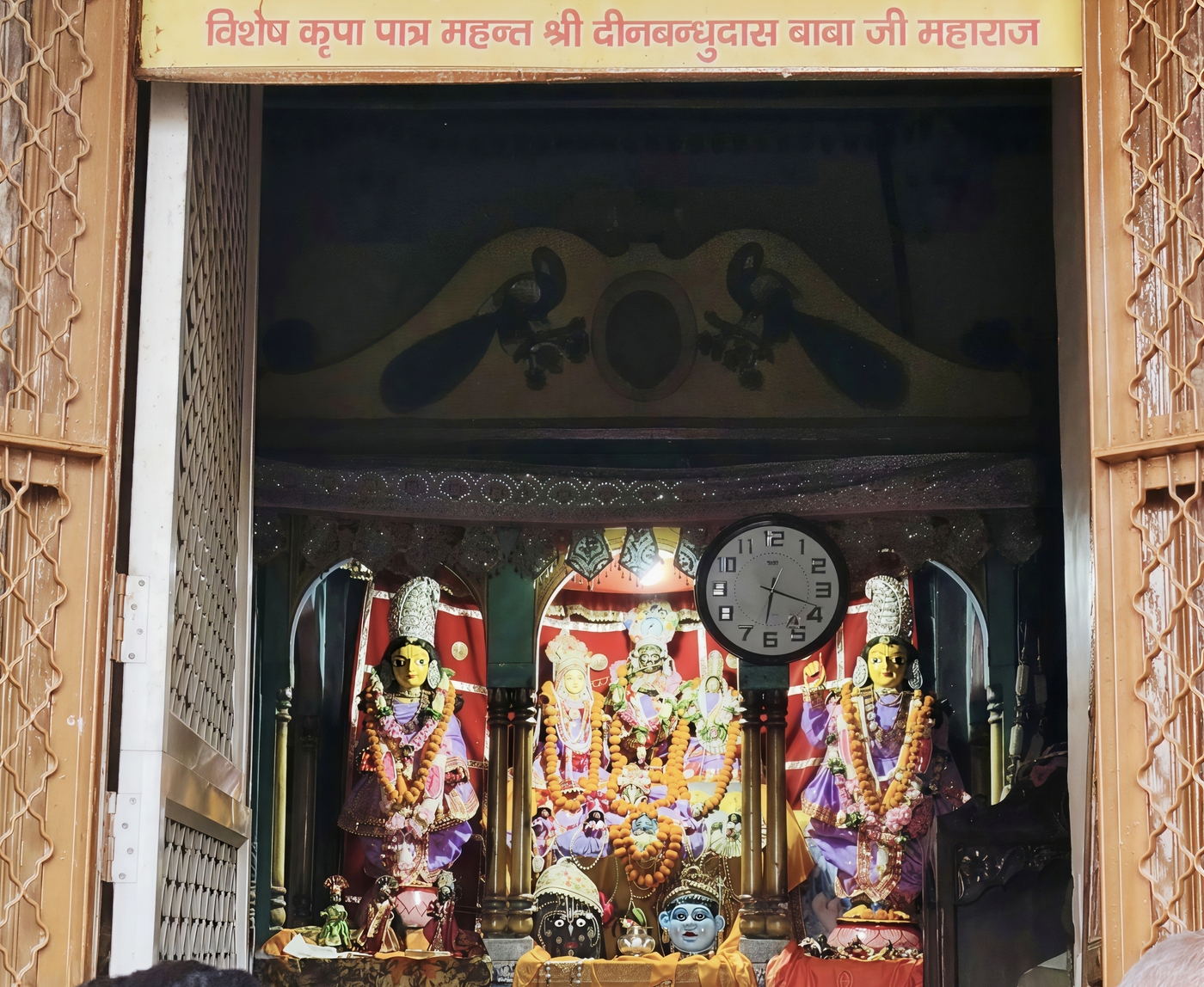
After forty-three years of hard, village-to-village wandering, old age finally caught up with Sanatana Gosvami. He handed over the daily service of his beloved Madana-mohana to his disciple Krishna Dasa Brahmachari. Then he moved to spend his final years in bhajana on the banks of the Manasi-Ganga at Govardhana, near the shrine of Chakaleshvara Mahadeva. Even there, well past sixty years of age, he kept to the discipline that had marked his whole life in Vrindavana. Every day he walked around Govardhana Hill, and he kept a vow of offering 1,008 obeisances each day, both to the Hill itself and to any Vaishnava he happened to meet along the way. The tradition places in this final period the story of Madana-mohana appearing to excuse him from the daily parikrama because of his age, and of Sanatana's quiet refusal. That story is told in Arrival in Vrindavana and Madana-mohana. It is the last recorded exchange between the Deity he had discovered and the devotee who had served Him for decades.
An Ocean of Love and Mercy #
The Bhakti-ratnakara sums up how Sanatana was remembered by those who actually lived alongside him in these years. Its words are given here almost exactly: "Mahaprabhu often said that Sanatana Gosvami was His favorite devotee. As an ocean of love and mercy, Sanatana excelled all other devotees in his compassion toward the suffering souls." Readers may give such glowing traditional praise more or less weight. But the more concrete details kept alongside it give a consistent picture. Villagers brought him their disputes over crops and their family quarrels. In return they received both practical guidance and instruction in devotional life. This shows a man whose learning and former experience in government were, in the end, placed entirely at the service of ordinary people. He did not keep them for the learned upper class he had grown up among.
Disappearance and Samadhi #
Sanatana Gosvami is traditionally said to have disappeared from this world in 1558, at Vrindavana. His samadhi stands to this day directly behind the Radha-Madana-mohana temple, where he had established the Deity's worship decades earlier. So at the end he remained close, even in body, to the Deity whose service had been the center of his whole life in Vraja. In Gaudiya Vaishnava theology, he is remembered as the eternal associate Labanga-manjari (or, in some accounts, Rati-manjari), who serves Srimati Vishakha-sakhi within Radha and Krishna's own eternal pastimes. This is understood to be his confidential identity, hidden behind his outward life as a renounced scholar who searched out Vraja's holy places.
What He Left Behind #
Sanatana's importance to the tradition that followed him can perhaps be seen most clearly in how his own brother regarded him. By Srila Prabhupada's account, Srila Rupa Gosvami accepted Sanatana as his spiritual master. Rupa was his own younger brother, and by any ordinary measure his equal in scholarship. Rupa opened his own Bhakti-rasamrita-sindhu with an offering of respect to Sanatana as his spiritual master. Elsewhere Srila Prabhupada calls Sanatana "the ideal spiritual master, for he delivers one the shelter of the lotus feet of Madana-mohana," and these words give Sanatana a special place in the Gaudiya guru-parampara's own understanding. In that understanding, he is the doorway through which a sincere seeker first comes into a right relationship with Krishna. He is the sambandha-acharya. In this reading, without him the later stages of devotional life have no firm ground to stand on.
His nephew Srila Jiva Gosvami arrived in Vrindavana as a young scholar after the death of his own father, Anupama, in Bengal. Jiva studied directly under both Sanatana and Rupa. He carried their shared work of writing and teaching further, and made it fuller and more orderly than ever. In his own writings he openly built on the groundwork Sanatana had already laid in the Brihad-bhagavatamrita and the Dasama-tippani. Sanatana laid the foundation in conduct and scripture. Rupa laid it in the theory of rasa and in poetry. Jiva brought the whole philosophy together. In this way, within the span of one generation, the three Goswamis of this single Bengali family gave Gaudiya Vaishnavism nearly all of its scriptural and doctrinal structure. They built it quite literally from nothing but what Sri Chaitanya Mahaprabhu had asked of them, and what each of them was willing to give up in order to carry it out.
Five centuries later, that inheritance still continues. In the tradition's own understanding, every pilgrim who visits the Radha-Madana-mohana temple, with Sanatana's samadhi behind it, is visiting a special place. Here the eldest of the Six Goswamis chose a beggar's bati bread over a minister's table. Here a Deity discovered by a man who had escaped from Hussain Shah's court became one of the most beloved Deities of Vrindavana. In the end, his life made a small circle. It began with a young scholar's dream of the Bhagavatam, told in Birth and Early Life in Bengal. It ended with an old man's samadhi beside the Deity of the same Krishna who, the tradition says, had come to him in that dream. In between, he spent almost his whole life patiently guiding others toward the same shelter, just as he himself had once been guided.
Scriptural evidence for this chapter (2)
gauḍendrasya sabhā-vibhūṣaṇa-maṇis tyaktvā ya ṛddhāṁ śriyaṁ
rūpasyāgraja eṣa eva taruṇīṁ vairāgya-lakṣmīṁ dadhe
antar-bhakti-rasena pūrṇa-hṛdayo bāhye 'vadhūtākṛtiḥ
śaivālaiḥ pihitaṁ mahā-sara iva prīti-pradas tad-vidām
Word for word
gauḍa-indrasya sabhā vibhūṣaṇa maṇiḥ: the fundamental gem of the parliament of the ruler of Gauḍa-deśa; tyaktvā ṛddhām śriyam: relinquishing his opulent kingly enjoyment; rūpasya agrajaḥ: the elder brother of Śrīla Rūpa Gosvāmī; taruṇīm vairāgya-lakṣmīm dadhe: accepted the youthful fortune of renunciation; antaḥ-bhakti-rasena pūrṇa-hṛdayaḥ: his heart fully satisfied by the mellows of inner devotion; bāhye avadhūta-ākṛtiḥ: externally in the dress of a mendicant; śaivālaiḥ pihitam mahā-saraḥ iva: like a great lake covered with moss.
"Srila Sanatana Gosvami, the elder brother of Srila Rupa Gosvami, was a most important minister in the government of Hussain Shah, the ruler of Bengal, and he was considered a most brilliant gem in that assembly. He possessed all the opulences of a royal position, but he gave up everything just to accept the youthful goddess of renunciation... Thus he can be compared to a deep lake covered with moss."
A verse from the poet Kavi-karnapura's Chaitanya-chandrodaya-nataka, quoted within Sri Chaitanya-charitamrita, describing how Sanatana Gosvami's contemporaries remembered his years as a minister and his renunciation of that position.
"In the course of time, the transcendental news of Krishna's pastimes in Vrindavana was almost lost. To enunciate explicitly those transcendental pastimes, Sri Chaitanya Mahaprabhu empowered Srila Rupa Gosvami and Sanatana Gosvami with the nectar of His mercy to carry out this work in Vrindavana."
Sri Chaitanya-charitamrita's own summary statement of why Sri Chaitanya Mahaprabhu sent Rupa and Sanatana Gosvami to Vrindavana, and what their combined life's work there accomplished for the tradition.
- Sri Chaitanya-charitamrita, Madhya-lila, Chapter 1 (Bhaktivedanta VedaBase)
- Sri Chaitanya-charitamrita, Madhya-lila, Chapter 20 (Bhaktivedanta VedaBase)
- Sri Chaitanya-charitamrita, Madhya-lila, Chapter 24 (Bhaktivedanta VedaBase)
- Sri Chaitanya-charitamrita, Adi-lila 1.47 (Bhaktivedanta VedaBase)
- Sanatana Goswami - Gaudiya History
- Six Gosvamis Lecture, Sri Sri Sad-gosvamy-astaka, Los Angeles, November 18 1968
- Bhagavad-gita 6.25-29 Lecture, Los Angeles, February 18 1969
